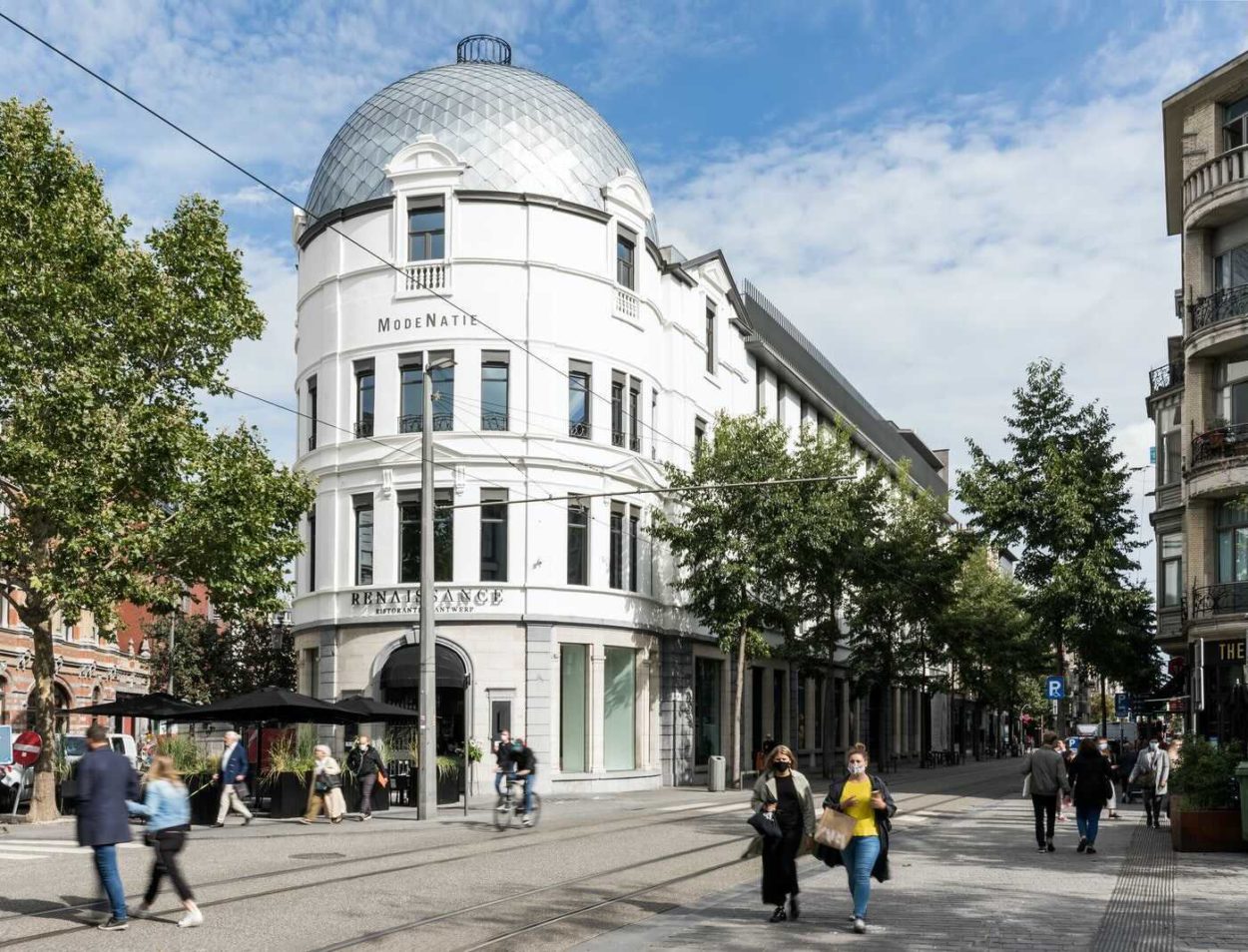
The Antwerp Six fashion architecture is not a metaphor — it is a postcode, a 1893 department-store building at Nationalestraat 28, and a hand-drawn list of six graduates from the 1980–1981 cohort of the Royal Academy of Fine Arts Antwerp. On 28 March 2026, MoMu opened “The Antwerp Six”, the first museum-scale survey of the group, exactly forty years after Walter Van Beirendonck, Dries Van Noten, Ann Demeulemeester, Dirk Bikkembergs, Dirk Van Saene and Marina Yee drove a rented van to the British Designer Show at Olympia and were branded, by reporters who could not pronounce their names, with the label that stuck. The exhibition runs until 17 January 2027. The building it sits inside has been holding the lineage together since 2002. Everything else in this piece is the map.
The argument is this. The Antwerp Six is not a brand collective and was never a manifesto. It is a school cohort that crystallised, at one tradeshow, into a market category — and the reason the category survived is that Antwerp, alone among the small European cities that produced a fashion moment in the 1980s, built the physical infrastructure to keep it. Three institutions sit inside ModeNatie at Nationalestraat 28: a museum, a fashion school, and an industry body. A fourth surface — Axel Vervoordt’s Kanaal at Stokerijstraat 19 in Wijnegem — sits eight kilometres up the Albert Canal. A fifth — the Dries Van Noten Modepaleis — has never closed its central Antwerp doors. The lineage is held together by buildings, not by a foundation board.
ModeNatie, Nationalestraat 28: the three-tenant block
The building at Nationalestraat 28 is, materially, a piece of late nineteenth-century Antwerp commerce. It was built in 1893 by the local architect Ernest Dieltiens for the “New England” department store, a name that already tells you what the early commercial ambitions of the district were. The store gave way, in the twentieth century, to Hotel Central. By the late 1990s the block was vacant and the Antwerp city government, under pressure from a fashion sector that had finally produced a generation worth keeping, agreed to convert it into a single multi-tenant fashion building.
The renovation was led by Ghent architect Marie-José Van Hee, working the project from 2000 to 2002. Van Hee’s intervention is not the museum-scale gesture the rest of European cultural infrastructure was producing in that decade — no white-cube atrium, no signature staircase. Her single defining move is a covered merbau-wood passage cut through the block, opening a pedestrian route between Nationalestraat and Drukkerijstraat the city had not had before. The passage is the building’s public organ; step into it from the street and the three tenants are visible from the same axis.
Those tenants are MoMu, the ModeMuseum Antwerpen, founded on 21 September 2002 with Linda Loppa as its first director; the Flanders Fashion Institute, now operating as Flanders DC for Fashion, co-founded by Geert Bruloot; and the fashion department of the Royal Academy of Fine Arts Antwerp itself. A museum, an industry body, a school. Three floors, one entrance, one architect.
The genius of the arrangement is structural rather than aesthetic. A museum without a school feeds on archive; a school without a museum feeds on memory; an industry body without either becomes a trade association. By forcing the three tenants into one building, Van Hee’s renovation guaranteed that the institutions would have to share a circulation diagram. Students walk past the museum cases on the way to the studio. The MoMu curators sit one floor above the school. The Antwerp fashion system, in 2026, runs on this single piece of co-located real estate.
The 1986 van and what it actually was
The Antwerp Six story has been told often enough that the cliché has thickened around it. The corrective is to be precise. In 1986 the group — minus Demeulemeester, who was pregnant — rented a van in Antwerp, loaded six collections, and drove to the British Designer Show at Olympia in London. The tradeshow was the small annual fixture of the British fashion calendar, not Paris and not Milan. The six were graduates of the same Royal Academy cohort under Mary Prijot, the long-serving head of the school’s fashion department before Linda Loppa took the role in 1985. They did not arrive with a coordinated manifesto. They arrived with rented shelf space and six separate label names.
The “Antwerp Six” label was applied collectively, after the fact, by British buyers and reporters who could not spell Walter Van Beirendonck’s surname. It was a handling label, not a movement. Its adhesive force came from the cohort logic: all six came out of the same teaching environment in the same eighteen-month window, shared the same Belgian fabric suppliers and pattern-cutters, and used the same Olympia booth to break into the international wholesale market the Antwerp economy could not, on its own, sustain.
Six birth years, six biographies, one cohort:
| Designer | Birth year | Birthplace | Royal Academy graduation | Current label HQ | Antwerp surface in 2026 |
|---|---|---|---|---|---|
| Walter Van Beirendonck | 1957 | Brecht | 1980–1981 | Antwerp | Royal Academy fashion department head (since 2006); MoMu retrospective room |
| Ann Demeulemeester | 1959 | Kortrijk | 1980–1981 | Antwerp | MoMu retrospective room; label HQ in Antwerp |
| Dries Van Noten | 1958 | Antwerp | 1980–1981 | Antwerp | Modepaleis flagship; MoMu retrospective room; brand HQ in Antwerp |
| Dirk Van Saene | 1959 | Leuven | 1980–1981 | Antwerp | MoMu retrospective room; Royal Academy fashion department faculty |
| Dirk Bikkembergs | 1959 | Cologne (DE) | 1980–1981 | Milan / Antwerp | MoMu retrospective room |
| Marina Yee | 1958 | Antwerp | 1980–1981 | Antwerp | MoMu retrospective room |
| Martin Margiela (“Antwerp 6+1”) | 1957 | Genk | 1979 | Paris | MoMu retrospective room (as adjacent cohort) |
The table is what gives the lede its anchor. Five of six Antwerp Six designers run labels still headquartered in Antwerp; Bikkembergs operates from Milan but retains an Antwerp surface through MoMu. Martin Margiela — graduated one year earlier, did not show at Olympia, not one of the original six and only ever the “+1” appended by later commentators — is the seventh row because the cohort logic of the school includes him even when the label logic of the 1986 trip does not.
Walter Van Beirendonck and the Royal Academy
The Royal Academy of Fine Arts Antwerp founded its fashion department in 1963, almost two decades before the Antwerp Six cohort entered it. Linda Loppa ran the department from 1985 to 2006. Van Beirendonck has run it since. The chain of headship is the most underrated piece of the Antwerp fashion architecture, because it explains why the school’s pedagogical voice did not drift between generations. Loppa’s tenure spans Margiela’s 1979 graduation, the 1980–1981 cohort, Raf Simons’s early-1990s entry into the Antwerp orbit, and Demna Gvasalia’s 2006 graduation the same year she stepped down. Van Beirendonck has carried the method into the Vetements-and-after generation.
That continuity is the reason “the Royal Academy graduate” reads, in 2026, as a fashion-industry credential with the specificity of “Central Saint Martins” or “Bunka”. The school does not produce a house style — its alumni list is too varied to pretend that it does — but it produces a method. Six-month research books before a single garment is cut, a mandatory historical reference for every collection from second year onward, a final-year graduation show that the European buying offices fly in to attend. The method is what the building at Nationalestraat 28 protects.
Van Beirendonck’s own label has occupied a stubbornly unfashionable place in the lineage — too colour-saturated, too club-kid, too sci-fi for the monochrome reading of Belgian fashion the press preferred to write — and that is part of why his appointment to the headship in 2006 mattered. The institutional handover did not flatten the school toward the Margiela end of the Antwerp palette.
MoMu, Linda Loppa, Kaat Debo
MoMu opened on 21 September 2002 inside the same building, on the floor below the school. Loppa was its founding director — moving, in effect, from the floor above to the floor below without leaving the address. Kaat Debo has been director since 2008. The museum’s exhibition history has been the official record of the Belgian fashion system: monograph shows on Van Noten, Demeulemeester, Margiela, Simons and Bikkembergs over the past two decades.
The 2026 retrospective is the first time the museum has staged the six together. “The Antwerp Six” runs from 28 March 2026 to 17 January 2027 — a nine-and-a-half-month run, longer than MoMu’s typical monograph exhibitions, which is itself a signal that the curators expect international rather than local visitation. The exhibition is co-curated by Geert Bruloot, who organised the 1986 Olympia trip; Romy Cockx, the MoMu collection curator; and Debo herself. The catalogue is roughly four hundred pages, published by Hannibal Books, treated by the museum as the long-form publication record the cohort has never had in a single volume.
The exhibition’s structural argument — readable off the press materials, the curatorial team, and the choice to mark the fortieth anniversary rather than wait another decade — is that the cohort moment is now historical. The six are between sixty-five and sixty-nine years old. Van Noten stepped down from his eponymous brand in 2024. Bikkembergs sold his label long ago. The retrospective is positioned not as a victory lap but as the transfer of the cohort’s authorship from the designers themselves to the institution that holds their archive.
Martin Margiela, the “+1” that the school admits
Martin Margiela graduated from the Royal Academy in 1979, the year before the 1980–1981 cohort that the Antwerp Six were drawn from. He did not show at the 1986 Olympia tradeshow. He is not one of the original six. The “Antwerp 6+1” label was applied by later commentators, primarily after the 1988 Paris launch of Maison Margiela, and it has been resisted, on and off, by Margiela himself and by the surviving six.
MoMu’s 2026 retrospective handles the question with deliberate precision: Margiela is acknowledged as the adjacent cohort, the year-earlier graduate whose presence at the school overlapped with the 1980–1981 group, but he is not treated as a seventh member. The “Antwerp 6+1” formulation is the language used by writers, not by the museum. The exhibition’s title is “The Antwerp Six”, and the count is exact.
This matters more than it sounds. Belgian fashion’s international reception has always tended to fold Margiela in for ease of narrative — six is awkward, seven is rounder, and a Paris-based designer helps the geography. The school knows better. Margiela is the immediately preceding cohort, taught by the same department under Mary Prijot, but he launched his label out of Paris in 1988, never showed at Olympia, and operated his career on a separate trajectory through the OTB structure that bought his house in 2002. He is part of the school’s lineage. He is not part of the cohort.
Dries Van Noten and the Modepaleis
Dries Van Noten is the Antwerp Six member whose surface in the city is largest and most public. The Modepaleis — his Antwerp flagship store in a turn-of-the-century commercial building on Nationalestraat, two minutes’ walk from ModeNatie — has been operating since the late 1980s and is the most architecturally legible fashion retail address in the city. The brand has been Puig-owned since 2018 and Van Noten stepped down as creative director in 2024; the Modepaleis has not closed, and the brand’s Antwerp headquarters remain in the city.
His other 2026 surface is not in Antwerp at all. In May 2025 Van Noten and partner Patrick Vangheluwe announced the Fondazione Dries Van Noten at Palazzo Pisani Moretta on the Grand Canal in Venice, with an inaugural exhibition co-curated by Geert Bruloot. The Venice surface is the new patronage move; the Antwerp surface is the historical store. The Antwerp Six’s most commercially successful member is also the one most legibly anchored to Antwerp infrastructure — Modepaleis still on Nationalestraat, MoMu retrospective room one block south. The parallel Phoebe Philo trajectory through the 2024–2026 fashion exits cycle is the other reference case for an author-designer’s post-departure footprint. The Antwerp version is the more architecturally legible. Van Noten kept the buildings.
Ann Demeulemeester, the missing van, the Antwerp HQ
Ann Demeulemeester was born in Kortrijk in 1959. She did not make the 1986 van trip — she was pregnant — and the story is usually told for atmosphere rather than for what it implies: her absence from Olympia did not exclude her from the cohort. The Antwerp Six label was applied by British reporters covering the booth five of the six were standing at; Demeulemeester’s absence from the room did not change the count.
Her label, founded in 1985 with her husband Patrick Robyn, has been headquartered in Antwerp throughout its existence. She stepped away from fashion design in 2013 and the label has continued under successive directors; the Antwerp address has remained constant. Her MoMu retrospective room is one of the most heavily documented in the 2026 exhibition because the museum holds, by donation, a large fraction of her runway archive.
Dirk Van Saene, Dirk Bikkembergs, Marina Yee
The lesser-discussed three of the six are the ones whose Antwerp surfaces matter most for the architecture argument, because they are the ones for whom the city’s infrastructure has substituted for the international commercial reach the other three achieved.
Dirk Van Saene was born in Leuven in 1959 and has spent the bulk of his post-1986 career teaching at the Royal Academy alongside running his own label. His Antwerp surface is dual: the school where he teaches, two floors above the MoMu room that holds his archive. ModeNatie literalises the relationship — Van Saene teaching studio and Van Saene museum case, one building.
Dirk Bikkembergs, born in Cologne in 1959 to a Belgian family, built a menswear-focused label that drifted toward Milan and the Italian licence-and-distribution structure that swallowed several Belgian designers through the 1990s and 2000s. He no longer designs the label that carries his name. His Antwerp surface is now archival — the MoMu retrospective room, the school’s alumni record, the permanent collection’s holdings of his 1986–1990 collections — rather than commercial.
Marina Yee, born in Antwerp in 1958, has had the most discontinuous trajectory of the six. She left the commercial cohort in the late 1980s, taught for years, and re-emerged in the late 2010s with a sustainability-driven small-batch label out of a studio in the city. Her MoMu retrospective room handles both phases and is the strongest single argument the museum makes for why the cohort frame is alive rather than historical. Yee is not finished. The retrospective treats her accordingly.
Axel Vervoordt’s Kanaal and the architecture infrastructure around the cohort
Kanaal sits eight kilometres up the Albert Canal from Antwerp’s centre, at Stokerijstraat 19 in Wijnegem. The complex is a 55,000-square-metre former 1857 distillery and malthouse that Axel Vervoordt — born in Antwerp in 1947, an antiques dealer since 1969 in the Vlaeykensgang alley, owner of the Kasteel van ’s-Gravenwezel since 1984 — converted into a campus that reopened in 2017. The masterplan and the principal new buildings are by Stephane Beel, with additions by Coussee & Goris and Bogdan & Van Broeck. The interiors are by Tatsuro Miki; the landscape design is Michel Desvigne’s.
Kanaal is not, strictly, an Antwerp Six surface — none of the six show there, and the Vervoordt programme is dealer-led and art-led rather than fashion-led. But the campus matters for the architecture-infrastructure argument for two reasons. First, it is the second piece of fashion-adjacent cultural real estate in the Antwerp region built at a scale that requires architectural treatment rather than interior treatment — ModeNatie is the first; Kanaal is the second; there is no third. Second, it sets the precedent for the Venice patronage pavilion model that the Fondazione Dries Van Noten and others have now exported. The Vervoordt campus is the Antwerp version of what Pinault built in Venice.
The Vlaeykensgang is the older surface. Vervoordt began his business there in 1969, in a sixteenth-century alley off the Oude Koornmarkt, and the alley remains the Antwerp address most architecturally legible as a survival rather than a renovation. Kanaal is the renovated version. The two surfaces are bracketed by fifty years and the same dealer’s eye.
Antwerp Six and the architecture of Belgian fashion
The lineage holds because the buildings do. Strip the institutions out and the cohort would have dissolved at the pace every other 1980s small-city fashion moment dissolved at — London’s Buffalo, Tokyo’s DC Brands, Florence’s New Italian Look. The Antwerp Six survived because the building at Nationalestraat 28 was renovated to hold them.
The renovation by Marie-José Van Hee is the load-bearing intervention. Three tenants in one envelope, one circulation diagram, one entrance off the street. The merbau-wood passage is the building’s public organ but the structural decision — the one the rest of the system depends on — is the co-location. A museum, a school and an industry body that share an address share a recruitment funnel, an archive request system, and a press calendar.
The second-order infrastructure is the network around the building. The Modepaleis on Nationalestraat. The Coccodrillo shoe store, opened by Geert Bruloot and Eddy Michiels in 1983 and the de facto launching ground for Margiela and Raf Simons through the 1980s and 1990s. The Vlaeykensgang alley that Vervoordt rescued. The Kanaal campus at Wijnegem that made the architectural ambition of the region legible at building scale. The graph of addresses is small — fewer than a dozen surfaces, all within an hour’s walk or a fifteen-minute drive of each other — but it is denser than any comparable European fashion geography outside Paris.
What MoMu’s retrospective does, in this map, is publish the index. The 28 March 2026 – 17 January 2027 exhibition is not the cohort’s first retrospective at the museum level, but it is the first treatment of the cohort as a single archive object, with a single catalogue, in a single building. The forty-year window is the curatorial alibi. The architectural argument is the structural one. Walter Van Beirendonck runs the school on the floor above. Kaat Debo runs the museum on the floor below. The students who will, in three or four years, be the next Demna walk through Van Hee’s passage every morning.
The Antwerp Six story is usually told as a designer story — six biographies, one road trip, one British tradeshow that mispronounced six surnames into a market category. The architecture story is the one that explains why it is still legible four decades later. A 1893 department-store building, converted by a Ghent architect over twenty-two months, holding three institutions under one roof. A 1857 distillery on the Albert Canal, converted by a dealer and three architecture offices. A Modepaleis on Nationalestraat that has been open since the cohort began, and a Venice palazzo that opened in 2026 as the cohort’s most successful member’s next address. The buildings are the lineage. The 2026 retrospective is the moment the museum says so out loud.