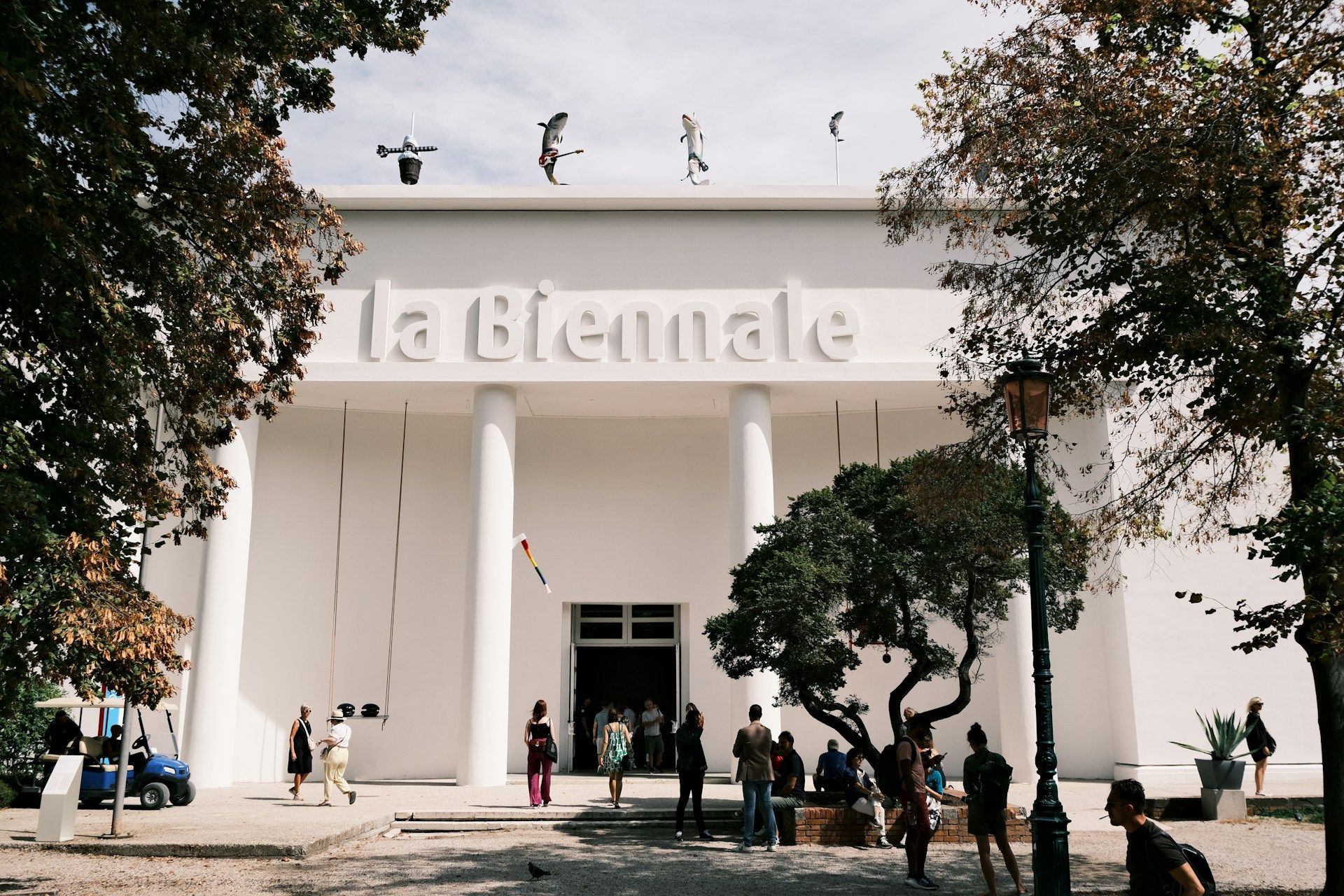
For the first time in La Biennale di Venezia’s 130-year history, the institution has named an Exclusive Partner — Bvlgari, on a 2026–2030 contract that spans three editions of the Art Biennale and anchors a purpose-built Spazio Esedra pavilion in the Giardini and a Fondazione Bvlgari collateral show in the Marciana’s Salone Sansovino. This is what the Bvlgari Venice Biennale partnership actually is: not a sponsorship line in a catalogue, but a title invented for the occasion, written into the institution’s architecture of patronage so that the LVMH-owned Roman jeweller occupies a tier above every other corporate name attached to the 61st International Art Exhibition. No monetary figure has been disclosed, and we are not going to invent one.
The framing matters because Venice has, until now, refused this kind of exclusivity. The Biennale’s commercial structure since the 1990s has been a mosaic of headline sponsors, technical partners, country-pavilion underwriters and collaterale-level patrons — a deliberately federated model that kept any single brand from defining the event. Bvlgari is the brand that finally cracked the rule, and the rule was cracked by inventing a new tier rather than handing an existing one to one party. The “Exclusive Partner” title did not exist on 1 January 2026. It exists now because Bvlgari signed a five-year contract for it.
What the Bvlgari Venice Biennale partnership covers, edition by edition
The contract runs across the next three International Art Exhibitions — 2026, 2028 and 2030. Architecture editions, which alternate with Art in Venice’s biennial rhythm, are not in current reporting and we are not extrapolating. Five years, three editions, one tier.
The first deliverable opened on 9 May 2026 and runs to 22 November 2026: the Biennale Arte 2026, titled In Minor Keys, conceived by Koyo Kouoh before her death in May 2025 and realised by the team she had chosen. Inside the Giardini della Biennale, the partnership has produced a newly named “Bvlgari Pavilion” inside the Spazio Esedra — the curved, free-standing structure adjacent to the Central Pavilion that the Biennale has, in past editions, used for rotating programming. For 2026 it is a single-artist commission: the Toronto-based Canadian artist Lotus L. Kang, with the installation The Face of Desire Is Loss. Long strips of unfixed 35mm photographic film, shot in Korean mud flats, hang from a metal armature shaped like a lotus root; plaster casts of crying baby birds nest inside the structure. Because the film is unfixed, it remains light-sensitive across the seven-month run. The work physically changes as the public sees it — by November, the strips that opened on 9 May will not be the strips on the wall. The pavilion is, in effect, a slow-burn photograph of its own visitors.
This is a meaningful choice and worth dwelling on. The instinct, when a luxury house buys an institution-wide title, is to plant something gleaming and durable — a permanent commission, a marble, a bronze, a sapphire vitrine. Bvlgari has done the opposite. The flagship commission of the first edition of its partnership is materially fragile and conceptually impermanent. The film will degrade. The plaster birds will not be lit dramatically. Nothing inside the Bvlgari Pavilion at the 2026 Giardini reads as jewellery, and that is the point — the brand is signalling, in the first contract year, that the partnership is not a product showcase.
The second deliverable is the parallel official collateral event mounted by Fondazione Bvlgari — the corporate foundation Bvlgari established in 2024 — inside the Salone Sansovino of the Biblioteca Nazionale Marciana on Piazza San Marco. Two Italian artists: Lara Favaretto with Momentary Monument – The Library, and Monia Ben Hamouda with Fragments of Fire Worship. Favaretto’s “Momentary Monument” series, which she has developed across nearly two decades in different institutional settings, fits the Marciana’s reading-room logic in an almost too-clean way; Ben Hamouda’s Fragments of Fire Worship is the louder, younger work and the one most likely to be photographed for the European fashion press. Placing the foundation show inside the Marciana — not in a leased palazzo, not in a Bvlgari-owned space, but inside the working state library on Piazza San Marco — is the second tell. It is an act of public-institutional grafting rather than the more familiar luxury-Venice gesture of buying a palazzo and writing your logo on the gondola landing.
The 2028 and 2030 editions are not yet programmed publicly, and we are not pretending they are. What the contract guarantees is the title, the Spazio Esedra footprint and the right of first commission inside the Giardini for two further Art Biennales. That is the structure.
How the Bvlgari Venice Biennale partnership rewrites the patronage hierarchy
The cleanest way to see what is new about the Bvlgari deal is to put it next to every other model of luxury patronage that has touched the Biennale in the past twenty years, and to ask what was actually being bought in each case.
| Brand / foundation | Venice footprint | Start year | Programme type | Public or private |
|---|---|---|---|---|
| Bvlgari (LVMH) | Spazio Esedra “Bvlgari Pavilion” inside the Giardini + Salone Sansovino at the Biblioteca Marciana | 2026 | Institution-wide Exclusive Partner title across three Art editions | Public-institutional graft (Biennale + state library) |
| Pinault Collection | Palazzo Grassi + Punta della Dogana + Teatrino | 2005 | Permanent private collection display, parallel to but separate from Biennale | Private |
| Prada Foundation | Ca’ Corner della Regina | 2011 | Long-lease palazzo, biennale-timed exhibitions | Private foundation |
| Rolex Mentor and Protégés | Floating across collaterale venues; off-site events | 2002 (programme) | Mentorship pairing, biennale-aligned | Private programme, public framing |
| Fondazione Dries Van Noten | Palazzo Pisani Moretta | 2026 | Single-edition artist commission inside a leased Grand Canal palazzo | Private foundation, public-facing |
| Fondazione Sandretto Re Rebaudengo | Isola di San Giacomo in Paludo | 2026 | New island pavilion, single-edition opening project | Private foundation, public-facing |
Read across that table and the Bvlgari column does not match any other row. Pinault and Prada both used the historic palazzo route — buy or hold long-term, programme on your own walls, run your calendar in parallel to the Biennale’s. François Pinault’s Pinault Collection at Palazzo Grassi and Punta della Dogana has, since 2005, been the dominant private art presence in Venice precisely because it is not the Biennale. It opens before the Biennale opens, it stays open between editions, it programmes its own artists, and it is by design independent of whoever is running the Giardini that year. Prada Foundation took the same logic to Ca’ Corner della Regina in 2011: a palazzo lease, a research-library programme, exhibitions timed to but never contained by the Biennale calendar.
Rolex’s Mentor and Protégés model, running since 2002, was a different proposition again — a mentorship programme that brought pairings of established and emerging practitioners into public events scheduled around the Biennale’s openings without ever occupying a named footprint inside the Giardini or Arsenale. Visible to the right audience, invisible to most visitors. Effective. Cheap, relatively.
What Bvlgari has done is structurally distinct from all three. The Exclusive Partner title is granted by the Biennale, not adjacent to it. The Spazio Esedra pavilion is inside the Giardini perimeter — inside the ticketed event — not in a leased palazzo on the Grand Canal. The Marciana collateral is in a state library, not a Bvlgari-controlled building. Bvlgari is not running a parallel programme that happens to coincide with the Biennale; Bvlgari is woven into the Biennale’s own naming and signage architecture for the next three editions.
The closest functional parallel from the 2026 edition itself is not Fondazione Dries Van Noten at Palazzo Pisani Moretta, which is a single-edition collaterale in the Pinault-style leased-palazzo mode, and not Fondazione Sandretto Re Rebaudengo on Isola di San Giacomo in Paludo, which is a private foundation opening a new island venue. Both of those are projects running alongside the Biennale. Bvlgari is the only project running through it.
Why Spazio Esedra is the right footprint, not the wrong one
A quick parenthesis on the venue, because the choice of Spazio Esedra over a louder address tells you something about how the deal was negotiated. The Giardini has two obvious places to plant a brand pavilion: directly attached to the Central Pavilion, or in one of the historic national pavilions whose country has fallen out of programming. The first is impossible — the Central Pavilion is the Biennale’s own front door. The second is politically toxic; every national pavilion is loaded with diplomatic history that no luxury house wants to step on.
Spazio Esedra is the third option, and the elegant one. It is curved, free-standing, modest in scale, adjacent to the Central Pavilion, and has been used in past editions as a flexible secondary space rather than as anyone’s home. Naming it the “Bvlgari Pavilion” for 2026 stakes a claim inside the Giardini without colonising any of the load-bearing institutional architecture, and it leaves the door open to redefine the footprint across 2028 and 2030 without anyone losing face. The negotiation here was visibly handled by people who understood the building.
The choice of Lotus L. Kang as the first artist matches the choice of room. Kang’s installation is large enough to fill the Esedra but materially quiet — film, plaster, metal, light. There is no shock-value object, no signature centrepiece, no luxury crossover. The first impression a visitor takes from the “Bvlgari Pavilion” in May 2026 is not Bvlgari at all. That restraint is the partnership’s opening sentence.
Fondazione Bvlgari at the Salone Sansovino — and why the Marciana matters
The Biblioteca Nazionale Marciana sits on the south side of Piazza San Marco, opposite the Doge’s Palace, in Jacopo Sansovino’s sixteenth-century Libreria. The Salone Sansovino is the building’s principal reading room — a working state-library space whose ceiling and walls are themselves a Renaissance artwork. Putting two contemporary commissions inside that room, under the Fondazione Bvlgari banner, is not a neutral act. The Marciana rarely opens the Salone for contemporary collaterali, and the optics of a Roman jeweller’s foundation occupying it during the world’s most-photographed art event are exactly as loaded as they sound.
Favaretto’s Momentary Monument – The Library is a fitting placement for the Sansovino because the work’s central conceit — the library as a temporary, fragile, partial monument — talks to the room rather than at it. Ben Hamouda’s Fragments of Fire Worship introduces a different temperature: a younger Italian artist working with iconography drawn from pre-Islamic and Mediterranean fire-cult traditions, dropped into a Christian-humanist library on Christian-humanist Piazza San Marco. The dissonance is the work.
This is also where the structural cleverness of the Bvlgari deal becomes visible. The Spazio Esedra commission is a Biennale commission, branded Bvlgari. The Marciana commission is a Fondazione Bvlgari commission, branded as a Biennale collateral. The same group is operating at two different levels of the Biennale’s own taxonomy simultaneously — inside the Giardini as the institution’s Exclusive Partner, and inside the city as one of the official collaterali. No other luxury name has ever held both positions in the same edition.
Bvlgari’s own track record, and why this is an evolution, not a debut
Bvlgari did not invent its patronage posture for the Biennale. The 2016 restoration of Rome’s Spanish Steps was a public-monument intervention in the city where Bvlgari was founded in 1884 by the Greek-Italian silversmith Sotirios Voulgaris — a project that placed Bvlgari money behind a piece of state-owned baroque urbanism rather than a private collection. The brand has also held running partnerships with MAXXI in Rome and the Whitney Museum in New York, both contemporary-art institutions with significant public mandates. The throughline across all three is that Bvlgari has consistently chosen to attach itself to public or quasi-public institutions rather than to build its own museum.
That is the relevant context for reading the Venice deal. Bvlgari Deputy CEO Laura Burdese, who became CEO from July 2026, has framed the partnership in exactly these terms: “Supporting the Biennale is not simply a sponsorship for us; it is an evolution of Bvlgari’s idea of patronage.” The word doing the work in that sentence is “evolution”. This is not Bvlgari pivoting from product-marketing to art-philanthropy; it is Bvlgari extending a posture it has held since at least 2016 — fund the public institution, do not compete with it — into the highest-visibility public-institutional art event in Europe.
The contrast with LVMH stablemates is worth flagging. Louis Vuitton has the Fondation Louis Vuitton in Paris, the Frank Gehry-designed private museum that runs its own exhibition programme and is, by design, an LVMH cultural object rather than a graft onto a public institution. Bvlgari has chosen a different posture inside the same parent group. The Fondation Louis Vuitton is a building Bernard Arnault commissioned; the Bvlgari Pavilion is a room La Biennale di Venezia gave a name to.
What the absence of a disclosed figure tells you
The Bvlgari Venice Biennale partnership has been announced without a public price tag. This is unusual at the upper end of luxury patronage — the Louis Vuitton Foundation, the LACMA Geffen Galleries, the various Prada Foundation properties have all carried publicly cited figures, and even Bvlgari’s earlier Spanish Steps restoration was reported with a number attached. The Venice contract has not. We will not invent one.
The silence on the figure is itself worth reading. The Biennale is a public foundation in Italian law; its sponsor relationships are not private commercial contracts but partnerships with a state-adjacent institution. Disclosing a number invites political conversation about what an “Exclusive Partner” title actually costs and whether the Biennale should be selling one. Not disclosing a number lets the partnership be received as a cultural commitment rather than a transaction. Both Bvlgari and the Biennale have an obvious interest in the framing landing on the cultural side. The number, if and when it becomes public, will tell us something about the next tier of luxury patronage in Italy. Until then, what we have is the structure.
How this resets the field for 2028 and beyond
The medium-term consequence of the Bvlgari deal is that the “Exclusive Partner” tier now exists, and an existing tier is far easier to renew, transfer or replicate than a new one is to invent. By 2030, when the current contract concludes, the Biennale will have to decide whether the title survives Bvlgari’s departure and is offered to someone else, or whether it disappears with the contract that created it. Both outcomes have implications. If the title persists, Venice has acquired a new top-tier sponsorship product and the luxury houses now in the second tier — Prada, Pinault-adjacent vehicles, Kering brands not currently in Venice, Richemont houses — have a clear next move. If it disappears, Bvlgari’s five-year window will read in retrospect as a one-off, and the Biennale’s federated model will reassert itself.
The other open question is how the partnership scales across the 2028 and 2030 editions. The 2026 first move is materially modest — Lotus L. Kang’s unfixed film is the opposite of a flagship commission. That restraint buys Bvlgari room to escalate. A 2028 commission with a larger physical and material footprint, programmed against whichever curator the Biennale appoints to succeed Kouoh’s team, would read as a logical second-act move. A more ambitious deployment of Fondazione Bvlgari’s collaterale slot — perhaps moving out of the Marciana and into a second public-institutional grafting — would read as the third. The architecture of the contract has been designed to let both happen without renegotiation.
What is harder to imagine is the reverse: Bvlgari spending 2028 and 2030 retreating into a quieter footprint. The whole point of paying for an institution-wide tier is to use it.
The coda
The Bvlgari Venice Biennale partnership has been read in some early coverage as the latest example of luxury money colonising the art world. That reading is too easy and it misses what is structurally interesting about the deal. Pinault colonised Palazzo Grassi in 2005. Prada Foundation colonised Ca’ Corner della Regina in 2011. Both of those moves were palazzo acquisitions that built private cultural objects parallel to the Biennale and effectively in competition with it for press attention every two years. Bvlgari has not bought a palazzo. Bvlgari has bought a title inside the Biennale’s own architecture, paid for a pavilion inside the Giardini that visitors will read as part of the Biennale itself, and routed its corporate foundation into the working state library on Piazza San Marco. The brand is not running its own museum in Venice; it is grafted onto Venice’s existing public-cultural plumbing. That is a different and, in the medium term, a more consequential move than the palazzo-acquisition model. Whether it stays a one-off Bvlgari aberration or becomes the template for a new tier of corporate patronage at public European art institutions is the question 2030 will answer.