Twenty years is a long time to wait for a building. When Peter Zumthor’s David Geffen Galleries opened to the public on April 19, the inevitable question was whether the result could possibly justify the duration — the demolished buildings, the displaced collections, the cost overruns, the public debate that at various points turned genuinely hostile. The answer, like most things Zumthor designs, is both simpler and more complex than expected. Here is a building that does not look like the cultural argument it is, that hides its polemics under a coat of board-formed concrete and a tinted-glass eyebrow, and that has at last been built — not as the project the city debated, but as the project the architect drew.
The Building
From a distance, the Geffen Galleries read as a single gesture: a sinuous sweep of concrete, wrapped in glass, elevated nine metres above Wilshire Boulevard. The building floats — not metaphorically but structurally, supported by eight massive pavilions that create a covered public space at ground level. It’s an architectural move that shouldn’t work at this scale but does, thanks to the precision of Zumthor’s engineering collaboration with SOM. Without that partnership, the curve does not happen; the elevated plane becomes either a viaduct or a roof. Instead it is a plane — a horizon held up off the boulevard, the ground beneath it given back to the city. There is something almost agricultural about the move, as if Wilshire had grown a long, low concrete cloud.
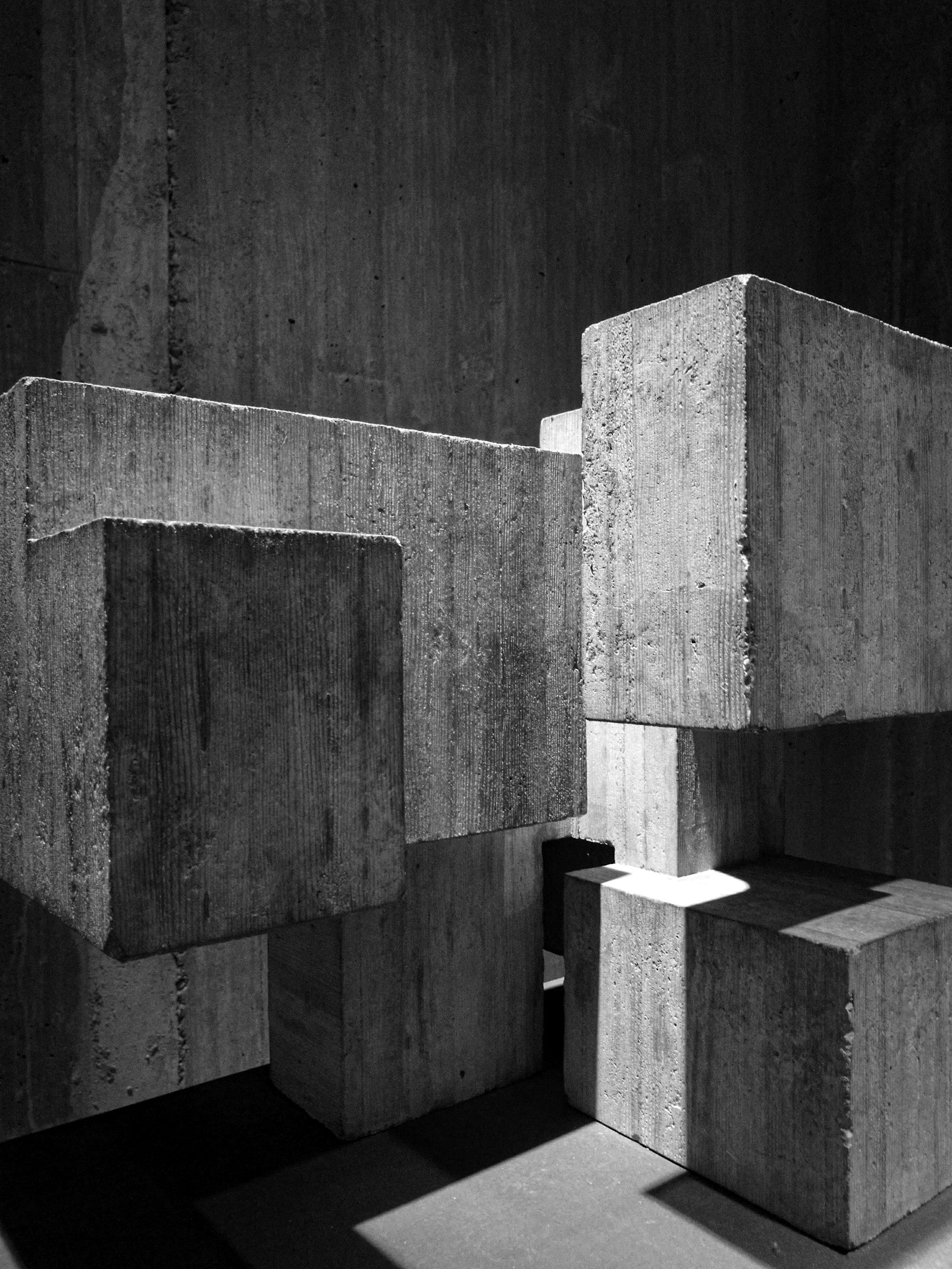
The concrete is extraordinary. Zumthor has always been a material architect — his buildings are defined less by shape than by surface — and the Geffen Galleries continue this obsession. The concrete is board-formed, its surface carrying the grain of the timber moulds in which it was cast. In the Los Angeles light, which is unlike any other light, the material shifts constantly: warm and golden in the morning, bleached and abstract at midday, deep amber at sunset. The surface is dense enough to read as monolithic from the boulevard and porous enough at close range to register every plank, every nail-hole, every chance variation in the timber. It is concrete that has been asked to remember how it was made.
The glass, meanwhile, is not the neutral transparency of most museum facades. It’s tinted, slightly green, and it mediates between interior and exterior in a way that makes the boundary between gallery and city genuinely ambiguous. You’re always aware of the street below, the palms, the traffic — and yet the art never competes with the view. It’s a balance that few museum architects achieve, and one that has been worked out, in different ways, in Zumthor’s previous buildings: the Therme Vals, the Bregenz Kunsthaus, the Kolumba in Cologne. What links those projects to this one is a refusal to choose between mass and light. The Geffen Galleries are massive in plan and weightless in section. They sit on the ground and at the same time refuse to.
The Galleries
The interior is organised as a single continuous plane — approximately 220,000 square feet of exhibition space on one level, with no permanent walls. This is Zumthor’s most radical move: a museum without departments, without wings, without the hierarchical separation of cultures and periods that defines virtually every major encyclopaedic museum in the world. The encyclopaedic museum, as a typology, is the inheritance of nineteenth-century empire. Wings get assigned to civilisations; corridors get walked in chronological order; the Egyptian galleries lead to the Greek galleries lead to the Roman galleries lead, eventually, to the West. Zumthor has dismantled the diagram. There is no longer an order to walk in. There is a plane to wander across.
LACMA’s collection spans 6,000 years and approximately 155,000 objects. In the Geffen Galleries, a Mesopotamian cylinder seal can sit near a Rothko, a Japanese screen alongside a contemporary photograph. The curatorial logic is thematic and associative rather than chronological or geographic — a decision that will infuriate some art historians and thrill others. It is a decision that is, in effect, an argument: that a comprehensive museum is not the sum of its departments but the relationship between them, and that the building should make those relationships available rather than suppress them.
It works because the architecture supports it. The open plan creates sightlines that allow unexpected visual conversations between objects. Temporary partitions — lightweight, movable, almost humble compared to the concrete and glass that contain them — define individual galleries without ever creating the sense of enclosed rooms. The effect is of a landscape rather than a building: you wander through art rather than being directed through it. The room, as a unit of museum experience, has been deliberately demoted. What replaces it is the field. Whether that is a gain or a loss depends on what one believes a gallery is for. If a gallery is a place to concentrate, the field will frustrate; if a gallery is a place to compare, the field is generous.
The Twenty Years
It is worth dwelling on the duration. Twenty years between commission and opening is, by any measure, a long gestation for a single building, and longer than the institutions and individuals involved expected when the project began. The first scheme was unveiled in the mid-2000s. The plan changed; the budget grew; four buildings were demolished to make room. Through all of it, Zumthor — Swiss, Pritzker laureate, based in the Graubünden village of Haldenstein — kept drawing. The studio’s reputation for slowness is real and is, in this case, integral to the result. Zumthor does not draw fast and does not allow others to build fast on his behalf. The Geffen Galleries arrived at their final form through a series of revisions that reduced rather than added — fewer floors, a thinner profile, a longer plan. The building visitors now walk through is the leaner version of an idea that began larger.
Twenty years is also long enough for the cultural conversation around museums to change. When the project was first announced, the encyclopaedic museum was still the unmarked default; by 2026, after a decade of decolonial argument and institutional reckoning, the very premise of a single building containing 6,000 years of art reads differently than it did. Zumthor’s plan, in this light, is not just an architectural answer to a programmatic question. It is an argument that the encyclopaedic museum can survive its critics by changing how it shows what it has — by trading hierarchical separation for thematic adjacency, and by trusting the visitor to construct the narrative the building no longer imposes. Whether this argument convinces will depend on the curators who use the building. The architecture is, in any case, the most generous canvas they have ever been given.
The Controversy
It would be dishonest to write about the Geffen Galleries without acknowledging the cost. The project’s budget has been reported at over $750 million. Four buildings were demolished to make room for it. The museum operated for years with a significantly reduced collection on display. Critics — including some architects — have questioned whether the single-level design wastes valuable urban land, whether the open plan serves curatorial needs or architectural ego, whether the whole enterprise was too much building for too long at too high a price. There are versions of these objections that are unanswerable at the level of architecture alone, because they are objections to priorities rather than to plans. A museum that costs three-quarters of a billion dollars to build is a museum that has, by its mere existence, made claims on philanthropic capital that could have gone elsewhere.
These are legitimate questions, and they don’t disappear on opening day. Zumthor’s building is magnificent, but magnificence alone doesn’t settle the argument about whether this was the right building for this institution at this moment. The fairer question is narrower: now that the building exists, does it do the work the institution needs done? On that question, the early evidence is favourable. The galleries are generous; the public space underneath them is generous; the relationship to Wilshire is more civic than the previous LACMA campus ever managed. What was lost in demolition will be remembered as long as the institution chooses to remember it. What has been built is, at minimum, an argument that the loss was for something rather than for nothing.
The Experience
What can be said, unequivocally, is that the experience of being inside the Geffen Galleries is unlike any other museum in the world. The quality of the light — natural, filtered, constantly changing — transforms the viewing experience. Art seen here looks different from art seen anywhere else, not because of theatrical lighting design but because Zumthor has engineered an environment where daylight does the work. The frit-and-tint of the glass, the depth of the concrete reveals around the openings, the ratios of solid to glazed perimeter — these are details that read as architectural at first glance and as curatorial on closer attention. The light has been calibrated to the kind of objects the museum holds. A Mesopotamian seal needs different light than a Rothko, and the building, by varying its glazing zone by zone, gives them different rooms inside the same room.
The elevation matters too. Nine metres above the street, you lose the noise and gain the sky. The covered ground-level space below — free, public, open — creates the kind of civic gathering place that Los Angeles, a city notoriously hostile to pedestrians, desperately needs. Whether it will actually be used as such remains to be seen, but the gesture is generous. Civic space in Los Angeles has historically been negotiated in plazas, parking lots and the in-between zones of strip-mall sprawl; few major buildings have offered the city a covered, climate-shaded, publicly accessible plinth on this scale. The Geffen Galleries hand back a chunk of mid-Wilshire as half-shade. Whether the museum chooses to programme that space or to leave it deliberately empty will tell us, over the next decade, what kind of institution it intends to become.
The Vitra Argument, the LACMA Argument
It has been a strange month for architecture. The Geffen Galleries opened on April 19; three days later, the Vitra Campus added a Junya Ishigami pavilion at the opposite end of the architectural spectrum — 280 square metres of glass and impossibly thin steel, a building that argues for near-disappearance against a campus full of assertive monuments. Read together, the two openings sketch the available range of contemporary museum architecture. Ishigami subtracts; Zumthor consolidates. Ishigami builds for transparency; Zumthor builds for surface. Ishigami uses 47 steel columns of 16 to 31 millimetres to dissolve the building into a forest; Zumthor uses eight massive pavilions to lift a concrete plane off the boulevard. They are both Pritzker-tradition buildings. They are working at opposite ends of the same problem.
What links them is a shared distrust of the room. The Ishigami pavilion has no rooms — only a field of columns under a frit roof. The Geffen Galleries have no rooms — only a single plane, partitioned by lightweight screens. Both buildings refuse the diagram of the cellular museum; both offer landscapes instead. The difference is one of weight. Ishigami’s landscape is barely there. Zumthor’s landscape is nine metres of board-formed concrete. They are both arguments that the next museum should not be a sequence of enclosed boxes — but they make the argument from opposite material premises, and they leave the field of contemporary museum architecture wider than it was a month ago. The Vitra Campus and LACMA, an open-air collection in Weil am Rhein and an encyclopaedic institution on Wilshire, now share a structural assumption they did not share before.
The Verdict
Zumthor’s LACMA is not a perfect museum. Its open plan will challenge curators. Its scale will overwhelm some visitors. Its cost will shadow its reception for years. But it is a building that takes its medium — concrete, glass, light, air — as seriously as the art it houses. In an era of increasingly formulaic museum architecture, that seriousness is rare, and it is enough. The detail of the board-form, the calibration of the glazing, the discipline of the single plane — these are not surface gestures. They are the building’s method, and the method is what will keep the building interesting once the controversy fades and the visitors arrive for the second and third time.
The building exists. After twenty years, it exists. And it is beautiful.
The David Geffen Galleries at LACMA are open to the public. General admission is free for LA County residents.