The Vitra Campus has, since the late 1980s, functioned as an open-air collection of contemporary architecture. Frank Gehry’s Vitra Design Museum, Tadao Ando’s conference pavilion, Zaha Hadid’s fire station, Herzog & de Meuron’s VitraHaus, and SANAA’s factory building have made the site, in Weil-am-Rhein on the Swiss-German border, into one of the few places where significant work by major architects can be experienced in concentration. It is a campus that has, over four decades, accumulated Pritzker laureates the way most institutions accumulate furniture.
This week, the Campus opened its newest building: a small pavilion by Japanese architect Junya Ishigami, part of the broader Japanese contingent at Milan Design Week and beyond, intended to house a rotating programme of small exhibitions and to function, when not in use, as a quiet pavilion in the landscape. It is the most radical building added to the Campus in over a decade, and it raises the question of what architecture is actually for. The provocation is sharper than it looks. On a site whose previous additions have all been arguments for architectural presence — sculptural, monumental, expressive — Ishigami has built something that argues for the opposite.
The Lineage of the Campus
To understand what Ishigami has done, it helps to recall what he has done it inside of. The Vitra Campus is not a neutral context. Its buildings were commissioned, more or less in sequence, as a deliberate exercise in architectural patronage. Gehry’s Vitra Design Museum opened in 1989 — a small, white, deconstructivist building that announced both the museum and Gehry’s mature language several years before Bilbao. Hadid’s Fire Station, completed in 1993, was her first realised building, all sharp angles and concrete planes pointing in directions buildings do not usually point — a lineage Audi explicitly invokes for its Origin pavilion at Portrait Milano at MDW 2026. Ando’s Conference Pavilion turned in the opposite direction, toward stillness — a low concrete volume aligned to a row of cherry trees, the kind of restraint that looks easy and is not. Herzog & de Meuron’s VitraHaus, finished in 2010, stacked twelve archetypal pitched-roof “houses” into a single retail object. SANAA’s factory building, the round white production hall, did at industrial scale what SANAA does at any scale: dissolved the volume into a thin curved skin and let the programme show through.
Read together, these buildings form a small canon of late-twentieth- and early-twenty-first-century architecture, each one a representative work of its author. They share the Campus, but they do not share an idiom. Gehry, Ando, Hadid, Herzog & de Meuron, SANAA — five Pritzker positions, five different theories of what a building should do. Ishigami’s pavilion enters this conversation as a sixth position, and arguably the most extreme. Where the others assert, Ishigami subtracts. Where the others build for permanence, Ishigami builds for near-absence. The pavilion is the smallest building on the Campus and, in its own quiet way, the most argumentative.
The Structure
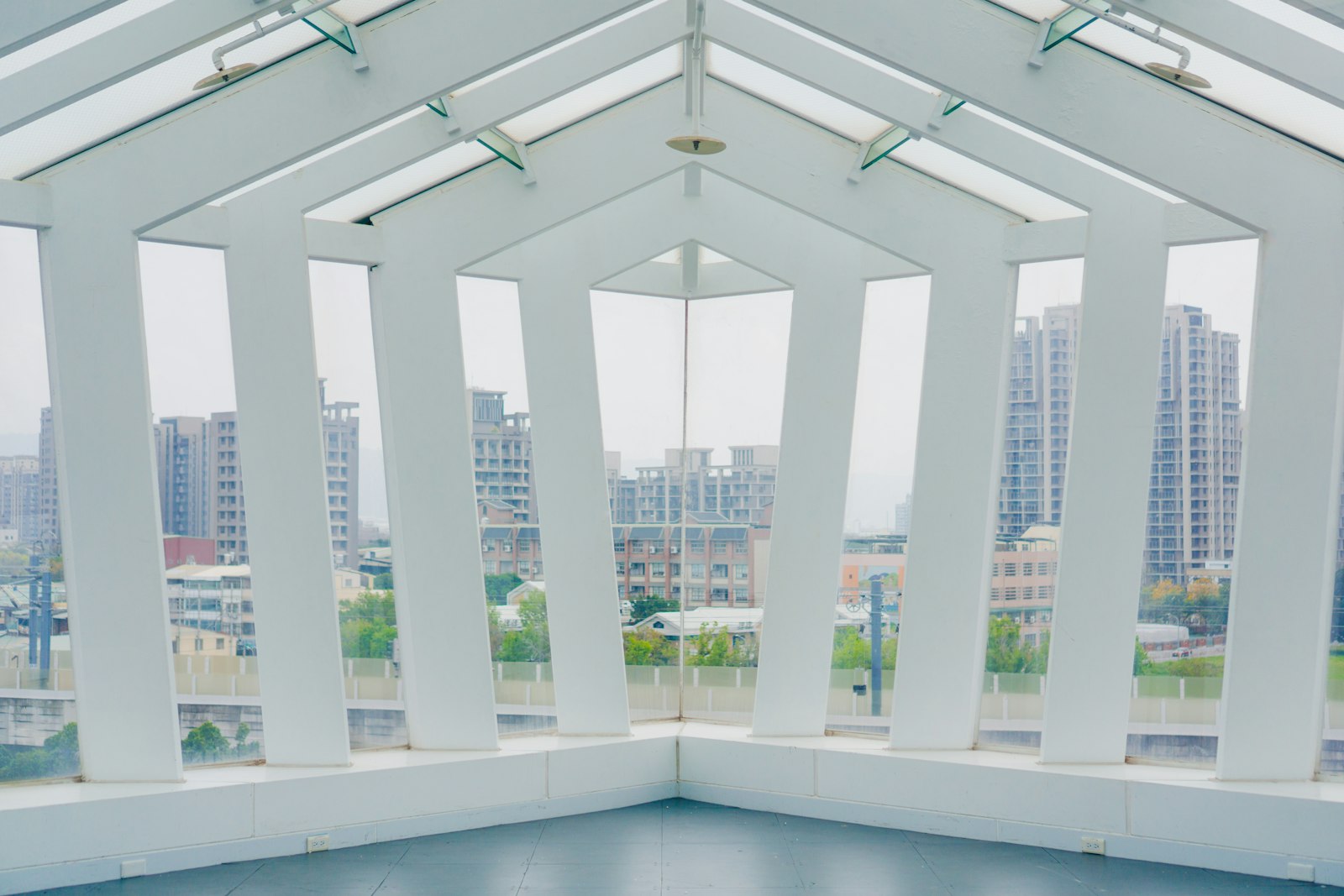
The pavilion is single-storey and approximately 280 square metres. The roof is supported by 47 steel columns of varying diameter, ranging from 16 millimetres to 31 millimetres. The columns are slightly irregular in their placement, suggesting a forest rather than a grid. The walls are entirely glass, with thin steel frames that almost disappear at certain angles of light.
The columns are the building’s defining feature. They are smaller in diameter than what conventional engineering would consider adequate for the load they carry. Ishigami’s office worked with the engineering firm Jun Sato Structural Engineers — a long-time collaborator — to develop a system in which each column carries only what it needs to carry, with redundancy distributed across the whole field rather than built into individual elements. The result is a structure that reads as fragile but is, in fact, robust. The intelligence is not visible in any single column; it is visible only in the relation between them.
This is a particular kind of engineering, and it has a specific intellectual provenance. Sato and Ishigami have worked this way before, most famously at the KAIT Workshop in Kanagawa, where 305 thin steel columns of varying section divide a single open hall into something between a building and a forest. The Vitra pavilion compresses that logic into a smaller field. The diameters here run thinner than at KAIT. The forest is denser. The roof above is more delicate. If KAIT was the proof of concept, the Vitra pavilion is a refinement — fewer columns, smaller section, longer development time per element.
The roof, made of laminated glass with a layer of pale ceramic frit, is supported by these columns and by occasional connections to the perimeter walls. The frit provides shading and gives the roof a slightly milky quality from below. From above — visible from the upper floors of nearby buildings, the VitraHaus included — the roof reads as a horizontal plane that is barely there. Stand on the top floor of Herzog & de Meuron’s stacked houses and the Ishigami roof is a faint horizontal whisper at the edge of vision, more reflection than object. This is, presumably, deliberate. The pavilion has been sited so that it can be looked down at as well as walked into, and what it offers from above is a study in how little a roof can be and still be a roof.
The Experience
To walk into the pavilion is to experience a building that almost refuses to be a building. The columns are too thin to read as structural elements. The walls are too transparent to define an interior. The roof is too thin to read as cover. What remains is a sense of enclosure that is felt rather than seen — the sound of the campus is muffled, the temperature is slightly warmer, the light is filtered through the frit — but the architectural substrate that produces this enclosure is barely visible.
There is a peculiar effect that occurs once one has been inside for a few minutes. The columns, which on first encounter read as a regular field, begin to differentiate. The eye starts to register the variation in diameter — 16 millimetres here, 31 millimetres there, several intermediate gauges in between — and the field reorganises into something less neutral than it first appeared. Some columns lean fractionally. Some are placed in tight clusters; others stand alone. The grid that wasn’t a grid reveals its underlying logic, which is structural rather than compositional. Each column is the diameter the engineering required at that point. The pattern is, in this sense, an honest diagram of the load — except that it is also a forest, and forests are not honest diagrams of anything.
This is the consistent project of Ishigami’s work, expressed here at small scale and exceptional precision. His larger buildings — the KAIT Workshop in Kanagawa, the Children’s Park in China, the Maison Owl forest house — pursue similar goals at greater complexity. The Vitra pavilion is a more concentrated, more refined version of the same investigation. Where KAIT was a statement of method, the pavilion at Weil-am-Rhein is something closer to a statement of belief.
Whether one finds this investigation moving or merely impressive is a matter of architectural taste. There is a lineage that runs from Mies van der Rohe through SANAA to Ishigami — a project of disappearing the building, of producing space without obviously producing structure — that some find profound and others find insubstantial. The Vitra pavilion will not change anyone’s mind on this question. It will, however, demonstrate the project’s current limits. The columns at this diameter, this height, this distribution — there is not much further to go. Subsequent work in this language will need to find a different problem to solve, or it will repeat itself.
The Site
The pavilion is sited at the eastern edge of the Campus, in an area previously used for parking and storage. The site borders a small wooded area that has been kept undisturbed; the pavilion’s columns, viewed from a distance, blend visually into the trees. This relationship is intentional. Ishigami has spoken in interviews about the building as “a pavilion in the forest” rather than “a pavilion next to the forest” — a distinction that would seem precious in another architect’s hands but feels appropriate here. The columns and the trees become, at certain angles, the same vertical pattern at different scales. From the right approach, the building disappears into its setting before one has registered that it is a building at all.
The relationship with the rest of the Campus is more ambiguous. The pavilion is a deliberate counterpoint to the assertive architectural personalities elsewhere on the site. Where Gehry’s Design Museum is sculptural and Ando’s Conference Pavilion is monumental, Ishigami’s building is almost negligible. Where Hadid’s Fire Station projects energy out into space, the pavilion absorbs energy from its surroundings. Where Herzog & de Meuron’s VitraHaus stacks twelve volumes into a vertical statement, Ishigami’s pavilion lays a single thin plane horizontally and lets the trees do the vertical work. This will be read by some as humility and by others as evasion. Both readings have validity.
There is also a generational point being made, even if the pavilion does not make it explicitly. The first Vitra buildings — Gehry, Ando, Hadid — were the work of architects in their forties and fifties, building first or formative projects. They were, in their different ways, statements of arrival. Ishigami, who was born in 1974 and whose office has been operating since 2004, arrives at Vitra at a different career stage. The KAIT Workshop and Maison Owl have already happened. There is less to prove and more to refine. The pavilion reflects that position: small, concentrated, unhurried, with the assurance of an architect who has worked out his methods and is now applying them at scales where they cease to read as method at all.
The SANAA Lineage
The most useful comparison on the Campus itself is not Gehry or Hadid but SANAA, whose factory building shares more with Ishigami’s pavilion than first appears. SANAA — Kazuyo Sejima and Ryue Nishizawa — has been pursuing thin walls, thin roofs, and dissolved volumes since the studio’s founding in 1995. Ishigami worked for SANAA between architecture school and starting his own office. The lineage is documented and direct.
What the Vitra pavilion makes visible, by sitting on the same site as the SANAA factory, is the difference between a master and an inheritor. SANAA’s factory building is white, opaque, programmatically demanding — it is a working hall first and an architectural statement second. The walls are thin but they are not transparent; the building is light but it is not weightless. Ishigami has taken the SANAA project and pushed it one further turn. The walls are not just thin; they are glass. The columns are not just minimal; they are, by ordinary structural standards, insufficient. The building is not just light; it is barely there.
Whether this is progress or self-parody depends on what one takes the project to be. If the project is dissolving the building into pure environment, the pavilion is a clear advance. If the project is producing useful space at appropriate cost, the SANAA position is more sustainable. The Campus now contains both arguments, on the same site, by architects of different generations working in the same Japanese tradition. That is the kind of curatorial coherence that does not happen by accident.
The Programme
The pavilion will house small exhibitions drawn from Vitra’s archive, beginning with a presentation of Sori Yanagi’s lesser-known work that opens in May. The programming will rotate every three to four months. Between exhibitions, the building will be open to visitors as a quiet space — no programmed content, no signage, just the building and the landscape.
This dual function — exhibition space and contemplative pavilion — is well matched to the architecture. The space is too small for major exhibitions and too distinctive for conventional ones. Anything hung on these walls would be hung against the trees outside; anything placed on the floor would sit beneath that ceramic-fritted plane. The objects will need to be the kind that can hold their own against a building that is barely there. Yanagi’s work — small, precise, material-attentive — is a sensible first choice. The decision to keep the programme modest, and to leave the building empty between rotations, is the right one. A bigger programme would crowd the architecture; a permanent collection would freeze the meaning of the space.
It is worth noting what the pavilion is not. It is not a retail extension, like the VitraHaus. It is not a corporate venue, like the Conference Pavilion. It is not a working facility, like the SANAA factory. It is something closer to a piece of grounds-keeping with delusions of grandeur — or, more generously, a folly in the older sense of the word: a building whose first justification is the experience of being inside it. Vitra has been adding buildings to the Campus for nearly forty years; this is the first of them whose programme is mostly the building itself.
The Verdict
The Ishigami pavilion is a small building. It has been added to a campus that already contains several large and important buildings, and it makes no claim to compete with them on their terms. Its claim is different: that architecture can pursue invisibility as a deliberate project, and that the result, when executed with sufficient precision, can be its own kind of presence. This is not a new argument — it is, in different forms, the argument that runs from Mies through SANAA into Ishigami’s whole career — but the pavilion makes the argument more concentratedly than any of his previous buildings, and at an address where the comparison to alternative architectural positions is unusually direct.
What the Campus now offers, with this addition, is a complete spectrum of contemporary architectural attitudes inside a thirty-minute walk. Gehry’s expressionism, Hadid’s deconstruction, Ando’s stillness, Herzog & de Meuron’s typological games, SANAA’s dissolution, Ishigami’s near-disappearance. There are not many places in the world where these positions can be compared in person, in their authors’ own work, on the same afternoon. The pavilion does not displace any of the older buildings; it makes the field more complete by occupying one of its remaining edges.
For visitors to the Campus, the pavilion is worth the detour. For architects, it is worth the careful study that Ishigami’s work usually rewards — the columns in particular, the engineering logic distributed across a field rather than concentrated in elements, the way the structural diagram and the spatial experience converge into the same thing. For Vitra, it represents another considered addition to a collection that continues to make the Campus one of the more useful pieces of architectural infrastructure in Europe — a place where a brand has, over four decades, slowly accumulated a working museum of contemporary architecture and kept it open to the public at the price of a standard ticket.
The pavilion will date. All buildings do, and buildings made of glass and very thin steel will date faster than most. The columns will need attention; the frit will need cleaning; the relationship to the wooded edge will change as the trees grow. But for the moment, walking out of the Conference Pavilion and across the gravel toward what looks, at distance, like a slightly denser patch of forest, the Vitra Campus offers the rare experience of arriving at a building one had not realised one was already inside. Ishigami has built less than any architect on this site. The result is a presence that the others, for all their assertiveness, cannot produce.
The Junya Ishigami Pavilion is open at the Vitra Campus, Weil-am-Rhein. Admission is included with the standard Campus ticket.