Frank Gehry will spend his 97th year (b. February 1929) drafting a parametric glass canopy over the tram station at the Getty Center, a hilltop institution he had not touched since the early 1990s. The frank gehry institutional commissions catalogued below — from the 1989 Vitra Design Museum in Weil am Rhein to the May 2026 Getty tram-station revamp confirmed by Dezeen on 29 May — span 37 years, four continents and a single argument: that civic culture deserves a roof shaped like weather. The new Getty job, awarded to Gehry Partners alongside WHY Architecture and landscape studio Olin, bookends the run that started on Rolf Fehlbaum’s grass in Baden-Württemberg.
Getty Center, Los Angeles, May 2026
On 29 May 2026, Dezeen reported that the J. Paul Getty Trust had selected three firms to overhaul the visitor sequence at the Getty Center: Gehry Partners on the tram canopy, WHY Architecture on the Welcome Hall, and Olin on the landscape. The Getty Center, designed by Richard Meier and opened to the public on 16 December 1997, will close 15 March 2027 for roughly eleven months and is scheduled to reopen in spring 2028 — the first substantial intervention on Meier’s travertine acropolis since the gates first swung in the final months of the Clinton administration.
Gehry’s slice of the brief is the parametric glass canopy that will roof the lower staging area where the funicular tram loads visitors at the base of the hillside above the 405 Freeway. The tram itself is being upgraded by Austrian firm Doppelmayr Group, whose new cars carry roughly 25 more visitors per trip than the originals — a throughput change that is the engineering rationale for the architectural one. More bodies need more shelter; more shelter, at the Getty’s altitude, needs a Gehry.
WHY Architecture, co-founded in 2003 by Kulapat Yantrasast (a former Tadao Ando associate) and Yo-Ichiro Hakomori, is reworking the existing Welcome Hall to add a café and improve wayfinding — the small, expensive moves that visitors notice without registering. Olin — the Philadelphia landscape studio that designed the Getty’s original 1997 gardens under Laurie Olin — is leading the landscape revamp, which means the same office now gets to edit its own younger work nearly thirty years later. The Getty Trust is, in effect, calling back the original landscape author and pairing him with the most American architectural signature of the late twentieth century.
The commission is also the cleanest possible bookend for the institutional run that began in Weil am Rhein in 1989. Gehry’s first European museum and his latest American civic intervention are separated by 37 years of titanium, Ductal, glass and stainless steel — and now by a single canopy that has to keep Angelenos dry while they wait for a Doppelmayr tram.
Vitra Design Museum, Weil am Rhein, 1989
The Vitra Design Museum on the Vitra Campus was Gehry’s first European commission. Clad in white plaster and titanium-zinc, it opened in 1989 on the Rhine-border parcel that Rolf Fehlbaum had already begun seeding with works by Tadao Ando, Zaha Hadid and Álvaro Siza. The building reads, at thirty-seven years’ distance, as the rehearsal for everything that came after: the collision of orthogonal volumes with curved appendages, the willingness to let a roof torque against a wall, the institutional confidence that a chair company’s archive deserved a building louder than its chairs.
Vitra mattered for two reasons that the architectural press did not always state out loud. First, it was the first time a European furniture client treated a museum as a brand asset rather than a civic gift — a precedent that FORMA has tracked through the Gehry furniture lineage from 1972 to 2026 and that would later be picked up by Hermès, LVMH and Kering. Second, Vitra gave Gehry the language — the white plaster, the torqued geometry, the small-scale collision of forms — that he would scale up at Bilbao eight years later. The Vitra Design Museum is a 7,000-square-foot building rehearsing the moves of a 256,000-square-foot one.
The campus context also turned Vitra into a graduate seminar in late-twentieth-century architecture. By the early 1990s, a visitor could walk from Gehry’s white plaster museum to Hadid’s fire station, Ando’s conference pavilion and Siza’s factory shed in a single afternoon. Gehry’s building had to hold its own against future Pritzker winners on adjacent lots — and did.
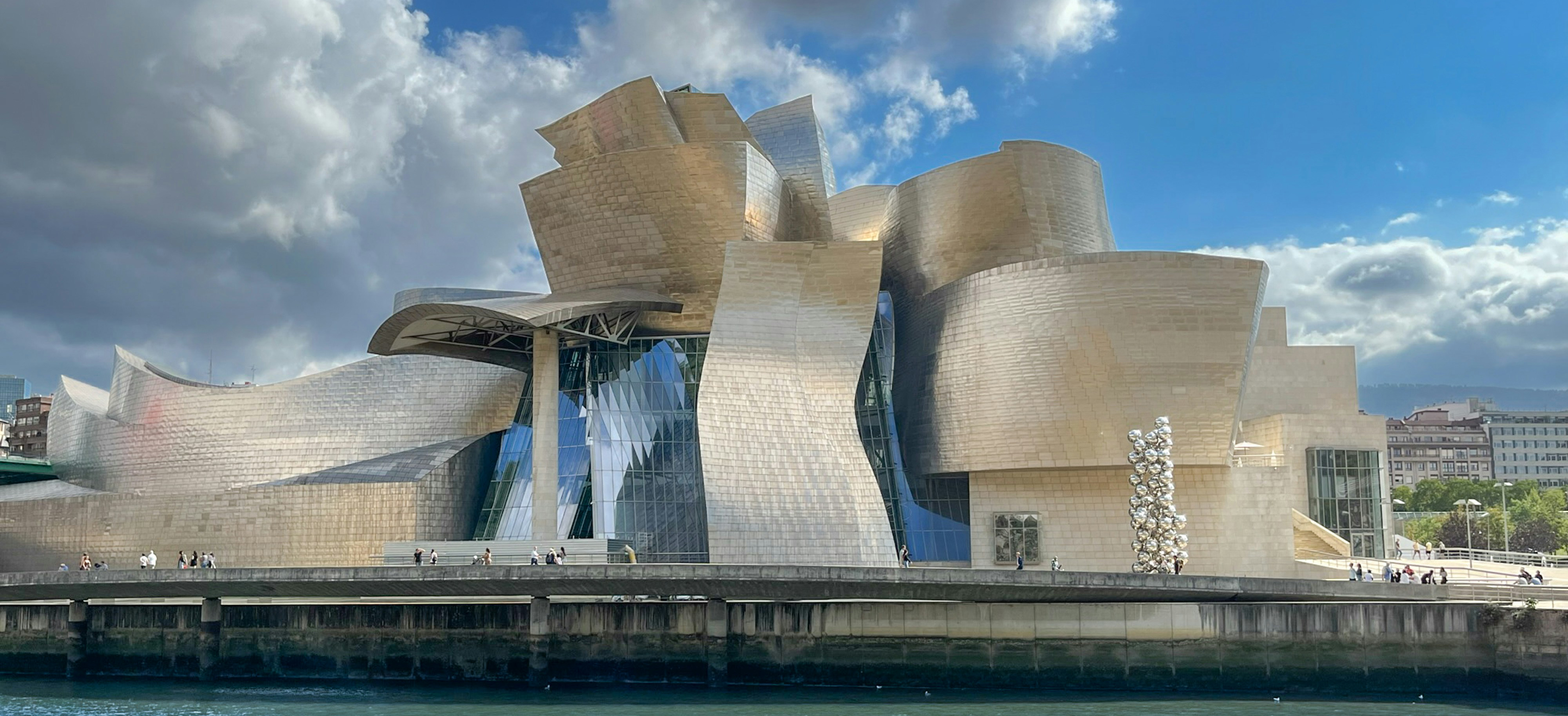
Guggenheim Museum Bilbao, 1997
The Guggenheim Museum Bilbao was inaugurated on 18 October 1997, commissioned by the Basque Government with the Solomon R. Guggenheim Foundation as part of a regeneration package that turned a declining shipbuilding city on the Nervión into a globally legible cultural destination. The building is wrapped in 33,000 titanium plates, each 0.4 mm thick — a specification thin enough that the metal flutters perceptibly in Atlantic wind and catches the river’s reflected light along its full 24,000-square-metre envelope.
The Bilbao Guggenheim did three things at once. It validated the parametric workflow Gehry’s office had developed using CATIA, the aerospace software that made the building’s compound curves both designable and buildable. It established the “Bilbao effect” — the proposition that a single piece of cultural architecture could rewrite a city’s economic story — which civic clients have been chasing, with mixed results, for the entire intervening generation. And it turned Gehry from a respected American architect into the only architect whose name a non-specialist could be relied upon to know.
Bilbao is also the moment when the institutional run became a brand. After 1997, every museum board with capital and ambition had to decide whether they were going to commission a Gehry, commission an explicitly anti-Gehry response, or pretend the question did not exist. The Vitra Design Museum had been a private gesture by a furniture client. Bilbao was a public dare.
Walt Disney Concert Hall, Los Angeles, 2003
The Walt Disney Concert Hall opened in 2003 as the new home of the LA Philharmonic, a downtown stainless-steel sail that completed Gehry’s claim on his own city. The project had been in gestation since 1987 — Lillian Disney’s initial $50 million gift predated Vitra by two years — but it was the post-Bilbao Gehry, with the CATIA workflow proven and the titanium-cladding logic transposed to stainless steel, who delivered the finished hall sixteen years later.
Disney Hall matters in the institutional run for three reasons. First, it is the building that made Gehry inescapable in Los Angeles, the city he had been working from since the early 1960s. Second, its acoustics — designed by Yasuhisa Toyota — silenced the long-standing critical claim that Gehry’s geometry was indifferent to interior performance. Third, the polished stainless-steel exterior was so reflective in its early years that it raised the temperature of adjacent sidewalks measurably, forcing Gehry’s office to sandblast portions of the cladding — a rare public acknowledgement that the parametric surface had consequences beyond its own drawing.
Disney Hall is also the only major Gehry institutional building whose client was a private foundation gifting a civic asset to a municipal performing-arts complex. The hybrid funding model — Disney family money seeding a county-owned hall — would become the template for several of the projects that followed.
Hotel Marqués de Riscal, Elciego, 2006
The Hotel Marqués de Riscal opened in 2006 in Elciego, Rioja Alavesa, as a titanium-ribboned wine hotel grafted onto the existing nineteenth-century bodega. It is the smallest building in the institutional run by floor area and the one that most clearly demonstrates that the Gehry move could be miniaturised for hospitality without losing its argument. The pink, gold and silver titanium ribbons that crown the hotel are colour-keyed to the Rioja bottle’s foil and its wine — a literalism Gehry’s office rarely indulges, but one that the client paid for explicitly.
Marqués de Riscal is also the moment Gehry’s institutional logic colonised hospitality. After 2006, the proposition that a hotel could be a destination architecture commission rather than a real-estate product became defensible, and a generation of European wine and luxury brands — Château La Coste, the Bordeaux first growths’ commissions to Foster, Nouvel and Herzog & de Meuron, eventually LVMH’s broader hospitality push — followed in its wake. Riscal is small, but it is a pivot in the run.
Fondation Louis Vuitton, Paris, 2014
The Fondation Louis Vuitton opened on 20 October 2014 in the Bois de Boulogne, commissioned by LVMH under Bernard Arnault and operated as the holding company’s Paris cultural address. The building is wrapped in 3,600 glass panels supported on twelve sail-like volumes, with the gallery interior — what Gehry’s office calls the “iceberg” — clad in 19,000 white Ductal concrete panels. The glass is engineered to flex; the Ductal is engineered to not. The fight between the two is the building.
The Fondation is the project that compressed the Bilbao argument — civic regeneration through signature architecture — into a private brand vehicle. The Bois de Boulogne is municipal parkland, but the building inside it answers to a luxury group, not a city council. The press treated this as a category problem in 2014. By 2026 it reads as an early instance of the now-routine collaboration between conglomerate capital and civic culture that has produced Luma Arles, the Pinault Collection at the Bourse de Commerce, the Prada Foundation’s Milan campus and (in a much smaller register) the Gehry small-objects exhibitions at Gagosian that FORMA covered in the 2026 small-objects piece.
For Louis Vuitton and Arnault specifically, the Fondation is the architectural translation of a portfolio strategy: a Gehry on the parkland edge of Paris, in the same way the group owns a maison on the Champs-Élysées. The building’s permanent collection — Basquiat, Richter, Rothko — is purchased; the building itself was commissioned. Both are assets.
Biomuseo, Panama City, 2014
The Biomuseo opened in Panama City in 2014 — the same year as the Fondation Louis Vuitton — and remains Gehry’s only Latin American institutional building. Sited on the Amador Causeway at the Pacific entrance to the Panama Canal, it is a museum of biodiversity clad in red, yellow, blue and green folded steel canopies that read, from a distance, as a collapsed circus tent. Gehry’s wife Berta Isabel Aguilera is Panamanian; the commission is, in part, a personal gesture.
The Biomuseo matters because it is the institutional commission Gehry took without the cultural-capital tailwind of Bilbao or Paris. The building was funded through a public-private partnership with the Panamanian government and the Smithsonian Tropical Research Institute, and the budget was a fraction of the Fondation’s. The result is a Gehry that has had to economise — the canopies are painted steel rather than titanium, the structure is more legible — and that economisation gives the building a directness the Paris project, with its 19,000 Ductal panels, deliberately suppresses.
It is also the only Gehry institutional building whose principal subject is biology rather than art, music or design. The exhibition design is by Bruce Mau — a Gehry collaborator since the late 1990s — and treats the canopied volumes as habitats rather than galleries.
Luma Arles, 2021
The Luma Arles tower opened on 26 June 2021 for Maja Hoffmann’s Luma Foundation, the Roche-pharma heiress’s Provençal arts campus on the site of the former Parc des Ateliers railway works. The tower is clad in 11,000 hammered stainless-steel bricks that twist above a glass rotunda — a vertical re-reading of the horizontal titanium-and-glass vocabulary Gehry had been developing since Bilbao, translated into a tower typology he had largely avoided until then.
Luma Arles is the institutional commission that most clearly demonstrates the run’s late phase. The client is a single heiress with a generational fortune. The site is a regional French city that was, before 2021, known principally for Van Gogh and a Roman amphitheatre. The programme is a multi-tenant arts campus rather than a single museum. The building has to compete for visual attention with a Roman ruin and a Provençal sky. Gehry’s response — the twisted stainless steel — is among the most aggressively figural moves of his career.
The Luma tower also closed the Hoffmann–Arnault triangle that has defined European cultural patronage in the 2010s and 2020s: the same architect builds for both rival heiress-and-tycoon dynasties, on opposite sides of France, within seven years. That a single signature can hold both commissions without either client objecting is itself a comment on the institutional run.
Gehry Partners and the institutional run
Gehry Partners is the LLP that succeeded Frank Gehry and Associates in 2001, and it is the entity carrying the 2026 Getty commission. The naming change is administratively boring and architecturally consequential: it formalised the office as a partnership rather than a sole-principal practice, which is how a 97-year-old architect can credibly accept a commission that will not open until 2028. The Disney Hall office had been a sole-principalship building a sole-principal’s building. The 2026 Getty office is a partnership stewarding a brand.
The institutional run, read across the LLP transition, sorts into three roughly equal phases. The pre-Bilbao phase, anchored by Vitra, is the rehearsal — the geometry is established, the workflow is not yet parametric, the client base is European and private. The Bilbao-to-Fondation phase, from 1997 to 2014, is the parametric mature work — CATIA-driven, titanium-and-glass dominant, clients ranging from regional governments (Basque, LA County) to private foundations (Disney) to luxury holding companies (LVMH). The post-Fondation phase, from Luma Arles in 2021 onward, is the brand-stewardship phase — a partnership executing on the established vocabulary for clients (Hoffmann, the Getty Trust) who explicitly want a Gehry signature on an existing institutional site.
It is worth noting what the institutional run does not include. The LACMA Geffen Galleries under construction in Los Angeles are by Peter Zumthor, not Gehry, despite a frequent press conflation born of geography and generation. That commission — a long, low concrete bridge across Wilshire Boulevard — is the anti-Gehry, both in form and in temperament, and it is opening into the same Los Angeles that is about to close Meier’s Getty for the Gehry canopy. The two projects will read, by 2028, as the two argument-poles of late-twentieth-century institutional architecture finally landing in the same city at the same time.
Frank Gehry institutional commissions, 1989–2026
| Year | Building | City | Client | Material / Form |
|---|---|---|---|---|
| 1989 | Vitra Design Museum | Weil am Rhein | Vitra / Rolf Fehlbaum | White plaster, titanium-zinc |
| 1997 | Guggenheim Museum Bilbao | Bilbao | Basque Government + Solomon R. Guggenheim Foundation | 33,000 titanium plates, 0.4 mm |
| 2003 | Walt Disney Concert Hall | Los Angeles | Walt Disney family + LA County (LA Philharmonic) | Stainless-steel sails, sandblasted exterior |
| 2006 | Hotel Marqués de Riscal | Elciego, Rioja Alavesa | Bodegas Marqués de Riscal | Pink/gold/silver titanium ribbons |
| 2014 | Fondation Louis Vuitton | Paris (Bois de Boulogne) | LVMH / Bernard Arnault | 3,600 glass panels + 19,000 Ductal concrete panels |
| 2014 | Biomuseo | Panama City (Amador Causeway) | Panama Govt + Smithsonian Tropical Research Institute | Folded painted-steel canopies, primary colours |
| 2021 | Luma Arles tower | Arles | Luma Foundation / Maja Hoffmann | 11,000 hammered stainless-steel bricks, glass rotunda |
| 2026 | Getty Center tram canopy | Los Angeles | J. Paul Getty Trust | Parametric glass canopy (with WHY Architecture and Olin on Welcome Hall and landscape) |
Coda
Read against itself, the institutional run is unusually disciplined. Eight major buildings in thirty-seven years, each one a museum or a hall or a wine hotel that functions as one, each one for a client with the patience to wait for a Gehry, and each one with a material decision — titanium, stainless steel, Ductal, glass — that the building’s parametric geometry then has to negotiate. The 2026 Getty canopy is the smallest brief on the list and arguably the highest-stakes one: it has to hold Meier’s travertine acropolis without rebutting it, shelter a Doppelmayr tram without dramatising it, and be recognisably a Gehry without overrunning a museum that is not. That is a constraint the 96-year-old who built Vitra in 1989 has now been working under, in one form or another, for thirty-seven years. The Getty will reopen in 2028 and the answer will be on the hillside above the 405.