Frank gehry furniture is a single 54-year argument that any material — corrugated cardboard, ColorCore plastic laminate, bentwood maple, mirror-polished stainless steel, ColorCore again, then bronze and copper — can be made to behave like architecture. The argument opens in 1972 at the Easy Edges workshop on Cloverfield Boulevard in Santa Monica, and it closes, posthumously, on 14 May 2026 in the back room of Gagosian Beverly Hills, where Larry Gagosian and the Gehry family have hung Fish on Fire — the last fish Frank Gehry executed in copper — beside a 2014 bear and a 2023 ColorCore crocodile under ten ink-and-watercolour drawings of fish in motion. Between those two dates sit the Wiggle Chair, the Fish Lamps, the Snake Lamps, the Knoll bentwood collection led by Cross Check, the Alessi Pito kettle, the 2006 Tiffany & Co. jewellery, the 2012 Gagosian fish revival, and the 2023 Louis Vuitton Capucines handbags. The 2026 show, organised six months after Gehry’s death and designed by his own studio, is also the prologue to “O Século de Gehry” at Fundação de Serralves in Porto, opening June 2026 and running until January 2027.
This piece reads the furniture as the primary axis of the practice, not the side hustle. The objects came before the famous buildings, shaped the vocabulary that produced them, and kept arriving every decade until the year of Gehry’s death.
Why the Furniture Was Always Load-Bearing
The first Easy Edges prototypes were glued together in 1969, three years before Gehry began drawing the studio addition that became his own house on 22nd Street in Santa Monica (1978), and seventeen years before Vitra gave him his first museum building at the Vitra Design Museum in Weil am Rhein (1989). The objects predate the architecture. They are not a coda; they are the test bed.
Every Gehry furniture project, from Easy Edges in 1972 to Black Crocodile in 2023, treats the chosen material as a structural skin. Cardboard is laminated in alternating directions until it behaves like a rigid panel. Maple veneer is wound through itself until it stands without a frame. ColorCore is shattered and reassembled as fish scales over wire. Stainless steel is scaled in overlapping panels until it reads as a bear’s hide. The same logic recurs in the buildings — gridded plywood at the Gehry Residence, titanium fish-scale at Guggenheim Bilbao (1997), steel ribbons at Walt Disney Concert Hall (2003), eleven thousand angled panels at LUMA Arles (2021). Reading the buildings without the furniture is reading the second half of the sentence.
Easy Edges and Cardboard, 1972: The First Year
Easy Edges, developed 1969–1973 and put into commercial production through Easy Edges Inc. in Santa Monica in 1972, is the foundational line. Gehry layered corrugated cardboard sheets in alternating directions, glued them under press, and discovered a laminate strong enough to allow full-scale seating cut from a single block. Seventeen models followed — side chairs, lounge chairs, rockers, tables, screens — sold through Bloomingdale’s in New York and a small constellation of design shops.
The most iconic piece is the Wiggle Side Chair, a ribbon of laminated cardboard that folds back on itself five times to form seat, back, and base in one continuous gesture. Wiggle is the object that ended up on the Vitra catalogue and stayed there, and it is the object that put the lamination logic into circulation: every subsequent Gehry furniture system is a translation of the Wiggle’s structural argument into a different material.
Gehry pulled the line in 1973. The reasons were authorial: Easy Edges Inc. had sold roughly ten thousand pieces in twelve months, but Gehry feared the cardboard business was about to overshadow the architecture practice. He shut the company and destroyed the press dies. The decision is the founding act of Gehry’s career-long ambivalence about object production — the work matters enough to do, but not enough to let it eat the studio.
Vitra reintroduced the Wiggle Chair from 1986 under a licence Rolf Fehlbaum negotiated on the same trip that secured the Vitra Design Museum commission. The Heller brand later reissued Easy Edges pieces in the United States, and the Sirmai-Peterson House gave Gehry’s furniture-architecture continuum its first canonical residential expression.
Fish Lamps and ColorCore, 1984–1986: The Formica Year
The Fish Lamps originated in a 1983 commission from the Formica Corporation in Cincinnati. Formica had just developed ColorCore, a through-coloured plastic laminate whose pigment ran through the full thickness of the sheet, and offered samples to a small invited group — Stanley Tigerman, SITE, Robert Venturi, Gehry — asking for objects that would showcase the material. Most made tables. Gehry accidentally shattered a ColorCore sheet with a hammer in his Santa Monica back room, saw the shards as fish scales, and built the first Fish Lamp in late 1983 out of wire armature wrapped in laminate fragments lit from inside.
The series ran 1984–1986 at New City Editions in Venice, California. Each lamp was a unique piece, ranging from table-top fish under fifty centimetres to ceiling-suspended Pacific halibut scale, hand-built with varying combinations of ColorCore tones, acrylic, white and amber glass, and copper armature. Roughly fifty Fish Lamps and a smaller number of Snake Lamps were produced before Gehry suspended the series in 1986.
The Fish Lamps are the formal hinge of the practice. The shard-clad fish armature of 1984 is the prototype of the titanium-scaled volumes Gehry began producing in CATIA in the mid-1990s, and the surface he eventually executed in Bilbao is, at the level of construction logic, an inflated Fish Lamp. The lamps proved that a curved sculptural skin could be built out of small flat panels pinned to a welded armature — the exact premise that scaled to the building envelope a decade later.
Snake Lamps, 1989: ColorCore on Wire Continues
The Snake Lamps extend the ColorCore-on-wire technique into a different animal vocabulary. Gehry began the snakes as a counter-form to the fish in 1984 at the same New City Editions workbench, but produced them in much smaller numbers and pulled them back into the studio for further development through the late 1980s. The 1989 pair the Gehry family loaned to Gagosian for the 2026 show were made in newspaper and wheatpaste over a coiled wire armature, sealed with shellac and painted with watery gouache in greens, ochres, and blacks. They remained in Gehry’s personal collection for thirty-five years and are the only finished sculptural snakes from Gehry’s hand to enter public view.
Cross Check and Bentwood, 1992: Maple at MoMA
The Knoll bentwood collection, designed 1989–1992 and launched at MoMA New York under “Frank Gehry: New Furniture Prototypes,” is the second major Gehry furniture system. Gehry developed the line over three years at the Knoll Research and Development Center in East Greenville, Pennsylvania, stripping the chair down to white maple veneer strips wound into a self-supporting structure with no internal frame. The strips were laminated in six to nine layers using a thermoset glue and woven through one another in patterns derived, Gehry has said, from the structure of an old wooden bushel basket he kept on a studio shelf.
The MoMA show presented six prototypes, each named for a hockey term in a nod to Gehry’s Toronto childhood: Cross Check, Power Play, Hat Trick, Face Off, Off Side, and High Sticking.
Cross Check is the canonical piece. A flat ribbon of white maple veneer, two inches wide and one-eighth of an inch thick, laminated and wound through itself five times to form seat, arms, and back without a hidden armature. The chair weighs under ten pounds, supports an adult, flexes slightly under load, and uses the same lamination logic Gehry developed for Easy Edges twenty years earlier — corrugated cardboard substituted with thin maple veneer. The Knoll bentwood collection has been in continuous production since 1992 and is, along with the Vitra Wiggle, the only Gehry furniture system to remain commercially available three decades after launch.
Pito Kettle, 1992: Whistling Fish in Stainless Steel
The Pito kettle, designed in 1988 and produced from 1992 by Alessi, is the object that brought Gehry into the European household. Alberto Alessi had run the Tea & Coffee Piazza project in 1983 with eleven invited architects, including Gehry, whose contribution was a fish-shaped silver coffee service. Pito followed as a production object: 18/10 mirror-polished stainless steel body, mahogany handle and cap, whistling top shaped like two darting fish soldered together at the mouth.
Pito has been in continuous Alessi production since 1992 and remains, along with Michael Graves’s 9093 Bird Kettle (1985) and Aldo Rossi’s La Cupola (1990), one of the three signature kitchen objects of the firm’s postmodern decade. The double-fish whistle is the smallest and most reproduced of Gehry’s fish forms.
Tiffany & Co., April 2006: Frank Gehry Furniture for the Body
In April 2006 Tiffany & Co. launched the Frank Gehry for Tiffany & Co. jewellery collection — the firm’s first major design partnership since Paloma Picasso in 1980. The collaboration ran to six lines: Torque, Orchid, Fold, Fish, Equus, and Axis. Materials were 18k yellow gold, 18k black gold (an oxidised alloy developed for the collection), oxidised sterling silver, agate, and cachalong. Each line carried the lamination-and-scaling vocabulary of the furniture into a body-scale register — Torque folds gold in a single ribbon the way Wiggle folds cardboard; the Fish pendant resolves the Fish Lamp armature into a carved profile; Axis threads through itself in a maple-bentwood loop reduced to the diameter of a finger. The collaboration extended into tabletop and chess sets in oxidised silver and 18k gold. It is the only major Gehry object project conceived for the body rather than the room.
Fish Lamps Revival, 2012: ColorCore Returns at Gagosian
In 2012 Larry Gagosian asked Gehry to return to the Fish Lamps. The result was a second series, executed in the Playa Vista fabrication studio with Tomas Osinski and shown across Gagosian Beverly Hills and Gagosian Paris in 2012–13 under the title “Frank Gehry: Fish Lamps”. The 2012 fish were bolder and more jagged than the 1984 originals, built with larger ColorCore shards cut by hand from full Formica sheets, fixed to copper armatures, and lit with internal incandescent bulbs whose warmth pushed through the through-coloured laminate as amber, ochre, and bottle-green light.
The 2012 revival sold rapidly. Prices ran $300,000 to $750,000 in the gallery, and by 2024 the secondary market had carried full-scale specimens past $1.4 million at Phillips and Sotheby’s. The 2012 series confirmed that the Fish Lamp was an active and unfinished line — one Gehry continued to develop until the 2023 copper Fish on Fire ended the sequence.
Bear With Us, 2014: Bronze and Stainless Steel at Life Size
Bear With Us, 2014, is the start of Gehry’s bronze and stainless-steel animal sculptures at Gagosian. A life-size bear standing on its hind legs, executed in 316L marine-grade stainless steel sheet over a welded armature, the piece was produced in the Playa Vista studio with Tomas Osinski using the same steel grade and surface finish as the LUMA tower then in development in Arles.
The bear stands roughly 2.4 metres tall. The stainless-steel sheets are scaled in overlapping panels of varying size — larger across the chest and rear, smaller around the muzzle and paws — pinned to the welded armature with the same fastener detail as the Bilbao titanium. Bear With Us is a domestic-scale rehearsal of LUMA Arles: same alloy, same scaling logic, same skin behaviour, executed in a room rather than at fourteen floors. The piece reappears at the centre of the Camden Drive show in 2026.
Louis Vuitton Capucines, December 2023: The Handbag
The Gehry collaboration with Louis Vuitton debuted at Art Basel Miami Beach in December 2023 as a special edition of the Capucines line. The headline piece, Capucines MM Floating Fish, references the Fish Lamps displayed at the Fondation Louis Vuitton — the building Gehry designed for Bernard Arnault, which opened in 2014. The bag carries a metal fish charm developed from the same vocabulary that runs back through Pito and the 1984 Fish Lamps to the 1983 Formica commission. It is Gehry’s only handbag project and the smallest, most portable expression of the fish form — pocket-scale where Fish on Fire is body-scale and Walt Disney Concert Hall is city-scale. Architect-to-object crossovers at major art and luxury venues — Tadao Ando at the Pinault Collection in 2026 is the immediate parallel — sit in the same continuum the Capucines bag and Fondation Louis Vuitton bookend.
Fish on Fire, 2023: The Last Fish in Copper
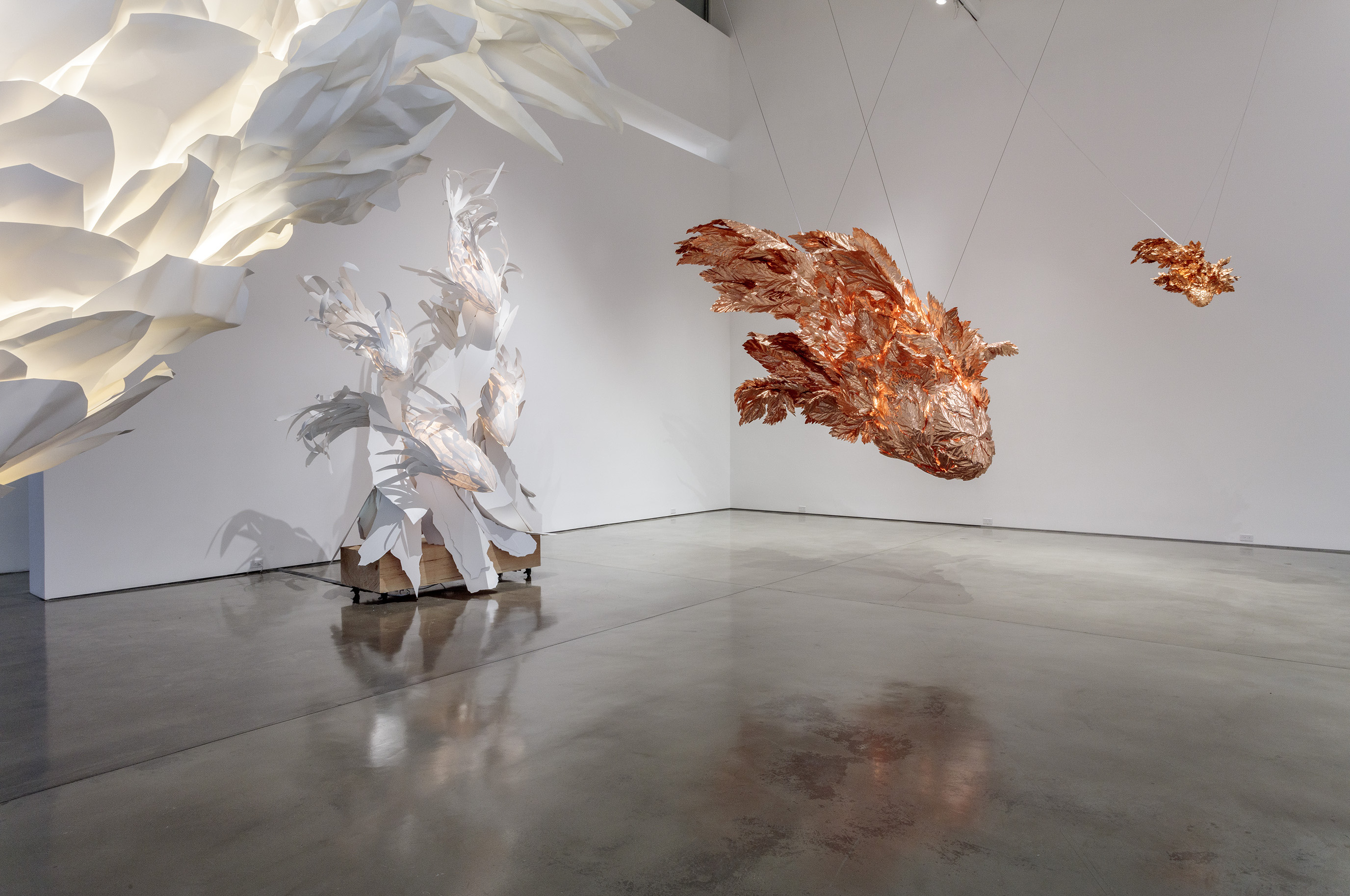
Fish on Fire, 2023, is the last fish sculpture Gehry executed before his death and the first to use solid copper rather than ColorCore shards. The skin is solid copper plate — patinated to a deep, near-black-red surface that catches the gallery light as if lit from inside. It is the closing object of the fish sequence that opened in 1984.
Untitled (Black Crocodile New York), also 2023, was produced in the same studio year in ColorCore Formica and silicone — black ColorCore shards over a wire armature — and reads as a return to the 1984 ColorCore vocabulary at the end of the life. The two 2023 sculptures are paired in the Gagosian show, the copper fish and the black laminate crocodile, as the closing material statements of the practice.
Gagosian Beverly Hills, 14 May – 27 June 2026
The Gagosian Beverly Hills 2026 show is the first posthumous Gehry exhibition after his death in 2025. Organised by Gagosian with the Gehry family and designed by Gehry Studio in the months immediately before his death, it runs at 456 North Camden Drive from 14 May to 27 June 2026 and includes four sculptures — Bear With Us (2014), Untitled (Black Crocodile New York) (2023), Fish on Fire (2023), and the 1989 pair of Snake Lamps — alongside ten works on paper. (Prior Gagosian context for the practice sits in our 2026 objects piece.)
The presentation also stages the first public screening of “Gagosian Premieres,” a video work documenting performances by Esperanza Spalding, Gustavo Dudamel, and the YOLA youth orchestra programme staged in 2021 for the “Spinning Tales” exhibition Gehry produced at the same gallery.
The exhibition is the prologue to “O Século de Gehry” — “The Century of Gehry” — the major retrospective opening at the Fundação de Serralves in Porto in June 2026 and running through January 2027. The Porto show is the first comprehensive treatment of the full practice since the MoCA Los Angeles “Frank Gehry” retrospective of 2015–16.
Frank Gehry Furniture: The Timeline, 1972 to 2026
The chronology below collapses the fifty-four-year material argument into a single table — what was produced, in what substance, through which manufacturer, and what the object did for the practice.
| Year | Object | Material | Manufacturer | Note |
|---|---|---|---|---|
| 1972 | Easy Edges line (17 models) | Corrugated cardboard, alternating-direction lamination | Easy Edges Inc. (self-produced) | First commercial Gehry furniture line; discontinued 1973; press dies destroyed |
| 1972 | Wiggle Side Chair | Corrugated cardboard lamination | Easy Edges Inc.; Vitra from 1986 | Most iconic Easy Edges piece; still in Vitra production |
| 1984 | Fish Lamps (first series) | ColorCore plastic laminate shards over wire armature | New City Editions, Venice CA | Originated from 1983 Formica Corp. commission; ~50 unique pieces 1984–86 |
| 1989 | Snake Lamps (pair) | Papier-mâché on wire armature, painted gouache | Self-produced, Santa Monica | Only finished sculptural snakes from Gehry’s hand; remained in family collection |
| 1992 | Cross Check (bentwood collection) | White maple veneer, 6–9 layers, thermoset glue | Knoll | MoMA debut “Frank Gehry: New Furniture Prototypes”; hockey-term names |
| 1992 | Pito kettle | 18/10 mirror-polished stainless steel, mahogany handle | Alessi | Designed 1988; double-fish whistle; still in production |
| 2006 | Frank Gehry for Tiffany & Co. | 18k gold, black gold, oxidised silver, agate, cachalong | Tiffany & Co. | Six lines: Torque, Orchid, Fold, Fish, Equus, Axis; tabletop and chess sets |
| 2012 | Fish Lamps (revival) | ColorCore laminate shards, copper armature | Gagosian, Beverly Hills and Paris | Bolder, more jagged ColorCore shards; secondary market past $1.4M by 2024 |
| 2014 | Bear With Us | 316L marine-grade stainless steel sheet over welded armature | Gagosian | Start of bronze and stainless animal sculptures; same alloy as LUMA Arles |
| 2023 | Louis Vuitton Capucines MM Floating Fish | Leather, metal fish charm | Louis Vuitton | First Gehry handbag; debut Art Basel Miami Beach |
| 2023 | Fish on Fire | Solid copper plate, patinated | Self-produced for Gagosian | Last fish executed by Gehry; first in solid copper rather than laminate |
| 2023 | Untitled (Black Crocodile New York) | ColorCore Formica, silicone | Self-produced for Gagosian | Return to 1984 ColorCore vocabulary at end of life |
| 2026 | Posthumous show, Gagosian Beverly Hills | (Bear With Us, Black Crocodile, Fish on Fire, Snake Lamps, 10 drawings) | Gagosian with the Gehry family | First posthumous exhibition; designed by Gehry Studio; 14 May – 27 June 2026 |
What Frank Gehry Furniture Was For
Reading the table downward, the line is continuous. Cardboard laminated in alternating directions becomes maple veneer laminated in alternating directions becomes ColorCore shattered and reassembled in alternating shards becomes stainless steel scaled in overlapping panels becomes copper plate patinated over a welded armature. Five materials, one logic, fifty-four years.
That continuity is also the answer to why Gagosian and the Gehry family opened the posthumous programme with objects rather than buildings. The objects are what the practice was about all along. The buildings are the larger object: Bilbao is a Fish Lamp scaled past the human, Walt Disney Concert Hall is a Wiggle Chair scaled past the room, LUMA Arles is a Bear With Us scaled past the cathedral. Reading the buildings first is reading the conclusion before the premise. The Camden Drive show puts the premise back in its proper place — on a low riser, in a back gallery, in the same Beverly Hills block where Gagosian first hung the 1984 Fish Lamps in 2009.
The next move is Porto in June. “O Século de Gehry” at Fundação de Serralves will, for the first time, hang the cardboard and the bentwood and the ColorCore and the copper and the titanium models of Bilbao in a single sequence — the full argument, end to end, of what frank gehry furniture actually was. Until then, the four sculptures and ten drawings on Camden Drive carry the entire fifty-four-year case on their own.