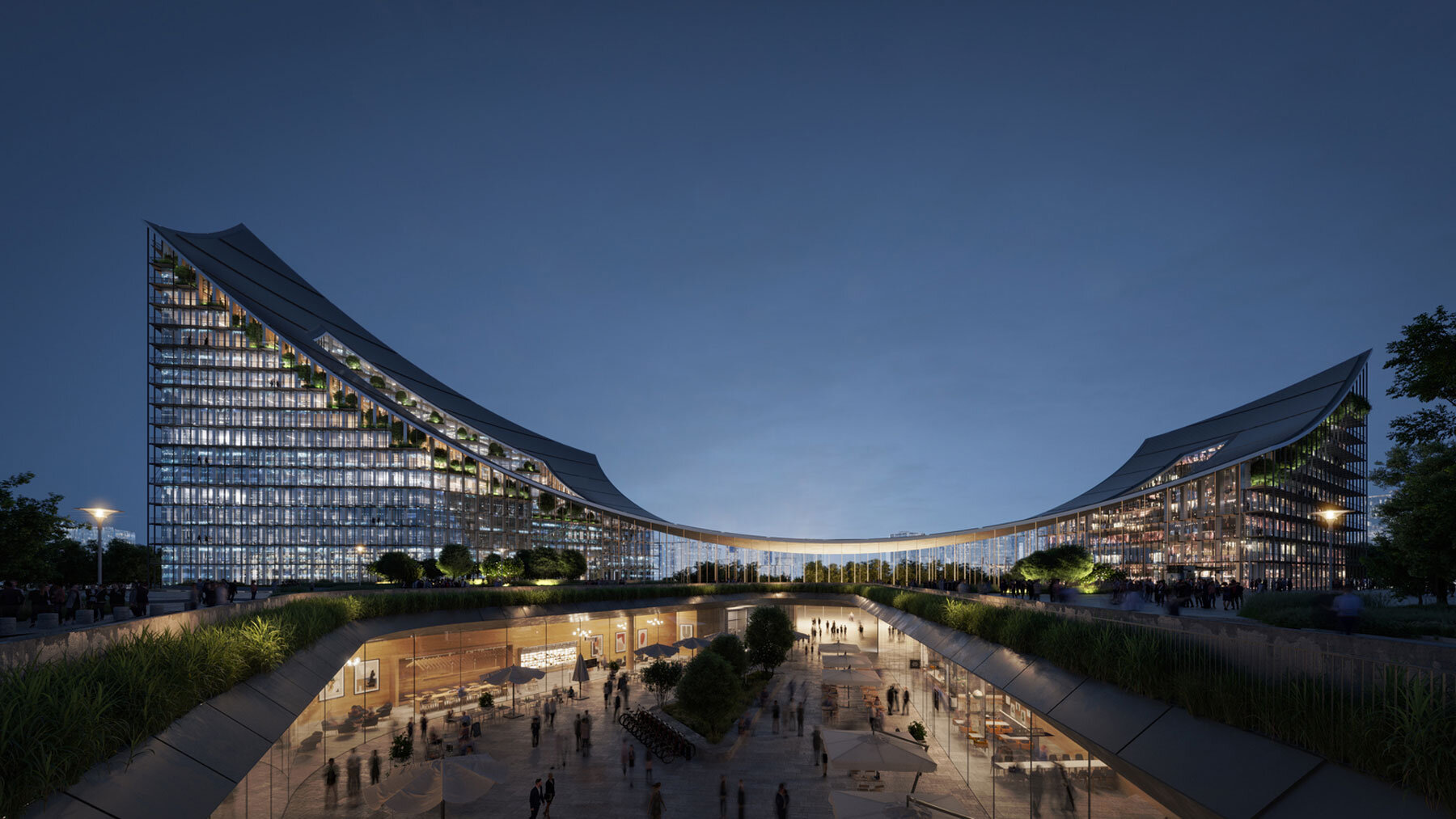
Bjarke Ingels’ CityWave closes the only multi-architect tower district Milan has built in half a century, 22 years after Arata Isozaki, Zaha Hadid and Daniel Libeskind won the 2004 masterplan for the 36.6-hectare former Fiera grounds. The question — every tower in the Milan CityLife towers district, by architect and completion year, 2015 to 2026 — has a clean answer because the consortium that won the competition imposed a clean rule: one signature tower per Pritzker-class author, then one residential complex per author, then a final phase by a single invited practice. Isozaki’s Allianz Tower delivered in 2015, Hadid’s Generali Tower in 2017, Libeskind’s PwC Tower in 2020, and BIG’s CityWave is nearly complete as of May 2026. That is the district. Everything else — the park, the metro stop, the residential blocks, the LEED Gold pre-certification on the office towers — is scaffolding around four projects by four authors.
CityLife sits on the western edge of central Milan, where the original Fiera di Milano trade-fair grounds operated from 1923 until the 2005 relocation to Rho Pero. The 2004 international competition for the cleared site was won by a consortium that the Italian architectural press immediately read as a deliberate provocation: an Italian-Japanese laureate, an Iraqi-British laureate-to-be, and a Polish-American author of the Jewish Museum Berlin, all asked to share a single masterplan. Generali, Allianz and a private real-estate vehicle backed roughly €2 billion of investment across what eventually delivered around 164,000 square metres of housing, 1,300 apartments, 4,500 residents, and over 170,000 square metres of car-free park served by the dedicated Tre Torri stop on Metro Line 5. The shorthand “Tre Torri” — three towers — predates CityWave; the 2026 BIG project will leave the district with five buildings reading as towers, but the metro stop will keep the older name.
The 2004 competition and the masterplan logic
The Isozaki–Hadid–Libeskind consortium did not assemble itself. The 2004 competition brief explicitly asked for an authored skyline rather than a corporate masterplan, and the three architects were paired by the developer side — Generali plus the CityLife consortium — partly because their formal languages were legibly distinct. Isozaki’s late work had moved toward modular repetition and rigorous verticals; Hadid was at the height of the parametric phase that would produce the MAXXI Rome opening (2010) and the Heydar Aliyev Center (2012); Libeskind, having delivered the Jewish Museum Berlin in 1999 and won the Ground Zero masterplan in 2003, was working in the faceted, angular register that the consortium needed to differentiate the third tower from the other two.
The masterplan that emerged divided the site by axis rather than zone. The three signature towers were grouped at the eastern edge, around the new metro plaza, so they would read as a skyline from central Milan rather than dispersed objects. The residential allocations — seven low-rise curvilinear buildings to Hadid, five faceted blocks to Libeskind — were arrayed along the southern and western edges of the park. Isozaki, having taken the largest tower, was not given residential floor area in the initial round. The 36.6-hectare park itself, the second-largest in central Milan after Sempione, was treated as the connective tissue: car-free, served by underground service tunnels, and crossed by pedestrian and cycle routes terminating in the tower plaza. The car-free condition is not decorative. Service vehicles use underground deliveries; the surface above is a continuous public park that the city accepts as municipal open space.
The choice of metro infrastructure was as decisive as the architecture. Metro Line 5 — the lilac line, fully driverless — opened the Tre Torri station in 2015, simultaneously with the Allianz Tower, and that pairing converted CityLife from a peripheral redevelopment into a directly addressable destination. Without Line 5, the towers would have remained corporate islands accessible mainly by car; with it, the office towers and the residential blocks function as a transit-oriented district with a measured walk to Piazza Duomo of around twenty minutes by metro.
Allianz Tower (Il Dritto), Arata Isozaki + Andrea Maffei, 2015
The Allianz Tower opened in 2015 as the Italian headquarters of Allianz and the first of the three masterplan towers to complete. The building rises 50 floors above the metro plaza in a tightly disciplined module: eight curved triple-glazed bays per face, repeated up the full height of the slab, with golden steel diagonal bracing tying the corners. The Milanese nickname “Il Dritto” — “the straight one” — fixed itself before the building was even topped out, because the tower’s verticality was the most legible answer to the question of how to differentiate three towers next to each other.
The credit line matters. The tower is by Arata Isozaki with Andrea Maffei, the Milan-based architect who had collaborated with Isozaki since the late 1990s and who effectively ran the Italian execution. Isozaki, born 1931 and trained under Kenzo Tange, opened his Tokyo studio in 1963 and worked through the postmodern decades — the Tsukuba Civic Center, the Museum of Contemporary Art Los Angeles (1986), the Palau Sant Jordi in Barcelona (1990) — before the 2004 CityLife commission. He received the Pritzker Prize in 2019 and died in 2022. The Allianz Tower is therefore one of the late works that the Pritzker jury cited, and the only one of the three signature CityLife towers whose author did not live to see the masterplan completed.
The structural strategy explains the silhouette. Italian seismic regulations require Milanese high-rises to dissipate horizontal load, and Isozaki and Maffei addressed this by placing the lateral bracing at the four corners of the slab rather than in a central core. The diagonals are exposed on the short faces, painted in a warm gold-bronze, and read from a distance as decorative emphasis; they are in fact the primary seismic system. The repeated curved bays on the long faces — eight per floor, each a triple-glazed convex panel — were designed so that no two adjacent bays share the same vertical joint, breaking the surface into a quiet pattern that resists the slab proportions. At 207 metres to the architectural top, the Allianz is the tallest occupied building in Italy, a record CityLife had explicitly competed for.
Generali Tower (Lo Storto), Zaha Hadid Architects, 2017
The Generali Tower opened in 2017 as the headquarters of Assicurazioni Generali. At 177 metres and 44 storeys, it is shorter than the Allianz but no less assertive: the entire structure torques along its vertical axis, with each floorplate rotated a small degree from the one below, so that the slab arrives at the ground at a different angle from the one it presents at the crown. The Milanese nickname “Lo Storto” — “the twisted one” — was inevitable; in Hadid’s office it was simply called “the twist.”
The project was developed by Zaha Hadid before her death in March 2016 and completed under Patrik Schumacher’s direction at Zaha Hadid Architects. It belongs to the same arc of late projects as the Heydar Aliyev Center (2012) and the Sky SOHO Shanghai (2014) — projects in which a rigorous geometric move was carried through the whole envelope rather than concentrated in a roof or a lobby. The torsion at Generali is generated by a tapered ground plate that sits cantilevered over the entry hall and resolves at the top into a clean horizontal cut. Structurally, the rotating floors are supported by a central core that remains vertical; the perimeter columns lean outward as they rise, and the glazing follows them. Each panel of the curtain wall is a unique shape, parametrically generated and CNC-cut, which is the part of Hadid’s late practice that survived into the post-2016 work.
Hadid’s residential allocation in the masterplan — the Hadid Residences — was delivered in parallel with the tower. Seven low-rise curvilinear buildings, with sinuous balconies wrapping the perimeter and rising to between five and thirteen storeys, occupy the southwestern quadrant of the site. They are the Hadid office’s clearest mid-rise housing project in Europe, and they read explicitly as a horizontal counterpart to the vertical torsion of the tower. Where the tower rotates, the residences undulate. The vocabulary is the same; the scale and orientation are inverted.
PwC Tower (Il Curvo), Daniel Libeskind, 2020
The PwC Tower opened in 2020 as the Milan headquarters of PricewaterhouseCoopers. At 175 metres and 28 storeys, it is the shortest of the three signature towers but the most singular in profile: a cupola-inspired slab that curves inward at its top, crowned by a 40-metre superstructure that doubles as gallery and viewing platform. The nickname “Il Curvo” — “the curved one” — completes the triptych with Il Dritto and Lo Storto. The three Milanese names form the only consistent piece of branding the district has produced.
Libeskind’s design strategy was to make the third tower legible at distance precisely because it was the shortest. The two longer faces of the slab curve toward each other at the crown so that the building reads as the upper section of a dome cut and inverted. The 40-metre cupola at the top — clad in glass and steel — is structurally a separate piece, designed to be experienced from inside as a daylit volume above the office floors. The lower section’s glazing is broken by horizontal cornices that step at irregular intervals, a Libeskind signature carried over from the Jewish Museum Berlin (1999) and the Royal Ontario Museum extension (2007).
The Libeskind Residences sit immediately south of the tower and pick up the same faceted vocabulary. Five buildings, each with angled, faceted facades, range between five and twelve storeys; the geometry of the windows and balconies echoes the diagonal cuts of the PwC crown. The residences and the tower were designed as a unit, and the masterplan documents treated them as a single contiguous parcel: Libeskind delivered the third corner of the tower triangle plus its dedicated residential mass, the same proportional allocation Hadid received.
The PwC Tower’s 2020 completion closed the three-tower phase of the masterplan, sixteen years after the 2004 competition. With the residential complexes already delivered, the only remaining parcel was a central plot directly above the metro plaza — the parcel that would become CityWave.
CityWave: Bjarke Ingels’ 2026 milan citylife towers finale
CityWave is, in May 2026, “nearly complete.” That is the formulation Domus used on 27 May 2026 in its on-site report from the canopy, and it is the formulation the project deserves: the photovoltaic canopy is installed, the two towers are at full height, the plaza-level cladding is being finished, and tenants begin fit-out this summer. The project is the final phase of CityLife and the only one not assigned in the 2004 masterplan; the parcel above the metro plaza was held back, then awarded by the CityLife consortium to BIG – Bjarke Ingels Group, the Copenhagen- and New York-based practice founded by Bjarke Ingels in 2005.
The geometry is the cleanest BIG has built in Italy. Two asymmetrical office towers — one 53 metres, one 105 metres — flank a central plaza. A 140-metre curved canopy bridges the two towers, springing from the shorter mass and landing on the taller, and it is the canopy that carries the project’s most quoted figure: 11,000 square metres of photovoltaic panels integrated into the underside. The canopy is structurally a single shell, not a series of trusses; the photovoltaic skin is the visible expression of what is also the rain-shedding and shading layer. Beneath it, a car-free public plaza extends the CityLife park’s logic across the metro plaza to the office entrances of the two towers. Total office area is more than 60,000 square metres, distributed across the two slabs.
CityWave is the only one of the four CityLife signature projects designed from the outset to a net-zero operational target, and the only one in which the architectural figure and the sustainability strategy are the same gesture. The 11,000 m² photovoltaic canopy was sized to produce a significant share of the project’s annual electricity demand; the curved geometry of the canopy follows the optimal angle for Milanese solar exposure, and the underside of the canopy is the plaza’s daylit ceiling. Where Isozaki, Hadid and Libeskind treated environmental performance as a curtain-wall question — better glass, better shading — Ingels has treated it as a massing question. The result is that the canopy reads, even unfinished, as the formal signature of the building, the same way Il Dritto’s diagonals or Lo Storto’s twist or Il Curvo’s cupola were the formal signatures of the earlier towers.
The 2026 completion also closes the temporal arc of the masterplan. Counting from the 2004 competition award to the 2026 CityWave delivery, CityLife took 22 years — a duration that places it in the same league as the largest European urban-renewal projects of the era and that is, importantly, only two years longer than the original 20-year development schedule the consortium published in 2005.
Milan CityLife towers, side by side
The four authored projects can be set against each other in a single table. Heights and floor counts are from the masterplan documentation and the architects’ offices; nicknames are the Milanese vernacular.
| Tower | Architect | Year | Height (m) | Function |
|---|---|---|---|---|
| Allianz Tower (Il Dritto) | Arata Isozaki + Andrea Maffei | 2015 | 207 | Allianz Italian HQ, 50 floors |
| Generali Tower (Lo Storto) | Zaha Hadid Architects | 2017 | 177 | Assicurazioni Generali HQ, 44 floors |
| PwC Tower (Il Curvo) | Daniel Libeskind | 2020 | 175 | PricewaterhouseCoopers Milan HQ, 28 floors |
| CityWave (north tower) | BIG – Bjarke Ingels Group | 2026 | 105 | Office, with 140 m photovoltaic canopy |
| CityWave (south tower) | BIG – Bjarke Ingels Group | 2026 | 53 | Office, beneath shared canopy |
Two observations follow. First: the project that opened the district — Isozaki’s Allianz — is also the tallest, and the project that closed it — BIG’s CityWave — is the shortest by absolute height, despite spanning two towers and a canopy. CityLife’s skyline was built in descending order, with the most assertive vertical first. Second: each architect’s signature is a different geometric operation. Isozaki’s tower is verticality without rotation; Hadid’s is rotation without translation; Libeskind’s is curvature without rotation; BIG’s is duality bridged by a canopy. The four projects do not stack into a single style. They were not meant to.
The residential complexes and the rest of the site
The residential allocation of the masterplan is easy to miss in tower coverage but accounts for most of the site’s floor area. Around 164,000 m² of housing was distributed between the two residential complexes — Hadid’s seven buildings and Libeskind’s five — and a smaller number of independently developed parcels along the edges. Roughly 1,300 apartments produce an estimated resident population of about 4,500, which makes CityLife one of the densest planned residential additions to inner Milan since the postwar reconstruction. The car-free condition extends to the residences: parking is underground, deliveries are sub-surface, and the surface above is a continuous park.
The Hadid Residences and the Libeskind Residences were marketed in parallel from 2013 onward and delivered in phases through the late 2010s, overlapping the tower programme. Both complexes were positioned as ultra-prime housing — the developer’s pricing put them among the most expensive new-build addresses in the city — and both treated the park as their front garden rather than a setback. The Hadid complex’s curvilinear plan and the Libeskind complex’s faceted plan are formal opposites; the masterplan placed them on adjacent quadrants so that the contrast was legible from the park’s central pathways.
The remaining buildings on the site — a shopping centre, a multiplex cinema, a clubhouse, and smaller commercial pavilions — were treated as background by the masterplan. The shopping centre is by Zaha Hadid Architects and Studio Libeskind in joint authorship and was treated, intentionally, as an extension of the park’s hard surface rather than as a fourth signature object. The trade-off was that CityLife would have one corporate skyline (the three towers and now CityWave), one residential vocabulary (the curvilinear and faceted complexes), and one continuous landscape (the park), with no fifth or sixth typology demanding equal architectural attention.
What the LEED Gold pre-certification means
All four CityLife office projects carry LEED Gold pre-certification, applied to the three earlier towers and confirmed for CityWave in the project’s environmental documentation. LEED Gold is the second-highest rating on the US Green Building Council’s commercial scale and reflects measured performance across energy, water, materials and indoor environmental quality. For the three earlier towers, the certification was retrofit-style: the buildings were designed in the pre-NZEB era and certified after the fact, with the curtain wall and HVAC systems doing the heavy lifting. For CityWave, the certification is integrated into the architectural figure: the photovoltaic canopy is part of the building’s energy strategy rather than a credit add-on.
The pre-certification matters commercially. Major Milanese corporate tenants — Allianz, Generali, PwC, and the still-unnamed CityWave tenants — have ESG reporting requirements that make uncertified office space increasingly hard to underwrite. CityLife is, on that metric, the most credentialed office address in central Milan, and the only district in the city where the four primary towers all hold the same certification. The Porta Nuova district to the east, developed in parallel from 2009 onward, has a mixed certification record across its towers; CityLife is uniformly LEED Gold or higher.
Why the answer is four authors, not three
The instinct to describe CityLife as a three-architect district is older than the project. It comes from the 2004 competition press: Isozaki, Hadid, Libeskind, named together, became the shorthand for the masterplan, and the “Tre Torri” metro stop reinforced the three-author reading. CityWave undoes that arithmetic. Bjarke Ingels was not in the 2004 consortium; BIG was effectively founded in 2005, after the competition was already decided. The CityWave commission was awarded later, on a parcel that had been held back. The result is a four-author district whose press identity has not yet caught up with the building count.
That gap matters because it changes the kind of district CityLife is. A three-architect district reads as a closed group portrait — three Pritzker-class authors, three towers, one masterplan. A four-architect district, with a 22-year gap between the first and last tower, reads as something else: a sequence, in which a younger generation has been invited to complete the work begun by older laureates. Isozaki was 73 when he won the competition and 84 when his tower opened; he died at 91 without seeing CityWave begin. Hadid was 54 at the competition and died at 65, before her tower opened. Libeskind was 58 at the competition and 74 when his tower opened. Ingels was 30 when the competition closed and is 51 in 2026; CityWave will be his first completed building in Milan. The temporal asymmetry is part of the project, not an accident of scheduling, and it is what makes CityLife a closer analogue to the long-arc European urban projects — La Défense in Paris, Potsdamer Platz in Berlin — than to a single corporate campus.
The four-author reading also clarifies what each tower contributed to the city. Allianz proved that Milan could build, on Italian soil and to Italian seismic code, a 207-metre tower that took the national height record. Generali proved that the city could absorb a parametric figure — Hadid’s twist — as civic architecture rather than as a one-off folly. PwC proved that a faceted, cupola-inspired profile could co-exist with the other two without producing a stylistic crash. CityWave proves that the masterplan’s underlying contract — one author per signature, one signature per building — survives the energy transition, and that a 140-metre photovoltaic canopy can be the formal climax of a project whose first move, eleven years earlier, was a 207-metre vertical slab. The district held its rule for 22 years, and the rule held the district together. That is what every tower in the Milan CityLife towers district adds up to.