When Edward Barber and Jay Osgerby announced on 20 May 2026 that their London studio would close after 30 years, they ended a partnership that put one product into the hands of 8,000 Olympic torchbearers and another under millions of office workers. The question this piece sets out to answer is the simplest one anybody asks after such an announcement: what, exactly, did Barber Osgerby make between 1996 and 2026? The answer is roughly four dozen products of consequence, spread across a tight roster of manufacturers — Vitra, Flos, Cappellini, B&B Italia, Established & Sons, Knoll, Hermès, Isokon Plus, Mutina, Fredericia and Emeco — plus one Olympic torch, one circulating coin, and two sister practices that outlived the founding studio in different corporate hands. What follows is that catalogue, in order.
1996–2002: Loop and the Isokon revival
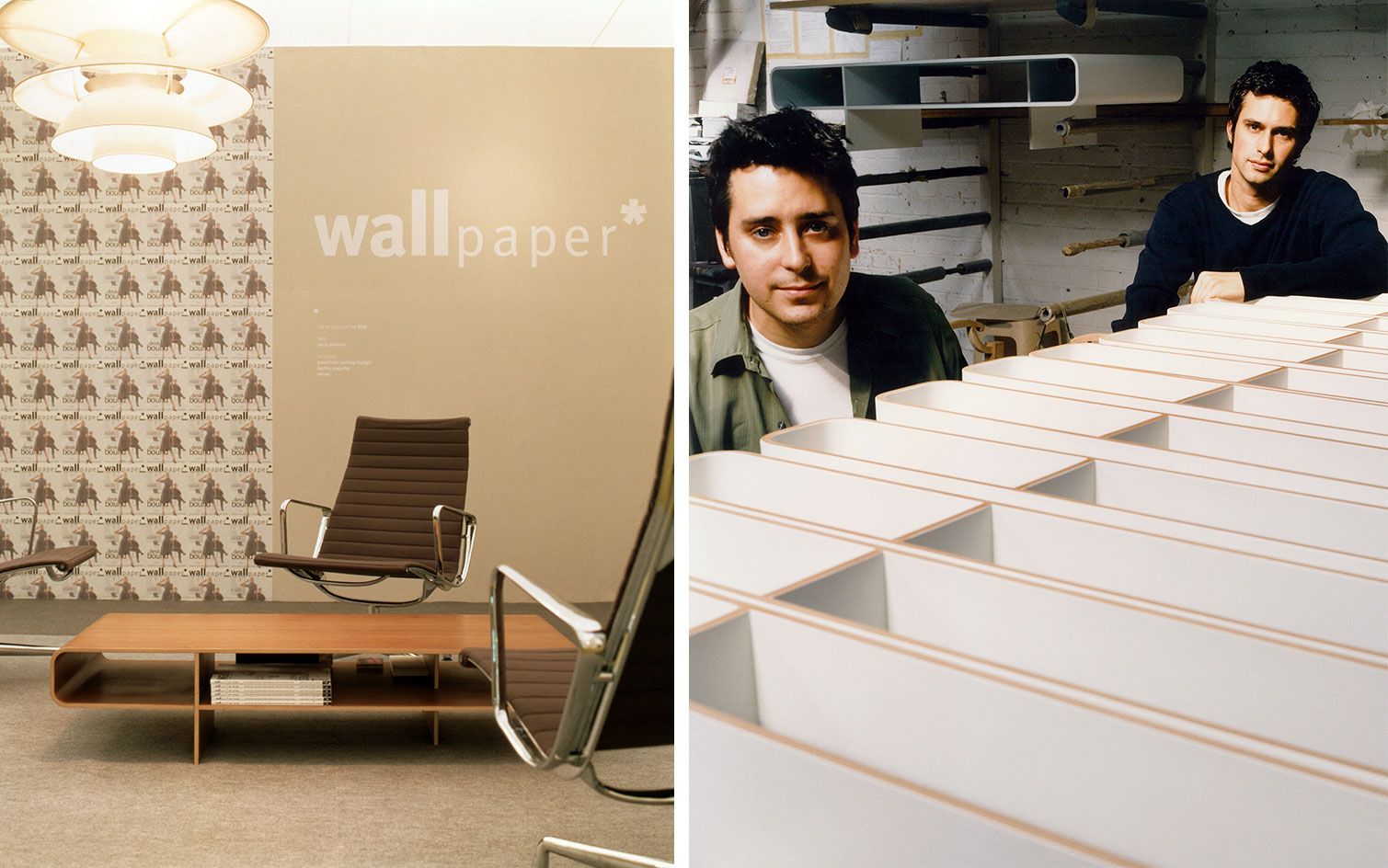
Barber and Osgerby met at the Royal College of Art in London, both born in 1969, both finishing their MAs in product design in 1994. They founded the studio under their own names in 1996 and almost immediately produced the object that defined the next three decades of their output. The Loop Table, designed in 1996 and put into production the following year, was a low coffee table in bent birch plywood — a curved, single-volume form that read as one continuous loop rather than a top sitting on legs. It was the first new product Isokon Plus had released since 1963, reactivating a British plywood furniture lineage that ran back through Marcel Breuer and Egon Riss to the 1930s. The Loop Table later passed into the Cappellini catalogue, which is how most of continental Europe encountered it.
The first six years of the practice ran on plywood and on small British editions. The Hula Stool for Cappellini in 2000 took the language further: stacked plywood rings cut and laminated from a single 15 mm sheet, the rings tapering from a wider base to a seat. It was the kind of object that revealed the studio’s working method — a material constraint (one sheet, one thickness) producing a form that looked inevitable in hindsight. Loop and Hula together established the vocabulary of bent and laminated wood that Barber Osgerby would return to repeatedly, including the much later Plan Collection for Fredericia.
Cappellini, Hula, and the plywood vocabulary
The early Cappellini relationship mattered because it placed the studio inside the Italian system at exactly the moment Giulio Cappellini was running the most aggressive young-designer programme in Europe. Cappellini took the Loop Table from Isokon and added Hula in 2000, which gave Barber and Osgerby the same launch platform that Marc Newson, Jasper Morrison and Tom Dixon had used the decade before. That Italian exposure is what set up the next round of clients — Established & Sons in London, then Vitra, then Flos.
In parallel, the partners began the structural decision that distinguished them from most British contemporaries: in 2001 they founded Universal Design Studio, a separate architecture and interiors practice operating out of the same building. The point of Universal was that Barber Osgerby would remain a product studio while architecture, retail and exhibition work flowed through a different legal entity with its own director. It worked, and it set up the pattern they would repeat eleven years later with Map.
2003–2010: Established & Sons, Flos, and the move to industry
The middle 2000s were when Barber Osgerby stopped being a young British studio and became an international one. The Tab Light for Flos in 2007 was the pivot. A folded die-cast aluminium shade that pivoted 90 degrees on its stem, produced in T (table), F (floor) and W (wall) variants, Tab took an entire family from a single sheet-metal gesture. It became one of Flos’s longest-running architectural lamps and put the studio’s name into specifications across hotels, offices and apartments through the 2010s.
The Iris Table for Established & Sons followed in 2008 and went the other direction — a limited edition rather than a long production run. Iris was a circular table top made of machined, individually hand-anodised aluminium segments arranged like an iris diaphragm, sealed under low-iron glass. Five diameters, editions of 12 each, with anodising colours that shifted between segments to produce the prismatic effect. It was the most overtly collectible piece Barber Osgerby ever made, and it sat at the high end of the Established & Sons programme alongside Zaha Hadid and Konstantin Grcic.
Vitra: Tip Ton, Pacific, and the office
The Vitra relationship is the one that defined the studio’s mass-market footprint. Tip Ton, launched in 2011, was a single-mould polypropylene chair with a kinked rocker on the front legs that allowed a 9-degree forward tilt — a posture Vitra’s research suggested kept children and adults more alert at desks. The chair weighed 4.5 kg, stacked, and was fully recyclable. Tip Ton ended up in schools and offices across Europe and remains one of the few injection-moulded chairs to combine an educational ergonomic argument with a credible domestic silhouette.
Five years later came Pacific Chair, the studio’s first office task seating and a four-year development with Vitra. Launched at Orgatec in 2016, Pacific carried a weight-responsive synchronised mechanism inside what looked like a residential armchair — the technical apparatus hidden under a low-back upholstered silhouette that would not look wrong in a hotel lobby. It was the studio’s argument against the visible-mechanism workplace chair tradition that ran from the Aeron forward. Tip Ton and Pacific together gave Vitra two Barber Osgerby chairs at opposite ends of the catalogue: the cheap polypropylene rocker for schools, and the four-year-development task chair for executives.
Olympics, mint, and museum: 2012–2014
The years 2012 to 2014 contained the studio’s three most public commissions, none of them furniture. The London 2012 Olympic Torch was the assignment that made Barber and Osgerby household names in Britain. Designed for the London 2012 organising committee, the torch was 800 mm tall, weighed 800 g, and was made of triangular gold-anodised aluminium pierced by 8,000 perforations — one for each torchbearer who would carry it through the relay. It was manufactured by Premier Sheet Metal in Coventry, a midlands fabricator whose name went onto the credits alongside the designers’. The triangular section answered the brief for the three Olympic values; the perforation count answered the brief for the relay narrative; the gold anodising answered the brief for television.
In 2013 the Royal Mint issued a Barber Osgerby-designed £2 coin marking 150 years of the London Underground — a small, dense, low-relief object that sat at the opposite material extreme from the perforated aluminium torch. Then in 2014, for the London Design Festival, the studio installed Double Space for BMW in the V&A’s Raphael Gallery: two suspended, slowly rotating reflective structures, each the length of a Boeing 737-700, that hung above the museum’s Raphael Cartoons and reflected both the cartoons and the visitors below. It was the largest installation Barber Osgerby ever produced, and the only one of these three commissions that did not enter mass production in any form.
B&B Italia, Knoll, and the second wave: 2014–2016
The middle 2010s ran on furniture for clients the studio had not previously worked with. The Mariposa Sofa for Vitra in 2014 extended the upholstered programme — a modular sofa whose pleated cushion construction read as soft architecture rather than as a frame with cushions on top. The Pilot Chair for Knoll in 2015 was a lounge chair launched at the Salone del Mobile, the studio’s first sustained collaboration with the American firm that Florence Knoll had built around Saarinen, Bertoia and Mies. It was a four-legged residential lounge in moulded shell with upholstered insert, sitting in the same Knoll catalogue alongside the Womb and the Tulip.
Tibbo for B&B Italia in 2016 was the studio’s outdoor collection — a teak frame programme with woven cord seats and modular tables, aimed at the high-end residential outdoor market that B&B had only recently begun to take seriously. The same year, Puzzle for Mutina gave Barber Osgerby their first tile collection: glazed porcelain stoneware in geometric modules that could be combined into larger patterns, sitting in the Mutina catalogue beside Patricia Urquiola, Konstantin Grcic and Tokujin Yoshioka. Mutina’s whole programme depends on this kind of designer-led tile system, and Puzzle was Barber Osgerby’s entry into surface design after twenty years of objects.
Flos and the Bellhop family
If Tab was the studio’s first Flos hit, Bellhop was the family. The portable Bellhop table lamp launched in 2015 — a small, battery-powered, rechargeable cordless lamp with a coloured polymer body, designed originally for a London restaurant and then taken into the Flos catalogue as a standalone product. The mains-powered Bellhop table followed in 2017, and then the Bellhop floor lamp arrived in 2021: 1.78 m tall, with a hand-blown opal glass diffuser sitting on a slim aluminium stem rising from a concrete-weighted base. The concrete weight is the detail that gives Bellhop floor its physical authority — it allows the stem to stay slender while keeping the lamp upright. Across portable, table and floor, Bellhop became Flos’s most successful Barber Osgerby family and remains in production at the time of the studio’s closure.
Hermès, granite, and pumpkin leather
The Hermès relationship was the late-period luxury commission. Aes Table in 2017 was a console in leather and wood, made for the Hermès Maison collection, with a tray top that lifted off. Then in 2019 came Halo and Hecate, two lamps in the Hermès collection that sat at the most material-specific end of anything Barber Osgerby produced. Halo was a ring-form lamp whose cable was sleeved in pumpkin-coloured saddle leather — Hermès leather, sewn by Hermès leatherworkers, used on the part of a lamp most designers hide. Hecate was a table lamp carved from a single block of black granite, with a vertical slot cut through the stone to admit light. The Hermès commissions were the moments where the studio’s interest in material extremity went furthest from mass production: a leather cable on one lamp, a stone block on the next, both made in small quantities for the Hermès Faubourg catalogue.
On & On, Emeco, and the recycled brief
On & On for Emeco in 2019 was the studio’s most explicit sustainability brief. The chair was made from a single material composition: 70% recycled PET, 20% glass fibre, and 10% non-toxic pigment, moulded into a stacking chair whose name referenced the spiral-tower geometry it formed when stacked. Emeco’s whole catalogue runs on this kind of single-material story — Gregg Buchbinder’s bet that designers should be told the material first and the form second — and On & On extended the company’s recycled-PET work that had begun with Philippe Starck’s Broom Chair. It was the cheapest chair Barber Osgerby ever produced in volume and arguably the one with the clearest material argument.
Fredericia and the Plan Collection: 2022–2024
The last sustained production relationship of the studio was with the Danish manufacturer Fredericia. The Plan Collection launched in 2022 with a chair, a table and a barstool, and was then extended in 2023 and 2024 with wood and armchair variants. Plan returned Barber Osgerby to the bent-wood vocabulary of Loop and Hula a quarter-century later, made now by Danish cabinetmakers rather than British plywood specialists. The collection was still being extended into 2024, two years before the studio’s closure was announced.
Universal Design Studio and Map Project Office: the sister practices
The two sister practices need their own paragraph because they are part of how Barber Osgerby actually operated. Universal Design Studio, founded in 2001, handled the architecture and interior work — retail for Stella McCartney, exhibitions for the Design Museum, hospitality interiors that would have crowded a product studio. Map Project Office, founded in 2012, was the industrial-design consultancy: Barber Osgerby took on Google, Sony, IBM and other technology clients through Map rather than under their own names, because the consulting model did not fit the limited-edition furniture work. In 2018 WPP, the British advertising holding company, took majority stakes in both Universal and Map — leaving Barber Osgerby as the founders’ personal studio while the two sister practices became part of a larger group. That 2018 corporate manoeuvre is what allowed the founding studio to wind down cleanly in 2026: Universal and Map continue under WPP, while Barber Osgerby itself closes.
The barber osgerby catalogue, in chronological order
The clearest way to read 30 years of output is as a single list. The table below is every Barber Osgerby project named in the historical record, by year of release, with manufacturer and primary material.
| Year | Project | Client | Material / Note |
|---|---|---|---|
| 1996/97 | Loop Table | Isokon Plus (later Cappellini) | Bent birch plywood |
| 2000 | Hula Stool | Cappellini | Stacked plywood rings, single 15 mm sheet |
| 2001 | Universal Design Studio founded | — | Architecture and interiors practice |
| 2007 | Tab Light (T/F/W) | Flos | Folded die-cast aluminium, 90-degree pivot |
| 2008 | Iris Table | Established & Sons | Hand-anodised aluminium under low-iron glass; five diameters; editions of 12 |
| 2011 | Tip Ton | Vitra | Single-mould polypropylene; 9-degree forward tilt; 4.5 kg |
| 2012 | Map Project Office founded | — | Industrial-design consultancy |
| 2012 | London 2012 Olympic Torch | London 2012 / Premier Sheet Metal | Gold-anodised aluminium; 800 mm; 800 g; 8,000 perforations |
| 2013 | London Underground 150 £2 coin | Royal Mint | Circulating coinage |
| 2014 | Mariposa Sofa | Vitra | Modular upholstered sofa |
| 2014 | Double Space for BMW | V&A, London Design Festival | Two suspended reflective structures, Boeing 737-700 length |
| 2015 | Pilot Chair | Knoll | Moulded shell lounge chair, Salone launch |
| 2015 | Bellhop (portable) | Flos | Rechargeable cordless table lamp |
| 2016 | Pacific Chair | Vitra | Weight-responsive synchronised task chair; 4-year development; Orgatec launch |
| 2016 | Tibbo | B&B Italia | Outdoor teak frame and woven cord |
| 2016 | Puzzle | Mutina | Glazed porcelain stoneware tile collection |
| 2017 | Bellhop (table) | Flos | Mains-powered table lamp |
| 2017 | Aes Table | Hermès | Leather and wood console |
| 2018 | WPP takes majority of Universal and Map | — | Corporate restructure of sister practices |
| 2019 | On & On | Emeco | 70% recycled PET, 20% glass fibre, 10% pigment; spiral stacking |
| 2019 | Halo + Hecate | Hermès | Pumpkin-leather cable; carved black granite |
| 2021 | Bellhop (floor) | Flos | 1.78 m; hand-blown opal glass; concrete-weighted base |
| 2022 | Plan Collection (chair, table, barstool) | Fredericia | Bent and solid wood |
| 2023 | Plan Collection (wood extension) | Fredericia | Additional wood variants |
| 2024 | Plan Collection (armchair) | Fredericia | Armchair variant |
| 2026 | Studio closure announced | — | 20 May 2026 |
Coda: 2026 and the end of the studio
The 20 May 2026 announcement said Barber and Osgerby would pursue independent practices, that Universal and Map would continue under WPP, and that existing production at Vitra, Flos, B&B Italia, Cappellini, Hermès, Emeco, Mutina, Fredericia, Knoll, Established & Sons and Isokon Plus would not be withdrawn — meaning the catalogue laid out above remains a live catalogue, sold under the names of its eleven manufacturers, while the studio that produced it no longer exists. Thirty years from Loop to Plan, with the Olympic torch and the Pacific Chair as the two poles of public reach, is a specific and unusual shape for a design career; it is also, in 2026, a finished one.