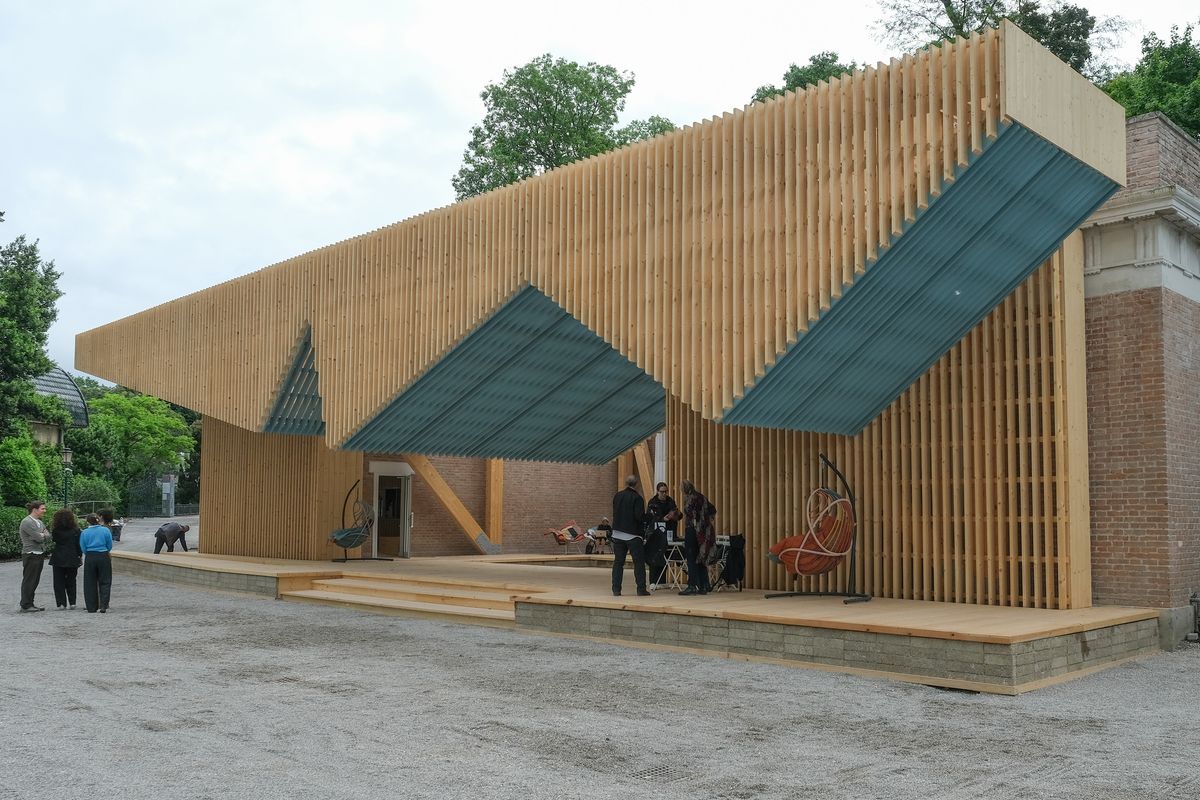
The Venice Architecture Biennale 2027 will be the first edition in the show’s 47-year history to be co-directed by a husband-and-wife studio that has built almost everything in salvaged tile and recycled brick — and the first to give equal billing to the woman whom the Pritzker jury did not name. When the 20th International Architecture Exhibition opens to the public on 8 May 2027 at the Giardini and Arsenale, Wang Shu and Lu Wenyu — co-founders of Amateur Architecture Studio in Hangzhou — will become the first Chinese curators ever to take the directorship, working under the theme Do Architecture — For the Possibility of Coexistence Facing a Real Reality. The pre-opening runs 6–7 May; the show closes 21 November 2027.
That is the headline. The structural shift behind it is bigger. Since Paolo Portoghesi opened the first International Architecture Exhibition in 1980 with The Presence of the Past and built the Strada Novissima inside the Corderie, the directorship of the Venice Architecture Biennale has functioned as the discipline’s roving editorial chair — a position that, almost without exception, has gone to a working architect with a built portfolio close enough to be read against the curatorial line. Do Architecture is the bluntest reassertion of that principle in twenty years: a Pritzker laureate and his co-author, both still on site at projects in Hangzhou and Ningbo, taking the Central Pavilion — restored by Labics for the 2026 Art edition — and using it to argue that the discipline’s central problem is no longer the brief but the act. “Architecture,” reads the curatorial line, “is not only something to be discussed, but above all something to be done firsthand.”
Hangzhou before Venice: what Amateur Architecture Studio actually builds
To read the 2027 brief without reading the buildings is to miss the argument. Amateur Architecture Studio was founded in Hangzhou in 1997 — a one-office practice whose name is a deliberate refusal of the professionalised, image-led delivery model that came to dominate Chinese commercial architecture through the 2000s. The studio’s portfolio is small by the standards of any peer-group: roughly two dozen completed works in twenty-eight years, almost all of them in Zhejiang province, almost all of them built with bricks and tiles salvaged from demolished villages around the Yangtze delta.
The four works that anchor the studio’s reputation, and which sit behind the 2027 curatorial argument, are the Library of Wenzheng College at Suzhou University (1999–2000), the Ningbo Museum of Art (2001–05), the first two phases of the Xiangshan Campus of the China Academy of Art in Hangzhou (2002–07), and the Ningbo History Museum (2008). The Xiangshan campus is the studio’s largest single commission: a low-slung, hill-hugging group of teaching pavilions that Wang Shu and Lu Wenyu designed together as Dean (Wang) and lead designer (Lu) of the China Academy of Art’s School of Architecture, with the studio handling the architectural delivery. The Ningbo History Museum is the most-photographed: a single, slab-like volume whose facades are clad in wapan — a regional bricklaying technique that re-uses tiles and bricks recovered from villages razed in the surrounding Yinzhou district. Twenty different brick types are visible in a single wall; the surface is, in the literal sense, the archive of what stood there before.
This is the practice the directorship is built on. Wang Shu was awarded the Pritzker Prize in 2012 as the first Chinese citizen to receive it; Lu Wenyu, who co-authored every project listed above, was excluded from the citation. The omission was criticised at the time as a repeat of the 1991 Robert Venturi / Denise Scott Brown asymmetry, and it has shadowed the studio ever since. The 2027 Biennale will be, among other things, the first directorial post the two have held together at this scale. That alone is worth registering: a curatorial chair structured around a question of authorship that the discipline’s most public prize refused to resolve.
Wang Shu joined the French Academy of Architecture in 2023 and remains Dean of the School of Architecture at the China Academy of Art; Lu Wenyu directs the academy’s Sustainable Construction Center. Both teach. Both build. The brief is written from inside an academic-practice hybrid that does not look like a Western office, and the Do Architecture phrasing — translated from Mandarin — should be read with that texture in mind: not “design architecture”, not “imagine architecture”, but the plain English verb, foregrounded.
Venice Architecture Biennale 2027 and the directorship as built argument
The 20th edition lands inside a long sequence in which the choice of director has frequently mattered more than the chosen theme. Strip the brochures away and the Venice Architecture Biennale has been, since 1980, a rotating series of self-portraits by working architects — interrupted occasionally by critics (Kurt Forster in 2004, Richard Burdett in 2006) and historians (Francesco Dal Co in 1991), but otherwise drawn from the practising discipline. The interesting question, then, is not what Do Architecture says but what the lineage looks like when Do Architecture is placed at the end of it.
| Year | Director | Edition title | What they built |
|---|---|---|---|
| 1980 | Paolo Portoghesi | The Presence of the Past | Strada Novissima inside the Corderie; Roman postmodern churches and the Mosque of Rome (1995) |
| 1985 | Aldo Rossi | Project Venice | Teatro del Mondo (1979); Gallaratese housing, Milan; San Cataldo Cemetery, Modena |
| 1991 | Francesco Dal Co | Architettura del Mondo | Historian and editor of Casabella; not a builder |
| 1996 | Hans Hollein | Sensing the Future. The Architect as Seismograph | Haas-Haus, Vienna (1990); Abteiberg Museum, Mönchengladbach; jewellery boutiques in Vienna |
| 2000 | Massimiliano Fuksas | Less Aesthetics, More Ethics | Milan Trade Fair (Rho); Zenith music hall, Strasbourg; later Shenzhen Bao’an Airport T3 |
| 2002 | Deyan Sudjic | Next | Critic and dean; not a builder |
| 2004 | Kurt Forster | Metamorph | Historian; not a builder |
| 2006 | Richard Burdett | Cities. Architecture and Society | LSE Cities director; planner and urbanist, not a builder |
| 2008 | Aaron Betsky | Out There: Architecture Beyond Building | Critic and museum director; not a builder |
| 2010 | Kazuyo Sejima | People Meet in Architecture | 21st Century Museum of Contemporary Art, Kanazawa; New Museum, New York; Rolex Learning Center, Lausanne (with SANAA) |
| 2012 | David Chipperfield | Common Ground | Neues Museum, Berlin; River and Rowing Museum, Henley; Hepworth Wakefield |
| 2014 | Rem Koolhaas | Fundamentals | Seattle Central Library; CCTV Headquarters, Beijing; Casa da Música, Porto (with OMA) |
| 2016 | Alejandro Aravena | Reporting from the Front | Quinta Monroy incremental housing, Iquique; UC Innovation Center, Santiago (Elemental) |
| 2018 | Yvonne Farrell & Shelley McNamara | Freespace | Università Luigi Bocconi, Milan; Toulouse School of Economics; UTEC campus, Lima (Grafton Architects) |
| 2021 | Hashim Sarkis | How Will We Live Together? | Houses at Aabey, Lebanon; Byblos Town Hall; Balloon Landing Park, Houston |
| 2023 | Lesley Lokko | The Laboratory of the Future | African Futures Institute founder; academic, not a builder |
| 2025 | Carlo Ratti | Intelligens. Natural. Artificial. Collective | MIT Senseable City Lab director; CRA-Carlo Ratti Associati installations and pavilions |
| 2027 | Wang Shu & Lu Wenyu | Do Architecture — For the Possibility of Coexistence Facing a Real Reality | Ningbo History Museum (2008); Xiangshan Campus, Hangzhou (2002–07); Ningbo Museum of Art (2001–05); Library of Wenzheng College, Suzhou (1999–2000) |
The table is the argument. Of the 18 directorships since 1980, the ones that produced the most-cited editions — Hollein 1996, Sejima 2010, Aravena 2016, Farrell & McNamara 2018 — were given to architects whose own buildings were widely visible to the visiting profession at the moment they took the chair. The editions that have aged most awkwardly — Out There: Architecture Beyond Building (2008), The Laboratory of the Future (2023) — were the ones that argued, explicitly or implicitly, that building was either insufficient or beside the point. Do Architecture is the inverse of those: a thesis written from inside the act.
It is worth being specific about which of those lineages Do Architecture most clearly answers. The 1996 Hans Hollein edition framed the architect as a seismograph — an instrument receiving and registering futures. Do Architecture keeps the conviction that architects have something to say and inverts the instrument: from receiver to actor. The 2008 Aaron Betsky edition argued that the discipline’s most important work was happening beyond building; Wang Shu and Lu Wenyu’s text — by the simple choice of verb — refuses that proposition. And the 2025 edition under Carlo Ratti, with its triadic Intelligens. Natural. Artificial. Collective, was a Biennale of frameworks. Do Architecture is a Biennale of work.
Sejima 2010, Lokko 2023, Wang Shu 2027 — the three firsts
Inside the longer lineage, three editions function as firsts of a kind that the institution itself has emphasised. Kazuyo Sejima in 2010 was the first woman director of the Architecture Biennale. Lesley Lokko in 2023 was the first African director. Wang Shu and Lu Wenyu in 2027 are the first Chinese curators. The three positions are not interchangeable, but they share a procedural detail: each appointment shifted the geography from which the Biennale’s framing question was being asked.
Sejima’s 2010 People Meet in Architecture was, in retrospect, the edition that broke open the Biennale’s preference for showpiece pavilions over atmospheric, walk-through, body-scaled installations. Junya Ishigami’s pencil-thin column work in the Corderie that year is the still-cited image. Lokko’s 2023 Laboratory of the Future re-described the discipline’s centre of gravity by populating the Arsenale with practices from West and East Africa and the African diaspora. Both editions reorganised what the Biennale looked like — Sejima atmospherically, Lokko demographically — without committing to a built-work polemic.
Do Architecture takes a different route through the same kind of “first”. The argument is not primarily geographic, although the appointment of two Hangzhou-based architects after eighteen directorships drawn overwhelmingly from Western Europe, Latin America, Japan and Lebanon is itself a reframing. The argument is methodological. Wang Shu and Lu Wenyu’s practice is one of the few internationally legible architectural operations in which the procurement of materials — where the brick comes from, who fired it, what village it was salvaged from — is part of the design. Do Architecture asks the visiting profession to take that as the discipline’s central question for two years.
What “Do” rejects from “Intelligens”
Read against the 2025 edition directly preceding it, Do Architecture reads as a deliberate course-correction. Carlo Ratti’s Intelligens. Natural. Artificial. Collective was a Biennale organised around a tripartite framework — biological intelligence, artificial intelligence, collective intelligence — and populated, predictably, with installations dense in screens, sensors, and large-language-model outputs. It was a competent edition and a deeply 2025 one: confident that the discipline’s most useful conversation was about cognition and computation.
The 2027 brief refuses both the framework and the screen. “Architecture is not only something to be discussed, but above all something to be done firsthand.” The sentence is not anti-intellectual; Wang Shu’s writing is among the most consistently philosophical in contemporary Chinese practice, and Lu Wenyu’s teaching at the China Academy of Art’s Sustainable Construction Center is built on detailed technical research into traditional Zhejiang building methods. The sentence is, instead, a refusal of the assumption that the Biennale’s job is to map cognitive frontiers. Do Architecture says the job is to show, in built fragments and full-scale installations, what it looks like when an architect picks up a salvaged brick.
There is a procedural consequence to that. Biennales organised around frameworks tend to fill the Corderie with text panels, video, and tabletop models. Biennales organised around acts tend to fill it with full-scale built work. Aravena’s 2016 edition — eight metric tons of recycled metal studs and plasterboard panels at the entrance to the Central Pavilion, salvaged from the previous year’s Art Biennale — was the most recent precedent. Wang Shu and Lu Wenyu’s instinct, on the evidence of every project they have built since 1999, is to push that precedent further. The 2027 Corderie should be readable as a building site.
Coexistence with a real reality
The full theme — Do Architecture — For the Possibility of Coexistence Facing a Real Reality — has two halves that should be read separately. The first is the verb: do. The second is the qualifier: coexistence facing a real reality.
The phrasing is awkward in English and reads more cleanly in the Chinese original, but the load-bearing word is coexistence. In the studio’s practice it means specifically: coexistence of new construction with the salvaged materials of demolished buildings; coexistence of the architect with the regional bricklayer; coexistence of contemporary academic architecture with the vernacular traditions of Zhejiang province. The Xiangshan campus is the most legible demonstration: a contemporary university built in a recognisable contemporary idiom, but built with tiles, bricks and timber whose first life was in the villages around Hangzhou, and built using techniques — wapan most prominently — that were close to being lost when the studio began documenting them in the late 1990s.
“Facing a real reality” — zhenshi de xianshi, in the original — is the studio’s standard refusal of speculative architecture. The studio does not publish unbuilt proposals. Almost every project that appears in monographs about Amateur Architecture Studio was built; the ones that were not, were not built because the brief changed, not because the project was an exercise. The 2027 Biennale will almost certainly be a Biennale of completed work, full-scale fragments, and physical samples, with relatively little space given to the speculative-render culture that dominated the 2010s editions.
This has implications for the national pavilions as well. The director sets the theme of the Central Pavilion in the Giardini and the Corderie at the Arsenale; the national participations are organised independently, but historically respond to the director’s framing. A Biennale organised around Do Architecture will pressure participating countries to show built work rather than research displays. That is a meaningful shift from the 2023 and 2025 editions, both of which leaned heavily on academic and research-led contributions.
The Central Pavilion after Labics
The 2027 edition will be the first Architecture Biennale to use the Central Pavilion in its restored form. Labics’ two-year restoration of the Giardini’s central building — recovering original 1909 volumes, opening previously closed circulation, and consolidating the structural fabric — was completed for the 2026 Art Biennale, which used the restored building for the first time last month. The 2027 Architecture edition will be the second show to occupy it, and the first to do so with a director who can plan from the outset around the new circulation.
Wang Shu’s prior installations in European institutional buildings — most recently the 2012 Decay of a Dome installation in the Cini Foundation’s Sala dei Cipressi, on San Giorgio Maggiore in Venice — have consistently engaged with the existing fabric of the host building rather than overlaying it. The 2027 Central Pavilion is likely to be the largest such engagement of the studio’s career. What that looks like in practice will not be public until the spring of 2027, but the studio’s working method — full-scale mock-ups built on-site by the architects and their students, using regional materials brought in from Zhejiang — would be a logical extension of the curatorial line.
A note on the lineage from the inside
It is worth saying directly what Do Architecture repositions. The Venice Architecture Biennale has, since the mid-2000s, drifted toward editions organised around themes the discipline is supposed to be addressing — cities (Burdett 2006), front lines (Aravena 2016), cohabitation (Sarkis 2021), futures (Lokko 2023), intelligence (Ratti 2025). Each of those editions had defenders, and several produced first-rate individual installations. But cumulatively, the run from 2006 to 2025 produced a Biennale culture in which the most-discussed contributions were the ones whose curatorial framing was easiest to summarise — frequently at the expense of the buildings the participating architects had actually built.
A Biennale curated by Wang Shu and Lu Wenyu under the theme Do Architecture is, structurally, a correction to that. Both directors are practising architects with twenty-eight years of built portfolios. Both teach. Both will arrive at the Giardini in May 2027 with a working method already legible in Hangzhou and Ningbo. The interesting test will be whether the participating architects, given the chance to show built work rather than framing, take it.
Coda
When the 20th International Architecture Exhibition opens on 8 May 2027, the visiting profession will be reading two things in parallel: the Central Pavilion as restored by Labics, and the Corderie as redirected by Wang Shu and Lu Wenyu. The two readings will be inseparable. A restored 1909 building, with its full original volumes recovered, will be the host to an exhibition that argues — by way of wapan facades, salvaged Zhejiang tiles, and full-scale built installations — that the discipline’s central question is what gets done with the materials of the buildings already standing. The choice of director and the state of the host pavilion will, for once, be making the same point. It will be a Biennale where the verb is the theme, the directors are still on site at projects in Hangzhou, and the woman whose name the Pritzker did not say will be — at the Giardini, until 21 November 2027 — explicitly named.