Hermès — Hermes in plain ASCII — does not do spectacle. While other fashion houses compete for the most dramatic venue, the most immersive installation, the most Instagram-ready moment, Hermès returns quietly to La Pelota — the former Basque pelota court at Via Palermo 10 — and lets the work speak. The question every April in Milan is which house has decided to perform luxury and which has decided to construct it. Hermès, in 2026 as in every year it has come to Brera, has unambiguously chosen the second. Les Mains de la Maison — the hands of the house — is the title and the thesis. The exhibition design follows from it as inevitably as a saddle stitch follows a punched leather hole.
The collection, presented under the direction of Charlotte Macaux Perelman and Alexis Fabry, is twelve new pieces — furniture, lighting, textiles, tableware. Twelve is a number Hermès keeps returning to, and it is the same count Bottega Veneta chose for its first Casa collection at Via San Maurilio 14 a few blocks west. The coincidence is not coincidence. Twelve is the editioning instinct of fashion houses that have started to think like furniture publishers: enough range to read as a domestic argument, few enough to remain underwritten by the maker’s hand. It is the opposite of a catalogue.
The House and Its Hands
Hermès was founded in 1837 by Thierry Hermès as a Parisian harness workshop on the Grands Boulevards, and the saddle has never quite left the building. The house remains family-controlled — one of the very few of its scale that is — and that ownership structure shows up in the work as patience. There is no quarterly furniture drop. There is a Maison line developed slowly under Macaux Perelman and Fabry, both of whom carry the title of artistic director rather than designer, a distinction that matters: their job is curatorial and editorial as much as it is formal. The collection is composed, not styled. Pieces enter when the workshop has solved them, and not before.
The two have been shaping the home category for over a decade now, and the consistency of the result — quiet, geometrically literate, dependent on a tight set of materials worked extremely well — is the kind of multi-year coherence that a salaried creative director cycle rarely produces. The contrast with the more turbulent fashion side of Hermès’ competitors is the unstated subtext of every Pelota visit. While Kering and LVMH replace creative directors at the cadence of a hedge fund replacing portfolio managers, the Maison line accrues. Les Mains de la Maison is an archive being built in real time.
Twelve Pieces, Three Rooms of Logic
A writing desk in pale sycamore is the room’s first object. Joinery so precise it appears seamless; a top that reads as a single plane until the eye finds the line where two boards have been edge-joined, and then loses it again. There is no veneer. Sycamore is the choice for its quiet figure and the way it lightens a room without shouting blond. The drawer pulls are leather — saddle-stitched, of course — and the only metal in the piece is the hardware that holds the drawer slides.
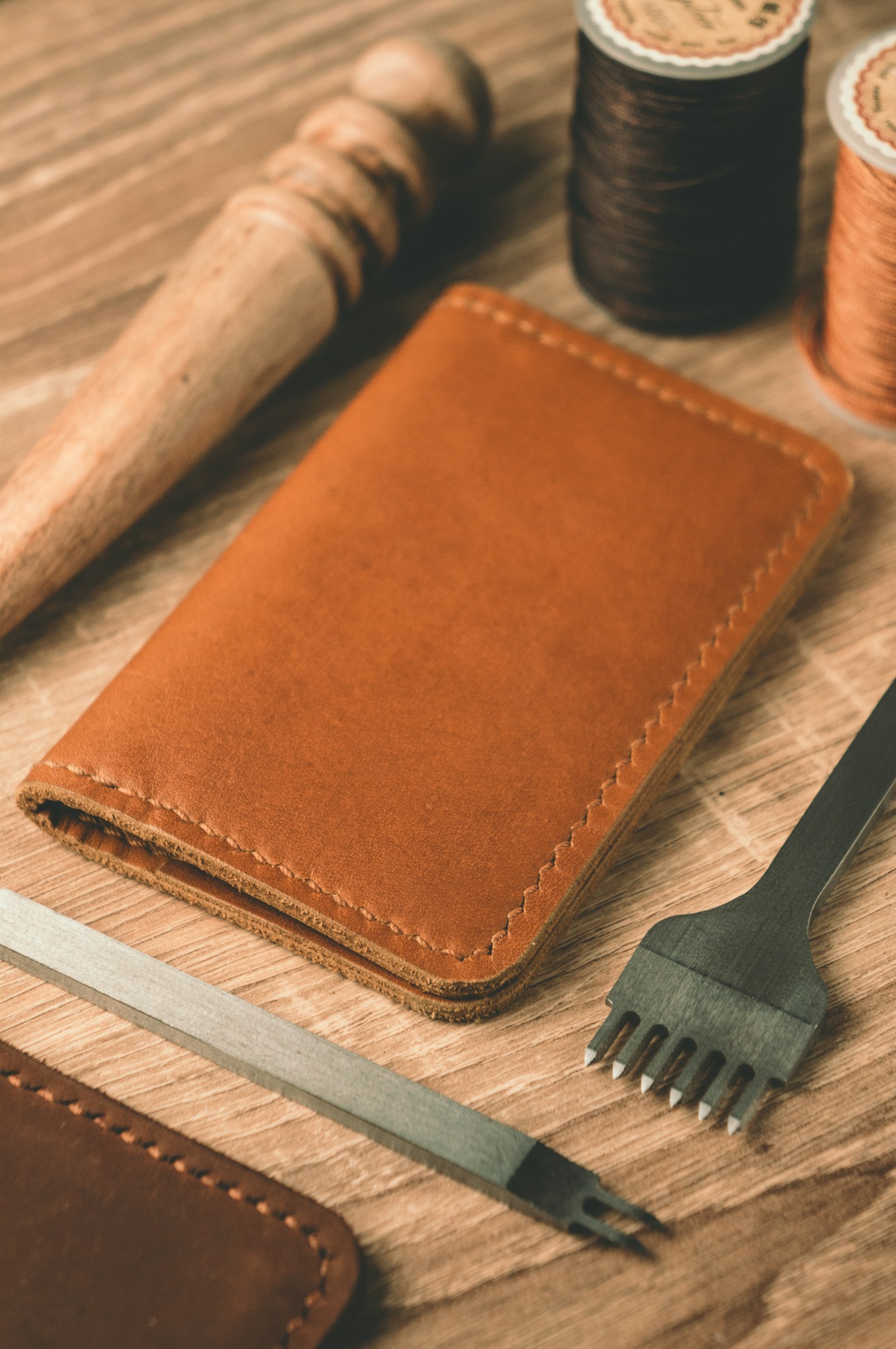
A pair of armchairs in saddle-stitched leather sits opposite. Saddle stitch is not decoration at Hermès; it is the structural technique adapted from the equestrian harness, executed by hand with two needles drawing waxed linen thread through pre-punched holes. Machine lock-stitch fails one stitch and unzips. Saddle stitch fails one stitch and holds. The armchairs use this property as a design argument: they are upholstered in panels you can read, the seams are visible at the edge of every plane, and the geometry of those seams tells you exactly how the chair was put together. Monumental and intimate at once because monumental in volume, intimate in the trace of the hand.
The textiles are exceptional. Cashmere throws in gradients that shift like dawn light. Silk cushions with patterns derived from the house’s scarf archive but abstracted to the point of pure geometry — a recognisable carré motif reduced to a four-colour field, then to a two-colour field, then to a single washed tone. The archive is treated as a quarry rather than a source, mined for proportion and palette and then released from its specifics. A set of porcelain bowls rests on a low table, glazes that reference the patina of well-worn leather: oxblood deepening to bistre, a slip that pools at the foot of the bowl and reads as wax. Lighting: three pendants in blown opaline, a floor reader in lacquered ash with a parchment shade, a small bedside object that is essentially a leather sleeve around a glass cylinder.
Why La Pelota
Choice of venue is choice of argument. La Pelota is a former Basque pelota court — a long indoor frontón built for a sport that needed walls hard enough to take a goatskin ball at speed and ceilings high enough to let it fly. Concrete floor, plain plaster walls, exposed industrial roof, the volume scaled to a game rather than a domestic interior. Hermès has been the regular tenant during Design Week for years, and the building has acquired the status of a reliable variable. It is the room everyone in Milan now reads against. When other brands take a palazzo and dress it, the message is appropriation. When Hermès takes a sport hall and barely touches it, the message is confidence in the objects.
What makes the Pelota presentation remarkable in 2026 is its spatial intelligence. Rather than creating room-like vignettes — the default mode for furniture presentations, and the format Hermès’ competitors lean on at Palazzo Serbelloni and Casa Brera and the various neoclassical addresses around Brera — Hermès treats the vast industrial space as a landscape. Objects are arranged across the concrete floor with generous breathing room between them, encouraging visitors to walk, circle, approach from different angles. The chairs do not form a conversation pit. The desk does not stand against a wall. Each piece is given the space a sculpture would be given in a museum, and the visitor is asked to do the work that a room would normally do — to imagine the chair next to a window, the desk in the right light, the pendant at the right height.
The lighting is natural, filtered through translucent fabric panels that create a diffused, gallery-like atmosphere. There is no music. The only sound is footsteps on concrete and the occasional murmur of conversation. Entry is by appointment. The dwell time, in our visits, runs to forty minutes for the patient, ten for the impatient — a useful inversion of the usual brand-activation arithmetic, in which dwell time is engineered upward by spectacle. Here it sorts the audience naturally.
Restraint as a Strategic Position
The Hermès Maison position belongs to a small cohort. Loro Piana’s Casa Brera on Via Solferino 11, a four-floor 19th-century townhouse restored over three years by Vincenzo De Cotiis, makes a parallel argument with different means: a residence that mixes the house’s home collection with Carlo Scarpa, Charlotte Perriand and Japanese folk furniture, and lets the building do the talking. Phoebe Philo’s first non-clothing object, a bronze mirror cast at Fondazione Battaglia in an edition of 200, sold out in four hours at £4,800 with no advertising and no event — pure object, pure restraint. These are different houses with different problems, but the strategy rhymes. They have decided that the post-2024 luxury consumer is not interested in being shouted at.
What makes the Hermès case clarifying is scale. Loro Piana is now an LVMH brand, but it works at couture-textile volume; Philo’s label is a few seasons old. Hermès is a global luxury house with revenues in the tens of billions, and its Milan stand could plausibly be the most expensive square-metre activation of the week. It chooses not to be. The decision to under-perform — to take a sport hall, to put twelve objects on a concrete floor, to forbid music — is unavailable to a brand that has not done the work to be confident the objects will hold the room alone. This is not minimalism as a style. It is restraint as a structural advantage.
The Rest of the Week, in Contrast
Walk fifteen minutes from La Pelota and the contrast is the point. At Palazzo Serbelloni on Corso Venezia 16, Louis Vuitton’s Objets Nomades — running annually since 2012 — leans on collaboration as its argument: 2026’s additions include works from Studio Mumbai’s Bijoy Jain, India Mahdavi, and the Danish-Italian studio GamFratesi. The neoclassical 18th-century palazzo and the trunk-and-travel narrative do their job; the work is genuinely good; but the format is curated assembly rather than house language, and the brand reads as patron rather than author.
At the Basilica di San Simpliciano in Brera, Gucci’s Memoria, Demna Gvasalia’s first design-world statement at the house, weaponises archive (GG canvas, flora print, Web stripe) into twelve distressed domestic objects designed to read as discovered rather than made. The aesthetic is the inverse of Hermès — provocation rather than recession — and the venue choice (a 4th-century Romanesque church) leans into the drama. Both are legitimate strategies. They produce different rooms.
Even Prada’s Chawan Cabinet, curated by Theaster Gates — a vitrine of Japanese tea bowls in a utilitarian wooden cabinet, with no Prada branding visible in the work — reads against Hermès as a related but distinct gesture. Prada is performing patronage: providing resources for cultural work that does not reference the brand. Hermès is performing identity: showing the brand by showing its hands. Different positions, both anti-spectacle, both readable only to a literate audience. The fact that Milan in April rewards both is the most interesting thing about the week right now.
Material Intelligence as a Competitive Moat
The Hermès home collection is not an extension; it is an expression of the same values that inform everything the house makes. Saddle-stitched leather is not borrowed from the bag department for the armchair — it is the technique the house was founded on, applied to a different geometry. Sycamore and porcelain and silk are governed by the same material rules: the surface earns its keep, the joint earns its keep, the form earns its keep. None of this is a discovery in 2026; the consistency itself is the discovery, year after year, in a market that has structurally incentivised novelty.
This is what people mean when they call Hermès’ position a moat. It is not the leather. It is not even the workshops. It is the institutional ability to keep the same materials in production at the same level for a hundred and eighty-nine years, training each generation of artisans on the same substrate the previous one trained on. A young saddle-stitcher in Pantin learns the technique on the same kind of waxed linen and the same kind of butt-end leather as a saddle-stitcher in 1860. The collection of objects across the Pelota floor is, quite literally, what a hundred and eighty-nine continuous years of one technique looks like when it is asked to make a chair.
Coda
The result is work that feels inevitable. Each piece exists because the material demanded that form, because the technique made it possible, because the craftsperson’s hands found their way there through years of practice. Les Mains de la Maison is more than a title; it is an honest description of the production logic. In a Milan that is now, structurally, a fashion-into-design fair as much as a furniture fair, Hermès’ contribution is to insist on the older, harder argument — that the way an object is made is the only argument it should ever need to win.
Hermès Les Mains de la Maison is on view at La Pelota, Via Palermo 10, April 22–28. Entry by appointment.