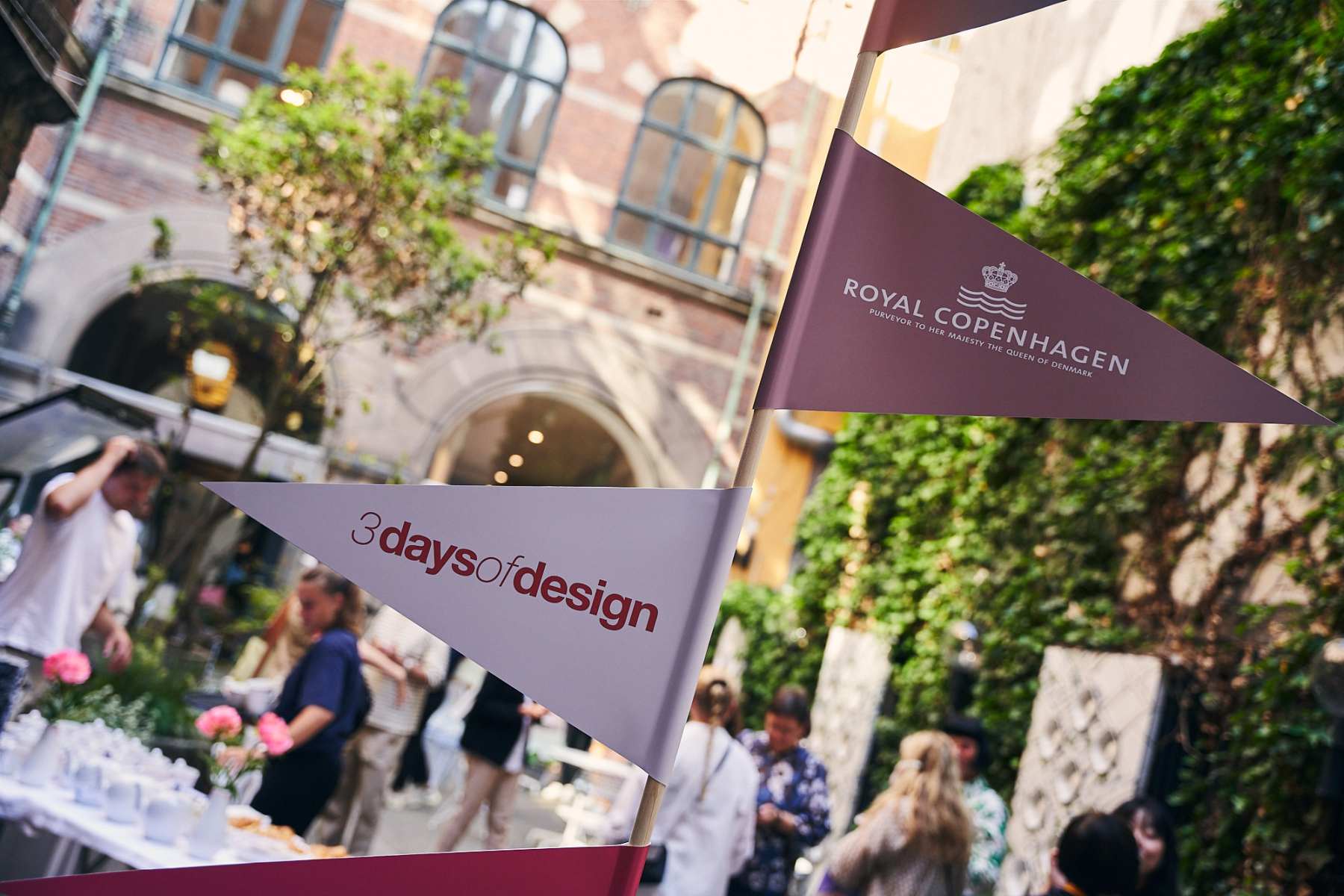
3 Days of Design 2026 lands across eight Copenhagen districts on 10–12 June with 460-plus exhibitors and a single thesis — ‘Make This Moment Matter’ — pulling Audo Copenhagen in Nordhavn, Fredericia in Rosengård, and Bang & Olufsen’s centennial residence in Christianshavn into the same 72-hour window. The 13th edition does not pretend to be a fair, and that is the point: the city itself is the floor plan, and the floor plan now spans Holmen, Nordhavn, Islands Brygge, Kulturdistriktet, Rosengård, Kongens Nytorv, Christianshavn and Frederiksstaden. Free admission, exhibitions open 10:00–18:00, 600-plus events, and a festival office anchored at Frederiksgade 1, 1st floor, 1265 Copenhagen K — issuing the anchor symposium ‘Entering the Now’ as the intellectual frame.
This is the map. Not every brand, but every Danish house that matters in the 2026 line-up, sorted by where you will actually stand when you visit them. The point of this article is logistical and editorial in equal measure: which districts to bracket on which morning, which addresses house which thesis, and which exhibition deserves the slow walk-through versus the in-and-out. The 3 days of design 2026 danish houses circuit cannot be done in a single tram loop — but it can be done in three disciplined half-days, and the geography below is how.
Why districts matter more than brands in the 2026 3 days of design danish houses programme
The festival has crossed a threshold. With 460+ exhibitors and 600+ events, the brand-by-brand approach — the one most visitors brought in 2022, 2023, even 2024 — collapses under its own weight. Eight districts is not a marketing flourish. It is the only practical unit. Holmen and Nordhavn read as the post-industrial north, glass-and-warehouse showrooms with water on three sides. Frederiksstaden and Kongens Nytorv are the old palatial spine, neoclassical façades hosting heritage houses with collection archives. Rosengård is the festival’s working centre — the dense grid around Skindergade and Løvstræde where six houses now cluster within a five-minute radius. Christianshavn is the canal interlude, where HAY occupies the Overgaden Neden Vandet warehouse beside O—Overgaden and B&O takes Strandgade for its centennial.
The ‘Make This Moment Matter’ thesis lands differently in each district. In Nordhavn it reads as monumentality and material weight; in Rosengård as heritage continuity through new commission; in Frederiksstaden as a pharmacy-turned-collage; in Christianshavn as sound and surface; on Holmen as the System PH lineage made physical. The festival’s anchor symposium, ‘Entering the Now’, is the editorial through-line, but the brands answer it in the specific language of their own building. That is why we are mapping by neighbourhood: because the buildings are doing as much of the talking as the objects inside them.
A practical note before the walk. The festival office at Frederiksgade 1 sits in Frederiksstaden, walking distance from the Amalienborg palaces and the Marble Church — useful as a registration anchor on day one, particularly if you are starting from Frama at Fredericiagade 57. Free admission means the queue logic of conventional fairs disappears; instead, the constraint is opening hours (10:00–18:00 daily) and the simple physics of how many addresses you can hit between them.
Nordhavn and Holmen: the post-industrial north
The northern harbour districts carry the heaviest single concentration of monumental shows in the 2026 edition. Audo Copenhagen presents ‘MONUMENTS — A Journey Through Timeless Design’ at Audo House, Aarhusgade 130, 2150 Copenhagen, art directed by Christian Møller Andersen with Norm Architects. The title is exact: this is not a ‘collection update’ framing, it is a thesis show about objects that have refused to date. Audo has spent the last three years rebuilding its identity around the Tribeca space in New York and the Norm Architects collaboration; the 2026 show is the European-language counterpart to that argument.
Crucially, By Lassen shares the same Aarhusgade 130 address inside Audo House. The two brands have been editorially adjacent for years — the Kubus candleholder is family to several Audo objects in spirit if not in catalogue — and the shared address resolves what had been an ambiguous separation. Visitors should plan to spend a full morning here. Aarhusgade is not a five-minute stop. The building rewards reading the captions, walking the upper floor, and sitting through whatever programme Møller Andersen has staged for that half-day.
A short walk west on Orientkaj, Gubi opens ‘SCENES’ at the Orientkaj 18–20 flagship. The show is structured as a Verner Panton colour tribute — fitting for a brand whose Panton holdings remain the commercial backbone of mid-century Danish licensing. ‘SCENES’ is less a retrospective than a chromatic re-staging, and the Orientkaj flagship — with its harbour-front glazing — is the right architectural answer to a Panton colour exercise. The light off the water at noon will do half the curatorial work.
Holmen, the small island south of Nordhavn proper, holds two of the festival’s most architecturally specific addresses. Louis Poulsen hosts ‘PH — an exploration’ at Kuglegårdsvej 19–23, 1434 Copenhagen, tracing the System PH lineage from Poul Henningsen through Arne Jacobsen, Verner Panton, Øivind Slaatto, Alfred Homann, Louise Campbell and Oki Sato. That designer list is the entire argument: Louis Poulsen is asserting that System PH is not a historical artefact but a living grammar, and the brand has assembled the names to prove it. The Kuglegårdsvej building — former naval territory, brick and timber — is the right room for a ‘PH’ show; Henningsen’s logarithmic shade was always going to read better in a hall with proper height.
Two doors down, Ferm Living stages ‘Form of Life’ at Kuglegårdsvej 1–5 on Holmen, with a satellite presentation at Taarnet on Kongens Nytorv. The dual-site format is increasingly common at 3 Days of Design — major houses use a primary architectural statement and a smaller secondary address to catch the central-district foot traffic — and Ferm’s Holmen anchor is the substantive one. The Taarnet outpost on Kongens Nytorv is useful if you are crossing the city between districts; the full ‘Form of Life’ thesis lives on Kuglegårdsvej.
For the morning of day one, the disciplined route is: Aarhusgade 130 (Audo + By Lassen) at opening, Orientkaj 18–20 (Gubi) before lunch, then a harbour-bus south to Kuglegårdsvej for Louis Poulsen and Ferm Living. That is a single coherent district-and-a-half, and it absorbs the four heaviest monumental shows of the festival in one walking arc.
Rosengård: the dense central cluster of 3 days of design 2026 danish houses
If Nordhavn-Holmen is the festival’s monumental north, Rosengård is its working core. Three of the most important heritage presentations sit within a five-minute walk of one another, and the density is the point: the visitor experience here is closer to a salon than to a fair.
Fredericia stages ‘Fredericia: A Chronicle of Danish Design’ at Løvstræde 1, 1152 Copenhagen. The show pairs heritage by Børge Mogensen, Hans J. Wegner, Mogens Koch and Nanna Ditzel with new work from Barber Osgerby, Jasper Morrison, Cecilie Manz and Maria Bruun. Reading those eight names together is the entire editorial provocation: Fredericia is arguing that the canonical mid-century Danish vocabulary now lives in conversation with a specific quartet of contemporary voices, three British and one Danish, and that the conversation is structural rather than ornamental. Løvstræde 1 is a tight, multi-floor address; the show will reward an unhurried hour and probably benefit from a second visit on the festival’s third morning, when the crowd thins.
A two-minute walk south, &Tradition presents ‘Traces’ across its Kronprinsessegade 4 flagship, Lille Petra Café and Petra Hotel. The three-venue format is a signature for &Tradition — the brand has been treating the hotel-café-flagship triangle as a single editorial unit since 2023 — and ‘Traces’ continues that logic. The Kronprinsessegade flagship is the formal showroom; Lille Petra is the social-anchor café where the brand stages its informal programme; Petra Hotel is the lived-in interior where finished objects sit against fabric, wallpaper and bedding. Visit all three in sequence, in that order, and the editorial argument resolves.
Montana presents ‘The Myth of Timeless Colour’ at Skindergade 38, 1159 Copenhagen, with an 11 June 11:00 talk and a 19:00 DJ lounge in the same building. The title is a provocation worth taking seriously: Montana has built its commercial identity on a colour system, and the show is positioned as a critical inquiry into whether colour is ever genuinely timeless or merely correctly chosen for its moment. The Wednesday 11:00 talk is the editorial centre; the 19:00 DJ lounge is the social one. If you are pacing the festival, this is the address that justifies returning at night.
Fritz Hansen runs the ‘Fritz Hansen Sound Club’ at Løvstræde 5, around the corner from Fredericia, with DJ sessions at the Kronprinsessegade 13 outpost. The Sound Club is not an exhibition in the conventional sense — it is the festival’s most explicit social-programming move from a heritage house, anchored editorially by the burgundy Kaiser Idell Luxus 6631-T edition with Technics that the brand is previewing in the same room — and the dual-address logic, like Ferm Living’s and &Tradition’s, splits formal viewing from evening atmosphere. Pair Løvstræde 5 with the Fredericia visit at Løvstræde 1; they are literal neighbours.
The Rosengård walking loop is the festival’s most efficient. Begin at Løvstræde 1 (Fredericia), step next door to Løvstræde 5 (Fritz Hansen Sound Club), walk north to Kronprinsessegade 4 (&Tradition flagship), then Lille Petra Café and Petra Hotel, then south to Skindergade 38 (Montana). That circuit absorbs five major houses in under three hours of actual viewing time. Do it on day two, when day one has acclimatised your eye and day three is reserved for cleanup visits.
Kongens Nytorv and Frederiksstaden: the palatial spine
The neoclassical spine of the city — Bredgade, Amagertorv, Fredericiagade, Kongens Nytorv itself — hosts the heritage-density addresses where the buildings are arguments in their own right.
Carl Hansen & Søn shows ‘Balanced Principles’ at Bredgade 33, the brand’s Kongens Nytorv flagship, with new work by Fabricius Kastholm and Øivind Slaatto plus a Mentsen surplus-wood mobile workshop. Three contemporary commission lines and a material-circularity programme inside one Bredgade address is a substantial undertaking; the Fabricius Kastholm collaboration in particular signals the brand’s continued investment in mid-twentieth-century names whose archives can still produce new work. The Mentsen mobile workshop is the kind of process-visible programming that 3 Days of Design has been pushing harder each edition — it is the festival’s answer to a fair-booth model in which the object simply appears, finished.
Georg Jensen runs ‘Georg Jensen At Play’ at the Amagertorv 4 flagship with three ‘Playdate’ events 11:00–12:00 daily. The Amagertorv address is the brand’s historic Copenhagen anchor; the ‘At Play’ framing is doing real work, signalling that the silverware-and-jewellery house is willing to programme its flagship as a daily-scheduled venue rather than a passive showroom. The 11:00–12:00 ‘Playdate’ slot is calibrated for mid-morning visitors moving between Strøget addresses; plan to arrive at Amagertorv 4 at 11:00 sharp on whichever day suits your route.
Bredgade 28 — the Odd Fellow Palace — hosts the 40+ brand ‘FRAMING’ group show, with a solo extension at Harsdorff House, Kongens Nytorv 5. The list of houses inside FRAMING is the festival’s most concentrated single-venue assembly: Arper, Auping, BoConcept, Cane-line, Kasthall, Kettal, Luceplan, Moooi, Naver Collection, Secto Design, Swedese, Viccarbe. That is a Nordic-and-Italian roll-call sitting inside a single palace, and the Odd Fellow Palace’s interior — a building that has historically resisted easy commercial conversion — is one of the more remarkable architectural choices of the 2026 edition. The Harsdorff House extension at Kongens Nytorv 5 is the satellite where individual brands run more focused single-house presentations. Treat Bredgade 28 as the dense group survey and Kongens Nytorv 5 as the close-read room.
In Frederiksstaden, Frama hosts ‘COLLAGE’ with British studio Faye Toogood at Fredericiagade 57, 1310 Copenhagen — an 1878 former pharmacy — extending into Apotek 57. The building is the editorial premise. The 1878 pharmacy interior, with its preserved cabinetry and tile work, has been Frama’s Copenhagen identity since the brand took the space, and pairing it with Faye Toogood — whose practice consistently reads spaces as material assemblages — is the kind of brand-and-studio match that makes the festival worth visiting in person rather than reading about. Apotek 57, the adjacent extension, gives the show room to breathe; the original pharmacy floor is the editorial anchor.
For the morning of day three, the palatial-spine route reads: Fredericiagade 57 (Frama with Faye Toogood) at opening, then north-east to Bredgade 33 (Carl Hansen & Søn), Bredgade 28 (Odd Fellow Palace / FRAMING group show), Kongens Nytorv 5 (Harsdorff House solo extension), and finally Amagertorv 4 (Georg Jensen) for the 11:00 Playdate. That is the festival’s most architecturally dense single morning, and it closes the circuit cleanly.
Christianshavn: the canal interlude
Across the canal from the central districts, Christianshavn holds two of the festival’s most distinctive single-venue statements. HAY occupies HAY House at Overgaden Neden Vandet 17, 1414 Copenhagen, beside O—Overgaden. The HAY House address has been the brand’s Copenhagen anchor for several editions, and the building — a former warehouse on the canal — is the right room for HAY’s annual line refresh because the volume forgives the brand’s tendency to show breadth rather than a single object.
Bang & Olufsen opens ‘Residence of Beautiful Sound’ — the centennial presentation — at Strandgade 26 in Christianshavn, with performances by Karen Rosenberg and Coco O. The centennial framing is exact: B&O is marking 100 years, and Strandgade 26 is being treated as a temporary residence rather than a showroom. Performance programming from Karen Rosenberg and Coco O. anchors the address as the festival’s most explicitly cross-disciplinary venue — sound, object, and live performance under one centennial banner. Plan for an evening visit; the residence reads better after dark, and the performance schedule is the reason to come.
Christianshavn is the half-day that absorbs an afternoon-to-evening transition on day two. Walk from Rosengård across the canal, take HAY House at the late-afternoon shoulder, and stay in Christianshavn for Strandgade 26 and the B&O performance slot.
The brand-by-brand map
The fourteen venues above, by district, address, and exhibition:
| District | Address | Brand / House | Exhibition |
|---|---|---|---|
| Nordhavn | Aarhusgade 130, 2150 Copenhagen | Audo Copenhagen | MONUMENTS — A Journey Through Timeless Design |
| Nordhavn | Aarhusgade 130, 2150 Copenhagen (inside Audo House) | By Lassen | Shared presentation at Audo House |
| Nordhavn | Orientkaj 18–20 | Gubi | SCENES — Verner Panton colour tribute |
| Holmen | Kuglegårdsvej 19–23, 1434 Copenhagen | Louis Poulsen | PH — an exploration |
| Holmen | Kuglegårdsvej 1–5 (+ satellite at Taarnet, Kongens Nytorv) | Ferm Living | Form of Life |
| Rosengård | Løvstræde 1, 1152 Copenhagen | Fredericia | Fredericia: A Chronicle of Danish Design |
| Rosengård | Kronprinsessegade 4 (+ Lille Petra Café + Petra Hotel) | &Tradition | Traces |
| Rosengård | Løvstræde 5 (DJ sets at Kronprinsessegade 13) | Fritz Hansen | Fritz Hansen Sound Club |
| Rosengård | Skindergade 38, 1159 Copenhagen | Montana | The Myth of Timeless Colour |
| Kongens Nytorv | Bredgade 33 | Carl Hansen & Søn | Balanced Principles |
| Kongens Nytorv | Amagertorv 4 | Georg Jensen | Georg Jensen At Play |
| Kongens Nytorv | Bredgade 28 (Odd Fellow Palace) + Harsdorff House, Kongens Nytorv 5 | FRAMING group show (Arper, Auping, BoConcept, Cane-line, Kasthall, Kettal, Luceplan, Moooi, Naver Collection, Secto Design, Swedese, Viccarbe) | FRAMING + solo extension |
| Frederiksstaden | Fredericiagade 57, 1310 Copenhagen (+ Apotek 57) | Frama with Faye Toogood | COLLAGE |
| Christianshavn | Overgaden Neden Vandet 17, 1414 Copenhagen | HAY | HAY House annual presentation |
| Christianshavn | Strandgade 26 | Bang & Olufsen | Residence of Beautiful Sound (centennial) |
Read down the table, and the geography of the 3 days of design 2026 danish houses circuit resolves into three working clusters and two outliers. The Nordhavn-Holmen anchor in the north absorbs four houses across two walkable addresses. The Rosengård central cluster absorbs five houses inside a five-minute radius. The Kongens Nytorv-Frederiksstaden palatial spine absorbs four addresses along the Bredgade-Amagertorv-Fredericiagade arc. Christianshavn’s two venues bridge the central districts and the canal, and the satellite addresses — Taarnet for Ferm Living, Kronprinsessegade 13 for Fritz Hansen — act as central-city catch points for visitors who cannot make the primary venue.
The three-morning plan
Day one, north: Aarhusgade 130 at 10:00 for Audo and By Lassen, Orientkaj 18–20 for Gubi before noon, harbour-bus to Holmen for Kuglegårdsvej 19–23 (Louis Poulsen) and Kuglegårdsvej 1–5 (Ferm Living) in the afternoon. Close the day at the festival office on Frederiksgade 1 if you need registration or programme materials.
Day two, central and canal: Rosengård in the morning — Løvstræde 1 (Fredericia), Løvstræde 5 (Fritz Hansen Sound Club), Kronprinsessegade 4 (&Tradition flagship), Lille Petra Café, Petra Hotel, Skindergade 38 (Montana). Cross to Christianshavn in the afternoon for HAY House at Overgaden Neden Vandet 17, then Strandgade 26 for Bang & Olufsen’s centennial residence in the evening, with the Karen Rosenberg and Coco O. performances as the editorial anchor.
Day three, palatial spine: Fredericiagade 57 (Frama with Faye Toogood) at 10:00, Bredgade 33 (Carl Hansen & Søn) mid-morning, Bredgade 28 (Odd Fellow Palace / FRAMING) and Kongens Nytorv 5 (Harsdorff House) before lunch, Amagertorv 4 (Georg Jensen) for the 11:00 Playdate slot. Reserve the afternoon for return visits to whichever Rosengård or Nordhavn address rewards a second walk-through — Fredericia at Løvstræde 1 and Audo at Aarhusgade 130 are the two that consistently do.
This is a tight three days. The festival’s 460-plus exhibitor figure includes addresses beyond the fourteen mapped here — international houses, smaller Danish studios, satellite programming at Islands Brygge and in Kulturdistriktet — and a serious visitor will detour into them. But the fourteen above are the Danish-house spine of the 2026 edition, and the district logic above is how to walk them without losing a full day to transit.
The 13th edition arrives with a thesis the brands are taking seriously. ‘Make This Moment Matter’ is not the soft branding it might read as on the festival’s homepage. Audo’s ‘MONUMENTS’, Fredericia’s ‘Chronicle’, Louis Poulsen’s ‘PH — an exploration’ and Bang & Olufsen’s centennial ‘Residence’ all answer the prompt directly: each is an argument about what survives, what continues, and what counts as a present-tense object in a year when so much of the catalogue chases the next release. The geography above is the floor plan for that argument. The 72 hours between 10 and 12 June 2026 are the test of whether the moment, in fact, matters.