Theaster Gates’s June 2026 Freedmen’s Town Pavilion in Houston, co-designed with Sara Zewde of Studio Zewde, completes a sixteen-year arc that began in 2010 with the founding of Rebuild Foundation in Chicago. Read end to end, the Theaster Gates commissions catalogue is less a portfolio of artworks than a sustained argument that buildings — specifically the abandoned, the redlined, the bombed-out and the deconsecrated — are the strongest medium available to a Black American artist born in 1973 on the South Side. Stony Island Arts Bank, Huguenot House, Bristol’s Temple Church, the 2022 Serpentine Pavilion and the Houston pavilion belong to a single body of work, and the through-line is structural rather than stylistic.
Gates trained as both an urban planner and a ceramicist — a BS from Iowa State in 1996 in urban planning and ceramics, followed by an MA in fine arts and religious studies from the University of Cape Town in 1998 — and the two qualifications have remained perfectly legible across every commission since. He thinks in zoning maps and glazes simultaneously. Where most artists of his international standing operate through galleries and biennials, Gates has built a parallel apparatus of nonprofit, real estate, archive and ceramic studio, and the public commissions are the visible tip of that apparatus rather than its centre.
Rebuild Foundation (2010): the South Side platform
The first Theaster Gates commission is, properly speaking, an institution rather than an object. Rebuild Foundation was incorporated by Gates in 2010 and received 501(c)(3) status in December of that year. Its mandate, written in plain language on the founding documents, is the restoration and reactivation of cultural buildings on Chicago’s South Side. Without Rebuild, almost none of what follows — not the bank, not the Huguenot House, not the freight of moral weight that travels with Gates into Serpentine commissions and Prada collaborations — would have its delivery vehicle.
Rebuild matters to the commissions catalogue for a structural reason: it makes Gates a client of himself. When a museum or a city or a foundation funds a Gates project, the money very often flows through Rebuild, which holds the buildings, employs the makers and stewards the archives. The result is that public commissions in the Gates body of work do not evaporate after their opening night. The Stony Island Arts Bank is still open eleven years after acquisition; the Dorchester Projects houses continue to operate. This is the opposite of the biennial economy, in which a pavilion is built, photographed, dismantled and forgotten by Christmas.
12 Ballads for Huguenot House (2012, Kassel)
Gates’s major international debut came with the 12 Ballads for Huguenot House commission for Documenta 13 in Kassel in 2012. The piece reactivated an abandoned 18th-century townhouse on Friedrichsplatz that had stood derelict for decades. Gates and a team of craftsmen, musicians and Chicago collaborators moved into the building for the duration of Documenta, repaired sections of the structure using salvaged material shipped from a parallel townhouse on Chicago’s South Side, and ran a continuous programme of performances, meals and ceramic firings inside.
12 Ballads established three signatures that would persist across every later commission. First, the building itself is the artwork — not a sculpture inside the building, not a video projected onto its facade, but the act of repair carried out in public. Second, the transatlantic logic: material from a condemned American house is used to restore a European one, and vice versa, so that the work happens simultaneously in two cities. Third, the soundtrack: Gates’s gospel-trained baritone and the Black Monks ensemble performed throughout the run, embedding sacred music into the structural fabric of what would otherwise be read as a sculptural installation. Documenta 13 was Gates’s introduction to a curatorial Europe that had no comparable category for what he was doing.
Stony Island Arts Bank (2013–2015, Chicago)
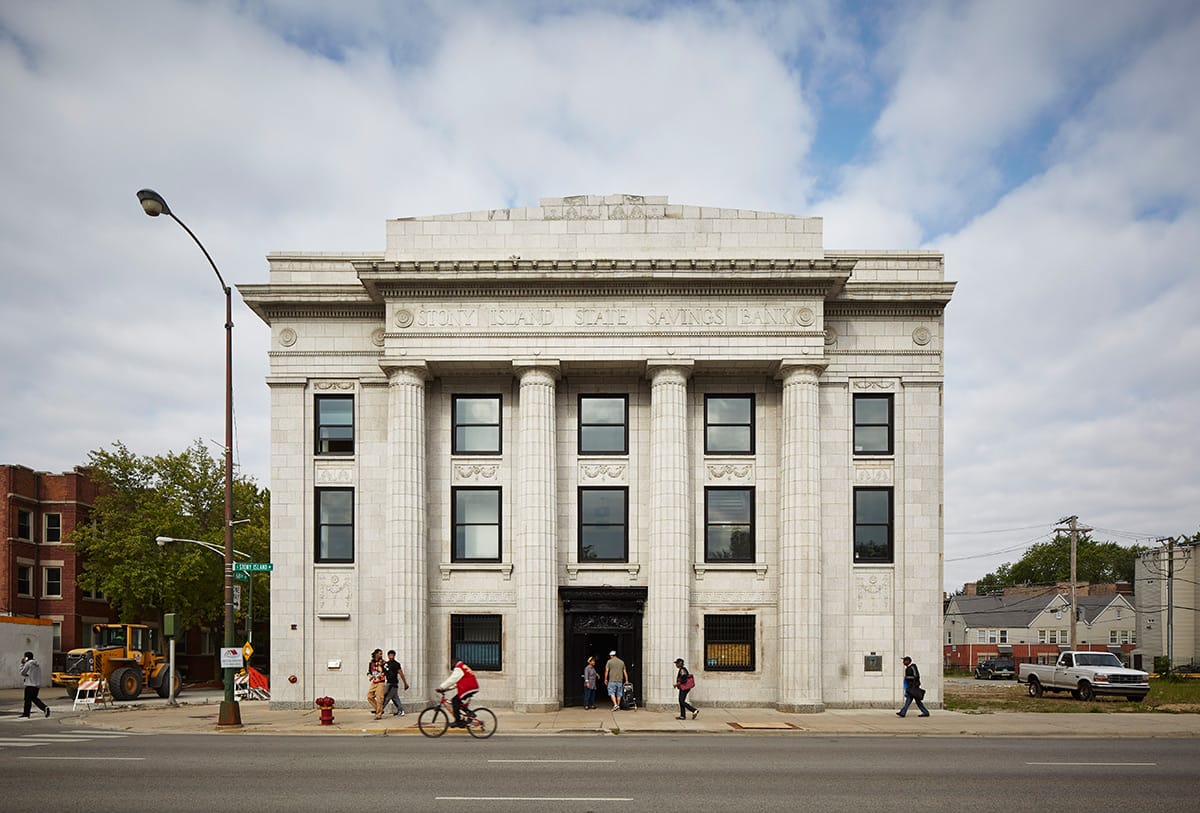
In 2013 Gates acquired the former Stony Island Trust and Savings Bank at 6760 South Stony Island Avenue, a 1923 Classical Revival building designed by William Gibbens Uffendell. The bank had been vacant since the early 1980s and was scheduled for demolition; the city sold it to Gates for one dollar on the condition that Rebuild Foundation undertake the restoration. The building reopened in October 2015, restaged not as a bank but as a multidisciplinary African American cultural centre.
The Arts Bank now houses, on its upper floors, the Johnson Publishing Company library — the bound runs of Ebony and Jet, the photography archive, the corporate furniture — acquired from the publisher in 2015 when Johnson liquidated its physical assets. It also holds Frankie Knuckles’s vinyl collection, which Gates secured from the late house-music pioneer’s estate, and the slide library of the late art historian Edward J. Williams. To call the Arts Bank a Gates artwork understates the matter. It is a working library and concert hall that doubles as the single most coherent statement of his project: that the cultural infrastructure of Black America is itself a material in need of preservation, and that an artist trained in urban planning is positioned to do that preservation in plaster and ledger as much as in pigment.
The financing model deserves attention. Gates issued a limited edition of marble bonds, cut from the bank’s original interior cladding and inscribed In Art We Trust, which sold for $5,000 each at Art Basel in 2013. The bond sale funded a meaningful share of the restoration. This is patronage reverse-engineered: the artwork is sold to pay for the building that is itself the artwork. No European Kunsthalle has yet replicated the manoeuvre.
Sanctum (October 2015, Bristol): the first UK commission
Gates’s first UK public commission opened on 29 October 2015 inside the bombed-out shell of Temple Church in Bristol, a medieval parish church gutted in the Blitz and preserved since as a roofless ruin. Commissioned by Situations, the Bristol-based public-art agency led by Claire Doherty, Sanctum was a 24-day continuous sound piece: a temporary timber pavilion built inside the ruin from salvaged materials donated by local Bristolians — pews, doors, floorboards, beams — hosted an uninterrupted programme of live sound, twenty-four hours a day, for the full duration. No published schedule, no advance billing of performers; visitors arrived and heard whatever was happening.
Sanctum matters in the Theaster Gates commissions sequence because it is the first time the Bristol or London public encountered the full Gates method outside Chicago: the salvaged-material pavilion, the deconsecrated sacred building, the durational sound work, the refusal of the spectacle of the named performer. It also seeded the relationships that would lead, seven years later, to the Serpentine commission. The pavilion itself was dismantled after the 24 days; Temple Church returned to being a ruin.
Dorchester Projects and the cumulative ground (ongoing)
It is worth pausing between the early international commissions and the late-period institutional ones to note the parallel domestic catalogue. The Dorchester Projects on South Dorchester Avenue — Archive House, Listening House, Black Cinema House, the Stony Island Arts Bank, the Currency Exchange Cafe, the Dorchester Art and Housing Collaborative — have grown continuously since 2009 and are not, strictly, public commissions in the museological sense. Read as a single corridor along Stony Island Avenue and its parallel streets, those buildings make up the spine of a Chicago South Side cultural patronage campaign that now reaches as far east as the Obama Presidential Center in Jackson Park. They are nonetheless the substrate on which the public commissions are built. The Black Monks rehearse there; the ceramics that appear in Gagosian shows are thrown there; the bricks salvaged from condemned South Side houses that surface in Documenta, Serpentine and Houston commissions are stored there.
A reader interested only in the commissioned outputs can skip Dorchester. A reader interested in why those commissions look the way they do cannot.
Black Vessel for a Saint (October 2020, Gagosian New York)
Gates’s October 2020 Gagosian New York exhibition, Black Vessel, was anchored by Black Vessel for a Saint: a freestanding brick chapel, cylindrical and roofed, built inside the 555 West 24th Street gallery and housing a salvaged 19th-century saint statue rescued from a deconsecrated Chicago Catholic parish. Visitors entered the brick cylinder one or two at a time through a low arched opening and stood with the saint in near-darkness, lit only by the oculus above.
The piece consolidates several strands. The brick — fired clay, the ceramicist’s material at architectural scale — is recurrent across Gates’s late work and reappears at the Serpentine two years later. The salvaged saint enacts the same operation as the salvaged Johnson archive or the salvaged Frankie Knuckles vinyl: a piece of Black or sacred American material culture that institutions discarded is recoded as the centre of a new attention. The chapel typology — a small, dark, single-occupancy interior — is the third recurrence and points directly to Black Chapel at the Serpentine.
That Black Vessel for a Saint opened in October 2020, during the worst quarter of the pandemic, also shaped its reception. Gagosian limited the gallery to small numbers; the chapel itself was a one-person interior. The work read, accurately, as a meditation on solitude and sacred shelter at a moment when both were unusually scarce.
Black Chapel (Serpentine Pavilion 2022, London)
The 21st Serpentine Pavilion, opened in Kensington Gardens in June 2022, was Gates’s Black Chapel: a cylindrical timber pavilion, eleven metres high, with a single circular oculus cut in its roof. The cylinder reads simultaneously as a traditional English bottle kiln (Gates cited the Stoke-on-Trent pottery kilns explicitly), a Romanesque rotunda, and a sacred space. Adjaye Associates provided architectural advisory input on the structural execution, the first time the Serpentine commission had paired its lead artist with a named architectural advisor in this way.
Inside, Gates installed a working bronze bell salvaged from St Laurence Catholic Church on Chicago’s South Side, demolished in 2014, and hung seven of his own tar paintings — large black panels made with the roofing tar his father had used as a Chicago roofer. The pavilion programmed a continuous schedule of sound, sermon and silence over the four-month run. It was the first Serpentine Pavilion conceived primarily as a sacred space and the first by an artist rather than an architect since the commission’s founding in 2000.
The Black Chapel is the cleanest single distillation of the Gates method to date: ceramic kiln typology, salvaged Chicago sacred object, paternal labour material, sound programme, durational opening, partnership with a Black-led architectural studio. The Theaster Gates commissions of the 2010s read, in retrospect, as preparatory studies for it.
The Theaster Gates commissions catalogue: a comparative reading
The full Theaster Gates commissions list, set side by side, makes the structural argument visible at a glance. Note the persistence of salvaged sacred material, the recurrence of the small chapel typology and the steady widening of the institutional partners.
| Year | Commission | Venue / City | Partner |
|---|---|---|---|
| 2010 | Rebuild Foundation (founding) | South Side, Chicago | Self-founded 501(c)(3) |
| 2012 | 12 Ballads for Huguenot House | Friedrichsplatz, Kassel | Documenta 13 |
| 2013–15 | Stony Island Arts Bank (restoration & opening) | 6760 S. Stony Island Ave, Chicago | Rebuild Foundation / City of Chicago |
| 2015 | Sanctum | Temple Church, Bristol | Situations |
| 2020 | Black Vessel for a Saint | Gagosian, 555 W 24th St, New York | Gagosian |
| 2022 | Black Chapel (Serpentine Pavilion) | Kensington Gardens, London | Serpentine Galleries / Adjaye Associates |
| 2026 | Prada Chawan Cabinet | Salone del Mobile, Milan | Prada / Hosoo Kyoto |
| 2026 | Freedmen’s Town Pavilion | Freedmen’s Town, Houston | Studio Zewde (Sara Zewde) |
Three patterns surface in the table that prose tends to obscure. The first is that Gates worked publicly for a decade before any major commercial gallery anchored a museum-scale brick work, and the institutional commissions cluster late: Serpentine 2022, Prada 2026, Houston 2026. The second is that every commission from 2012 onward involves a salvaged building or a salvaged sacred object as its primary material — there are no Gates commissions made entirely from new material. The third is the slow widening of collaborators: Documenta’s curators, then Situations, then Gagosian, then Adjaye Associates, then Prada and Hosoo, then Studio Zewde. Each new commission absorbs a new specialist partner without dropping the previous register.
Prada Chawan Cabinet (Salone del Mobile 2026, Milan)
At Salone del Mobile 2026 Gates presented the Prada Chawan Cabinet, a teaware project developed with Prada and the Kyoto textile house Hosoo. The cabinet stages a sequence of chawan — Japanese tea bowls — thrown by Gates in his Chicago studio alongside Hosoo’s woven silk panels and Prada-designed lacquered casework. The collaboration matters in the commissions sequence because it is Gates’s first sustained engagement with a luxury maison as patron rather than as collector, and because it formalises a connection between his ceramic practice and the Japanese pottery tradition that his teachers in Tokoname had been pointing toward since the early 2000s.
The Prada commission also clarifies what counts as a public commission in the Gates catalogue. The Chawan Cabinet is exhibited at Salone, will tour through Prada’s Fondazione spaces and is accessible without ticket — closer to a public installation than to a private collectible. The line between the commercial and the public commission, blurred in Gates’s practice since 2010, is here all but erased.
Houston Freedmen’s Town Pavilion (June 2026)
Reported by Dezeen on 2 June 2026 and opened the same week, the Houston Freedmen’s Town Pavilion sits in the historic Black neighbourhood of Freedmen’s Town in Houston’s Fourth Ward, established by formerly enslaved people in 1865 and largely cleared by mid-20th-century urban renewal. The pavilion is built from recovered building materials salvaged from the neighbourhood’s demolished and threatened structures — bricks from the brickyards that Freedmen’s Town residents themselves once operated, timber from churches lost to redevelopment, ironwork from gates and porches.
The pavilion is co-designed with Studio Zewde, the Harlem-based landscape and public-art practice founded and led by Sara Zewde. The collaboration is generative rather than ceremonial: Zewde shaped the surrounding planted ground, the approach paths and the relationship between the pavilion and the Freedmen’s Town street grid, while Gates designed the structure and the material salvage protocol. The pavilion functions simultaneously as a performance space for the Black Monks and visiting musicians, a community centre programmed by local Freedmen’s Town organisations, and an interpretive structure for the neighbourhood’s history.
In the Theaster Gates commissions catalogue the Houston pavilion is the first to be designed in genuine architectural partnership with another principal — Adjaye Associates’ role at the Serpentine was advisory; Zewde’s at Houston is co-authorial. It is also the first commission to bring the Gates method back to a specifically African American urban context outside Chicago, and it pairs his salvage practice with Zewde’s expertise in the landscape of Black heritage sites, which Studio Zewde has built over a decade of work at Harriet Tubman’s Auburn farm, the Mellon-funded Black landscape research and a string of municipal commissions in the American South.
The pairing matters beyond Houston. Zewde, born 1985, trained at Harvard GSD and the Conway School and founded Studio Zewde in Harlem in 2018; her practice is the closest landscape-architectural counterpart to what Gates has been doing in buildings since 2010. The 2026 pavilion suggests that the next decade of Gates commissions may be co-authored with practitioners of his own generation and the one after, rather than executed solo.
What the catalogue argues
Set the eight commissions against one another and a thesis surfaces that no individual project quite makes alone. Gates has spent sixteen years arguing that the public commission, as the art world has practised it since the 1970s, is structurally inadequate to the work that Black American artists need to do with cities. The biennial pavilion gets built and dismantled; the museum retrospective travels and is forgotten; the gallery installation is sold to a collector and disappears into storage. None of these formats can hold a Johnson Publishing archive, a Frankie Knuckles record collection, a salvaged bank, a Catholic-parish bell, a brick chapel that needs ongoing programming, or a Houston neighbourhood that needs decades of stewardship.
Gates’s response — visible in the catalogue only when the catalogue is read whole — is to build, alongside each commission, the institutional vehicle that can hold it permanently. Rebuild Foundation holds the Chicago buildings. Documenta’s 12 Ballads house was acquired afterward and continues to operate. The Stony Island Arts Bank is open and programmed eleven years on. The Black Chapel salvaged bell returned to a Rebuild building after the Serpentine run. The Houston pavilion will be stewarded by a Freedmen’s Town nonprofit that Gates and Zewde helped seat before the opening. The commission and the institution are co-designed.
That this argument is being made now, in the same calendar season as the Prada Chawan Cabinet at Salone and the Houston pavilion at Freedmen’s Town, also matters. Gates is one of very few living artists whose work is being commissioned simultaneously by a Milanese luxury maison and by a Texan historically Black neighbourhood without either commission seeming out of register. The Theaster Gates commissions catalogue, read from Rebuild in 2010 to Freedmen’s Town in 2026, is the record of an artist who refused to choose between those two registers and has instead spent sixteen years building the apparatus that holds them in the same hand.