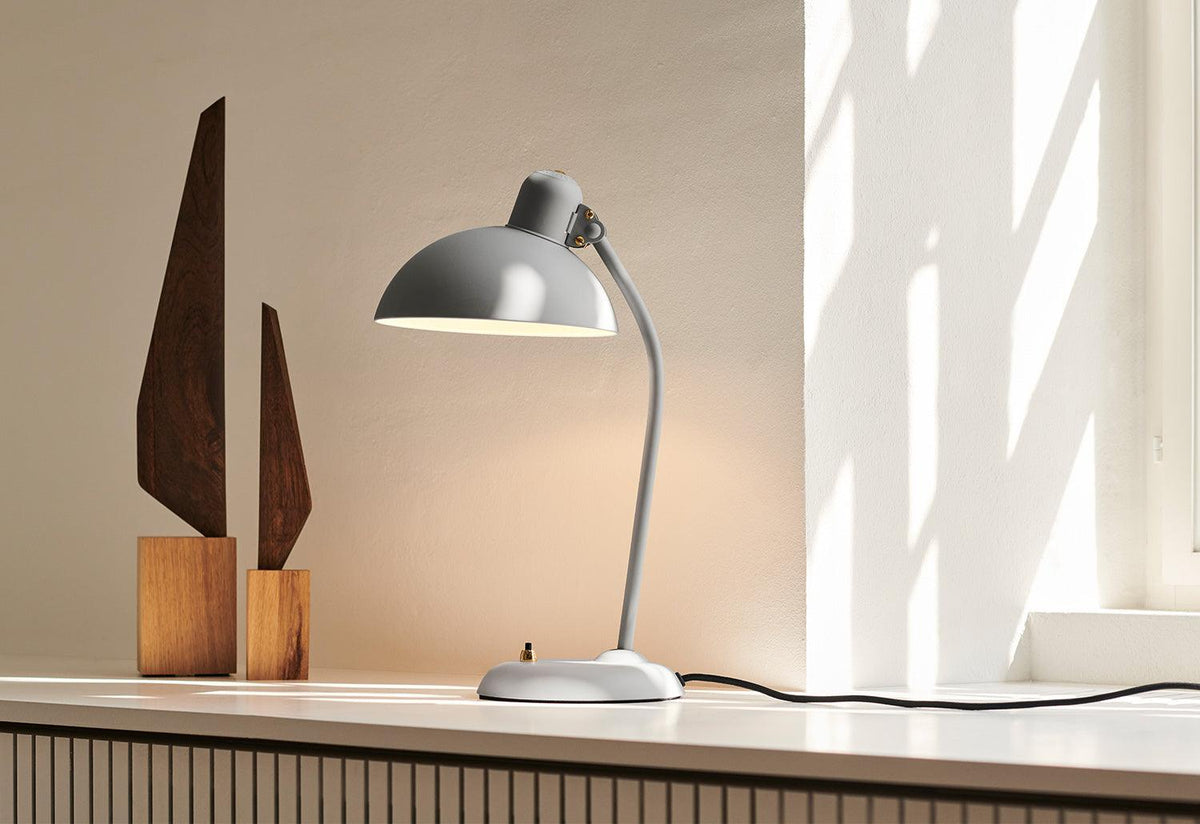
In June 2026, Fritz Hansen will issue a deep-burgundy edition of the Kaiser Idell Luxus 6631-T desk lamp in 200 units, paired with a matching Technics SL-40CBT direct-drive turntable in up to 300 units, previewed at 3 Days of Design 2026 in Copenhagen — and the headline is not the colour. The headline is that a 1872 Danish carpentry firm has become, by way of a series of catalogue acquisitions, one of the most consequential publishers of Bauhaus design objects working today. The Fritz Hansen Bauhaus catalogue runs from Christian Dell’s 1936 desk lamp to Arne Jacobsen’s 1952 Ant and 1955 Series 7, with the Technics 6631-T as its 2026 punctuation mark, and it is now the through-line that the company has chosen to make legible.
The Republic of Fritz Hansen — the brand’s own corporate name for itself, registered out of Allerødvej 8 in Allerød — has spent the better part of a century stitching together a single coherent design argument out of two distinct national modernisms: Danish mid-century craft and German Bauhaus rationalism. The Jacobsen line, which began in 1934, is the Danish half; the Kaiser Idell collection, acquired and reissued under the Fritz Hansen marque, is the German half. Most people who know the brand know the chairs. Fewer know that the lamps belong to the same catalogue. The 2026 Technics edition is the company’s quietest, hardest argument that they should be read together.
Christian Dell at the Bauhaus metal workshop, 1922–1925
Christian Dell (1893–1974) is the figure most easily forgotten in any roll call of Bauhaus designers, because he was not a student. He was a foreman. From 1922 to 1925, Dell ran the metal workshop at the Bauhaus in Weimar under Walter Gropius, supervising the apprentices who would become better-remembered names — Marianne Brandt, Wilhelm Wagenfeld, Wolfgang Tümpel — while turning out the technical drawings, the production prototypes, and the silversmith-quality finishing that the workshop’s reputation depended on. The Bauhaus’s signature aesthetic of geometric tube-and-disc lighting, the language that Brandt and Wagenfeld would carry into the global design vocabulary by the late 1920s, is in significant part a Dell language. He just did not sign it.
When the Bauhaus moved from Weimar to Dessau in 1925, Dell did not follow. He took a job heading the metal workshop at Frankfurt’s Kunstgewerbeschule and, more consequentially, began designing lamps for outside clients on a freelance basis. The shift from foreman to designer was unusual in 1920s German design culture — the institutional metalworker was supposed to be invisible — and the move into commercial lighting was the part of Dell’s career that turned him from a Bauhaus footnote into a designer with a catalogue. By the early 1930s he was supplying lamp designs to several German lighting manufacturers, and one of them — Gebrüder Kaiser & Co. of Neheim-Hüsten, in what is now the Sauerland region of North Rhine-Westphalia — became the lifelong partner.
The Bauhaus training shows in every Kaiser Idell drawing. The lamps are constructed from a small vocabulary of primitives — hemisphere, cylinder, disc, cone — joined by visible adjustment hardware: a rotating joint at the base, a hinged elbow at the arm, a swivel cup at the shade. There is no decorative element that is not also a functional one. The reflector is the shade; the counterweight is the base; the hinge is the silhouette. That is not generic 1930s modernism. That is the specific Weimar metal workshop discipline, scaled into a factory product. Dell’s contribution to lighting design was to translate the Bauhaus’s prototype rhetoric — short runs of hand-finished metal objects intended to demonstrate principles — into a catalogue of injection-moulded, series-produced lamps that ordinary buyers could specify by model number. The model numbers run to several dozen. The most famous is 6631.
The Kaiser Idell Luxus 6631, 1936
The Kaiser Idell name combines the German Idee — idea — with the Dell surname and the original manufacturer’s name, and the 1936 Gebrüder Kaiser catalogue is the document that fixed it. The Luxus 6631 entered that catalogue as the high-end variant of the family: a shaded reflector lamp with a chromed steel column, a hemispherical aluminium shade, and a heavy circular base designed to hold the arm at any angle without slipping. Earlier Kaiser Idell models, dating to 1933, had been wall-mounted or desk-clamped; the 6631 was the version that stood on its own foot. It was meant for the architect’s drafting table, the doctor’s writing desk, the executive office. The ‘Luxus’ label was a price-segment designation, not a nickname.
What gives the 6631 its second life — and what made it the lamp that Fritz Hansen would eventually choose to anchor a 2026 collaboration around — is the disciplined refusal of any decorative gesture. The lamp has a base, an arm, and a shade. The base is a disc; the arm is a tube; the shade is a half-sphere. The transitions between them are hinges, and the hinges are exposed. There is nothing on the lamp that is not load-bearing or articulation-bearing. In a decade — the 1930s — when most lighting in production for the German market was either historicist (brass scrolls, glass globes) or expressionist (asymmetric cones, painted reflectors), the 6631 was a quiet anomaly: a Bauhaus prototype that had passed the productisation test and gone into series. It sold well enough through the late 1930s for the Kaiser firm to keep the model running through several reissues, and well enough through the post-war decades for the design to remain in continuous catalogue presence at one factory or another for the better part of ninety years.
The lamp’s relationship to Fritz Hansen began later than the chair lineage. Where Jacobsen’s Ant and Series 7 are catalogue-original Fritz Hansen pieces — manufactured at Allerød from the year of their design — the Kaiser Idell collection was an acquisition, brought into the Republic of Fritz Hansen catalogue as part of the brand’s late-twentieth-century consolidation of mid-century lighting rights. The exact handover year is the kind of detail Fritz Hansen has been careful not to over-publish, and we have not been able to verify a clean date for the 6631’s first Allerød-stamped reissue. What is verifiable is that the lamp is today produced by Fritz Hansen, sold under the Kaiser Idell collection name, and treated as part of the company’s permanent catalogue alongside the chairs.
Fritz Hansen’s Bauhaus catalogue beyond Jacobsen
The chairs are the part of the Fritz Hansen catalogue everyone knows. Arne Jacobsen began collaborating with the firm in 1934, supplied the Ant (Model 3100) in 1952, the Series 7 / 3107 in 1955 — still the brand’s bestseller and the most-licensed chair silhouette in twentieth-century furniture history — and the Egg and Swan in 1958 for the SAS Royal Hotel Copenhagen, his concrete-and-curtain-wall hotel on Hammerichsgade. Jacobsen’s contribution to Fritz Hansen is the contribution most easily summarised in a single sentence: he made it a chair brand. The Jacobsen catalogue is what the public means by Fritz Hansen.
The Kaiser Idell line sits beside that catalogue, and the brand’s argument — which is not an argument it has made loudly, but is the one the 2026 Technics edition forces into the open — is that the two lineages are not two collections but one. The argument runs as follows. Jacobsen trained as an architect at the Royal Danish Academy of Fine Arts under Kay Fisker and Kaj Gottlob, was exposed to Bauhaus pedagogy through the international modernist publications of the late 1920s, and built his furniture practice in direct response to the rationalist vocabulary that Dell and the Weimar workshop had codified. The Ant chair’s bent-plywood seat is, in formal terms, a one-piece molded curve descended from the Breuer–Mart Stam tubular-steel cantilever tradition of the late 1920s. The Series 7 extends the gesture; the Egg and Swan translate it into upholstered foam. The lineage is Bauhaus-into-Danish, and the lineage runs through Fritz Hansen.
Reading the catalogue this way explains why the Kaiser Idell acquisition fits, and why a 2026 Fritz Hansen Bauhaus edition with Technics is not a costume change but a thesis statement. The brand is not pairing a German lamp with a Japanese turntable because the colours match. It is naming, in product form, the through-line that connects a 1922 Weimar metal workshop foreman to a 1934 Allerød chair brief to a 2026 Copenhagen showroom. That through-line is the Republic of Fritz Hansen’s actual editorial position, and the Kaiser Idell collection is its most explicit anchor.
The line beyond Jacobsen and Dell — Hans Wegner’s CH-marked pieces are not in the Fritz Hansen catalogue, despite the frequent conflation; Wegner’s work lives at Carl Hansen & Søn — sits with Poul Kjærholm (the PK series, brought in from E. Kold Christensen in the 1980s) and Piet Hein (the Superellipse table). Both are Danish modernists rather than Bauhaus designers. The Bauhaus half of the catalogue is, narrowly, the Kaiser Idell collection. That makes the 6631 the load-bearing piece in the brand’s German-modernist argument, and explains the choice of model for the Technics partnership.
Technics × Fritz Hansen: a burgundy edition at 3 Days of Design 2026
The 2026 collaboration was previewed at 3 Days of Design 2026 — the Copenhagen festival’s 17–19 June edition — and is published as a paired edition: a Kaiser Idell Luxus 6631-T desk lamp in 200 units split across Asia and Europe, and a matching Technics SL-40CBT direct-drive turntable in up to 300 units, both finished in the same deep burgundy. The lamp is sold by Fritz Hansen; the turntable is sold by Technics. The pair is sold as an editorial proposition rather than a single SKU. The preview was staged at Fritz Hansen’s Copenhagen store at Løvstræde 5 in the Rosengård district, with the Fritz Hansen Sound Club installation — a vinyl programme of furniture-making field recordings — running through the festival weekend at the showroom and its satellite DJ venue at Kronprinsessegade 13.
Technics, the audio sub-brand of Panasonic, was launched by Konosuke Matsushita’s Osaka conglomerate in 1965, pioneered the direct-drive turntable with the SL-1200 in 1972, was discontinued in 2010 as part of Panasonic’s broader retreat from premium consumer audio, and was relaunched in 2014–2015 under a sound-engineer-led product team. The SL-40CBT is one of the post-relaunch direct-drive products and sits well below the SL-1200’s flagship slot in price and performance terms, which is part of what makes the Fritz Hansen partnership legible: the lamp and the turntable are both editorial-tier objects at upper-furniture rather than collectible-design price points. The pair will not be cheap, but it will not be the kind of edition that lives behind glass.
The colour choice — burgundy — is the part of the edition most likely to be over-read in the design press, and the part Fritz Hansen has been most careful about. Burgundy is the colour the original 1936 Kaiser Idell catalogue did not offer. The Kaiser Idell palette ran to factory black, factory white, and a small range of muted greens and creams. Adding burgundy is an editorial gesture — the choice of a colour that signals ’limited edition’ and ‘collectible’ to the contemporary furniture buyer — and the gesture works because the rest of the lamp does not change. The hardware is the 1936 hardware. The silhouette is the 1936 silhouette. Only the finish moves. That is the discipline a reissue of this kind has to have, and the discipline Fritz Hansen has consistently applied across the Jacobsen catalogue as well: when the Series 7 is reissued in a new colourway, the chair does not change, only the lacquer does.
Technics’ Ryo Ogasawara framed the collaboration with a line that reads, on first encounter, as the kind of vague poeticism press releases tend toward: “Music is an art of time. Time flows without form, quietly imprinting itself on our emotions through sound.” Fritz Hansen’s Dario Reicherl returned with: “Sound and light both change how a space feels without touching its structure.” The two quotes are doing the same work in different registers — both are framing the edition as an argument about how non-structural elements (light, sound) shape the experience of a room — and the structural argument is the Bauhaus one. The room is the structure; the lamp and the turntable are the modifications. That is, almost literally, the Weimar metal workshop’s pedagogical position on industrial design: the everyday object’s job is to inflect the inhabited space without competing with its architecture.
The Sound Club programme at Løvstræde 5 — vinyl recordings of the furniture-making process at the Allerød factory — is the contextual frame the brand has built around the edition, and it is the part most worth flagging for visitors. The recordings are not background ambient music. They are documentary tracks: the sound of bending plywood, of upholstering a Swan, of finishing a metal hinge. Played through an SL-40CBT in a Fritz Hansen showroom under a Kaiser Idell, the installation closes a loop the brand has been opening for ninety years. The factory is audible, the workshop is visible, and the room is the result.
Fritz Hansen × Bauhaus & modernism, 1934–2026
The catalogue dates below are the verifiable ones; where Fritz Hansen’s specific year of distribution differs from the design year, the entry shows the design year and flags the distribution status honestly. We have not invented dates we could not verify.
| Year | Designer | Project | Source |
|---|---|---|---|
| 1934 | Arne Jacobsen | Begins collaboration with Fritz Hansen | Fritz Hansen brand history; FORMA graph |
| 1936 | Christian Dell | Kaiser Idell Luxus 6631 published in Gebrüder Kaiser & Co. catalogue | Gebrüder Kaiser 1936 catalogue; FORMA graph |
| 1952 | Arne Jacobsen | Ant Chair (Model 3100) | Fritz Hansen catalogue; FORMA graph |
| 1955 | Arne Jacobsen | Series 7 / Model 3107 | Fritz Hansen catalogue; FORMA graph |
| 1958 | Arne Jacobsen | Egg and Swan, for SAS Royal Hotel Copenhagen | Jacobsen archive; Fritz Hansen catalogue; FORMA graph |
| TBD | Christian Dell (acquired) | Kaiser Idell collection enters Fritz Hansen catalogue; today in current production | Fritz Hansen current catalogue (specific year of acquisition not publicly documented) |
| 2026 | Christian Dell × Technics | Kaiser Idell Luxus 6631-T burgundy edition, 200 units, with Technics SL-40CBT turntable up to 300 units | Wallpaper, June 2026; FORMA graph; 3 Days of Design 2026 preview |
The table is short on purpose. Fritz Hansen’s Bauhaus-and-modernism catalogue is not vast — the brand is selective about which historical designers it carries — and the discipline of the selection is part of why the catalogue reads as a coherent argument rather than a heritage roster. Six entries, one acquisition flagged honestly, and a 2026 edition that lands the thesis.
Why the Copenhagen design week reads this edition correctly
The festival context matters because 3 Days of Design 2026 is the only major European design week where a lamp-plus-turntable edition can be staged inside a single brand showroom and read by the visiting press as a thesis rather than a curio. Milan’s Salone is too vast and too commercial to give a 200-unit edition the room it needs; Paris’s Maison & Objet is too transactional. Copenhagen’s festival — founded in 2013, now in its thirteenth edition, structured across showrooms rather than a fairground — gives editorial pieces like this one a venue that matches their register. FORMA has mapped the festival’s full district programme in the 3 Days of Design Copenhagen map and tracked the Audo Copenhagen showroom programme that anchors the same week in Audo Copenhagen’s Tribeca opening with Norm Architects; both pieces sit alongside this one as the Copenhagen-week reading list.
The Iittala pavilion on the harbour — a seven-metre walkable aluminium reconstruction of Aalto’s 1936 Savoy vase, covered in Iittala’s Savoy pavilion piece — is the other major 1936-anchored project at the 2026 festival, and the rhyme is the part of the week worth marking. Two of the festival’s most ambitious editorial commissions in 2026 both pivot on objects from 1936: a Finnish glass vase and a German Bauhaus lamp. Both have been put through a translation gesture for the festival — the vase to seven-metre aluminium, the lamp to burgundy plus a turntable — and both translations are arguments about what the original object meant and what it can be made to mean now. The festival is reading 1936 as the hinge year of European modernism, and the Fritz Hansen and Iittala commissions are reading 1936 with it.
What the 2026 edition is, finally, doing
The Kaiser Idell Luxus 6631-T edition is, on the surface, a 200-unit limited-edition desk lamp in a new colour, paired with a turntable for a design-week preview. Read against the brand’s catalogue and the lineage that produced it, the edition is doing three more specific things at once. It is naming the Bauhaus half of Fritz Hansen’s catalogue, which the public has tended to treat as the chair brand. It is making Christian Dell’s 1936 desk lamp legible as a piece of the same intellectual project that produced the Ant and the Series 7. And it is staking a position — quietly, on a Copenhagen showroom floor in June 2026 — that the Republic of Fritz Hansen is the publisher of record for a particular through-line in European modernism that runs from Weimar’s metal workshop to Allerød’s chair factory and now to a burgundy-finished turntable in a vinyl room. A lamp, a chair, and a turntable in the same room: that is the 2026 Fritz Hansen Bauhaus argument, and the burgundy is just the colour the argument happens to be wearing.