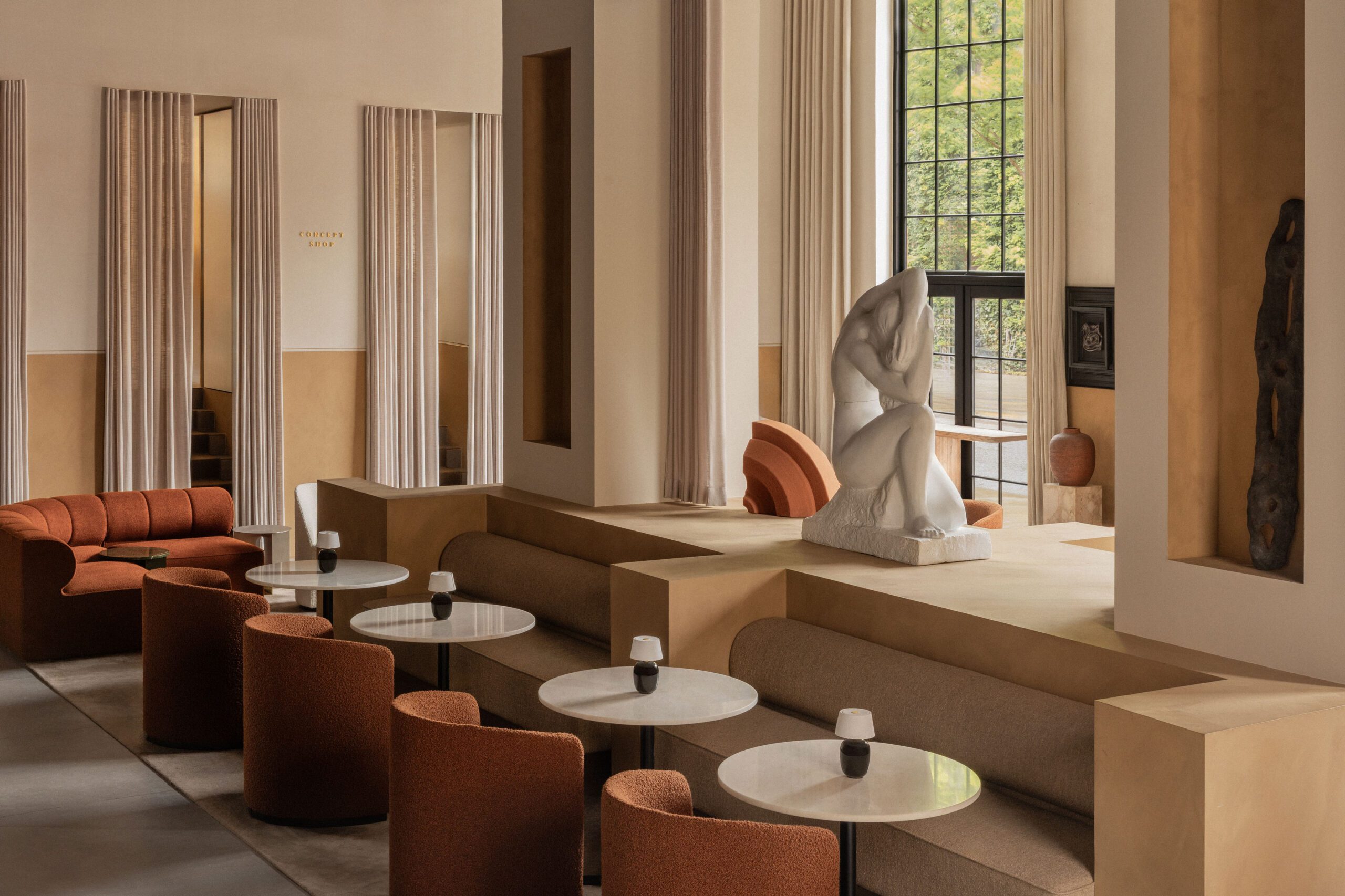
The audo copenhagen norm architects relationship is the longest brand-architecture alignment in the current Scandinavian design industry, and it is the reason a 1979 flatware company called Menu and a 1942 Lassen-family lighting house called by Lassen now share an 1880s neoclassical building at Aarhusgade 130 in Nordhavn that simultaneously functions as a showroom, a boutique hotel, a concept shop, a cafe, a restaurant, an event space and a stack of residences. Audo Copenhagen is the consolidated brand name that the Design Holding portfolio formalised in 2019 to operate that building and the catalogue inside it. Norm Architects is the studio that drew the building, that draws most of the furniture inside it, and that — in May 2026 — re-staged the entire format in lower Manhattan as Audo House Tribeca. The brand was assembled around the architecture. That is the unusual thing to record.
This article reconstructs the network. It traces the two predecessor brands back to their interwar and late-1970s starting points, narrates the 2019 Nordhavn consolidation and the Audo House Copenhagen opening, locates Norm Architects’ “soft minimalism” inside the Danish-Japanese craft axis the studio has built since 2008, and follows the Audo Tribeca showroom 2026 into a Tribeca North Historic District ground floor. The CVR number on the consolidated entity is 15214236; the trade-press shorthand for the parent group is Flos B&B Italia, marketed externally as Design Holding. The architecture is by one studio. The brand is run as one brand. The catalogue is one catalogue. Everything else about Audo Copenhagen follows from those three sentences.
Menu 1979 and by Lassen 1942: Two Brands Folded Into One House
Menu was founded in 1979 by Frederik Bagnara in Holbæk, on the Sjælland north coast, as a flatware and table-objects manufacturer working with Danish silversmiths and stainless-steel producers. The first catalogue years ran on cutlery, mills, ice buckets and small kitchen tools — the registers Stelton and Georg Jensen had already established as the Danish table vocabulary, restated for a younger retail audience. The 1980s and 1990s expanded the product range into glassware, ceramics and small furniture. By the mid-2010s Menu was running a contemporary collaborator roster — Norm Architects, Big-Game, Afteroom, Anderssen & Voll, Theresa Rand — and was one of the half-dozen Danish brands shown consistently at Maison&Objet and Salone del Mobile.
by Lassen is older and the heritage is heavier. The brand is the present-day operating company for the family archive of the Danish modernist Mogens Lassen (1901–1987) and his brother, the architect-designer Flemming Lassen (1902–1984). The Lassen brothers were inside the Danish modernist generation that ran through Kaare Klint’s design school and into the postwar furniture industry around Fritz Hansen, Carl Hansen & Søn and Louis Poulsen; Mogens Lassen’s Kubus candleholder of 1962 — a square brass-and-steel four-cube candle object originally made as a private gift — is the brand’s signature archive piece, with the Frame shelving system, the Twin Table series and Flemming Lassen’s Tired Man chair from 1935 forming the production catalogue. The brand was relaunched in its current form in 2008 by Mogens Lassen’s grandchildren under the by Lassen name.
The two brands were folded into a single operating company in 2019. Menu had acquired by Lassen earlier in the decade; the 2019 move consolidated them under one trade name, with one warehouse, one wholesale operation, one catalogue calendar, and — critically — one building. Joachim Kornbek Engell-Hansen, brought into Menu’s operating leadership in 2012 as head of design, became design and brand director of the merged entity; he is also a partner at Norm Architects, which clarifies how the consolidation actually got designed. The merged company filed under CVR 15214236 and took the trade name Audo Copenhagen. The address on the filing — Aarhusgade 130, Floor 1, 2150 Nordhavn — is the same address the brand operates from today.
How Audo Copenhagen and Norm Architects Built One Voice
The point of the 2019 consolidation was not to keep two catalogues running in parallel. It was to produce a single brand voice across what had been two marketing operations, two product calendars and two retail propositions — and to do it inside a single Norm Architects-designed environment, so that brand voice and architectural voice could be read as the same voice. The audo copenhagen norm architects alignment was the operating instrument for that argument.
Norm Architects was founded in 2008 in Copenhagen by Jonas Bjerre-Poulsen and Kasper Rønn. The studio sits in the same Copenhagen practice tradition that produced Cecilie Manz, GamFratesi and Space Copenhagen — design offices that work across architecture, interiors, photography and product, taking a position on every scale from building envelope to table lamp. Joachim Kornbek Engell-Hansen joined as a partner in 2014, and the studio’s product output expanded from that point onward into the Menu and Audo Copenhagen collaborations now anchoring the catalogue. By 2019, Norm Architects had been the lead design intelligence for Menu for roughly seven years; the consolidation simply formalised what the working relationship had already produced.
The studio operates a vocabulary the design press has shorthanded as “soft minimalism” — a label Jonas Bjerre-Poulsen has used himself in interviews. The substance behind the phrase is concrete: Norm Architects reduces every room to two or three material tones, deploys soft natural light through a single dominant window or skylight, arranges furniture in conversational groups around low tables, works in beige-on-beige or beige-on-stone palettes against dark-stained wood floors, and refuses, with discipline, any move that would break the room into more than two material registers. The studio’s published interiors — the Áreas residences in Lisbon, the Tatamiza house at Karuizawa, the Kinuta Terrace project in Tokyo with Keiji Ashizawa from 2019, the Karimoku Case Study showrooms in Tokyo and Kyoto — all deploy the same vocabulary. What is original is the consistency with which the studio refuses any other move.
That consistency is what made the studio the right author for a consolidated Audo Copenhagen. The 2019 merger needed a register that could absorb Menu’s contemporary collaborator roster and by Lassen’s interwar archive into a single room without either reading as out of place. Norm Architects’ two-tone material grammar produced exactly that register. A Kubus candleholder from 1962, a Harbour chair from the Menu archive, an Androgyne dining table drawn by Norm Architects for Menu in 2018, and a Tire Man lounge chair from the Karimoku Case Study collaboration all photograph in the same room without collision because the architectural envelope is doing the work of holding them together.
Audo House Nordhavn: How Norm Architects Made the Showroom-as-Hotel
Audo House Copenhagen, opened 2019 at Aarhusgade 130 in Nordhavn, is the only Scandinavian showroom that doubles as a hotel, a cafe and a stack of residences — and it exists because Norm Architects redesigned an 1880s neoclassical building before designing the brand that runs it. The structure was originally a maritime trading post on the inner Nordhavn harbour, built in a stripped-classical industrial vocabulary with masonry walls, segmental-arched windows and large internal floor plates. By the early 2010s it was vacant and on the redevelopment register of the Nordhavn masterplan. Menu acquired the building, and Norm Architects took the brief.
The renovation took the existing envelope as the starting point. Exterior masonry was retained, restored and re-pointed; the interior was opened into a continuous ground-floor plate, with upper levels broken into separate functional registers. The plaster columns and the structural rhythm of the original interior were left exposed and washed in a soft beige paint — not white, not stone, the warmer of the two cooler greys that has anchored the Norm Architects palette since the early 2010s. The floors are dark-stained wood, laid in wide planks. The contrast between beige envelope and dark floor is the single largest design move in the building, and is what allowed the furniture to be photographed against the walls at full saturation.
The functional programme inside that envelope is the part no other Scandinavian design house has matched. Ground floor: showroom, concept shop, cafe and the MENU restaurant. First floor: event space and additional showroom rooms. Upper floors: ten residence suites operated as a boutique hotel. The integration is total. A buyer who walks in during a trade-press week can sit in a Norm Architects-drawn Menu chair, eat at a Norm Architects-styled dining table, sleep in a Norm Architects-designed suite, and wake up to breakfast in the same restaurant — every object touched in that twenty-four-hour cycle is in the Audo Copenhagen catalogue at a wholesale price they can quote.
“Audo” derives from the Latin audere, “to dare” — the brand language Menu published at the 2019 opening was explicit about the etymology. The Audo House programme also gave the parent company its current trade name; the merged Menu + by Lassen entity rebranded itself Audo Copenhagen after the building rather than after either predecessor. Most consolidations under conglomerate ownership retain the older or larger brand name. Audo Copenhagen took the name of the building that Norm Architects designed.
The Design Holding Portfolio: Where Audo Sits
Audo Copenhagen sits in the Design Holding portfolio alongside B&B Italia, Flos, Louis Poulsen, Arclinea, Maxalto, Azucena, FENDI Casa and Lumens. The portfolio is held jointly by Investindustrial and the Carlyle Group; Design Holding has been the marketing umbrella since 2018, and the group is sometimes referenced in the design press as Flos B&B Italia after its two anchor brands. Audo Copenhagen was added through the Menu acquisition during the 2021–2022 cycle.
The portfolio context matters for two reasons. First, Design Holding gives Audo Copenhagen distribution scale an independent Danish furniture company at its revenue level could not produce on its own — dealer relationships in North America, Asia and the Middle East that were already built around B&B Italia, Flos and Louis Poulsen. Second, the portfolio positions Audo Copenhagen as functionally complementary to the rest of the holding: B&B Italia is the Italian high-end upholstery anchor, Flos the architectural-lighting anchor, Louis Poulsen the Danish lighting heritage anchor, and Audo Copenhagen the Danish furniture-and-objects programme aimed at the residential and hospitality contract market in the mid-to-upper segment. Louis Poulsen sells fixtures; Audo sells the room around the fixtures.
Brand-Architecture Table
| Brand / Venue | Founded | Heritage | 2026 Role in Audo |
|---|---|---|---|
| Menu | 1979 | Danish flatware and table-objects, founded by Frederik Bagnara in Holbæk; contemporary collaborator roster from the 2010s (Norm Architects, Big-Game, Afteroom, Anderssen & Voll) | Predecessor product brand; full catalogue absorbed into Audo Copenhagen from 2019; Androgyne, Harbour, Eave and Yeh archive carried forward |
| by Lassen | 1942 / revival 2008 | Lassen-family modernism: Mogens Lassen (1901–1987) and Flemming Lassen (1902–1984); Kubus candleholder (1962), Tired Man (1935), Frame shelving | Predecessor heritage brand; archive folded into Audo Copenhagen 2019 alongside Menu |
| Audo Copenhagen | 2019 (consolidated) | Menu + by Lassen merger; named after the Audo House building rather than either predecessor; CVR 15214236 | Single operating brand; Norm Architects is the lead studio; Joachim Kornbek Engell-Hansen is design and brand director |
| Audo House Copenhagen | 2019 (venue) | 1880s neoclassical maritime trading post on Nordhavn inner harbour; renovated and interior-designed by Norm Architects | Showroom + boutique hotel (10 suites) + concept shop + cafe + MENU restaurant + event space; brand’s physical centre of gravity |
| Audo House Tribeca | 2026 (venue) | Tribeca North Historic District ground-floor unit at 62 Laight Street, New York; landmarked late-nineteenth-century warehouse fabric | First flagship outside Scandinavia; ~3,500 sq ft; interiors by Norm Architects (Jonas Bjerre-Poulsen) with styling by Colin King |
| Norm Architects | 2008 | Copenhagen studio founded by Jonas Bjerre-Poulsen and Kasper Rønn; “soft minimalism” vocabulary; Karimoku Case Study, &Tradition, Vipp, Reform collaborations | Lead architecture, interior and product studio for Audo Copenhagen across Copenhagen and Tribeca venues and across most of the active product catalogue |
The table is the operating diagram. Two predecessor brands feed one consolidated brand; one consolidated brand operates from two architecturally-related venues; one studio designs both venues and most of the catalogue. The relationships compress in both directions — heritage upward into the Lassen family archive, distribution outward into the Design Holding portfolio — but the central column of the table is consistent. Audo Copenhagen and Norm Architects are inseparable as a working pair.
Audo Tribeca 2026: The American Outpost
The Audo Tribeca showroom 2026 opened in early May 2026 at 62 Laight Street in lower Manhattan, inside the Tribeca North Historic District designated by the NYC Landmarks Preservation Commission in 1992. The unit is a roughly 3,500 sq ft (about 325 m²) ground-floor space inside a landmarked late-nineteenth-century warehouse — cast-iron storefront, masonry above, deep floor plate inherited from a period when the neighbourhood was the city’s butter, egg and cheese wholesale market. Norm Architects took the existing envelope as the brief.
The interior moves are direct transpositions of the Audo House Copenhagen vocabulary. Exposed brick walls and structural columns are washed in the same soft beige used in Nordhavn. The floors are dark-stained wood. The decision to paint over the original brick rather than expose it runs against twenty years of Tribeca design vernacular, which treated red-brick-and-cast-iron archaeology as the authenticity signal. By coating brick and column in a single tone, Norm Architects dissolves the building’s history into the background and pulls the furniture forward.
The room is staged as a sequence of residential vignettes rather than a retail layout, with Colin King on the styling — the New York-based interiors stylist whose monograph Arranging Things (Rizzoli, 2023) anchors his slow-furniture editorial reputation. The centrepiece is a large Androgyne dining table — Norm Architects’ 2018 Menu piece, here in the longest version of the family. The Eave sectional turns the back corner into a conversational area; the Crescent shelving runs along the long beige wall opposite the entrance; the Elizabeth lounge chair from the Menu archive sits on one sight line, the Tire Man from the Karimoku Case Study x Norm Architects collaboration on the other. Paintings and small sculptures by the Portland artist Benjamin Ewing form the opening hang. There is no point-of-sale desk, no price tag, no visible signage other than the Audo wordmark above the entrance.
The Tribeca opening was timed to NYCxDesign 2026 (14–20 May). The brand could have opened in March or September; it chose the week the international design press was already in town. The opening drew the New York shelter-magazine bench, the Karimoku New Standard and Karimoku Case Study partners Norm Architects also works with on the Japanese side, and the Design Holding portfolio’s North American dealer network. Laight Street replaced a smaller 65 N. Moore Street showroom the brand opened in June 2024 as a beachhead; the new flagship is more than three times the footprint.
Soft Minimalism as Brand Language
The relationship between Norm Architects’ interior vocabulary and Audo Copenhagen’s brand language is the part of the network most under-described in the trade press. The trade press treats “soft minimalism” as a style — a Scandinavian aesthetic register copyable by other studios. That is true at the level of magazine layouts. It is not true at the level of the operating model. Inside Audo Copenhagen, soft minimalism functions as a brand-language constraint that every product, photograph, room and catalogue page has to pass through, and the studio holding the constraint is Norm Architects.
The constraint runs in three registers. Material palette: every Audo Copenhagen room is composed in two or three tones drawn from a fixed palette of beige, oat, stone, rust, deep brown and dark-stained oak. No exception is made for archive pieces; a Mogens Lassen Kubus from 1962 photographs in the same palette as a 2024 Norm-drawn Eave sectional. Light: soft natural light through a single dominant window or skylight, with no overhead grid lighting. Composition: conversational groups around low tables, with negative space treated as a primary compositional element. The three registers compound, and the result is a brand language that reads consistently across catalogue, campaign, showroom and hotel suite.
The Japanese craft axis sits inside the constraint as well. Norm Architects’ parallel work with Karimoku, Ariake, and Keiji Ashizawa’s studio in Tokyo has been running since the mid-2010s, and the “soft minimalism” register has been built in dialogue with the Japanese craft tradition as much as with the Scandinavian one. The Karimoku Case Study programme — solid-wood furniture pieces drawn for specific architecture projects and named for them (Kinuta Terrace, Tatamiza, Edition Karimoku) — is the most visible expression, and several pieces are stocked at both Audo House Copenhagen and Audo House Tribeca. The Tire Man on the Tribeca floor is from the line. The integration is a vocabulary decision, not a styling one, and it is the same vocabulary running through the Menu and by Lassen archive pieces in the next room.
The Working Diagram, 2026
The audo copenhagen norm architects network in May 2026 operates on a fully consolidated diagram. One brand (Audo Copenhagen, consolidated 2019 from Menu 1979 and by Lassen 1942). One studio (Norm Architects, 2008). Two architecturally-related venues (Audo House Copenhagen 2019, Audo House Tribeca 2026). One parent portfolio (Design Holding). One brand and design director (Joachim Kornbek Engell-Hansen, also a partner at Norm Architects). One styling collaborator on the New York side (Colin King). One sustained Japanese-craft thread (Karimoku Case Study with Karimoku New Standard alongside).
The diagram is unusual on three counts. The brand name was taken from the building rather than from either predecessor company — the inverse of the standard conglomerate-consolidation pattern. The lead architecture studio is also represented inside the brand’s design leadership through a shared partner, compressing what would normally be a client-architect relationship into a single decision-making structure. And the brand’s physical centre of gravity is a hybrid building — showroom plus hotel plus restaurant plus residences under one envelope — rather than the separate showroom-and-hospitality formats most Scandinavian design brands maintain. None of the three features is replicable by a competitor without rebuilding the operating model from the ground up.
What the 2026 Tribeca opening tested was whether the model would transpose. The answer is that it did. A New York buyer walking into Laight Street experiences the same envelope, palette, vignette grammar and catalogue a Copenhagen buyer experiences in Nordhavn — the only meaningful variable being the structural shell of the building. Norm Architects held the variable down to that single line item, and the brand language stayed legible across the Atlantic transfer. Audo Copenhagen and Norm Architects are inseparable as a working pair, and the work in 2026 is the export of a hybrid Scandinavian-Japanese vocabulary into rooms other design houses cannot stage because they do not have the architecture studio to stage them.