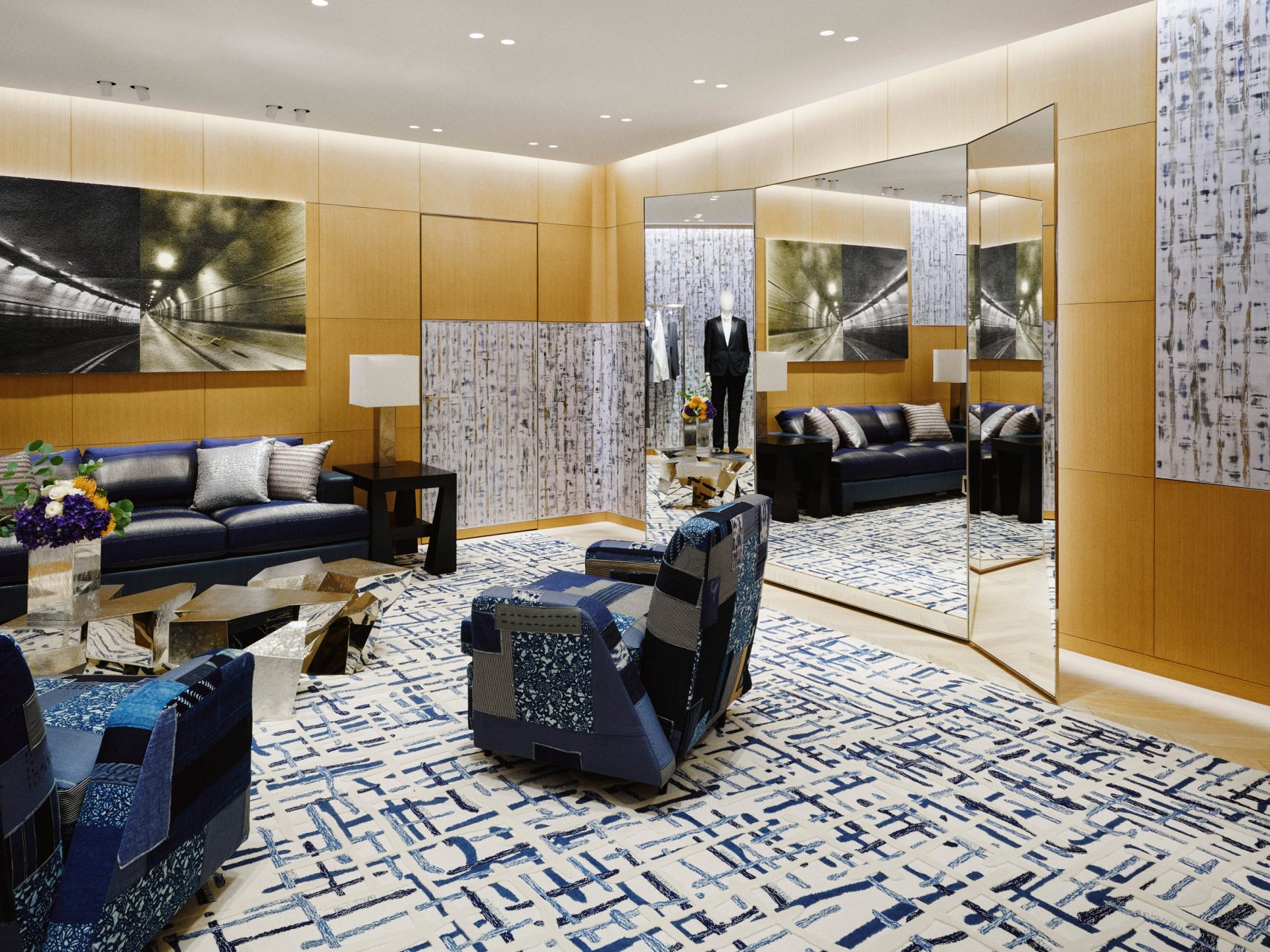
Sou Fujimoto’s House of Dior Shinsaibashi opened in Osaka on 21 May 2026 as the third star-architect Dior maison in East Asia in 23 years, after SANAA’s Tokyo and Christian de Portzamparc’s Seoul. The new four-storey flagship in the Shinsaibashi-suji shopping district wraps a ribbed, undulating facade — Fujimoto’s reading of haute couture drapery — around interiors by Peter Marino and an upper-floor restaurant by Anne-Sophie Pic. Dior Shinsaibashi is the most architecturally legible chapter yet in LVMH’s 23-year campaign to commission named architects for its Asian flagships rather than fit out anonymous retail shells.
Dior Shinsaibashi: the building
The House of Dior Shinsaibashi occupies a four-storey volume on Shinsaibashi-suji, the covered shopping spine that has been Osaka’s commercial artery since the Edo period. The site sits a short walk from the Midosuji axis, in the dense central district that links Namba to the south with Umeda to the north. Dior had previously operated in the city through department-store concessions and a smaller boutique; the 2026 building is the brand’s first ground-up Osaka maison and only its second purpose-built flagship in Japan after the 2003 Dior Omotesando in Tokyo.
The programme stacks vertically. Ground and first floors carry women’s and men’s ready-to-wear; the second floor holds high jewellery and made-to-measure salons; the third floor is given over to a Michelin-starred restaurant by Anne-Sophie Pic, the French chef whose Valence flagship retains three Michelin stars and whose London and Paris addresses have extended her reach into capital cities. The Pic restaurant — her first permanent address in Japan — is treated as a destination in its own right, with a dedicated lift core and bar lounge, following the template Dior established at 30 Avenue Montaigne in Paris with Monsieur Dior and at the 2022 Seoul refit with Pierre Hermé.
The construction palette is deliberately heavy at the base and atmospheric above. The plinth is a deep grey stone matched to the surrounding shopping-street fabric; from the first floor upward, the building reads as a translucent, layered envelope. At night, internal lighting filters through the ribbed exterior so that the facade glows like a paper lantern — the project brief explicitly invokes the visual register of Japanese architecture, in which screened light substitutes for sculptural mass.
The entrance is the building’s clearest gesture. Above a recessed doorway, the facade lifts and folds, as if a length of fabric had been pinched and raised to reveal the threshold beneath. The detail is structural rather than applied: the vertical fins that compose the ribbed envelope curve outward and upward at the entry bay, producing what the project literature calls “the lifted hem.” It is the same idea Fujimoto has tested at smaller scale in pavilion work — geometry doing the job of ornament — now executed at four-storey civic dimension.
Sou Fujimoto: drapery, washi, and the layered facade
Fujimoto was born on 4 August 1971 in Hokkaido and founded Sou Fujimoto Architects in Tokyo in 2000. The practice’s early reputation rested on small, intensely conceptual houses in which conventional plan logic dissolved — House N (Oita, 2008) nested three boxes inside one another; House NA (Tokyo, 2011) staged domestic life on a scaffold of platforms. Fujimoto’s Venice Biennale Golden Lion in 2012, awarded for the Japan Pavilion’s contribution under Toyo Ito, certified him internationally; in 2013 he became the youngest architect to design the Serpentine Pavilion in London, building a white steel cloud of 20mm rods at Kensington Gardens.
The Shinsaibashi facade extends that vocabulary. The exterior is composed of vertical ribbed elements — fins of cast and reinforced material — that undulate across the building’s primary elevation. The brand brief frames the geometry as homage to the haute couture toiles of Christian Dior, the muslin prototypes pinned and draped on a mannequin before a garment is cut in its final fabric. Fujimoto’s translation reads the toile not as cloth but as the structural memory of cloth: the regular pleating of a skirt, the folded lapel of a bar jacket, the corseted bodice of a New Look gown, all flattened into an architectural surface.
The second reference is material. The ribs are finished to a milky translucency that, in the Dior brief, “recalls Japanese washi paper” — the long-fibre handmade paper traditionally used for shoji screens and lanterns. Washi diffuses light without revealing what lies behind it; the Shinsaibashi facade does the same. From the street the building is opaque enough to read as a single sculpted mass, but the interior shows through as a soft glow, particularly after dusk. This is the operative move Fujimoto has been making since the early houses: an envelope that is neither solid nor transparent, but optically intermediate.
The lifted-hem entrance is the third move. Where SANAA’s Omotesando facade is a flat, double-skinned glass plane, and where Portzamparc’s Seoul building is a series of separate fibreglass sails, Fujimoto’s facade is continuous. The entire elevation is one fabric; the door is where that fabric has been gathered up. The detail recalls the way Yohji Yamamoto and Rei Kawakubo discuss garment construction — folding, gathering, raising — and aligns Dior, a French house, with a specifically Japanese architectural rhetoric about cloth and shelter.
Fujimoto’s other recent commercial work has been less explicitly fashion-coded. He delivered the Grand Ring, the world’s largest wooden structure, for Expo 2025 Osaka — a 2km circular timber colonnade that closed in October 2025, seven months before Shinsaibashi opened. He is also designing the Maison de l’Architecture in Paris and has been retained on the Hangzhou Wangjiao Park masterplan. The Dior commission is his first dedicated luxury retail building, but it sits within an unusually large, varied workload — the practice now employs roughly 60 people from offices in Tokyo and Paris.
Peter Marino: 30 years inside LVMH stores
Peter Marino was born in 1949 in Queens, New York, and has been LVMH’s preferred store architect since 1995, working directly under chairman Bernard Arnault. The relationship has outlasted any other client-architect pairing in the luxury industry. Marino’s New York studio has delivered hundreds of Louis Vuitton, Dior, Loewe, Fendi, Bulgari, and Chanel addresses across four continents; his signature combination of figurative bronze, custom plaster, and contemporary art commissions has become the de facto interior language of European luxury retail.
At Shinsaibashi, Marino installed Versailles parquet floors throughout the ready-to-wear levels — the same hand-laid pattern he has deployed at Avenue Montaigne and at the 2022 Seoul Cheongdam refit — and commissioned contemporary art for each landing. The art programme follows Marino’s standard method: works are commissioned specifically for the location, integrated into the casework and millwork, and selected to anchor the building in a local artistic context. (Marino’s own art holdings are vast; he collects contemporary ceramics, Old Master drawings, and figurative bronze, and he has staged museum-scale exhibitions at the Bass in Miami Beach.) Salon walls combine bouclé upholstery, lacquered cabinetry, and the cream-and-grey palette that has been Dior’s interior signature since the 2008 brand refresh under John Galliano.
Marino’s track record inside the Dior maison network is the relevant context. He delivered the interiors for House of Dior Seoul in 2015, working alongside Portzamparc’s exterior. He also led the 2014 refit of SANAA’s Dior Omotesando Tokyo, redoing the salons more than a decade after the original 2003 opening. At Shinsaibashi, then, Marino is not simply the interior architect on a new building; he is the connective tissue across three generations of Dior East Asian architecture, the figure who has been present at each major commission since the start.
This is the LVMH operating model in its mature form. The group separates the exterior architect — the named, frequently Pritzker-tier figure who delivers a building people can recognise from a photograph — from the interior architect, who is almost always Marino. The arrangement allows Dior to commission whoever the brand judges right for each city’s facade (SANAA for Tokyo, Portzamparc for Seoul, Fujimoto for Osaka) while maintaining absolute consistency across the customer-facing interior. A regular Dior client moving between the three buildings reads three different exteriors but one coherent interior register.
Dior Omotesando: SANAA’s 2003 double-skin
Dior Omotesando, completed in 2003, is the foundation stone of this strategy. The four-storey building on Omotesando-dori in Tokyo’s Aoyama district was SANAA’s first major commercial commission outside cultural and institutional work. Kazuyo Sejima and Ryue Nishizawa, who had founded the partnership in 1995, were known at the time for the O-Museum (1999) and the Christian Dior Building’s competitor, the Tod’s Omotesando by Toyo Ito then under design. The Dior commission predated SANAA’s New Museum in New York (2007), the Rolex Learning Center in Lausanne (2010), and the Louvre-Lens (2012) — buildings that would later anchor the practice’s 2010 Pritzker.
The Omotesando facade is a double-skin system: a sheer outer plane of clear glass set in front of an inner layer of translucent acrylic. The acrylic is partially patterned, partially blank, and varies in opacity from floor to floor, so that the building reads from the street as a stacked series of differently glowing volumes. The architects described the effect as a “dress” of light: from a distance the building looks like a single, slightly soft-edged box; up close, the layered surfaces resolve into discrete glass and plastic planes, with a narrow ventilated cavity between.
Internally, the floor plates are pulled back from the facade, so the double-skin reads as a freestanding envelope rather than as cladding. Each floor has its own ceiling height, calibrated to the merchandise (taller for couture, lower for accessories), and the resulting external proportions are deliberately irregular — the building is taller in some bays than in others, a SANAA signature now familiar from the Serpentine Pavilion 2009 and the New Museum.
Marino’s 2014 refit kept SANAA’s envelope intact and reworked the interiors only. The original 2003 fitout had been done by a Dior in-house team under Hedi Slimane’s first Dior Homme era; the Marino refit aligned the Tokyo salons with the global Avenue Montaigne palette. The arrangement set the pattern that would govern every subsequent commission: exterior by a regional or international name, interior by Marino, refit by Marino on the same cycle.
House of Dior Seoul: Portzamparc’s fibreglass sails
The second East Asian commission was the House of Dior Seoul, completed in 2015 and designed by Christian de Portzamparc. The site sits in Gangnam’s Cheongdam-dong luxury corridor, on a corner lot that Dior had acquired specifically for the project. Portzamparc, born in Casablanca in 1944 and the first French winner of the Pritzker Prize (1994), was an unexpected choice — his major commissions had been cultural (Cité de la Musique in Paris, 1995) and tall (One57 in Manhattan, 2014) rather than retail. The Seoul building was his first dedicated luxury-fashion commission.
Portzamparc wrapped the six-storey structure in 20-metre-tall curved fibreglass panels — eight of them, arranged around the building’s perimeter like sails caught mid-billow. The panels are not structural; they are clipped to a secondary steel frame standing slightly forward of the building’s load-bearing core, allowing the curves to read as detached sculptural objects rather than as cladding. The fibreglass is finished to a creamy white, and the curves were CNC-cut from a continuous parametric surface that Portzamparc developed in collaboration with the contractor in Seoul.
The reference, like Fujimoto’s at Shinsaibashi, was textile. Portzamparc described the panels as “a Dior dress in white,” and the building was widely received in Seoul as the most explicitly garment-like piece of fashion retail architecture commissioned to that date. The interior, by Marino, deploys the same Versailles parquet, contemporary art programme, and cream-and-grey palette that would later appear at Shinsaibashi. The top floor of Dior Seoul houses a Café Dior by Pierre Hermé — the prototype for the restaurant-as-flagship-amenity model that Pic now extends in Osaka.
The Seoul building made Dior the architectural reference point for Cheongdam’s emerging luxury cluster. Louis Vuitton’s Maison Seoul, by Frank Gehry and Peter Marino, opened on the same street in 2019; Chanel, Bottega Veneta, and Hermès have since followed with their own named-architect commissions. Within the LVMH portfolio, Dior Seoul sits as the pivot point between the early SANAA experiment in Tokyo and the mature Fujimoto exercise in Osaka.
A table of architect-designed Dior maisons in East Asia
| Year | City | Venue | Exterior Architect | Interior Architect | Key material |
|---|---|---|---|---|---|
| 2003 | Tokyo | Dior Omotesando | SANAA (Sejima + Nishizawa) | Dior in-house, refit by Marino 2014 | Clear glass over translucent acrylic |
| 2015 | Seoul | House of Dior Seoul | Christian de Portzamparc | Peter Marino | 20m fibreglass sail panels |
| 2026 | Osaka | House of Dior Shinsaibashi | Sou Fujimoto | Peter Marino | Ribbed translucent fins, washi-paper register |
The three buildings span 23 years, three cities, and three radically different architectural temperaments. SANAA reads as planar, atmospheric, and Modernist; Portzamparc as sculptural, gestural, and parametric; Fujimoto as woven, ornamental, and figurative. What unites them is the brief — a four-to-six-storey flagship, vertically programmed, with Marino interiors and a top-floor food destination — and the client logic: Dior commissions a named architect per East Asian capital, then maintains the interior under Marino in perpetuity.
Coda: the East Asia lineage
Three architects, three cities, 23 years. SANAA in 2003 Tokyo, Portzamparc in 2015 Seoul, Fujimoto in 2026 Osaka. The lineage is consistent in both client strategy and architectural ambition, but the three commissions also map a generational shift in luxury retail design. SANAA’s Omotesando, in 2003, was a Modernist proposition — the building disappeared into light. Portzamparc’s Seoul, in 2015, was a Postmodernist one — the building became a sculpted object, almost a freestanding dress. Fujimoto’s Shinsaibashi, in 2026, is something else again: a building that reads as ornament without giving up its structural logic, that returns to the surface and the rib and the fold after two decades of glass-box minimalism.
The Marino constant is what makes the lineage legible. Without a single interior architect across all three buildings, Dior would have three unrelated maisons; with Marino, the exteriors can diverge as far as the brand’s facade ambition demands, because the customer experience inside is identical. Marino has now worked with Sejima and Nishizawa, with Portzamparc, and with Fujimoto on Dior alone; in the wider LVMH portfolio he has worked with Gehry on the Louis Vuitton Foundation and Maison Seoul, with Jun Aoki on Vuitton Ginza, and with Olafur Eliasson on the Vuitton Maison Tokyo. He is the most exposed and probably the most influential interior architect in the luxury industry, and his 30-year tenure under Arnault has no obvious successor in view.
Fujimoto’s contribution at Shinsaibashi is to give the East Asian Dior lineage a Japanese architectural argument it had not previously made. SANAA’s double-skin in Tokyo was a Modernist gesture that happened to be in Japan; Portzamparc’s Seoul building was a French parametric exercise that happened to be in Korea. Shinsaibashi is the first Dior maison whose facade explicitly invokes the regional building tradition — washi paper, screened light, the lifted-fabric threshold — and grafts it onto the haute couture toile. The building is, in that sense, both more local and more brand-specific than either of its predecessors.
The commercial pressure behind these commissions is also worth naming. Japan is, after the United States and China, the third-largest luxury market globally, and Osaka — population 19 million in its metropolitan area — is the country’s second-largest urban region after Greater Tokyo. Dior’s previous Osaka presence had been a department-store concession at Hankyu Umeda and a smaller boutique on Midosuji; the 2026 flagship represents the brand’s bet that Osaka warrants a maison-grade investment of the kind previously reserved for global capitals. The Pic restaurant, the high-jewellery salon, and the Fujimoto facade are the public face of that bet.
What the lineage will look like next is an open question. Dior has not announced a fourth East Asian maison, but the brand has been linked to sites in Shanghai (currently served by a Tadao Ando–adjacent flagship that Marino has refit twice) and Hong Kong (where the Pacific Place address remains a fit-out rather than a building). Whoever Dior chooses for those commissions — and whether Marino remains the interior constant beyond his late 70s — will determine whether the East Asia lineage becomes a four- or five-building set, or whether Shinsaibashi marks its terminus. For now, Fujimoto’s ribbed, drape-derived, washi-glowing facade on Shinsaibashi-suji is the most architecturally articulate Dior building in Asia, and the clearest argument the brand has yet made that a luxury maison can be a piece of architecture first and a shop second.