Castiglioni objects between 1951 and 1971 are eleven domestic pieces — most of them still in production at Flos and Zanotta — that argued the readymade and the catalogue object could share a shelf without either losing its citizenship. The line begins in 1951 with Achille Castiglioni and Pier Giacomo Castiglioni drawing a linear fluorescent task lamp called Tubino for a Milanese lighting workshop that would soon be reorganised as Flos. It closes in 1971 with Achille and Pio Manzù tensioning a single steel cable between floor and ceiling, hanging a sliding bracket spotlight off it, and calling it Parentesi. In the twenty years between those two cables — a fluorescent tube and a steel tension wire — the brothers proposed that the household object could be assembled out of tractor seats, bicycle saddles, car headlamps and Carrara marble cylinders without ceasing to be furniture.
This article reads the eleven attested Castiglioni objects in order, anchored by their two main publishers — Flos for the lamps, Zanotta for the seating — with one outlier vacuum cleaner for REM and one collaborator (Pio Manzù) entering at the end. The thesis is that the Castiglioni catalogue is a single twenty-year argument about the legitimacy of the found object as a design material, executed through two Italian publishers that learned to manufacture it.
Two Brothers, One Studio: Achille and Pier Giacomo Castiglioni
The studio is a family. Giannino Castiglioni, a sculptor of national reputation, raised three sons in Milan who all became architects: Livio (the eldest), Pier Giacomo (born 1913), and Achille (born 16 February 1918). Pier Giacomo and Achille both graduated from the architecture faculty at Politecnico di Milano — Pier Giacomo in 1937, Achille in 1944 — and the partnership that produced almost every object in this article ran from 1945 until Pier Giacomo’s death in 1968. Twenty-three years, jointly attributed.
The eldest brother is the part of the story most often dropped. Livio Castiglioni had worked alongside Pier Giacomo and Luigi Caccia Dominioni in the late 1930s on the Phonola radio for the Milan firm of the same name, and he stayed in the joint Milan studio with his two younger brothers until 1952, when he departed to work on his own. The 1956 Spalter vacuum cleaner, designed under Livio’s residual influence and co-credited to all three brothers, is the last object the trio signed together; everything after Spalter, until 1968, is jointly attributed to Achille and Pier Giacomo only.
The credentials confirm the partnership was not nominal. Pier Giacomo, in twenty-three years of joint work, won five Compasso d’Oro awards before his death in 1968 and taught at the Politecnico di Milano from 1964 until that death; Achille, in fifty-seven years of professional work, won eight Compasso d’Oro plus a 1989 career award and was named a full professor at the Politecnico in 1980. Most of the eight Achille won are for objects designed before 1968 — i.e., jointly with his brother. The historiographical convention of attributing a 1962 Arco to “Achille Castiglioni” is a shorthand for what was, until 1968, a two-name studio.
The Inventory: Eleven Castiglioni Objects on a Single Table
The compressed argument of this article is best read as a table. Eleven objects, two decades, two principal publishers, three categories of gesture — fluorescent tube, readymade fragment, marble base — and a steadily widening definition of what a Castiglioni object could contain.
| Object | Year | Brand | Material | Gesture |
|---|---|---|---|---|
| Tubino | 1951 | Flos | Linear fluorescent tube, painted metal arm | First articulated fluorescent task lamp |
| Luminator | 1955 | Flos | Enamelled steel tubular column | Single-cylinder uplighter; Compasso d’Oro 1955 |
| Spalter | 1956 | REM | Nylon shell, leather strap | Shoulder-worn vacuum; Triennale collection |
| Mezzadro | 1957 | Zanotta (production 1971) | Stamped tractor seat, chromed steel cantilever | Readymade agricultural seat as stool |
| Sella | 1957 | Zanotta | Leather bicycle saddle, steel rod, cast-iron base | Rocking telephone perch |
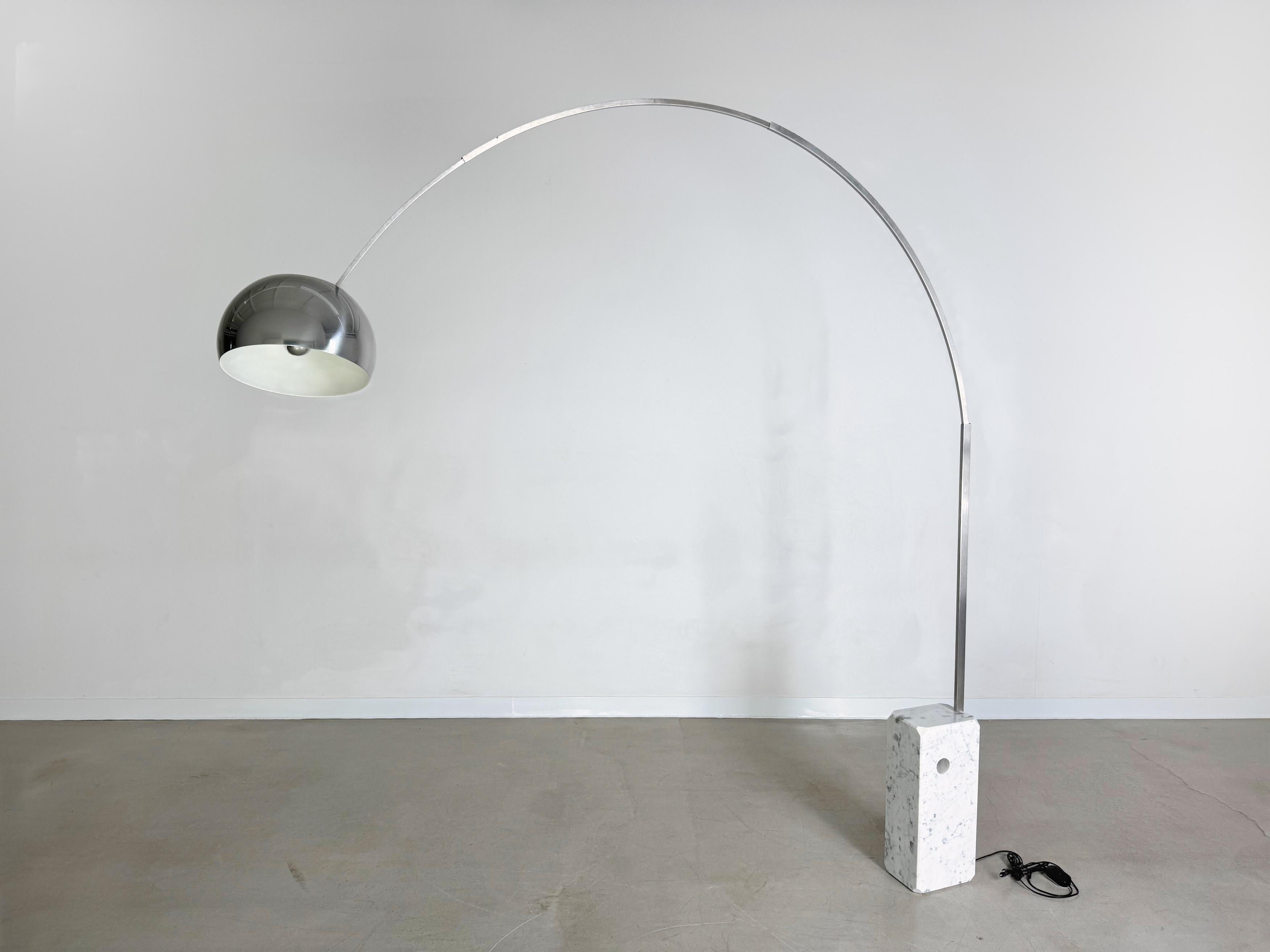
| Arco | 1962 | Flos | Carrara marble base, stainless steel arc, spun aluminium shade | Ceiling-free pendant over a dining table |
| Toio | 1962 | Flos | Car headlamp, telescopic steel stem, exposed transformer | Exposed-component uplighter |
| Taccia | 1962 | Flos | Finned aluminium column, blown-glass bowl, metal reflector | Heat-shedding table lamp with rotatable reflector |
| Allunaggio | 1965 | Zanotta | Anodised aluminium seat, tubular tripod legs | Outdoor stool for sitting on grass |
| Snoopy | 1967 | Flos | Carrara marble cylinder, enamelled metal dome | Marble-base reading lamp named for a cartoon dog |
| Parentesi | 1971 | Flos | Floor-to-ceiling steel cable, sliding bracket spotlight | Ceiling-anchored sliding spotlight; Compasso d’Oro 1979 |
Five Flos lamps cluster on 1962 and 1967; three Zanotta seats cluster on 1957 and 1965; one Flos lamp opens the line in 1951; one outlier vacuum sits at REM in 1956; one Flos lamp closes the line in 1971 with a second author beside Achille. The table is the cleanest way to read the catalogue, and the rest of this article walks down its rows.
Tubino 1951 and Luminator 1955: The Flos Lamps Before Flos
The first two lamps predate the brand. Flos as a corporate entity is founded in 1962 in Merano by Dino Gavina, Cesare Cassina and Arturo Eisenkeil; Tubino 1951 and Luminator 1955 are designed earlier, for the Milanese lighting workshop and small-batch producer environment that would later be absorbed into Flos’s catalogue. The two objects entered Flos production at the moment the company existed to receive them.
Tubino, 1951, is an articulated task lamp built around a single linear fluorescent tube — at the time an industrial light source associated with factories and offices, not with the desk lamp. The brothers exposed the tube horizontally inside a painted-metal frame and articulated it on a counterweighted arm, so the lamp behaved like a draughtsman’s tool rather than a furnishing. Tubino is the first Castiglioni object and the first declaration of method: take an industrial component, leave it visible, and let the joint and the counterweight carry the formal weight that ornament would otherwise have to provide.
Luminator, 1955, is the inverse object. Where Tubino spreads its light horizontally across a desk, Luminator throws a single point of light at the ceiling. The body is a slender enamelled-steel tube with a tripod at the floor and a recessed bulb at the top; the lamp reads, in profile, as a vertical line. The 1955 jury of the second Compasso d’Oro awarded it the prize. Luminator is the first object the Castiglioni partnership won the Compasso for, and it is the first lamp in the catalogue to behave architecturally — a floor-to-ceiling vertical that organises a room rather than a desk.
The two early lamps establish two of the three gestures that recur for twenty years: the exposed industrial component (Tubino) and the architectural verticality (Luminator). The third gesture — the readymade — arrives the following year, in a different object category, for a different publisher.
Spalter 1956: The Outlier Vacuum at REM
Spalter, 1956, is the one object in the eleven not produced by Flos or Zanotta. It is a household vacuum cleaner for the Milan firm REM, co-credited to all three brothers — Livio, Pier Giacomo, and Achille — and it is the last project Livio signed with his younger brothers before his independent practice took over.
The object is functionally radical. Where every postwar domestic vacuum was a wheeled canister dragged behind the user, Spalter is shoulder-worn. Its name contracts the Italian Spalla-Terra (“shoulder to floor”); the body is a nylon shell with a leather strap that doubles as carrying harness, handle, and fastener; the chassis has no wheels — it glides like a sled across carpet and rides on felt skids over hard floors. The user wears the machine the way one wears a satchel and pushes the suction nozzle around the room without dragging a canister behind. Spalter is held today in the Collezione Triennale Milano at Triennale di Milano, the institutional record that it counts as a permanent fixture of Italian design history rather than as a discontinued appliance.
Spalter matters in this article for two reasons. It is the proof that Castiglioni objects were not confined to lighting and seating, and it is the bridge between the early Phonola work of Livio and Pier Giacomo and the catalogue Achille and Pier Giacomo would build alone over the next twelve years. It is also, by 1956, the last time the three brothers’ names appear together on a credit line.
Mezzadro and Sella 1957: The Zanotta Readymades
The pair of objects designed in 1957 for Zanotta is the moment the Castiglioni argument about the readymade enters the seating catalogue. Aurelio Zanotta’s firm — founded 1954 in Nova Milanese — would publish them, but not immediately. Mezzadro was designed in 1957 and only entered Zanotta production in 1971; Sella was prototyped 1957 and produced shortly after. The fourteen-year gap on Mezzadro is itself a piece of evidence about how slowly the Italian furniture industry accepted what the brothers were proposing.
Mezzadro, 1957, is the canonical Castiglioni readymade. The seat is a stamped-metal agricultural tractor seat — bought off the shelf from a farm-machinery supplier, not redesigned — mounted on a cantilevered chromed-steel stem that bolts to a beechwood foot. The name means “sharecropper” in Italian. The object is a seat in the literal sense: an actual industrial seat, designed for a farmer’s body on a tractor, lifted out of the agricultural supply chain and placed in the living room. The argument is that the formal solution had already been engineered in another industry, and the designer’s task was to recognise it, not to redesign it.
Sella, 1957, applies the same logic to the bicycle saddle. A leather racing saddle sits atop a steel rod, which terminates in a cast-iron hemispherical base; the base rocks. The intended use is short standing-height telephone calls — the user perches, takes the call, and rocks gently while standing. Sella is the readymade scaled to a specific domestic gesture (the postwar telephone perch) that no other piece of furniture had identified as a category. It is also the first Castiglioni object to make the readymade comic: the bicycle saddle is funny in the living room, and the brothers knew it.
The Zanotta readymades complete the second of the three Castiglioni gestures and they confirm the brothers were not lighting designers who occasionally made furniture. They were object designers whose preferred verbs — expose, lift, reuse — translated across categories without losing meaning.
1962: Three Castiglioni Objects at Flos in a Single Year
1962 is the densest year in the catalogue. Flos is founded by Dino Gavina in Merano with Arturo Eisenkeil and Cesare Cassina; in the same year, the new house puts three Castiglioni lamps into production. The three are stylistically distinct — one architectural, one industrial-exposed, one heat-managed — and together they constitute the Castiglioni argument at its most mature.
Arco, 1962, is the canonical object. A block of Carrara marble — rectangular, weighty, drilled with a finger hole so it can be moved with a broom handle — anchors a cantilevered stainless-steel arc that springs out and over, terminating in a perforated spun-aluminium shade hanging 241.5 cm above the floor. The brief is functional: light a dining table without a ceiling fixture. The solution is architectural: a marble counterweight and a steel cantilever that suspends a pendant above the table from the floor, not from the ceiling. Arco has been in continuous Flos production since 1962 and is the single most reproduced postwar Italian lamp; it is the object that taught the Castiglioni studio that a piece of marble could behave as a structural component rather than as a luxurious surface.
Toio, 1962, is the same year’s exposed-industrial sibling. The lamp is built around an automotive headlamp — a real car headlight, bought from a supplier — mounted on a telescopic painted-steel stem; the electrical transformer sits at the base, visible, with the cable wound around the column on small fishing-rod loops. Nothing is concealed. The transformer is the object’s foot; the headlamp is the object’s head; the cable is the object’s spine. Toio reads as a kit-of-parts assembled in a workshop rather than a designed lamp, and that is exactly the point. The argument made by Mezzadro in the seating catalogue is made again by Toio in the lighting catalogue, in the same year that Arco proves the brothers could still do architectural composition when they wanted to.
Taccia, 1962, is the third 1962 Flos lamp and the most engineering-driven of the three. The body is a finned aluminium column designed to dissipate the heat of the high-wattage bulb inside; on top of the column sits a hand-blown glass bowl, and resting in the bowl is an inverted aluminium reflector. The reflector is not fixed. The user lifts it, rotates it, sets it back into the glass at any angle, and the lamp throws light in the chosen direction by indirect reflection. Taccia is the only 1962 Flos lamp whose primary innovation is thermal — the fins exist because the bulb runs hot — and the only one in which the user is meant to handle the optical component every time the room reorients.
Three lamps, one year, three categories: architecture (Arco), readymade (Toio), engineering (Taccia). The cluster confirms that by 1962 the Castiglioni studio could deploy any of its three gestures at will and could publish them simultaneously through a single house that had only just opened its doors.
Allunaggio 1965: The Zanotta Object That Names the Moon
Allunaggio, 1965, is the second-to-last Zanotta object in the catalogue and the only one to name a specific event in world history. The Italian word allunaggio means “moon landing.” The stool was designed four years before Apollo 11, in a period when the European press was already publishing rocket diagrams weekly, and the form is unmistakable: three splayed tubular aluminium legs ending in broad disc feet, a low triangular anodised seat, the whole assembly proportioned like a lunar lander module set down on a lawn.
The functional brief is outdoor. The stool is intended for sitting in a garden, on grass, at a low height — the splayed legs distribute load on soft ground, the disc feet do not sink, the seat does not stain. The Castiglioni gesture is to take the iconographic image of the era (the lunar module) and to deliver it as a piece of garden furniture, four years before the actual landing made the image canonical. By 1969, when Allunaggio’s name had become literal, the object had been in the Zanotta catalogue for four years.
Snoopy 1967: The Marble-Base Reading Lamp at Flos
Snoopy, 1967, is the last lamp Pier Giacomo signs before his death the following year, and it is the object that proves the marble base of Arco was a serial component, not a one-off. The base is again a cylinder of white Carrara marble; on top of it sits a glossy enamelled metal dome that throws light downward through a circular aperture in the base of the dome onto the surface beneath. The silhouette — a black dome on a marble cylinder, with the dome reading as a head and the cylinder as a neck — recalls the cartoonist Charles Schulz’s beagle, and the brothers named the lamp accordingly.
Snoopy compresses what Arco distributed across two and a half metres into a single tabletop object. The marble is no longer a counterweight; it is the lamp’s body. The reflector is no longer suspended at the end of an arc; it sits directly on top of the marble. The argument is that the Castiglioni vocabulary scales — the same materials that produced an architectural floor lamp can produce a domestic reading lamp without losing identity. Pier Giacomo dies in 1968. After Snoopy, the partnership is over.
Parentesi 1971: Pio Manzù and the Last Object in the Sequence
Parentesi, 1971, is co-authored. The credit line reads Achille Castiglioni and Pio Manzù, and the object closes the eleven-piece sequence three years after Pier Giacomo’s death. Manzù — son of the sculptor Giacomo Manzù, automotive designer at Fiat’s Centro Stile, the designer of the 1968 Fiat 127 — had been developing the lamp’s central idea (a sliding bracket on a vertical wire) when he was killed in a car crash in May 1969 at age 30. Achille completed the design and brought it to Flos in 1971.
The mechanism is elegant. A single thin steel cable runs from floor to ceiling, tensioned by a weight at the bottom. A bracket-shaped spotlight grips the cable and slides along it, held in any position by friction; the user moves the bracket up and down the cable by hand. The lamp has no shaft, no column, no fixture: it occupies a vertical line of air between floor and ceiling, and the only solid components are the cable, the bracket, and the bulb. Parentesi was awarded the Compasso d’Oro in 1979 — Achille’s sixth, and the last to recognise a 1971 design as the culmination of the studio’s argument.
Parentesi is the closing parenthesis of the title. Twenty years after the Tubino fluorescent tube of 1951 reorganised the task lamp around an industrial component, the Parentesi steel cable reorganises the entire room around a tensioned wire. Both objects keep their components visible. Both are still in continuous production at Flos. The sequence reads as a single argument with a clean opening and a clean close.
Why These Castiglioni Objects Held: Flos, Zanotta, and the Catalogue
The reason eleven domestic objects designed between 1951 and 1971 still occupy the front rows of the Flos and Zanotta catalogues in 2026 is not nostalgia. It is the fact that the brothers chose two publishers — Flos for lighting, Zanotta for seating — whose entire catalogue logic was to keep small-series, design-led objects in continuous production rather than to refresh them seasonally. Flos has carried Arco continuously since 1962. Zanotta has carried Mezzadro continuously since 1971. The catalogues of both houses, fifty and sixty years on, are still organised around objects the Castiglioni studio drew between 1951 and 1971.
The Castiglioni catalogue also held because the brothers were systematic about which publisher got which gesture. Flos received the lamps — the linear fluorescent of Tubino, the upright cylinder of Luminator, the marble counterweight of Arco, the exposed transformer of Toio, the rotatable reflector of Taccia, the marble cylinder of Snoopy, the floor-to-ceiling cable of Parentesi. Zanotta received the seating — the tractor seat of Mezzadro, the bicycle saddle of Sella, the lunar tripod of Allunaggio. The vacuum cleaner for REM and the suspension lamp with Manzù are the two outliers that mark, respectively, the end of the three-brother phase in 1956 and the end of the two-brother phase in 1971. Reading the catalogue back from 2026, the division is so clean it looks deliberate — and it was.
Italian postwar design did not converge on a single publisher or a single object type. It converged on a small group of designers who picked their publishers carefully and kept producing for the same houses for decades. The Castiglioni studio is the cleanest case: two brothers, two main publishers, eleven objects, two decades. The broader argument is laid out in our Italian Radical Design lineage, where the Florentine collectives of the 1960s pursue a different version of the same critique — the object refusing the structural logic of its category — that the Castiglioni studio had been making at Flos and Zanotta since 1951. The Mollino designs Zanotta won the licence to manufacture in 2026, documented in our Carlo Mollino at Zanotta piece, fit the same publisher-catalogue logic: a single house keeping a single designer’s work in production across decades.
The Castiglioni studio is not, in 2026, a heritage brand. It is an active argument about what a domestic object should contain — and it still settles, every time, on a tractor seat, a marble counterweight, a steel cable, or a single fluorescent tube left visible. The eleven objects between 1951 and 1971 are how that argument got built; the Flos and Zanotta catalogues are how it stayed in print.