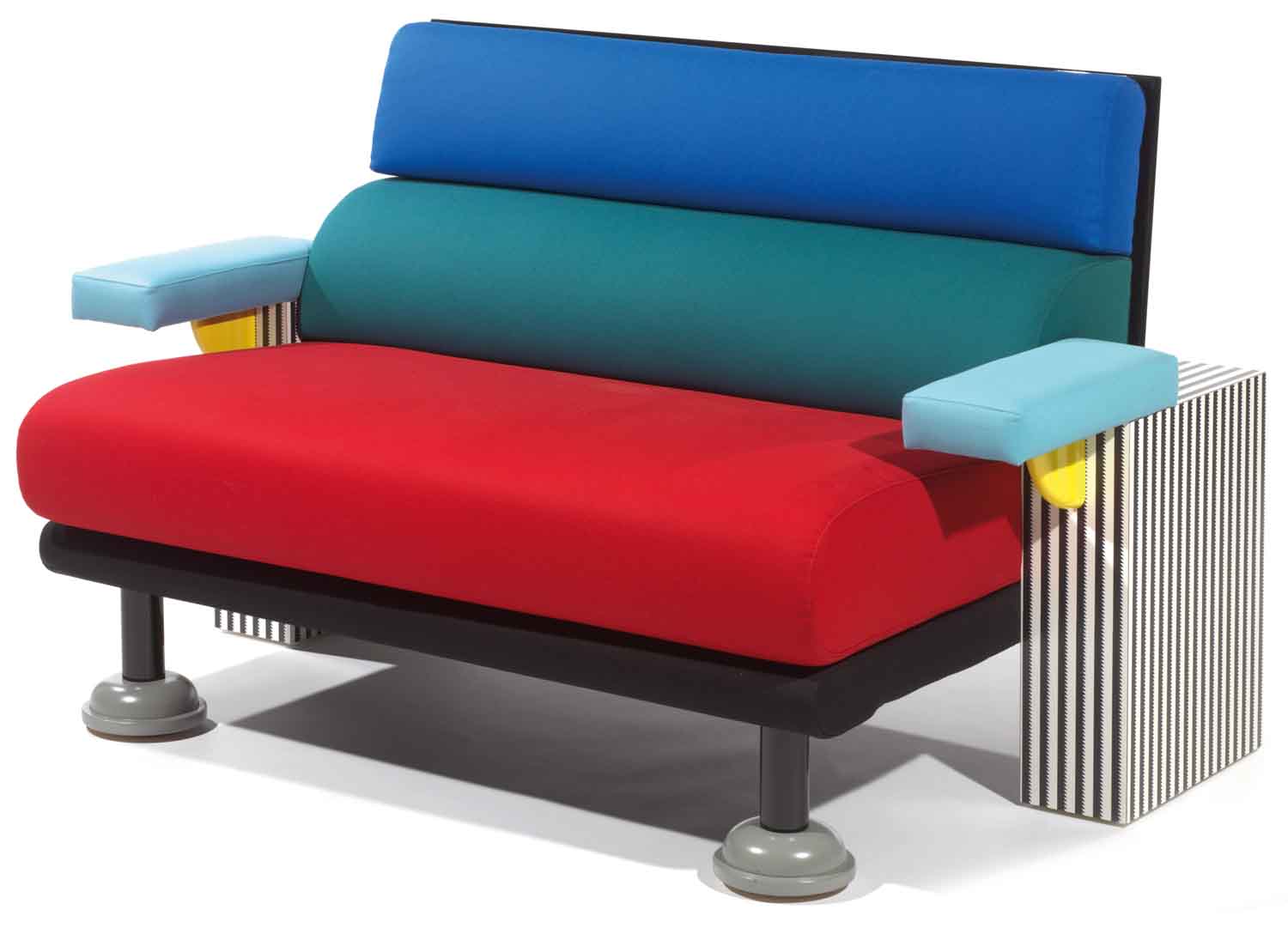
Italian radical design begins in Pistoia in December 1966, when Archizoom Associati and Superstudio mount Superarchitettura in two rooms of a provincial gallery and publish a founding statement against the modernist project. The movement runs for roughly thirty years from that exhibition to the opening of the Groninger Museum in 1994, passes through three distinct organisational forms — the Florentine collectives of 1966–1974, the Milanese teaching networks of Global Tools and Studio Alchimia in 1973–1980, and Memphis Milano in 1980–1988 — and is carried throughout by three protagonists whose careers overlap and intersect: Andrea Branzi, Ettore Sottsass, and Alessandro Mendini. The shape of the answer is a lineage, not a school. There is no single manifesto and no single object. There is a chain of groups, magazines, exhibitions and pieces of furniture in which each generation re-stages the argument of the previous one with different materials, different cities and different enemies.
This article reconstructs that lineage from the primary nodes attested in the graph: the founding of Archizoom and Superstudio in Florence in 1966, the Superonda sofa of 1967, the Continuous Monument of 1969 and Quaderna table of 1970, the founding of UFO and Gruppo 9999, MoMA’s 1972 “Italy: The New Domestic Landscape”, Global Tools in 1973, Mendini’s Lassù in 1974, the Proust Armchair in 1978, Memphis’s December 1980 founding and 1981 debut with Carlton, Casablanca and Tahiti, the Domus Academy in 1982, and the Groninger Museum delivered in 1994. The thesis is that Italian radical design is not a style — it is the longest sustained refusal in twentieth-century design to treat the object as a neutral instrument of function, and it is operated by a small, identifiable group of people working in two cities.
Florence 1966–1974: Archizoom and Superstudio
The two founding collectives are formed in the same city, in the same year, by architecture students from the same university. Archizoom Associati is founded in Florence in 1966 by Andrea Branzi, Gilberto Corretti, Paolo Deganello and Massimo Morozzi; the brothers Dario and Lucia Bartolini join in 1968. Superstudio is founded in Florence in 1966 by Adolfo Natalini and Cristiano Toraldo di Francia, and is later joined by Gian Piero Frassinelli, the brothers Alessandro and Roberto Magris, and Alessandro Poli. The two groups know each other; they share teachers, magazines and exhibition spaces, and their first joint act is to organise Superarchitettura in Pistoia in December 1966 — a small, deliberately provincial show that functions as the founding statement of the movement and that is read, retrospectively, as the moment Italian radical design begins.
The Pistoia statement is anti-functionalist. Superarchitettura is the architecture “of superproduction, of superconsumption, of superinduction to consumption, of the supermarket, of the superman and of super-petrol.” The tone is ironic but the targets are real: Ulm, the Hochschule für Gestaltung, the entire Bauhaus inheritance as it had been received into Italian industry through Olivetti and the Milanese furniture industry of the 1950s. Where modernism had argued that good design followed from rational analysis of need, the Florentines argue that need itself is manufactured, that consumption is the operating logic of postwar Italian life, and that the designer’s task is not to refine the object but to expose the conditions under which the object is produced.
The first piece of furniture to come out of this argument is the Superonda, designed by Branzi for Archizoom in 1967 and produced by Poltronova. It is a sofa made from a single block of polyurethane foam cut along a sinuous wave so that it splits into two complementary pieces that can be assembled in multiple positions. The Superonda is not a sofa in the modernist sense. It has no internal frame, no traditional upholstery, no four legs. It is a slab of industrial foam covered in glossy vinyl, and its formal language is closer to Pop sculpture than to the Cassina catalogue. It is the first object in the lineage and it sets the rule: the radical object refuses the structural logic of its category.
Superstudio’s contribution to the 1969 moment is the Continuous Monument, a photomontage project that proposes a single continuous architectural form — a white, gridded prism — extending across landscapes, oceans and cities. The Continuous Monument is not a building. It is a critique of building delivered in the form of a building, an argument that the modernist promise of universal architecture has produced, in fact, a universal grid that erases site, climate and culture. The grid returns the following year as the Quaderna table of 1970 — a laminate-clad table whose surface is printed with a regular black grid on white, the architectural critique compressed into a piece of furniture you can buy from Zanotta. The Quaderna remains in production. The Continuous Monument never built a square metre.
Two further Florentine collectives complete the founding generation. UFO is founded in Florence in 1967 by Carlo Bachi, Lapo Binazzi, Patrizia Cammeo, Riccardo Foresi and Titti Maschietto, under the supervision of Umberto Eco at the University of Florence; the group’s work is performance-oriented, semiotically literate, and built around inflatables and signage. Gruppo 9999 is founded in Florence in 1968 by Giorgio Birelli, Carlo Caldini, Fabrizio Fiumi and Paolo Galli, and in 1969 opens Space Electronic, a discotheque in a former mechanic’s workshop that doubles as an architecture school. In 1972, Gruppo 9999 co-wins the design competition for MoMA’s “Italy: The New Domestic Landscape”, the New York exhibition that introduces the Italian radical movement to an American audience and frames it, for the first time, as a coherent body of work.
The Florentine cycle closes in 1974. Archizoom dissolves that year. Mendini, working from Milan, designs Lassù — a small wooden chair that he takes into the countryside and ritually burns, with the act documented and published in Casabella, the magazine he has been editing since 1970. The image of a designer destroying his own object is the closing punctuation of the first phase. The Florentine collectives, whose argument had been that the object is overdetermined by consumption, end the phase by burning the object. Superstudio dissolves in 1978.
Milan 1973–1976: Global Tools and the magazine years
The bridge between the Florentine collectives and the Milanese movement is built through magazines and through one short-lived teaching network. Global Tools is founded in 1973 as a meta-organisation — a “school without students or teachers” — by Archizoom, Superstudio, UFO, Mendini, Sottsass, Branzi, Gaetano Pesce, Riccardo Dalisi and Ugo La Pietra. The premise of Global Tools is that craft, the body and the artisanal gesture have been written out of industrial design and need to be re-introduced as legitimate design materials. The organisation produces seminars, publications and a small body of experimental work; it dissolves in 1975 without leaving an institutional infrastructure. Its importance is symbolic. Global Tools is the first time the Florentine and Milanese strands acknowledge each other as a single movement, and it is the first time Sottsass and Mendini are listed as participants in the same project.
The vehicle that carries the argument through the 1970s is the magazine. Mendini edits Casabella from 1970 to 1976, then founds Modo in 1976, then is appointed by Gio Ponti to edit Domus from 1979 to 1985. The three editorships function as a continuous platform: Casabella gives him the architectural establishment, Modo gives him an independent voice, Domus gives him the international stage. The Lassù burning is published in Casabella in 1974. The arguments for Studio Alchimia and against Memphis are rehearsed in Modo. The Proust Armchair, the Bau.Haus collections, and the entire vocabulary of “banal design” enter the international design conversation through Domus during Mendini’s editorship.
Branzi follows a parallel trajectory through Milan in the same years. After Archizoom dissolves in 1974 he moves to Milan, writes the founding texts of what becomes known as the New Design, and wins the Compasso d’Oro for the first time in 1979. The Compasso, awarded for design research rather than for a specific product, is the first official recognition by the Italian design establishment that the radical critique is now part of the mainstream conversation rather than outside it. Branzi will win it again in 2005.
Studio Alchimia 1976–1981
Studio Alchimia is founded in Milan in 1976 by Alessandro Guerriero and his sister Adriana. The first furniture collection, Bau.Haus uno, appears in 1978 — the name is a calculated provocation, an explicit appropriation of the Bauhaus brand for a project whose stated intention is to refuse Bauhaus discipline. Mendini joins Alchimia as a partner in 1978 and, the same year, produces the Proust Armchair — a baroque armchair, sourced from a French market, hand-painted in a pointillist pattern derived from a Signac landscape. The Proust is the central object of the Alchimia phase. It is a piece of furniture that already exists, that the designer does not redesign but redecorates, and that takes its name from a novelist rather than from a function. Every assumption of modernist design — that form follows function, that ornament is crime, that the designer originates the object — is suspended.
Alchimia is awarded the Compasso d’Oro in 1981 for design research. The award arrives in the same year that Memphis debuts in Milan with its Salone presentation, and it is the high point of the Alchimia phase: an institutional endorsement of the redecoration argument at the exact moment Sottsass departs with most of the Alchimia network to form a different organisation.
Memphis Milano 1980–1988
Memphis Milano is founded by Ettore Sottsass on 11 December 1980 in his Milan apartment, with an inaugural meeting of designers that includes Michele De Lucchi, Aldo Cibic, Marco Zanini, Matteo Thun and Martine Bedin. Memphis debuts at the Salone del Mobile in September 1981 with a collection of furniture, lighting and ceramic objects that becomes, almost overnight, the most internationally photographed body of work in postwar Italian design. The roster expands quickly: George Sowden, Nathalie Du Pasquier, Peter Shire from Los Angeles, Michael Graves from Princeton, Shiro Kuramata from Tokyo. Mendini contributes individual pieces. The group is active for seven years, dissolving in 1988.
The 1981 debut produces three Sottsass objects that define the visual grammar of the movement and that remain the most-cited Memphis pieces. The Carlton is a room divider rendered as a cartoon of a bookshelf: angled supports, coloured laminate, no rationalisable storage logic. The Casablanca is a sideboard in the same anthropomorphic mode, clad in the Bacterio plastic laminate that Sottsass designs with Nathalie Du Pasquier — a pattern of irregular black dots on white that becomes the period’s signature surface. The Tahiti is a desk lamp shaped as a stylised bird, its head a tilted shade and its body a triangulated post in coloured laminate. The three objects are produced by Memphis itself rather than by an industrial partner, and they establish the rule of the second phase: Italian radical design now produces actual furniture, in actual editions, sold through actual showrooms, while continuing to refuse the modernist categories the furniture industry was built on.
The argument of Memphis is not the same as the argument of Alchimia, and Mendini and Sottsass diverge on this point. Mendini’s project, through Alchimia, is the redecoration of a generic industrial object; Sottsass’s project, through Memphis, is the design of new objects that look like nothing in the industrial catalogue. Mendini works with what exists; Sottsass produces what does not exist. The distinction matters because it determines the legacy. Memphis is the version of Italian radical design that enters the museum collections and the secondary market; Alchimia is the version that enters the curatorial and critical literature.
After Memphis: Branzi, Mendini and the Domus Academy
The third institutional form of the lineage is educational. Domus Academy is founded in Milan in 1982 as Italy’s first postgraduate design school. Mendini is among the co-founders; Branzi serves as cultural director for the first ten years. The Academy is the moment the radical operating system is formally absorbed into the structure of Italian design education, with the same generation that had spent the 1960s burning chairs now writing curricula for designers who will work in the 1990s and 2000s. The pedagogical model — project-based, theory-heavy, international in recruitment — becomes the template for postgraduate design schools across Europe.
The closing public statement of the lineage is architectural. Mendini designs the Groninger Museum in the Netherlands in 1989; the building opens in 1994 with three pavilions designed by collaborators — Philippe Starck, Michele De Lucchi and Coop Himmelb(l)au. The Groninger is a museum that argues against the museum: a polychrome, fragmented complex of contrasting volumes set on a canal, refusing the institutional neutrality that had been the modernist museum’s default position from the Stedelijk to the Whitney. The decision to give pavilions to other designers rather than to design the whole as a single signature object is itself a radical move — the museum as a collective rather than as an authorial statement.
After 1994, the protagonists continue to work but the movement, as a coherent lineage, closes. Sottsass dies in 2007. Branzi dies in 2023. Mendini dies in 2019. The institutional infrastructure — Domus Academy, the Triennale di Milano archives, the Alessandro Mendini Archive run by his daughters Elisa and Fulvia, the Memphis Milano brand — outlives the founders, and the 2026 archive cycle in Milan and at Lake Maggiore is the first major retrospective moment in which the lineage is being read as a whole rather than as separate careers.
Timeline: 1966–1994
| Year | Group or Person | Work or Event | City |
|---|---|---|---|
| 1966 | Archizoom Associati | Founded by Branzi, Corretti, Deganello, Morozzi | Florence |
| 1966 | Superstudio | Founded by Natalini and Toraldo di Francia | Florence |
| 1966 | Archizoom + Superstudio | Superarchitettura exhibition, founding statement | Pistoia |
| 1967 | Andrea Branzi / Archizoom | Superonda sofa, produced by Poltronova | Florence |
| 1967 | UFO | Founded under Umberto Eco at University of Florence | Florence |
| 1968 | Gruppo 9999 | Founded by Birelli, Caldini, Fiumi, Galli | Florence |
| 1969 | Superstudio | Continuous Monument photomontage project | Florence |
| 1969 | Gruppo 9999 | Space Electronic discotheque / architecture school | Florence |
| 1970 | Superstudio | Quaderna table, gridded laminate, Zanotta | Florence |
| 1970 | Alessandro Mendini | Begins editing Casabella | Milan |
| 1972 | Gruppo 9999 | Co-wins MoMA “Italy: The New Domestic Landscape” competition | New York |
| 1973 | Global Tools | Founded by Archizoom, Superstudio, UFO, Mendini, Sottsass, Branzi, Pesce, Dalisi, La Pietra | Milan |
| 1974 | Archizoom | Dissolved | Florence |
| 1974 | Alessandro Mendini | Lassù chair, ritually burned, act published in Casabella | Milan |
| 1975 | Global Tools | Dissolved | Milan |
| 1976 | Studio Alchimia | Founded by Alessandro and Adriana Guerriero | Milan |
| 1976 | Alessandro Mendini | Founds Modo magazine | Milan |
| 1978 | Studio Alchimia | Bau.Haus uno first furniture collection | Milan |
| 1978 | Alessandro Mendini | Joins Alchimia as partner; Proust Armchair | Milan |
| 1978 | Superstudio | Dissolved | Florence |
| 1979 | Andrea Branzi | First Compasso d’Oro for design research | Milan |
| 1979 | Alessandro Mendini | Appointed editor of Domus by Gio Ponti | Milan |
| 1980 | Memphis Milano | Founded by Sottsass, 11 December | Milan |
| 1981 | Memphis Milano | Debut at Salone del Mobile; Carlton, Casablanca, Tahiti | Milan |
| 1981 | Studio Alchimia | Compasso d’Oro for design research | Milan |
| 1982 | Domus Academy | Founded; Mendini co-founder, Branzi cultural director | Milan |
| 1985 | Alessandro Mendini | Closes Domus editorship | Milan |
| 1988 | Memphis Milano | Dissolved | Milan |
| 1989 | Alessandro Mendini | Designs Groninger Museum | Groningen |
| 1994 | Alessandro Mendini | Groninger Museum opens with pavilions by Starck, De Lucchi, Coop Himmelb(l)au | Groningen |
The shape of the argument
The lineage moves through three cities and three institutional forms, but it makes one continuous argument. The argument is that the object — the chair, the sideboard, the lamp, the magazine cover, the museum building — is the place where the assumptions of postwar consumer society are made visible, and that the designer’s task is to make those assumptions visible rather than to disguise them as function. In Florence in 1967, Branzi makes that argument by designing a sofa that refuses to be a sofa. In Milan in 1974, Mendini makes it by burning his chair. In Milan in 1978, he makes it again by buying a French armchair and painting it in pointillist dots. In Milan in 1981, Sottsass makes it by designing a bookshelf that looks like a child’s drawing of a bookshelf. In Groningen in 1994, Mendini makes it by designing a museum that looks like a collection of buildings none of which is the museum.
The objects are different. The argument is the same. What changes across thirty years is the institutional vehicle: a Florentine collective in 1966, a teaching network in 1973, a Milanese brand in 1980, a postgraduate school in 1982, a public museum in 1994. Italian radical design is the lineage that absorbs every available institutional form — the magazine, the manifesto, the exhibition, the furniture company, the school, the museum — and uses each of them to make the same case against the modernist contract. It is the longest sustained design argument of the postwar period. It is finishing now, in the 2026 archive cycle, because the people who made it are dead and because the institutions they built are old enough to need retrospectives. The argument itself — that the object is not neutral and that consumption is not innocent — has lost none of its force, and is being read, in Pallanza and in Milan this spring, by a generation that has fewer reasons than the Florentines did to believe that good design follows from rational analysis of need.