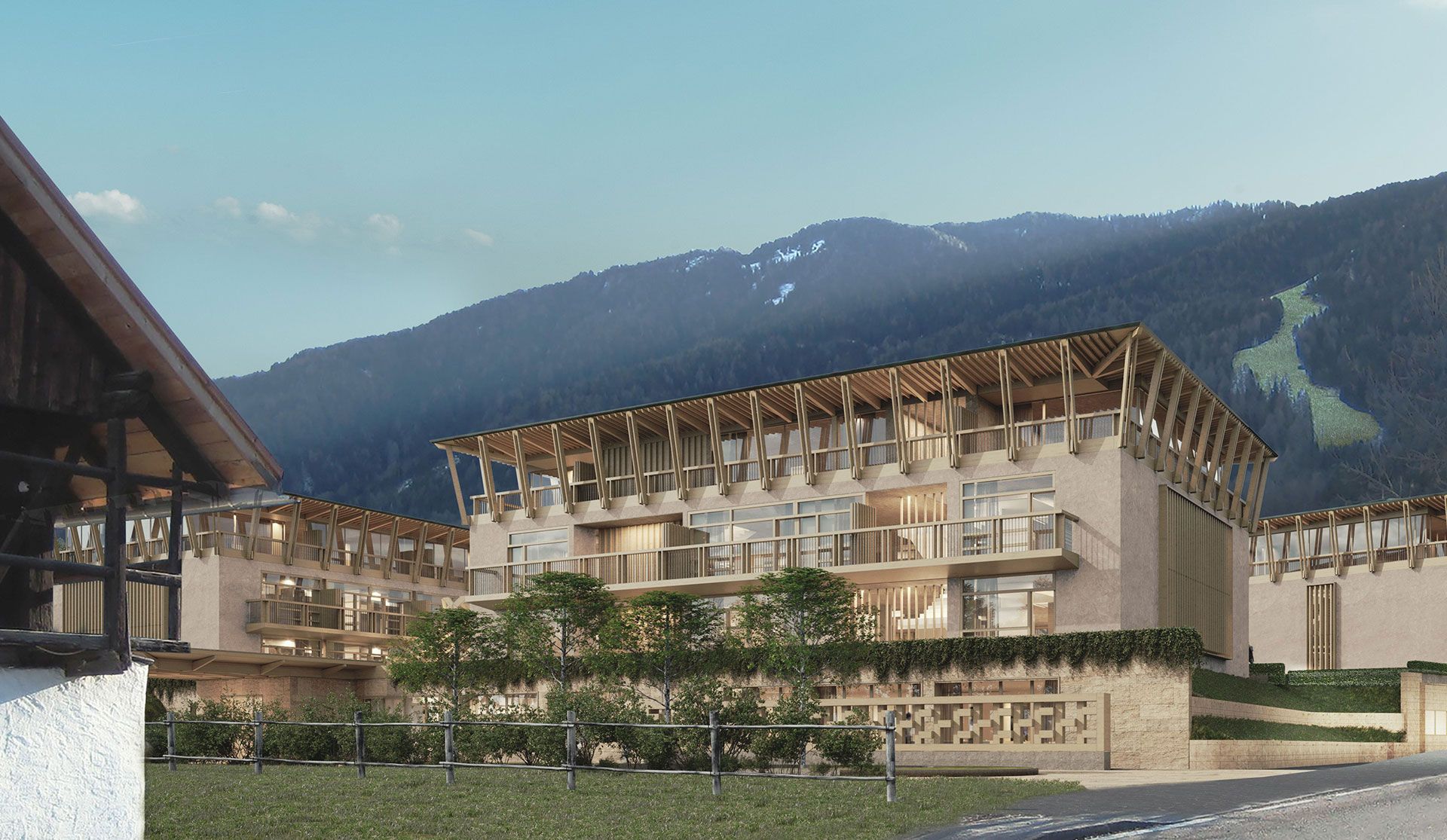
Matteo Thun has spent forty-five years drawing the same line, from the Memphis showroom on Via Solari in Milan in September 1981 to a 24-suite addition to Hotel Bella Vista Trafoi opening in May 2026 at the foot of the Ortler in South Tyrol. Born 17 June 1952 in Bolzano, Thun is one of the very few figures who co-authored the most cited Italian postmodern moment of the 1980s, ran a Vienna ceramics professorship through the 1990s, art-directed Swatch for three years, and then quietly converted the whole CV into a hospitality practice that now operates 70-strong across Matteo Thun & Partners in Milan and Munich. The Trafoi opening, in his birth province, is the closing argument.
This piece reads the Thun cabinet chronologically because the chronology is the argument. Memphis was not a youthful detour later renounced in favour of timber resorts; it was the licensing event that built the production network — fabricators, editors, journalists, hoteliers — Thun would later route through. The early 1980s Memphis pieces and the 2026 Trafoi cladding are, on his account, the same brief: a regional material, a precise edge, a small numbered run, a named commissioner.
Bolzano 1952, Salzburg, Florence 1975
Matteo Thun was born 17 June 1952 in Bolzano — the Italian-administered, German-speaking provincial capital of South Tyrol that would supply, forty years later, the cultural setting for his hospitality book. His mother, Lene Thun, was the South Tyrolean ceramicist whose Bolzano workshop sat behind his early exposure to glazed earthenware as both household object and shippable product. The Thun family ceramics name is not coincidental to the later Memphis vessels or to the Vienna ceramics chair; it is the upstream supply chain.
Thun’s training is the standard postwar dual-track Central European one. He studied painting at the Salzburg Academy of Fine Arts in the late 1960s and early 1970s under Oskar Kokoschka — the Vienna Expressionist then in his eighties — and under the Venetian abstract painter Emilio Vedova. Kokoschka and Vedova are the two names Thun has consistently credited as the structural teachers; the painting training is the reason the later Thun drawings, hospitality elevations included, read as figure-ground compositions rather than as technical sections. He then took an architecture degree at the University of Florence in 1975, in the immediate aftermath of the radical-design moment that had run through Archizoom, Superstudio and Global Tools — the Tuscan environment that would later route him to Sottsass.
The Florence-to-Milan move came in 1978. Thun arrived in Milan at twenty-six, with a Salzburg painting credential, a Florence architecture degree, a South Tyrolean surname and no Lombard production network. The network he joined was Ettore Sottsass’s.
Memphis 1981, Sottsass Associati, and the Via Solari debut
In 1978 Matteo Thun became one of the co-founders of Sottsass Associati, the Milan studio Ettore Sottsass was assembling at the close of his Olivetti consulting decade. Sottsass Associati would consolidate as the legal vehicle for Sottsass’s late-career design output; Thun, Aldo Cibic and Marco Zanini were the named young partners on the masthead. Thun’s specific brief inside the studio was ceramics and product — the family-history hand — though he would also draft on the broader furniture programme.
The Memphis group was decided in Sottsass’s flat on Via San Galdino on 11 December 1980, in the meeting that has become the dated origin event of Italian postmodern design. Thun was in the room. The first Memphis collection — sketched through the winter of 1980-81 and produced through the spring — debuted on 18 September 1981 at the Arc ‘74 showroom on Via Solari 12 in Milan, against the opening of the Salone del Mobile. The 1981 collection ran roughly forty pieces by eleven designers including Sottsass, Thun, Michele De Lucchi, Zanini, Andrea Branzi, Hans Hollein, Shiro Kuramata, Nathalie Du Pasquier and Martine Bedin. Thun’s contributions to the early Memphis catalogue were predominantly ceramics — the Italian radical design lineage cabinet in which he sits is the one Memphis exported.
Memphis matters to the Thun reading because it set every operating constraint Thun would later carry into hospitality. Numbered short runs. Named commissioners. Coloured laminate as a finish equivalent in standing to walnut. A central editor — Renzo Brugola at the workshop, Ernesto Gismondi as financial backer — coordinating fabrication. Thun’s later hotel book treats Swiss pine, fir and oak the way Memphis treated Abet Laminati plastic laminate: as named materials with named suppliers, priced and shipped on a programme.
Thun left the Memphis group at the end of its first chapter and stepped out of Sottsass Associati in 1984 to open his own Milan studio.
Matteo Thun studio 1984, Vienna ceramics chair, Swatch 1990-93
The Matteo Thun studio opened in Milan in 1984. The early-1980s product book ran across Alessi tableware, Memphis-adjacent ceramics, lighting for Arteluce and small furniture editions for Italian editors. The studio at that point was a product practice, not yet an architecture practice; the architecture credential from Florence sat in the drawer.
From 1983 to 2000 — seventeen years overlapping with the studio — Thun held the chair in design and ceramics at the University of Applied Arts Vienna, the Universitat fur angewandte Kunst on Oskarkokoschkaplatz that had been Hollein’s institutional home. The Vienna professorship matters because it tethered Thun to a teaching obligation through the entire postmodern hangover decade. While the Memphis cohort dispersed — Sottsass back to product, De Lucchi to Olivetti and later to architecture, Du Pasquier to painting — Thun spent the 1990s in front of postgraduate ceramics students every term, which is the reason the studio’s material vocabulary deepened in that decade rather than thinning.
In 1990 Thun took the art director role at Swatch, the Biel-based Swiss watch group then under Nicolas Hayek. The Swatch tenure ran three years to 1993 and covered the period in which the brand consolidated its 1980s plastic-watch graphics programme into a designer-collaboration model. The Swatch role is the structural antecedent for the Hugo Boss commission that would arrive thirteen years later: it was the first time Thun took an art-direction brief from a Swiss corporate client at scale, and it credentialled the studio inside the German-language industrial network that would later commission Coldrerio.
The 1984-2000 window therefore reads as the bridge phase. Product, ceramics, watch graphics, Vienna teaching. No hotels yet. The architecture credential remained dormant until 2001.
Side Hotel Hamburg 2001 and the pivot to hospitality
The pivot is dated. Side Hotel Hamburg, completed in 2001 on Drehbahn in central Hamburg, is consistently named as the first Matteo Thun hospitality project of consequence. The brief was a city hotel with a Stadtpalais facade designed by the German architect Jan Stormer; Thun took the interior architecture, the colour programme and the lobby installation, including a light installation by Robert Wilson that became the project’s marketing image.
Side Hotel mattered for three reasons. It moved Thun from product to interior architecture at scale. It located the studio’s first hospitality reference in Germany rather than Italy, which would set the next twenty years of commissions — Hamburg, Munich, the Black Forest, Burgenstock — disproportionately on the German-speaking client side. And it proved out the Thun thesis that a hotel could be commissioned as a coordinated material programme rather than as a decorated container, which is the thesis his entire subsequent book defends.
The Hamburg job was followed almost immediately by the project that would become the Thun signature reference for the next two decades. In 2003 Matteo Thun completed Vigilius Mountain Resort on Monte San Vigilio above Lana, in South Tyrol.
Vigilius Mountain Resort 2003: the signature reference
Vigilius is the Thun building everybody cites. It sits at 1,500 metres on Monte San Vigilio above the South Tyrolean spa town of Lana, on a wooded ridge of the Texelgruppe massif. The site is car-free; the resort can only be reached by the historic 1912 Lana-Vigiljoch cable car — one of the oldest aerial tramways in continuous service in the Alps — which is itself part of the brief.
The building is a 41-room horizontal larch-clad bar sliced into the ridge, with a single long corridor running north-south and the public spaces — restaurant, library, spa — strung off it. The cladding is local larch, weathered to a silver-grey within two seasons; the structure is a hybrid of timber and concrete; the heating runs off a wood-chip plant fed from the surrounding forest. The Vigilius thesis is that a contemporary hotel can be a long horizontal line laid into a mountain ridge — that the alpine vernacular reference is not the steep-gabled chalet but the larch bar — and that the absence of cars is a programmatic feature, not a logistics problem.
Vigilius opened to immediate critical reception and was cited through the 2000s in the German, Italian and English design press as one of the defining alpine hotels of the decade. It set every parameter the Thun studio would carry into the next twenty hospitality jobs: local timber as primary cladding, low horizontal massing, the lobby reading as a long room rather than as a check-in counter, a wellness programme that uses regional water and herbs as named ingredients. Twenty-three years later, the Trafoi expansion will reuse the same material list with one substitution.
Hugo Boss Coldrerio 2006 and the corporate book
Between the Vigilius opening and the Venice resort, Thun ran a parallel corporate-architecture book that is less visible in the hospitality coverage but underwrites the studio’s balance sheet. The headline reference is Hugo Boss Headquarters Coldrerio, completed in 2006 in the Ticino village of Coldrerio just north of the Italian-Swiss border at Chiasso.
The Coldrerio brief was a manufacturing and logistics headquarters for Hugo Boss’s shirts business — a low long building set into the Ticino agricultural plain, with a white louvred facade reading as a continuous slatted screen above a glazed ground floor. The Boss commission is the structural payoff of the 1990-93 Swatch art-direction tenure: the studio was, by 2006, the obvious choice for a German-speaking corporate client requiring a Swiss-Italian border facility, a constituency the Memphis-Vienna-Milan track-record uniquely fit.
The Coldrerio building also proved out a quieter Thun position. The studio could deliver a 30,000-square-metre corporate facility on a Swiss programme and budget without abandoning the material vocabulary — timber, local stone, white-painted timber screens — that the hospitality book was building. The Coldrerio facade is, at the level of detail, the same screen-and-mass logic the resort book uses; it is simply applied to a logistics shed rather than to a guest wing. The corporate book is where the studio learned to industrialise the regionalist detail.
JW Marriott Venice 2015: the island resort
By the mid-2010s the studio was working at international resort scale. JW Marriott Venice Resort + Spa opened in 2015 on Isola delle Rose, a private island of about sixteen hectares in the Venetian lagoon south of San Marco, reached only by a complimentary boat shuttle from the Marittima cruise terminal and from Piazza San Marco.
The island had been a 19th-century military and sanitary station; the existing building stock — barracks, chapel, infirmary — was listed and could not be demolished. The Thun studio worked through the existing footprints, converting the chapel into the resort’s events venue, the infirmary into a restaurant, and the barracks into the 266-key guest room programme, with new low garden pavilions added on the undeveloped portions of the island. The cladding is restored Venetian brick and Istrian stone on the historic shells; the new pavilions are clad in local timber and white render. A 1,750-square-metre spa, an olive grove producing the resort’s own oil, and a 1,400-square-metre rooftop pool sit inside the existing perimeter.
Isola delle Rose is the studio’s largest hospitality footprint to date and the one where the regionalist material thesis met the international resort-operator brief. The Marriott specification book is not a Thun document; the studio had to negotiate it down to a material list that the Stelvio cabinet would recognise. The fact that the negotiation produced a building that reads as a Thun rather than as a Marriott is the studio’s strongest argument for the South Tyrol method scaling beyond South Tyrol.
Waldhotel Burgenstock 2017 and the medical-wellness brief
The next dated reference is Waldhotel Healthy Living at Burgenstock Resort, completed in 2017 on the Burgenstock ridge above Lake Lucerne in central Switzerland. The Burgenstock Resort is the historic cliff-top complex first developed in the 1870s and reopened in 2017 after a multi-year reconstruction; Thun’s contribution is the Waldhotel — a 160-room medical-wellness hotel set into the forest behind the main resort terrace.
The Waldhotel brief was unusual. It combined a five-star hospitality programme with a clinical wing — consultation rooms, treatment suites, a diagnostic floor — operated under the Burgenstock medical-wellness label. The Thun response was a stepped horizontal volume clad in local stone and timber, with the clinical floors set into the slope and the hotel floors stepping out over them, giving every guest room a lake view across the Vierwaldstattersee. The wellness floor is 4,500 square metres, with hydrotherapy pools, saunas and a fitness floor calibrated to the medical programme.
Burgenstock matters because it formalised the studio’s competence in the medical-adjacent hotel category — a segment that, by the late 2010s, was the fastest-growing in European alpine hospitality. The Waldhotel reference is what the studio would later show prospective wellness clients; the 550-square-metre indoor spa programme at Trafoi is the Burgenstock thesis at smaller scale.
Matteo Thun and the South Tyrol return: Hotel Bella Vista Trafoi 2026
The closing reference is the Trafoi expansion. Hotel Bella Vista Trafoi sits in the village of Trafoi, in the municipality of Stilfs, at 1,543 metres on the Italian side of the Stelvio Pass, inside Stelvio National Park, at the foot of the Ortler (3,905 m). The original hotel was built in 1875 as a stagecoach-era guesthouse on the Habsburg postal road over the Stelvio; it has been operated as a family hotel since, and currently runs 36 rooms under family ownership co-held by the Olympic alpine skier Gustav Thoni, who won the men’s giant slalom gold at the Sapporo 1972 Winter Olympics and overall World Cup titles in 1971, 1972, 1973 and 1975.
The May 2026 expansion, designed by Matteo Thun & Partners with interior design by Studio Biquadra in Bolzano under the direction of Christina Biasi-von Berg, adds 24 suites, a lounge bar, and a wellness complex of 550 square metres indoor and 5,000 square metres outdoor, with an infinity pool oriented at the Ortler face, four saunas and an outdoor Jacuzzi. The exterior cladding is Swiss pine, fir and oak. The structure works with the existing 1875 building rather than demolishing it; the new suite wing is a stepped horizontal volume set behind the historic facade, with the wellness programme set into the slope below.
The project ran years late through the Stelvio National Park permitting process. The original public timeline anticipated an opening in the early 2020s; revised consents through the park authority, the municipality of Stilfs and the regional landscape commission pushed the practical handover to spring 2026. The delay is part of the South Tyrol story — the same protective consent regime that has prevented an alpine over-development of the Ortler approach is also what produced the multi-year permitting cycle.
The Trafoi reference closes the chronology Memphis opened. The site is twelve kilometres from Bolzano’s provincial border with the Stilfserjoch Pass road. The commissioner is a regional family operator co-held by a 1970s Italian Olympic name. The materials are named timbers from the South Tyrol supply chain. The cladding logic is the Vigilius logic, twenty-three years later, with the substitution of Swiss pine for larch as the dominant species. The studio that delivered it is 70-strong across Milan and Munich, with the offices Thun opened in 1984 and the early 2000s respectively.
Matteo Thun hospitality, 2001-2026: the named projects
| Year | Project | City / Country | Rooms / Scale | Primary material |
|---|---|---|---|---|
| 2001 | Side Hotel Hamburg | Hamburg, Germany | 178 rooms | white stone, timber lobby |
| 2003 | Vigilius Mountain Resort | Lana (South Tyrol), Italy | 41 rooms, car-free | local larch, wood-chip plant |
| 2006 | Hugo Boss Headquarters | Coldrerio, Switzerland | c.30,000 sqm office | white louvred timber screen |
| 2015 | JW Marriott Venice Resort + Spa | Venice, Italy | 266 rooms, 16 ha island | Venetian brick, Istrian stone, timber |
| 2017 | Waldhotel Healthy Living | Burgenstock, Switzerland | 160 rooms, 4,500 sqm spa | local stone, timber |
| 2026 | Hotel Bella Vista Trafoi expansion | Trafoi (Stilfs), Italy | 24 new suites, 36 existing rooms, 550 sqm indoor / 5,000 sqm outdoor spa | Swiss pine, fir, oak |
The table reads as a single argument repeated at six scales. The material list narrows from Hamburg’s white stone to Trafoi’s Swiss pine; the geography tightens from Hamburg’s port to Trafoi’s Ortler valley; the room count compresses from JW Marriott’s 266 keys to Trafoi’s 24-suite addition. The studio has, on the evidence of the table, been moving back toward Bolzano for twenty-five years.
The studio at 70: Matteo Thun & Partners, Milan and Munich
Matteo Thun & Partners runs at approximately 70 staff across the Milan headquarters on Via Appiani and the Munich office on Sendlinger Strasse. The partner roster includes Thun himself, who at seventy-three remains the lead design principal, alongside long-serving partners covering hospitality, retail, residential and urban design. The studio’s project pipeline is disproportionately hospitality, with the German-speaking and Italian alpine markets supplying the largest share of named commissions; the secondary book is retail and corporate, anchored by the Hugo Boss reference.
The studio’s design tone is consistent across categories. Horizontal massing. Local timber as the dominant cladding species. Restrained white interior render. A planted programme — herb gardens, orchards, olive groves — integrated into the brief rather than added at landscape stage. The wellness programme is named in the architectural drawings, not delegated to a consultant. The hospitality output is published with photography that consistently foregrounds the building’s reading from the approach road rather than from the lobby — a convention that ties the studio’s published image back to the larch bar at Vigilius.
The studio’s competitive position in 2026 is unusual. The mid-century-modern Italian generation that defined the 1960s and 1970s — Castiglioni, Magistretti, Sottsass — has passed; the architecture-as-brand generation that defined the 1990s — Hadid, Toyo Ito at certain scales, the Pritzker cohort — has moved to museums and very large infrastructure. The category Matteo Thun & Partners occupies — regionalist alpine hospitality at 25 to 250 keys, delivered to a five-star operator’s specification — has comparatively few credentialled competitors. The studio’s nearest references are smaller practices in Vorarlberg, the Engadin and the South Tyrol timber tradition; none of them carries the Memphis-to-Marriott CV.
Coda: the line from Via Solari to Trafoi
The closing observation is that the line is short. Forty-five years, twelve hundred kilometres of geography between the 1981 Memphis showroom on Via Solari in Milan and the 2026 Trafoi expansion at the foot of the Ortler, one Florence architecture degree carried in the drawer for twenty-six years before it was used. The Memphis chapter and the South Tyrol chapter are not opposed; they are bookends of the same operating method — regional material, named commissioner, numbered run, precise edge — applied first to a coloured laminate cabinet at the Salone in September 1981 and then to a Swiss-pine-clad suite wing in Stilstgemeinde Stilfs in May 2026. Matteo Thun is the Italian designer who treated the Memphis lesson as a production manual rather than as a graphic style, and the Trafoi opening is the lesson’s most local possible application: a hotel his grandfather could have walked to, finished in timber his cousins could name, opened in the village his mother’s ceramics workshop knew by post code.