Marco De Vincenzo’s appointment as head of leather goods design on 26 May 2026 makes Sarah Burton the first Givenchy creative director since Riccardo Tisci to share authority over the house’s most commercial category — and reopens the question of what continuity at Givenchy has ever actually meant. The list of Givenchy creative directors since the house opened in February 1952 is short and uneven: Hubert de Givenchy himself for 43 years, then six successors in 31 years under LVMH. Read end-to-end, from the founder’s Bettina blouse through John Galliano, Alexander McQueen, Julien Macdonald, Tisci, Clare Waight Keller, Matthew M. Williams and now Burton, the house’s design lineage looks less like a single thread and more like a sequence of complete brand reinventions, each one priced against the next.
Hubert de Givenchy (1952–1995): the Bettina blouse and the Audrey codes
Hubert de Givenchy — born 20 February 1927 in Beauvais, dead 10 March 2018 — opened the House of Givenchy on Rue Alfred de Vigny in Paris in February 1952, at 25 years old. He had trained in the workrooms of Jacques Fath, Robert Piguet, Lucien Lelong and, most decisively, Elsa Schiaparelli, where he had run the boutique from 1947 to 1951. The debut collection in February 1952 contained no eveningwear and no haute couture in the technical sense; it was a “Separates” collection of cotton blouses, gathered skirts and shirt-dresses sold off the rack at couture prices. The breakout piece was the Bettina blouse, a white shirting cotton top with broderie anglaise ruffles on the sleeves, named for and modelled by Bettina Graziani, then the most photographed model in Paris. That single garment functioned as the house’s first logo: cheap fabric, expensive cut, sold under the name of a woman the public already knew.
Givenchy met Audrey Hepburn — born 4 May 1929, dead 20 January 1993 — in July 1953, when she came to his atelier to be dressed for Billy Wilder’s Sabrina, released in 1954. He had been told to expect “Miss Hepburn” and had assumed Katharine. The misunderstanding produced one of the longest designer-muse relationships in twentieth-century fashion. Hepburn wore Givenchy on screen in Sabrina (1954), Funny Face (1957), Love in the Afternoon (1957), Breakfast at Tiffany’s (1961, the little black sheath worn at Tiffany & Co.’s Fifth Avenue windows), Charade (1963) and How to Steal a Million (1966), and offscreen for the rest of her life. Givenchy designed her wedding clothes, her funeral clothes, and the perfume L’Interdit (1957), the first scent in modern luxury to be created for and named after a specific woman, then released commercially with her face on the campaign. The Audrey codes — slim trousers, ballet flats, the boatneck, the small black dress, the oversized sunglasses, the chignon — were a Givenchy project as much as a Hepburn one, and they are still the visual shorthand for the house seven decades later.
The 1950s and 1960s atelier produced two further structural inventions. The “sack dress” of 1957 — a chemise without a defined waist, derived from the late Cristóbal Balenciaga’s tunic line — and the “baby doll” of 1958 made Givenchy the most legible interpreter in Paris of his friend Balenciaga’s volumetric thinking; the two houses ran their collections back-to-back on the same days at 3 Avenue George V (Balenciaga) and 3 Avenue George V’s near neighbour. When Balenciaga closed his house in 1968, Givenchy inherited his clients almost wholesale, including the Duchess of Windsor, Gloria Guinness, Bunny Mellon and Jacqueline Kennedy, who had worn Givenchy to John F. Kennedy’s state funeral in November 1963.
LVMH, under Bernard Arnault, acquired the House of Givenchy in 1988 — four years after Arnault had taken control of the Boussac group that owned Christian Dior, and three years before the LVMH conglomerate took its modern form. Givenchy was the third couture house Arnault added, after Dior and the smaller Christian Lacroix. Hubert de Givenchy stayed on as designer for a further seven years under LVMH ownership, then retired in July 1995 after a 43-year founder-tenure that remains the longest of any twentieth-century couturier still active at the house he founded. He sold his personal art collection through Christie’s in 2017, the year before he died, with proceeds going to his foundation.
John Galliano (1995–1996): one couture season before Dior
Arnault’s first post-Givenchy appointment, in July 1995, was John Galliano — born 28 November 1960 in Gibraltar, raised in South London, Central Saint Martins class of 1984. Galliano became the first British designer to head a French couture house, two years before Alexander McQueen would do the same at the very same house. The appointment was strategic and openly transactional: Arnault used Givenchy as a one-season holding pen for Galliano while he negotiated the exit of Gianfranco Ferré from Christian Dior. Galliano showed exactly one haute couture collection for Givenchy, Spring/Summer 1996, presented in January 1996 in the gardens of the Hôtel Marigny. It was a Belle Époque fantasia of bias-cut silver lamé, beaded slip dresses and tailcoats with no shirt underneath. He showed one ready-to-wear collection for Autumn/Winter 1996. Then, in October 1996, Arnault moved him to Dior and replaced him at Givenchy with the only British designer in Paris with comparable press momentum: Lee Alexander McQueen.
Alexander McQueen (1996–2001): Bathing Beauties to gothic
McQueen — born 17 March 1969 in Lewisham, London, dead 11 February 2010 — was 27 when he took the Givenchy job in October 1996, while continuing to run his own label in London. His five-year tenure is the most studied in the house’s post-LVMH history and is treated in detail in our Alexander McQueen leadership timeline. The Givenchy years coincide exactly with McQueen’s transformation from a Cool Britannia provocateur into an industrial-scale couturier, and they were unhappy almost from the start.
The debut couture collection, Spring 1997, was titled “Search for the Golden Fleece” but is universally remembered as the “Bathing Beauties” show. It was staged in white, with models wearing white togas, white wigs, sandals and gold horns — a literal reading of the Jason myth that the press received as either kitsch or insulting, depending on the publication. McQueen himself later called the collection “crap” in an interview with Vogue, in those exact words. He spent the next four years using the Givenchy machine — the embroidery ateliers, the Lesage and Lemarié sub-contractors, the budgets — to test ideas he could not afford on his own label, while reserving his most personal work for the McQueen runway in London. The Givenchy haute couture collections of 1998–2001 produced the gothic religious motifs, the chain-mail dresses and the surgical-steel corsetry that would become the McQueen vocabulary; the Givenchy ready-to-wear was, by McQueen’s own admission, a holding pattern. He left in March 2001 after Gucci Group (now Kering) bought 51 per cent of his own label, and Arnault did not contest the exit.
Julien Macdonald (2001–2004): knitwear in a couture house
Givenchy’s third post-LVMH appointment was the least obvious. Julien Macdonald — born 27 March 1971 in Merthyr Tydfil, Wales, Royal College of Art class of 1996 — had been head of knitwear for Chanel under Karl Lagerfeld and ran his own London-based label specialising in transparent, sequined cobweb dresses worn by Kylie Minogue, Geri Halliwell and the front row of British tabloid celebrity culture. Arnault named him creative director of Givenchy in March 2001, replacing McQueen.
Macdonald’s three-year tenure produced six ready-to-wear collections and six haute couture collections, none of which sold at the level Arnault wanted, and most of which the French fashion press treated as a category error. The defining image of the period is the Spring 2002 couture show, staged at the Stade Français rugby ground, with models in feathered gowns photographed against artificial turf. Macdonald was let go in March 2004. Givenchy then ran without a named creative director for almost a year, with the studio reporting directly to LVMH executives, while Arnault searched for the next appointment.
Riccardo Tisci (2005–2017): the street-luxury era
The next appointment changed the house’s commercial trajectory more than any since Hubert. Riccardo Tisci — born 8 August 1974 in Taranto, southern Italy, one of nine children, Central Saint Martins class of 1999 — was 30 years old and almost unknown outside Milan when he was named creative director of Givenchy in February 2005. His own label had folded after two seasons; he had been designing for the Italian brand Coccapani. The Givenchy appointment was a high-risk bet by Arnault and then-CEO Marco Gobbetti, and it grew the house’s turnover roughly sixfold over twelve years.
Tisci’s first three years were romantic and gothic — black tulle, leather harnesses, references to Catholic iconography from his Apulian upbringing. The pivot came around 2010, when Tisci took the streetwear vocabulary that Hedi Slimane had introduced at Dior Homme and married it to couture-grade construction. The Rottweiler T-shirt of Spring/Summer 2011, a $400 cotton crew-neck printed with a photographic dog’s head, sold out at retail and was bootlegged within weeks; it became the template for what the trade would later call “luxury streetwear” — Vetements, Off-White, Balenciaga under Demna, Dior under Kim Jones all worked from the same playbook. The Pre-Fall 2013 collection introduced the Givenchy “shark-lock” boot and the Bambi sweatshirt. Tisci’s celebrity client list — Kim Kardashian, Beyoncé, Madonna, Kanye West, with whom he co-designed the Watch the Throne album packaging in 2011 — turned Givenchy from a couture house with a perfume into a global ready-to-wear brand with a couture department.
He also designed Kim Kardashian and Kanye West’s wedding wardrobe in Florence in May 2014, and Madonna’s MET Gala custom Givenchy-by-Tisci dress in May 2013. By the time he resigned in February 2017, after twelve years, Givenchy’s revenue had moved from roughly €100 million to a figure LVMH does not disclose but which trade press estimated at €600–700 million. Tisci moved to Burberry as chief creative officer in March 2018, replacing Christopher Bailey.
Clare Waight Keller (2017–2020): the royal wedding dress
Clare Waight Keller — born 7 June 1970 in Birmingham, Royal College of Art class of 1994 — was named the first female artistic director of Givenchy in March 2017, less than a month after Tisci’s exit. She arrived from five years at Chloé, where she had restored that house’s romantic-bohemian register and grown sales by an estimated 60 per cent. Her appointment at Givenchy was read as a deliberate counter-pivot away from Tisci’s streetwear and back toward couture craft.
Waight Keller’s three-year tenure is dominated, fairly or not, by a single garment. On 19 May 2018, Meghan Markle married Prince Harry at St George’s Chapel, Windsor, in a Waight Keller-designed Givenchy haute couture wedding dress: bateau neckline, double-bonded silk Cady, three-quarter sleeves, a clean six-seam construction with no surface decoration, and a five-metre silk tulle veil hand-embroidered in the Givenchy atelier with the flora of all 53 Commonwealth countries plus the California poppy and wintersweet from Kensington Palace. The dress took the Givenchy haute couture ateliers six months and was, by Waight Keller’s own account, the largest single hand-embroidery commission Givenchy had executed in the LVMH era. The British Fashion Awards named her Designer of the Year in December 2018, the first woman to win the prize.
The commercial returns at Givenchy did not match the cultural impact. Ready-to-wear under Waight Keller was praised by critics — the tailoring was the cleanest the house had shown since the 1960s — but did not produce a hit accessory at the scale of the Tisci-era Antigona bag or the Bambi sweatshirt. LVMH and Waight Keller parted ways in April 2020, six weeks into the COVID-19 shutdown of European retail.
Matthew M. Williams (2020–2024): techwear in the founder’s house
The fifth post-Hubert appointment, in June 2020, was the first American to lead the house: Matthew M. Williams — born 6 October 1985 in Pismo Beach, California — founder of 1017 ALYX 9SM, the Italian-manufactured techwear label whose roller-coaster buckle (developed with Italian hardware manufacturer Cobra) had become a ubiquitous accessory closure across luxury streetwear from 2017 onward. Williams had worked as a creative consultant for Lady Gaga’s Haus of Gaga, then for Kanye West’s Donda, before founding ALYX in 2015 with backing from the LVMH-affiliated incubator that later became the LVMH Prize, of which he was a 2016 finalist.
Williams’s three-and-a-half-year Givenchy tenure imported the ALYX vocabulary almost verbatim: the rollercoaster buckle as belt closure, bag clasp and shoe lace; technical nylons; padlock hardware in chromed brass; a colour palette of black, military green and burnt orange. The G Cut denim cut, the 4G monogram (a quartet of Gs derived from a Hubert-era trademark), and the Antigona Cube bag were Williams’s most visible commercial moves. The Spring 2022 ready-to-wear show, staged outdoors at La Défense in Paris with a Young Thug performance, was the most attended Givenchy show in the house’s history.
Critical reception was mixed; commercial reception was, by LVMH’s standards, soft. Williams left on 1 January 2024, with the studio again running collections without a named creative director through the Spring 2024 ready-to-wear season and a Fall 2024 men’s pre-collection presented in look-book form only. The house did not show a runway collection for ten months.
Sarah Burton (2024–): the founder-discipline return
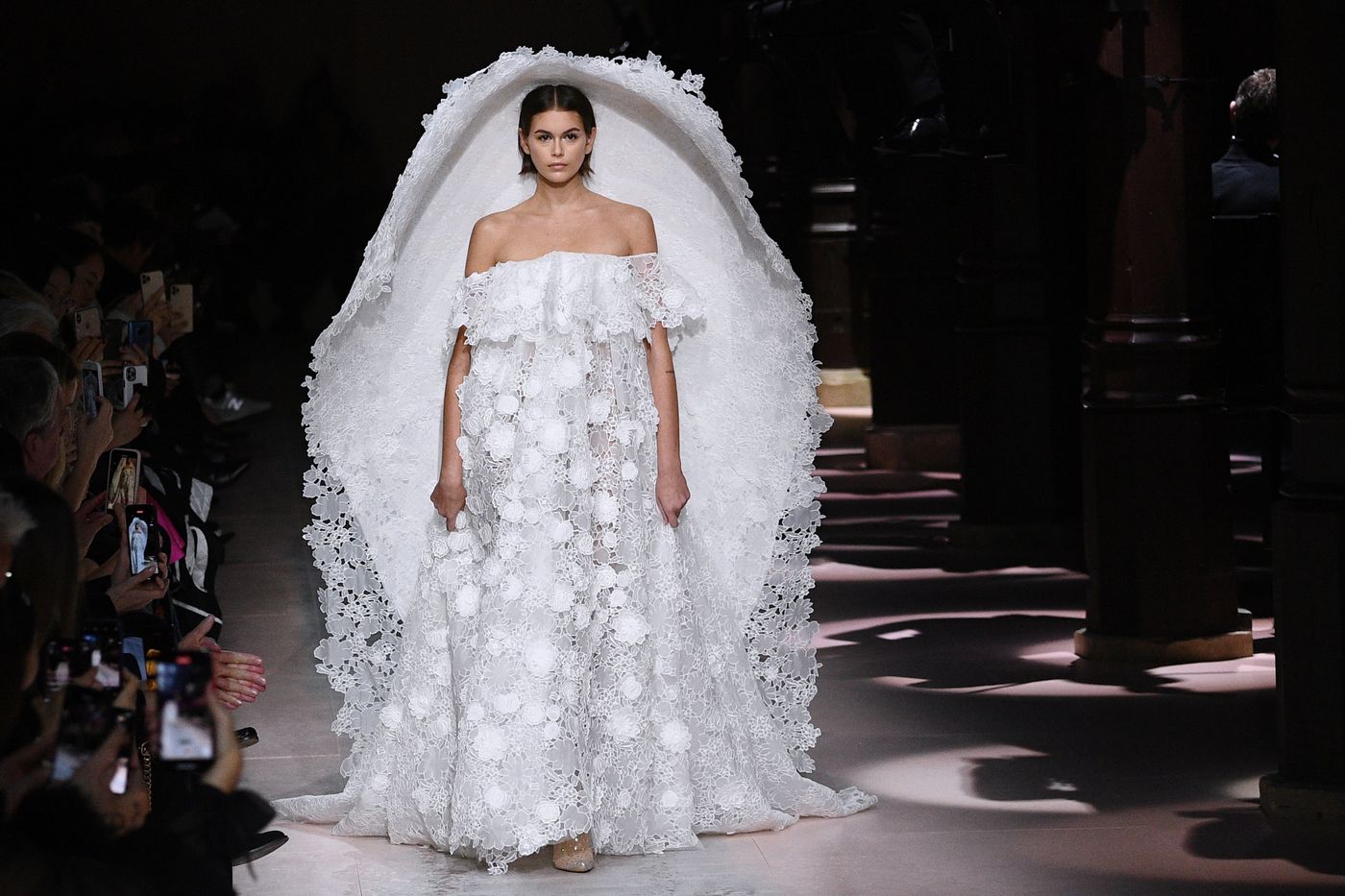
Sarah Burton — born 2 November 1974 in Macclesfield, Cheshire, Central Saint Martins class of 1997 — was announced as creative director of Givenchy in September 2024. She had spent 26 years at Alexander McQueen, 14 of them as creative director after McQueen’s death in February 2010, and had designed Catherine Middleton’s 2011 royal wedding dress — the structural counterpart to Waight Keller’s 2018 one. Burton’s debut collection for Givenchy, Fall/Winter 2025, was shown in Paris in March 2025, in the Hôtel de Beauharnais, an early-nineteenth-century Empire-period palace currently owned by the German embassy. The collection was read by the trade as a deliberate return to founder discipline: white shirting, sharp shoulders, the bateau neckline that Hubert had cut for Hepburn, the cabochon-embellished evening dresses that would not have looked out of place in a 1962 atelier book. The Bettina blouse was reissued in the look-book under its 1952 name.
Burton’s first commercial year has produced no streetwear and no graphic logo work. The brief, as the trade has read it, is to rebuild the couture-grade ready-to-wear base that the house has not had since the early 2000s. The hire of Marco De Vincenzo in May 2026 — the first dedicated head of leather goods design Givenchy has named since the LVMH acquisition — confirms that brief.
Marco De Vincenzo (May 2026–): the leather goods correction
Marco De Vincenzo — born 1978 in Messina, Sicily — was announced as head of leather goods design at Givenchy on 26 May 2026, reporting under Sarah Burton. He had been design director of Fendi leather goods from 2009 to 2023, where he had codified the Peekaboo, Baguette and Way bags into a coherent commercial system, and had run his own LVMH-backed eponymous label from 2014 to 2023. The Givenchy hire is the first time the house has split creative direction between ready-to-wear (Burton) and leather goods (De Vincenzo) since the brief 2005–2008 period when Tisci ran womenswear while a separate accessories team reported to then-CEO Marco Gobbetti.
The De Vincenzo appointment matters structurally. Leather goods are, at every LVMH house, the category that finances couture and ready-to-wear; at Louis Vuitton it is the entire business, at Dior it is the majority, at Givenchy it has historically been the weakest link. Splitting the role lets Burton concentrate on couture craft — the part of the brief LVMH hired her for — while De Vincenzo runs the cash-generating product. It is the same operational separation LVMH has used at Loewe under Jonathan Anderson (then Proenza Schouler), at Celine under Hedi Slimane, and at Fendi during De Vincenzo’s own tenure.
Givenchy creative directors as a sequence: what the lineage tells us about LVMH’s couture playbook
Read end-to-end, the seven post-Hubert Givenchy creative directors form the clearest single case study of LVMH’s couture playbook. The pattern is consistent: a brand-name appointment imported from outside Paris (Galliano from London, McQueen from London, Macdonald from London, Tisci from Milan, Waight Keller from London via Pringle and Chloé, Williams from California, Burton from London); a three-to-six-year cycle; a deliberate stylistic break with the predecessor; and a constant, almost mechanical, oscillation between couture-craft and street-commercial registers. Tisci was the street pole; Waight Keller was the couture pole; Williams was the street pole; Burton is the couture pole. The next appointment, whenever it comes, will be the street pole. The Givenchy creative directors are not a single design tradition but a controlled experiment in how often a single house can be re-launched without losing its name recognition.
| Director | Tenure | Defining work / collection |
|---|---|---|
| Hubert de Givenchy | Feb 1952 – Jul 1995 | Bettina blouse (1952); Audrey Hepburn wardrobe 1953–1993; L’Interdit (1957); sack dress (1957) |
| John Galliano | Jul 1995 – Oct 1996 | Spring/Summer 1996 haute couture (Hôtel Marigny); Autumn/Winter 1996 ready-to-wear |
| Alexander McQueen | Oct 1996 – Mar 2001 | Spring 1997 “Bathing Beauties” couture; gothic religious couture 1998–2001 |
| Julien Macdonald | Mar 2001 – Mar 2004 | Spring 2002 couture at Stade Français; sequined eveningwear continuation |
| (Studio interim) | Mar 2004 – Feb 2005 | No named director |
| Riccardo Tisci | Feb 2005 – Feb 2017 | Rottweiler T-shirt SS11; Antigona bag; Bambi sweatshirt; shark-lock boot; West/Kardashian wedding wardrobe (2014) |
| Clare Waight Keller | Mar 2017 – Apr 2020 | Meghan Markle royal wedding dress (19 May 2018); first female artistic director; British Designer of the Year 2018 |
| Matthew M. Williams | Jun 2020 – Jan 2024 | Rollercoaster buckle hardware; 4G monogram; G Cut denim; Antigona Cube; SS22 show at La Défense |
| (Studio interim) | Jan 2024 – Mar 2025 | No named director; lookbook-only seasons |
| Sarah Burton | Sept 2024 – | FW25 debut at Hôtel de Beauharnais, March 2025; Bettina blouse reissue |
| Marco De Vincenzo | May 2026 – (leather goods, under Burton) | First dedicated leather goods CD since LVMH acquisition |
The Hubert problem
Every Givenchy creative director since 1995 has had to negotiate the same structural problem: Hubert de Givenchy is the founder, the trademark, the silhouette and the muse-handler, and no successor has been allowed near the 1950s archive without an interpretive frame imposed from above. Galliano was the Belle Époque interpreter; McQueen was the gothic-religious interpreter; Macdonald was meant to be the Welsh-glamour interpreter; Tisci was the Catholic-streetwear interpreter; Waight Keller was the couture-craft interpreter; Williams was the techwear interpreter; Burton is, explicitly and by appointment, the founder-discipline interpreter. The frames have been imposed by LVMH’s CEOs — Arnault, then his sons Antoine and Alexandre — and they have been imposed on the assumption that the founder is a problem to be solved rather than a tradition to be extended.
Hubert himself, who lived until 2018, gave only two on-the-record interviews about his successors. He told Suzy Menkes in 2010 that he had “no opinion” about McQueen’s collections because he had not seen them. He told Vogue Paris in 2015 that Tisci was “a designer, not a couturier.” Both statements were read at the time as polite. They look now like the cleanest available description of the lineage. Hubert was a couturier — a fitter, a cutter, a workroom-trained tailor who could draft a sleeve. Every one of his successors, with the partial exception of Burton, has been a designer — a stylist, a brand manager, a curator of references. The Givenchy creative director title has, since 1995, meant something different from what it meant from 1952 to 1995. The question Burton’s appointment poses, and that De Vincenzo’s appointment confirms, is whether LVMH is now trying to close that gap.
What gets carried forward
Three things have survived all seven post-Hubert tenures intact: the four-G monogram (re-drawn but never abandoned), the bateau neckline (refused only by Macdonald), and the L’Interdit perfume line, which was reformulated in 2018 under a Daphne Guinness campaign and remains the house’s second-largest revenue line after leather goods. Everything else — the silhouette, the colour palette, the celebrity client list, the show venue, the bag — has been reset on a roughly five-year cycle. Burton’s first eighteen months have reinstated the bateau neckline as a house signature and reissued the Bettina blouse under its founder-era name, and De Vincenzo is now responsible for the bag.
Givenchy is the LVMH house most often described in the trade press as “unresolved.” Read across 74 years, that is probably not the right word. Givenchy is a house with one founder-couturier and seven appointed successors, six of whom were imported from outside Paris on three-to-six-year contracts, with a deliberate brand pivot built into each appointment. The unresolved quality is the design. Whether Burton and De Vincenzo, together, are the first pair allowed to break the cycle is a question the next two haute couture seasons in Paris — January 2027 and July 2027 — will start to answer.