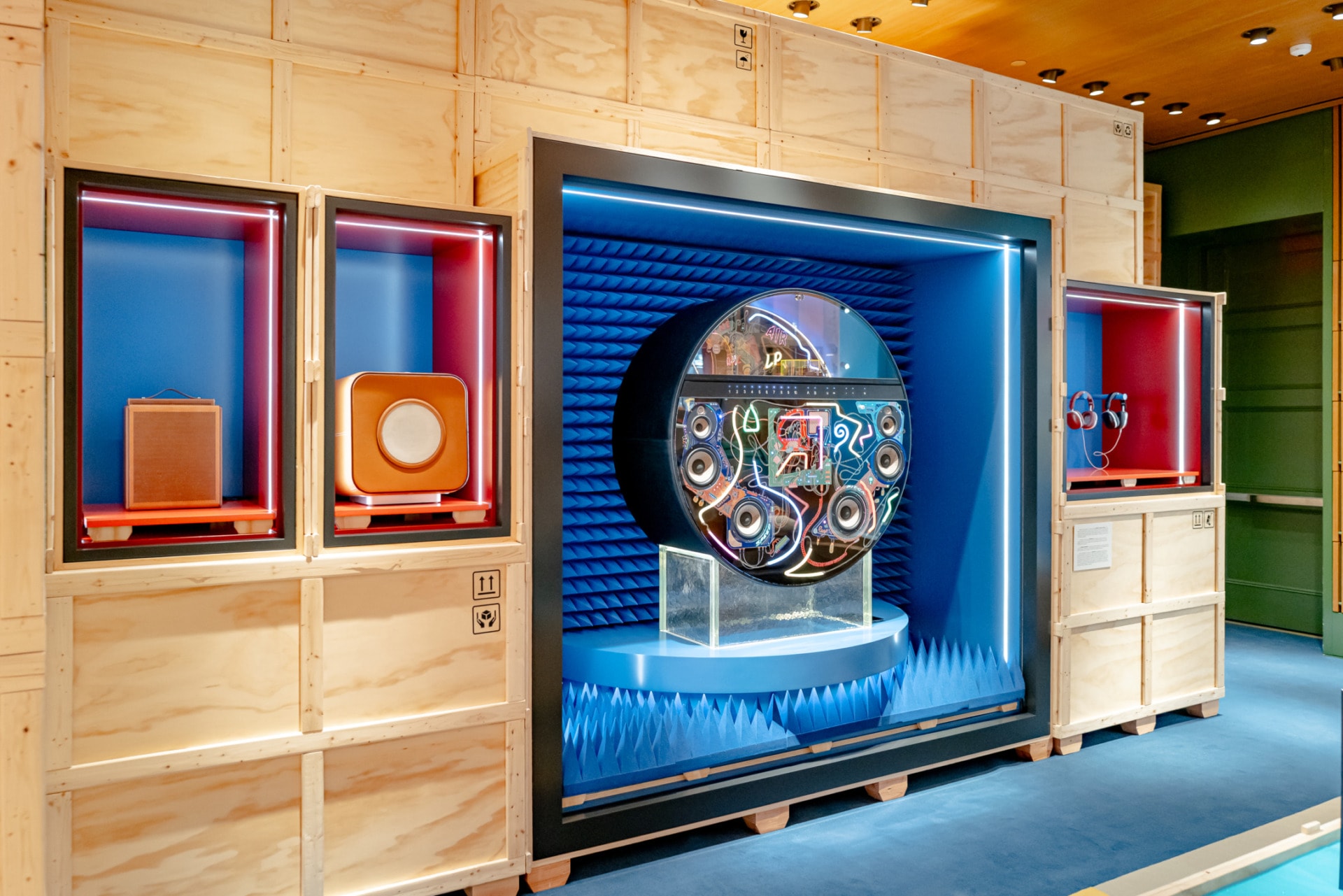
Hermès Atelier Horizons’ May 2026 Disque Jockey Club is the first DJ booth ever delivered as a leather-clad piece of mahogany cabinetry — and the most legible argument yet for treating the workshop, not Salone, as the place where the maison’s design language is actually being written. Reported by Domus on 28 May 2026, the booth was developed by Hermès’ bespoke workshop in collaboration with British DJ Prince Charles, with two Japanese turntables integrated into the cabinet and concealed beneath fitted leather covers. The cabinetry was executed by French cabinetmakers in mahogany, then panelled in cowhide. There is no announced price, no edition, no commercial release — and that absence is the point.
This is what hermes atelier horizons exists to do. Since 2013, the workshop has been the maison’s instrument for one-off, special-order objects that do not fit any product line: leather-clad jukeboxes, portable speakers, ping pong tables, surfboards, skateboards, bicycles, fishing rods, boxing gloves, disco balls. The Disque Jockey Club is the latest in that lineage, and arrives at a moment when the rest of the fashion-into-design field is busy chasing the same vocabulary Hermès quietly assembled across a century. Reading the booth without that century behind it — the 1924 Jean-Michel Frank commission, the 1984 table-setting department, the decade of La Pelota installations at Milan Design Week — misses what Atelier Horizons is actually for.
The Disque Jockey Club, May 2026: a mahogany cabinet that happens to mix records
Strip the brand off the brief and the Disque Jockey Club is a small piece of architecture. A mahogany carcass sized for two turntables. Cowhide panels stretched over the surfaces a DJ touches. A pair of Japanese decks — the unnamed but unmistakable industry-standard direct-drives — sunk into the top, hidden under leather covers when not in use. The booth, as Domus describes it, was developed in collaboration with British DJ Prince Charles, whose long-standing relationship with Hermès’ creative orbit appears to have driven the brief.
What matters formally is the inversion. A DJ booth is normally infrastructure: a black box, a road case, a folding table draped in cloth. The performer is the object; the equipment is invisible by being ugly. Atelier Horizons inverts that. The booth becomes a cabinet — joinable, finishable, in the same family as a writing desk or a bar — and the turntables become hardware concealed inside furniture. When the leather covers are down, the Disque Jockey Club reads as a low mahogany console. When they are up, the decks emerge as if from a humidor.
This is consistent with how Axel de Beaufort has been running the workshop for thirteen years. The leather-clad jukebox, the leather-bound portable speaker, the leather-handled ping pong table — every Atelier Horizons object proceeds from the same axiom: take an industrial typology, restore the cabinetry tradition it descended from, then re-skin the surfaces of contact in vegetable-tanned leather. The Disque Jockey Club is the highest-stakes version of that axiom yet, because DJ culture is the typology furthest from Hermès’ core vocabulary. Saddlery to surfboards was a stretch. Saddlery to a club booth, with two decks and a leather slipmat, is the longest reach the maison has made.
Domus does not publish a price, an edition size, or a delivery window, and Hermès has not announced one. The booth exists, has been photographed, and was delivered. That is the entire commercial fact pattern, and it is appropriate to leave it there.
Hermès Atelier Horizons, 2013–2026: the leather-clad commissions
The workshop was founded in 2013 under Axel de Beaufort — French designer and naval architect, born in Paris in 1977, trained at the University of Southampton in design and naval architecture — and has operated since then as the maison’s bespoke design-object programme. De Beaufort’s background matters more than it sounds. Naval architecture is the discipline of fitting cabinetry, mechanism and human use into a sealed hull; the methodology is closer to high-end joinery than to industrial design. Every Atelier Horizons object reads like a yacht interior fragment: a single typology, fully resolved, where the engineering disappears behind the millwork.
The reported commissions form a list that doubles as a thesis statement:
- Leather-clad jukeboxes
- Portable speakers
- Ping pong tables
- Surfboards
- Skateboards
- Bicycles
- Fishing rods
- Boxing gloves
- Disco balls
- (May 2026) The Disque Jockey Club DJ booth
What ties them together is not category — sports equipment, audio, games, now performance furniture — but a constant operation: the object is rebuilt as cabinetry, then re-clad in leather wherever a human body touches it. The handle of the fishing rod, the grip of the boxing glove, the deck of the skateboard, the cover of the turntable. Hermès’ core competence has always been the leather-bearing surface; Atelier Horizons is a research programme into how many object typologies can be re-described as leather-bearing surfaces.
The workshop also functions as the maison’s R&D lab for techniques that later filter into the production Maison line. The cabinetmaking partnerships, the integration of industrial hardware (a Japanese turntable, an audio amplifier, a bicycle drivetrain) into bespoke joinery, and the colour and tanning experiments developed for one-offs all feed back into the seasonal Hermès Maison collections that Charlotte Macaux Perelman and Alexis Fabry assemble for Milan.
1924–2026: every Hermès design-object programme, in order
The Disque Jockey Club only legible if you read it against the entire chronology of Hermès in furniture and design objects. Here is the sequence, anchor by anchor.
| Year | Programme / event | What it established |
|---|---|---|
| 1924 | Jean-Michel Frank meets Jean-René Guerrand (son-in-law of Émile Hermès) and commissions Hermès to upholster his armchairs and sofas in leather | Hermès’ first engagement with furniture as a category; founding link between the maison and modernist interior design |
| 1984 | Hermès creates a dedicated table-setting department | Formalises Hermès Maison as a permanent design-object discipline alongside leather goods and silk |
| 2011 | First Hermès presentation at Salone del Mobile, Milan | Maison enters the global furniture calendar as a recurring exhibitor |
| 2013 | Atelier Horizons founded under Axel de Beaufort | Bespoke workshop for one-off design objects established as a permanent in-house programme |
| 2014 | Charlotte Macaux Perelman and Alexis Fabry appointed deputy artistic directors of Hermès Maison | Maison line gains a stable curatorial duo: Macaux Perelman (ex-Philippe Starck, David Rockwell, André Balazs; founded Studio CMP in 2005) and Fabry (curator and publisher of Latin American photography, founder of Toluca Editions) |
| ~2014–present | Milan Design Week installations staged inside La Pelota, a former jai-alai hall off Via Palermo | For over a decade Hermès has occupied a single, architecturally specific Milan venue, treating it as the maison’s annual room |
| ongoing | Reeditions J.-M. Frank par Hermès programme (Confortable armchair, X-base dining table) | Active production line that returns to the 1924 Frank archive and reissues his designs under Hermès |
| May 2026 | Atelier Horizons Disque Jockey Club, with Prince Charles | First DJ booth delivered as leather-clad mahogany cabinetry; latest entry in the Atelier Horizons commission list |
Read top to bottom, the table makes one argument: Hermès has been a furniture house, intermittently or continuously, since 1924. The Disque Jockey Club is not a fashion-house pivot into design. It is the 102-year continuation of a relationship that began with Jean-Michel Frank’s armchairs.
1924: Jean-Michel Frank and the leather origin story
The founding event is precise and worth stating precisely. In 1924, the Parisian interior designer Jean-Michel Frank — by then already developing the stripped, luxurious modernism that would define his career — met Jean-René Guerrand, the son-in-law of Émile Hermès. Frank commissioned Hermès to upholster his armchairs and sofas in leather. That commission established two things at once: that Hermès’ leather expertise could move from saddlery into seating, and that the maison was prepared to subcontract its craft to an outside designer’s vision.
Both principles still organise the house. The Reeditions J.-M. Frank par Hermès programme — which reissues Frank designs including the Confortable armchair and the X-base dining table — is the most literal expression of that continuity. A century after the original commission, Hermès is again producing Frank’s furniture, under Frank’s name, with Hermès leather. There are few comparable lineages in any luxury house. LVMH and Kering operate their design lines as recent corporate decisions; Hermès operates its design line as a 1924 commitment that was never abandoned.
This also means that the Frank precedent — outside designer brings a brief, Hermès executes the leather and cabinetry — is the structural template for Atelier Horizons. Prince Charles in 2026 occupies a position formally analogous to Frank in 1924: an external practitioner commissions the maison to apply its leather craft to a piece of furniture from his world. The brief has migrated from an armchair for a Paris drawing room to a DJ booth for a club, but the commission logic is identical.
1984: the table-setting department
Sixty years after Frank, Hermès did the second formal thing required to become a furniture house: it created a dedicated table-setting department in 1984. This is the moment Hermès Maison stops being an occasional sideline and becomes a permanent discipline inside the house, alongside the leather goods, the silk scarves, and the ready-to-wear.
A table-setting department, in luxury-house terms, is a porcelain, glassware, silver and linen operation. It implies dedicated designers, dedicated production partners (porcelain in Limoges, glass in Saint-Louis, etc.), and a seasonal release cadence aligned with the rest of the maison. Once that infrastructure exists, the leap to furniture, lighting, textiles and bespoke objects is administrative rather than conceptual. The 1984 decision is therefore the moment Hermès committed to design objects as a category, not as a favour to a friend of the Guerrand family.
2011: Salone del Mobile and the Milan calendar
Hermès has presented its Maison universe at Salone del Mobile annually since 2011. That is the year the house joined the global furniture calendar as a recurring presence, on the same footing as the Italian historics and the major Northern European brands. Before 2011, Hermès Maison existed as a category but did not show in Milan; after 2011, the Hermès installation has been a fixed point in the Salone week’s choreography.
This was Hermès’ decision to be measured against the furniture industry rather than against the other luxury houses. Showing at Salone means showing alongside Cassina, B&B Italia, Vitra and Knoll, not alongside Louis Vuitton’s Objets Nomades or Dior Maison. The benchmark is craft and seating, not brand and packaging. That choice has structured everything Hermès Maison has done since.
2014: Macaux Perelman and Fabry, the curatorial duo
Charlotte Macaux Perelman and Alexis Fabry have served as deputy artistic directors of Hermès Maison since 2014. The pairing is unusual for a luxury house and worth taking seriously.
Macaux Perelman is the interior and product designer of the duo. She trained and worked with Philippe Starck, David Rockwell and André Balazs — three of the most important hospitality designers of the late twentieth century — and founded her own practice, Studio CMP, in 2005. Her formation is in hotels and restaurants: the discipline of designing rooms that strangers will use for short periods and remember as a single atmosphere. That sensibility is directly legible in the way Hermès Maison stages its Milan installations as inhabitable rooms rather than product displays.
Fabry is the curator and publisher of the duo. He is a specialist in Latin American photography and the founder of Toluca Editions, a publisher of photography books. His role inside Hermès Maison is closer to a museum’s curator than to a brand’s art director: assembling references, building narratives, and shaping how each season’s objects are framed against the maison’s archive and against the broader field. The decision to pair a hospitality designer with a photography curator, rather than appointing a single creative director, is itself a statement about how Hermès thinks about its Maison line.
Both directors also appear adjacent to the Atelier Horizons orbit. The bespoke workshop sits structurally below the Maison line in the house’s org chart — de Beaufort runs Horizons; Macaux Perelman and Fabry run Maison — but the two programmes share a leather and cabinetry vocabulary, and the experimental commissions in Atelier Horizons feed the seasonal Maison releases that the curatorial duo assembles for La Pelota.
La Pelota: the Milan room
For more than a decade — that is, since roughly the mid-2010s — Hermès has staged its Milan Design Week installation inside La Pelota, the former jai-alai hall off Via Palermo. The choice of venue is one of the most consequential decisions in the maison’s design-object programme, because it determines what every Hermès Salone presentation looks like before any object is placed in it.
La Pelota is a tall, raw, industrial volume with a long single-court footprint. It is not a showroom and does not pretend to be one. Hermès has used the volume as a constraint: each year’s Les Mains de la Maison-style installation builds an architectural intervention inside the hall, sized to the court, and arranges the season’s Maison objects inside that intervention. The result is closer to an art-fair pavilion or a small museum exhibition than to a furniture-brand booth. It is also why the Hermès Salone presentation is consistently reviewed in architecture and exhibition terms rather than in product-launch terms.
The decade-plus tenancy at La Pelota functions as a kind of permanent room for the maison, in the way that historic Italian furniture brands have permanent showrooms in their factory towns. Hermès’ Milan room is rented annually, but it is the same room every year. That continuity is part of why the maison’s Milan output reads as a coherent body of work rather than a series of seasonal launches.
Reeditions J.-M. Frank par Hermès: the active archive
The Reeditions J.-M. Frank par Hermès programme is the live, commercially available expression of the 1924 founding commission. Under the line, Hermès produces Frank designs — including the Confortable armchair and the X-base dining table — to the original specifications, in Hermès leather, sold through the maison’s furniture distribution. It is the rare case of a luxury house operating an active reissue programme for a historic outside designer, with the designer’s name on the line.
The strategic effect is that the Frank archive functions as part of Hermès’ current catalogue, not as a heritage citation. A client buying a Confortable armchair from Reeditions J.-M. Frank par Hermès is buying a 1920s design, manufactured today, by the leather house that made the original. The provenance is industrial, not narrative. This is the same logic that makes Atelier Horizons commissions credible: the maison is the actual maker, not the brand on the label.
What the Disque Jockey Club tells you about 2026 Hermès
Place the May 2026 Disque Jockey Club at the bottom of the timeline above and a clear picture emerges. Hermès is not pivoting into design; it has been a design house for 102 years. It is not chasing the fashion-into-design trend; it predates the category. What it is doing in 2026 is extending Atelier Horizons further into the typologies its peers cannot reach — performance equipment, club furniture, anything that requires both serious cabinetry and serious comfort with industrial hardware.
The booth also clarifies the division of labour at the top of Hermès Maison. De Beaufort and Atelier Horizons handle the one-off, technically ambitious commissions — the disco balls, the bicycles, now the DJ booth. Macaux Perelman and Fabry handle the seasonal Maison collection and the La Pelota installation at Milan Design Week. The Reeditions J.-M. Frank programme runs as a permanent production line beneath both. The three programmes are distinct, but they share a leather, a cabinetry standard, and a willingness to subcontract design vision to outside practitioners — Frank in 1924, Prince Charles in 2026, with a hundred years of commissions in between.
This is the part that the rest of the fashion-into-design field has not yet replicated. Most luxury houses’ design programmes are recent, brand-led, and structured as creative directorships or capsule collaborations. Hermès’ design programme is old, craft-led, and structured as a workshop. The Disque Jockey Club is what that structural difference looks like when it is finally pointed at a DJ booth: a mahogany cabinet, two Japanese turntables, cowhide panels, no announced price — and the entire 1924–2026 lineage standing behind it as the reason the object was even thinkable in the first place.
For the listener in the room when the leather covers come up and the first record drops, none of that history will be visible. There will be a low wooden console, two decks, a pair of hands. That is the correct outcome. A century of leather cabinetry has been spent so that the booth disappears into the room and the music is the only thing left.