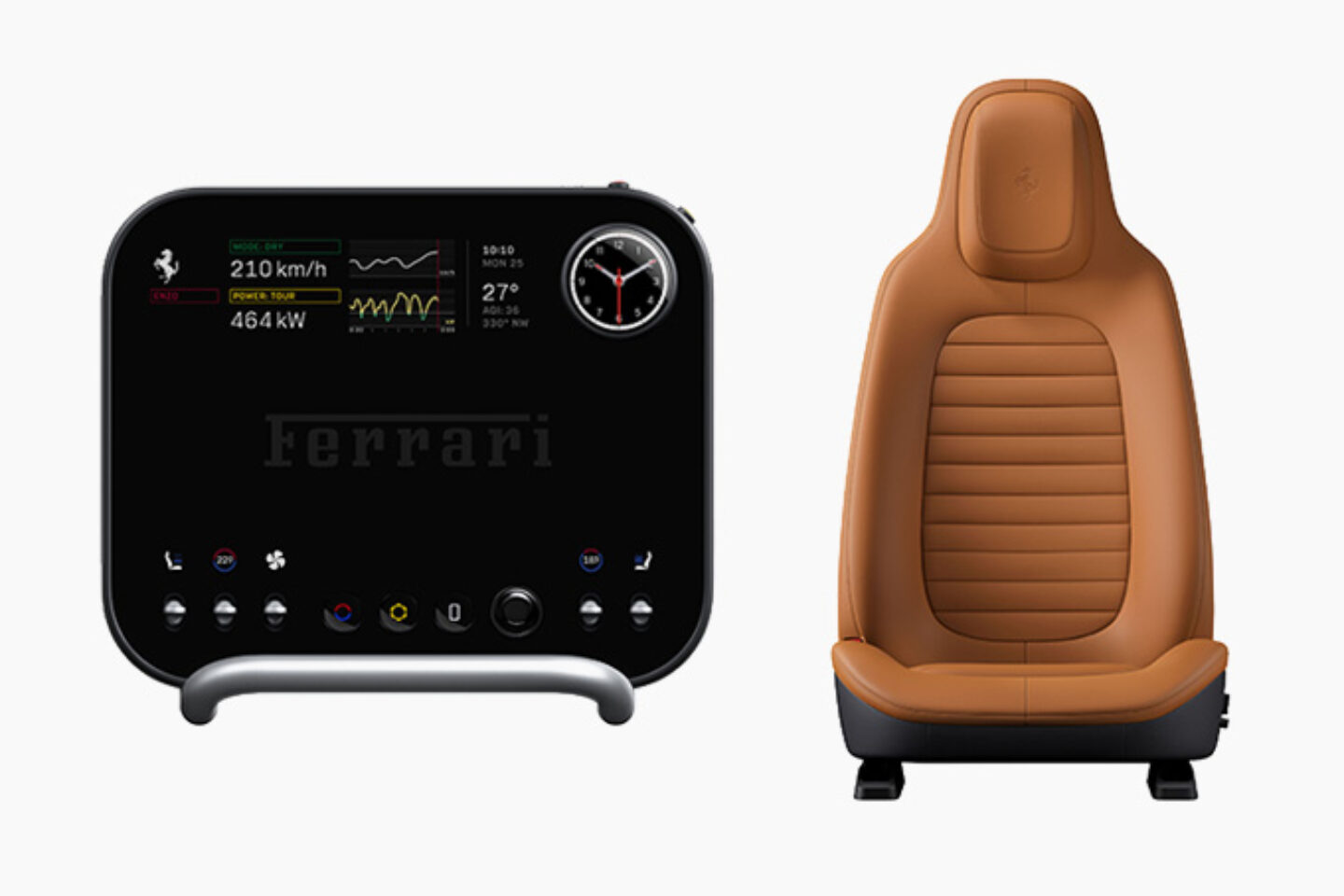
Marc Newson has shipped two of 2026’s most consequential industrial-design objects in eight weeks: the 114.2-metre Nausicaa for Lürssen, delivered in May, and the Ferrari Luce co-designed with Jony Ive under LoveFrom, unveiled in Rome on 25 May 2026. Read against the thirty-eight years that precede them — from the Lockheed Lounge in a Sydney studio in 1988 to a Maranello-built electric supercar at €550,000 — the marc newson collaborations file is the densest single-name partner cabinet in late-twentieth and early-twenty-first century industrial design, and the Luce is the moment the cabinet stops being a portfolio and starts being a system.
This piece is a chronological inventory. It counts every named partner Newson has worked with at the scale that produced shipped product or limited-edition pieces, from the late-1980s studio era through Ikepod, Cappellini, Magis, Ford, Nike, Qantas, Smeg, Riva, Pentax, Louis Vuitton, Beretta, Apple, Jaeger-LeCoultre, Knoll, Hennessy, Montblanc and Iittala, and ends with the Lürssen-built Nausicaa and the Ferrari Luce. The point is not the headcount. It is the consistency of the brief Newson has been answering for nearly four decades — and what that brief looks like now that LoveFrom and a Japanese billionaire’s research vessel have both delivered in the same quarter.
Marc Newson, Sydney, 1963–1988: before the catalogue
Newson was born on 20 October 1963 in Sydney and graduated from the Sydney College of the Arts in 1984 with a focus on jewellery and sculpture. The training detail matters: it explains why the early Newson catalogue reads as enlarged jewellery rather than scaled-down architecture. The Lockheed Lounge, designed 1988 and produced through 1990, is the locus classicus — a riveted aluminium chaise, with fibreglass core and hand-finished metal skin, that behaves like a polished cabochon laid on its side. The Embryo Chair followed in 1988, in three-legged neoprene-wrapped polyurethane, and was the first Newson object to enter wider production.
The Lockheed Lounge stayed in the gallery economy rather than industry for two decades. Its number arrived in April 2015, when an example sold at Phillips in London for £2.4 million — at the time, the auction record for any work by a living designer. Newson’s 1986 design wasn’t furniture so much as a sculpture allowed to function, and the £2.4 million at Phillips was the auction market acknowledging that the rest of the industry hadn’t caught up. The figure also re-priced every piece of pre-1995 Newson on the secondary market and supplied the financial gravity that subsequent brand partnerships have organised themselves around.
Marc Newson collaborations, 1994–2004: Ikepod, Cappellini, Magis, Iittala, Ford, Nike
The first decade after the Lockheed Lounge is the period in which Newson built the partner roster that subsequent corporate clients learned from. The structuring move was Ikepod, the Swiss watch brand he co-founded in 1994 and ran with until 2012 — eighteen years of round-cased, dial-forward mechanical pieces that gave Newson a watchmaking grammar he would later transpose to Jaeger-LeCoultre, Apple and Hennessy. Ikepod is the file that explains why a Sydney-trained jeweller can ship watches at industrial scale: because he had already done it for himself, on a partnership template he wrote.
The furniture cabinet ran in parallel. Newson’s long collaboration with Cappellini through the 1990s and 2000s produced the studio editions that distributed the Newson silhouette through the design-press circuit — Wood Chair, Orgone, Felt Chair, a sequence of moulded shells in the colour palette the Lockheed Lounge had pre-loaded. Magis added the Dish Doctor in 1997 — a polypropylene draining rack that took the Newson curve to a sub-€100 price point and into kitchens that had never heard the name. Iittala absorbed Newson into Finnish glass with a run of drinking glasses that sit, even today, on Helsinki tables alongside Aalto’s Savoy vase.
The transport file opened in 1999 with the Ford 021C, a concept car shown at the Tokyo Motor Show in a Ford booth that had been waiting for an outside designer to do something other than incremental sheet-metal. The 021C was a deliberately small, deliberately bright, deliberately drawer-fitted four-door — its rear bench slid out like a chest of drawers — and it remains the cleanest example of what Newson does when handed an automotive brief without a marketing department in the room. It did not enter production. It did, however, get Newson named as one of Ford’s senior creative advisors for a period afterward, and it pre-loaded the Ferrari conversation by almost three decades.
The sport-and-shoe file opened in 2004 with the Zvezdochka for Nike — a four-part lifestyle trainer with an interlocking sole, upper, midsole and insert that allowed the wearer to assemble the shoe from components. The Zvezdochka was the first time a Newson product was sold through a high-street sneaker distribution network; the construction logic re-appeared in the 2017 Nike Air VaporMax, which is the second Newson-credited Nike object and the one that pushed the Air sole unit to a full-length, visible cushion across the shoe.
Atmos, Aquariva, Smeg, Qantas, Pentax: 2008–2013
By the late 2000s the partner roster had widened far enough that Newson was running in parallel across categories that did not historically share a designer. The Jaeger-LeCoultre Atmos 561 and 566 — limited-edition versions of the perpetual-motion clock that runs on temperature differentials — gave Newson a Vallée de Joux complication piece to sign and reinforced the watchmaking grammar that Ikepod had been writing since 1994. The two Atmos editions remain the cleanest design-led objects in the Jaeger collaboration archive.
Aquariva, the 2010 Newson edition of the Riva runabout, is the partner project most often pulled out of context. Riva had been building lacquered mahogany speedboats on Lake Iseo since 1842; Newson’s 2010 version, executed in phenolic-treated birch laminate with anodised aluminium fittings, was the first time a Riva hull was finished by a non-Italian designer working outside the in-house atelier. It is the boat that pre-figures Nausicaa in 2026: a Newson signature on a vessel category whose customer base does not, structurally, take outside designers.
Smeg added a kitchen-appliance line in 2009–2010 — refrigerators, kettles, toasters in the Smeg palette extended with Newson’s preferred industrial colours — and locked Newson into the same retail aisle as the rest of the Smeg cabinet. Pentax added the K-01 in 2012, a mirrorless interchangeable-lens camera with a Newson body in yellow, white or black. The K-01 was not a commercial success on Pentax’s terms. It was, however, the first time a Newson object had to argue with a working photographer about ergonomics, and it produced the iteration that fed into later partnerships in which Newson designed around a sensor rather than around a sketch.
The most-flown Newson object of the period is the Qantas A380 economy seat, which won the 2009 Australian International Design Award of the Year and which has carried more passenger-miles than any other piece of Newson-credited industrial design. He followed it in 2013 with the A330 business suite — a herringbone-arranged lie-flat unit that became the visual signature of Qantas’s long-haul reset. The Qantas file is the most-mileage answer to whether Newson can ship at airline scale; the answer has been yes for sixteen years.
Louis Vuitton, Beretta, Hennessy, Montblanc: the luxury cabinet, 2014–2017
The mid-2010s file is the one in which Newson collected the European luxury houses. Louis Vuitton commissioned the Monogram Backpack in 2014, then the Newson-designed luggage programme that landed in 2016 — a small set of hard-sided trunks and roller bags in monogram canvas that reset the Vuitton hardware vocabulary and that have stayed in the catalogue across multiple creative-director cycles.
Beretta added the 486 shotgun in 2014 — a sidelock side-by-side with a Newson stock geometry and engraving programme that pushed a 500-year-old Italian gunmaker into territory it had not visited since the eighteenth century. James Hennessy, the 2015 decanter and cognac collaboration with Hennessy, gave Newson a glass-bottle commission inside one of the LVMH spirits houses; Montblanc M, also 2015, was the Newson-designed reset of the Montblanc pen line — a magnetic-cap, faceted-barrel writing instrument that became Montblanc’s most replicable Newson object and one of the few cap-and-clip designs Newson has put his name on.
The category point is that across 2014–2017 Newson was simultaneously inside a luggage house, a gunmaker, a spirits brand, a pen house, and — from September 2014 — Apple. No other designer of the period had a comparable cross-category footprint inside a single calendar year.
Apple, September 2014 — the Watch and the Ive partnership
The most consequential brand engagement of Newson’s career, until LoveFrom, was Apple. He joined in September 2014 as Senior Vice President of Design under Jony Ive and was credited as a contributor on the Apple Watch, Apple Watch Sport and Apple Watch Edition that launched in 2015 — the line that brought the Cupertino case grammar to the wrist and that absorbed the watchmaking vocabulary Newson had been writing at Ikepod and Jaeger-LeCoultre.
Apple is also the relationship that pre-loaded LoveFrom. The Newson–Ive partnership at Apple ran for five years before the two opened LoveFrom in June 2019, and the working language they refined inside Apple Park — small team, slow process, equity-flavoured engagements — is the language LoveFrom later sold to Airbnb, the Sustainable Markets Initiative, Moncler and, eventually, Ferrari. The Apple Watch is the prototype of the LoveFrom method. The Luce is its current end-state.
Knoll Aluminium Chair 2018, Task Chair 2022, Air VaporMax 2017
The late-2010s and early-2020s cabinet runs through Knoll, Nike and a small set of object commissions. The Knoll Aluminium Chair landed in 2018 — a single-shell cast-aluminium seat that took the Lockheed Lounge’s metal-skin instinct and miniaturised it to a four-leg office object. Knoll followed with the Task Chair in 2022, a more ergonomic, mesh-backed version that closed the loop on Newson’s working-furniture cabinet. The Nike Air VaporMax of 2017 sits alongside the Knoll work as the period’s other industrial-scale shipped object — the VaporMax pushed Nike’s full-length Air sole into mainstream sneaker distribution and is the second Newson-credited Nike shoe.
Marc Newson collaborations, 1986–2026: chronological timeline
The cabinet, in order, looks like this. Year given is the announce or production year of the headline piece; partner is the named brand or institution; note is one line.
| Year | Project | Partner | Note |
|---|---|---|---|
| 1988–90 | Lockheed Lounge | Self-produced / gallery editions | Riveted aluminium chaise; £2.4M at Phillips London, April 2015. |
| 1988 | Embryo Chair | Self-produced | Three-legged neoprene-wrapped polyurethane. |
| 1990s–2000s | Wood Chair, Orgone, Felt Chair, others | Cappellini | Long furniture programme; Italian distribution. |
| 1994 | Ikepod founded | Self-founded | Swiss watch brand; Newson exits 2012. |
| 1997 | Dish Doctor | Magis | Polypropylene draining rack; sub-€100 distribution. |
| 1990s–2010s | Iittala glasses | Iittala | Drinking-glass series in Finnish glassware tradition. |
| 1999 | Ford 021C concept | Ford | Tokyo Motor Show concept; small four-door with drawer-bench. |
| 2004 | Zvezdochka | Nike | Four-part assembled lifestyle trainer. |
| 2008 onward | Atmos 561, 566 | Jaeger-LeCoultre | Limited-edition Atmos clocks. |
| 2009 | Qantas A380 economy seat | Qantas | Australian International Design Award of the Year, 2009. |
| 2009–10 | Smeg appliance range | Smeg | Refrigerators, kettles, toasters in Newson palette. |
| 2010 | Aquariva | Riva | Newson edition of the Riva runabout in birch laminate. |
| 2012 | K-01 | Pentax | Mirrorless interchangeable-lens camera. |
| 2013 | Qantas A330 business suite | Qantas | Herringbone lie-flat for long-haul reset. |
| 2014 | Monogram Backpack | Louis Vuitton | First Vuitton commission; luggage programme follows 2016. |
| 2014 | 486 shotgun | Beretta | Sidelock side-by-side with Newson stock. |
| Sep 2014 | SVP design, Apple | Apple | Joins under Jony Ive. |
| 2015 | Apple Watch / Sport / Edition | Apple | Launch contribution; Cupertino’s wrist grammar. |
| 2015 | James Hennessy decanter | Hennessy | LVMH spirits glass commission. |
| 2015 | Montblanc M | Montblanc | Magnetic-cap, faceted-barrel writing instrument. |
| 2016 | Hard-side luggage | Louis Vuitton | Trunks and roller bags in monogram canvas. |
| 2017 | Air VaporMax | Nike | Full-length visible Air sole. |
| 2018 | Aluminium Chair | Knoll | Single-shell cast-aluminium office seat. |
| Jun 2019 | LoveFrom founded | LoveFrom (with Jony Ive) | San Francisco studio; founding partner. |
| 2022 | Task Chair | Knoll | Mesh-backed office chair completing the Knoll cabinet. |
| Aug 2025 | Nausicaa launched | Lürssen (for Yusaku Maezawa) | 114.2 m research yacht; delivered May 2026. |
| 5 Mar 2026 | Christie’s Rostrum | Christie’s / LoveFrom | Oak + stainless steel; 260th anniversary commission. |
| May 2026 | Nausicaa delivered | Lürssen | Delivered to Maezawa from Rendsburg. |
| 25 May 2026 | Ferrari Luce | Ferrari / LoveFrom | First Ferrari pure EV; unveiled Rome under Calatrava’s Vela dome. |
The table is the cabinet. The two 2026 rows are the cabinet’s current frontier.
Nausicaa: Lürssen, Rendsburg, August 2025 — May 2026
The Lürssen project, internally Project Cosmos, was commissioned by Yusaku Maezawa — the Japanese billionaire and SpaceX dearMoon principal — and built at Lürssen’s Rendsburg yard on the Kiel Canal. The vessel was launched in August 2025 and delivered to Maezawa in May 2026. It is named Nausicaa.
The numbers are the specification. 114.2 metres length overall. 18 metres beam. An Ice Class 1D steel hull built to operate in polar conditions. Diesel-electric propulsion with a 2 MW battery bank and Azimuth pods for low-noise station-keeping. A 19-metre observation lounge running across the forward superstructure. A two-level interior art gallery. A sushi bar. A helipad. And, as the visible architectural gesture, a skydome built from seven curved glass panes each 62 millimetres thick — the largest single piece of monolithic curved glass in a private vessel of its class.
Nausicaa is the boat that closes the loop the Aquariva opened in 2010. The 2010 Riva edition let Newson sign a runabout; the 2025–26 Lürssen lets him sign a research-grade explorer at fifteen times the length. The architectural detail — the skydome, the gallery, the lounge — is Newson working at the scale where furniture vocabulary gives way to ship-architecture vocabulary, and it is the first time a Newson interior has been delivered at a length that pushes past 100 metres. The Rendsburg yard, not Sydney, is now where the Lockheed Lounge’s metal-skin instinct has reached its largest physical expression.
Christie’s Rostrum, 5 March 2026
Two months before the Luce, the smallest Newson–LoveFrom object of 2026 was unveiled at King Street: a new rostrum for Christie’s, commissioned by the auction house for its 260th anniversary in 2026 and presented on 5 March. The piece — oak and stainless steel, crafted by Benchmark in French oak — replaced the previous Christie’s rostrum that had been in service for decades. It is the smallest piece in the LoveFrom 2026 trio and it is the one most directly legible as a Newson object: a sculpture allowed to function, finished in the materials Newson has used since the Lockheed Lounge.
The Christie’s commission is also the file that demonstrates LoveFrom is now in the institutional-furniture business. The studio has now designed a working object for the world’s oldest fine-art auction house, a recognition mark for King Charles III, and a supercar for Ferrari, in the same eighteen-month window. The headcount is still under thirty.
Ferrari Luce, Rome, 25 May 2026
The Luce is the file the rest of the cabinet has been pre-loading since 1999. Ferrari unveiled the car on 25 May 2026 inside Santiago Calatrava’s Vela dome at Rome’s La Vela complex, with Newson and Ive both on the floor. It is Ferrari’s first pure electric vehicle, co-designed by LoveFrom over six to seven years, and the engineering programme produced 60 new patents at Maranello.
The specification reads like a manifesto. Five seats. Four rear-hinged doors. More than five metres long, two metres wide, 1.54 metres high. Kerb weight 2,260 kilograms. Zero to 100 km/h in 2.5 seconds. Top speed greater than 310 km/h. Range 530 kilometres. Wheels 23 inches front and 24 inches rear. A 21-speaker 3,000-watt audio system. Pricing from €550,000.
Newson, on the floor in Rome, summarised the interior brief in one line: “The amount of interior space we’ve eked out of this platform is really impressive — it’s a bit like a Tardis.” The line is doing a specific job. It is reframing a 2,260-kilogram, five-metre-long, four-door electric Ferrari as a packaging problem rather than a horsepower problem — which is the Newson framing applied to every previous transport object he has signed, from the Ford 021C in 1999 through the Qantas A380 seat in 2009 to the Aquariva in 2010. The Luce is the largest, fastest and most expensive object in the marc newson collaborations file, and it is being described by its designer in the language of cabin volume.
What the marc newson collaborations file actually shows
Read end-to-end, the cabinet does three things at once. It distributes a single design grammar — the polished metal skin, the soft single-radius curve, the colour that reads as jewellery — across categories that do not historically share a designer, from a 1988 chaise to a 2026 Ferrari. It accumulates partner equity at a rate that almost no other industrial designer of the period has matched, with the consequence that the partner roster is now an asset class in its own right and the secondary market for Newson objects sets its own clearing prices. And it operates through institutional vehicles — Ikepod from 1994, Apple from 2014, LoveFrom from June 2019 — that let Newson move from individual commissions to long-form, equity-flavoured studio engagements without losing the signature.
The 2026 file is the cleanest single-year demonstration of the method. A 114.2-metre Lürssen built in Rendsburg, a rostrum at Christie’s in French oak, and a €550,000 four-door electric Ferrari built around a packaging brief — three objects across three categories, all signed Newson, all delivered in the same eighty-three days, all routed through partners (Maezawa, Christie’s, Ferrari) who would not, structurally, have taken an outside designer two decades ago. The Lockheed Lounge in 1988 was the auction market acknowledging Newson before the industry had caught up; the Luce in 2026 is the industry — Maranello, Rendsburg, King Street — acknowledging that the partner roster is now the design language, and that it ships at any scale the partner can build.