On a basement floor near Milan’s Duomo in 1958, a twenty-eight-year-old painter named Cesare Colombo drew a single perspective in unbroken pen-stroke and quit easel painting for good. The drawing was for the Santa Tecla, a jazz cave a few minutes’ walk from the cathedral; the painter, soon to call himself Joe, had trained in painting at the Accademia di Brera and architecture at the Politecnico di Milano, and the Santa Tecla project pulled those two trainings into a single discipline. The Joe Colombo Milan archive — the corpus held and stewarded by Studio Colombo under Ignazia Favata, with sibling holdings at Triennale Milano and the MoMA collection — has long described that pivot in summary form. In May 2026, two previously unknown perspective drawings of the Santa Tecla surfaced in the archive of Enrico Baj’s former law office, and the Joe Colombo Milan archive widened by one chapter. The rediscovery clarifies rather than rewrites: the arc that runs from Santa Tecla to the Boby Trolley is one continuous line, and the new drawings prove it in pen.
Santa Tecla, 1958: where the Joe Colombo Milan archive begins
The Santa Tecla was a basement jazz cave near Milan’s Duomo, the kind of place that smelled of cigarettes and damp brick by ten and was full by eleven. It mattered in two registers. As a venue it hosted Chet Baker on his Italian sojourns, the young Lucio Battisti before he was Battisti, and the Celentano family — the patrimony of post-war Milanese popular music played out across its small stage. As a commission it gave the young Cesare Colombo his first opportunity to draw a room as a designer rather than paint one as a painter. Colombo had been part of the Movimento Nucleare circles around Enrico Baj and Sergio Dangelo in the mid-1950s; he had shown paintings at the Galleria del Naviglio and contributed to the group’s manifestos. The Santa Tecla interior, executed at the end of the 1950s, was where the painter put down the brush.
The Joe Colombo Milan archive holds project notes, photographs and a small handful of plans from this period, but the Santa Tecla material has always been thin. That is why the May 2026 find matters. Researchers Ilaria Bollati and Marta Elisa Cecchi, working through the archive of Enrico Baj’s former law office — preserved after Baj’s death by his widow Laura Agnoletto Baj — came across two perspective drawings of the Santa Tecla that had not been catalogued anywhere. Studio Colombo, led since the 1980s by Ignazia Favata (Colombo’s long-time collaborator from the late 1960s until his death), authenticated the principal sheet on the strength of a single observation: in the more ambitious of the two perspectives, the lines run continuously, with no lift. “Joe never lifted his hand from the paper,” Favata noted, and the trace bears that out — a long unbroken loop describing a room.
That technical detail is not just connoisseurship. The unbroken stroke is also a thesis. The Santa Tecla drawings show a designer who already thought of interior, furniture and object as one connected thing — exactly the integration that would, twelve years later, produce the Boby Trolley and the Visiona 1 habitat. The drawings were found in a lawyer’s archive because Baj was Colombo’s friend and contemporary and because Milanese creative life in the late 1950s passed through legal offices and printers’ shops as readily as galleries. The Santa Tecla itself survived in various incarnations until its final closure in 2016, by which point the drawings had been quietly mis-shelved among Baj’s papers for half a century. The reopening of the Joe Colombo Milan archive in May 2026 effectively returns the building to its original author.
The plastics decade: Kartell, Flexform, Bieffeplast
Colombo opened his own design and architecture studio in 1962, at thirty-two, and over the next nine years he produced a body of work that re-defined what an Italian plastic chair could be. He won the IN-Arch prize in 1964, the ADI prizes in 1967 and 1968, and the Compasso d’Oro in 1970. The pivot from Santa Tecla to industrial production runs through three Brianza and Veneto manufacturers — Kartell, Flexform and Bieffeplast — each of which Colombo treated as a research partner rather than a client.
The most consequential of these was Kartell. Giulio Castelli had founded the company at Noviglio, south-west of Milan, in 1949, and by the mid-1960s Kartell’s research department was the most advanced injection-moulding operation in Italian furniture. Colombo’s Universale Chair, model 4860, designed between 1965 and 1967 and put into production in 1968, was the first chair fully injection-moulded in plastic. The shell began in ABS, migrated through nylon, and eventually settled on polypropylene as the tooling and chemistry matured. The detachable feet — three different lengths — allowed the same shell to serve as side chair, dining chair or children’s chair, a modularity that Colombo treated as a design constant rather than a marketing convenience. The 4860 is held at MoMA and Triennale Milano; it is also still in production, which is the harder test.
For Kartell, Colombo also designed the KD 27 table lamp in 1967: a chromed-ABS cylinder base with an opal PMMA disc shade, stackable, and convertible between table and floor use by stacking the same module. The KD 27 was produced from 1967 until 1981, and like the 4860 it described a single, repeatable industrial gesture — a cylinder cut by a plane — rather than a stylistic flourish. Stackability is the small genius: a shop could ship four lamps in the volume of one, and a user could grow a floor lamp out of two table lamps by adding a module. The thinking is identical to the Boby’s: storage and use as a single problem.
Flexform — founded at Meda in 1959 by the three Galimberti brothers Romeo, Pietro and Agostino — produced Colombo’s Tube Chair in 1969. Four polyurethane-foam-padded cylinders, each of a different diameter, ship nested inside one another and reassemble via rubber clips into different seating configurations — armchair, chaise, side-by-side bench. The flat-pack logic predates Western flat-pack discourse by a decade and the configurability anticipates the modular sofa as we now know it. The Tube Chair sits in MoMA’s permanent collection and is one of two Colombo objects (with the Multichair) regularly cited in the museum’s design literature as a 1960s archetype.
Earlier, in 1963, Colombo had designed the Elda Chair for Comfort, the Fratelli Longhi works in Brianza founded in 1959. Named after his wife Elda, the chair is a moulded fibreglass swivel shell with thick leather cushions on a swivel base; Colombo had taken the fibreglass technique directly from local shipyard boat-hull production. The Elda is the only major Colombo object that does not derive its tooling from injection-moulding plastics, and it is also the only one named for a person. Both facts mark it: it is the romantic exception within an otherwise relentlessly industrial decade.
The third partner, Bieffeplast at Padua, was founded in 1959 and specialised in ABS injection on small architectural objects. Colombo’s relationship with Bieffeplast — the manufacturer that would produce the Boby — was the closest he had to a long-running R&D collaboration in plastics. The plant geography is worth noting: Kartell south-west of Milan, Flexform north in Meda, Comfort in Brianza, Bieffeplast east in the Veneto. Colombo’s design office on via Argelati functioned as the centre of a hundred-and-eighty-kilometre triangle of injection presses, and he travelled it weekly.
1969: Visiona 1 and the Habitat of the Future
If the chair and lamp work was the practice, Visiona 1 in 1969 was the manifesto. Bayer, the German chemicals group, commissioned a series of speculative habitat installations for the Interzum furniture-supply fair at Cologne, mounted on a ship moored on the Rhine. Colombo’s contribution — billed as the “Habitat of the Future” — proposed a domestic interior organised not as rooms but as functional modules: a Night-Cell containing bed, wardrobe and bathroom in a single rotating volume; a Kitchen-Box containing all food storage and preparation in a wheelable cube; and a Central-Living zone with ceiling-mounted televisions and swivel walls.
Visiona 1 mattered for three reasons. First, it stated explicitly what the chair work had been demonstrating implicitly: that the unit of design is not the object but the inhabited situation, and that storage, seating, lighting, climate and communication should be treated as one problem. Second, it was a chemicals-industry commission — Bayer wanted to show what could be done with the polymers it sold — and Colombo used the brief to argue, in built form, that plastic was a serious architectural material rather than a substitute for wood. Third, the modules anticipated the late-1960s and early-1970s Italian Radical work of Archizoom, Superstudio and the young Andrea Branzi, who would arrive at related conclusions through harder polemic. The connecting tissue between Colombo’s pragmatism and Radical Italian theory is one of the threads explored in our Branzi continuous-present essay and in the Toyo Ito and Branzi reading of the same Triennale season — Colombo, in 1969, was already there in built form.
The Visiona ship at Cologne is also where Colombo first publicly demonstrated the rolling-cart logic that would become the Boby a year later: the Kitchen-Box was, effectively, a Boby Trolley scaled to the dimensions of a kitchen.
Boby Trolley and Multichair, 1970
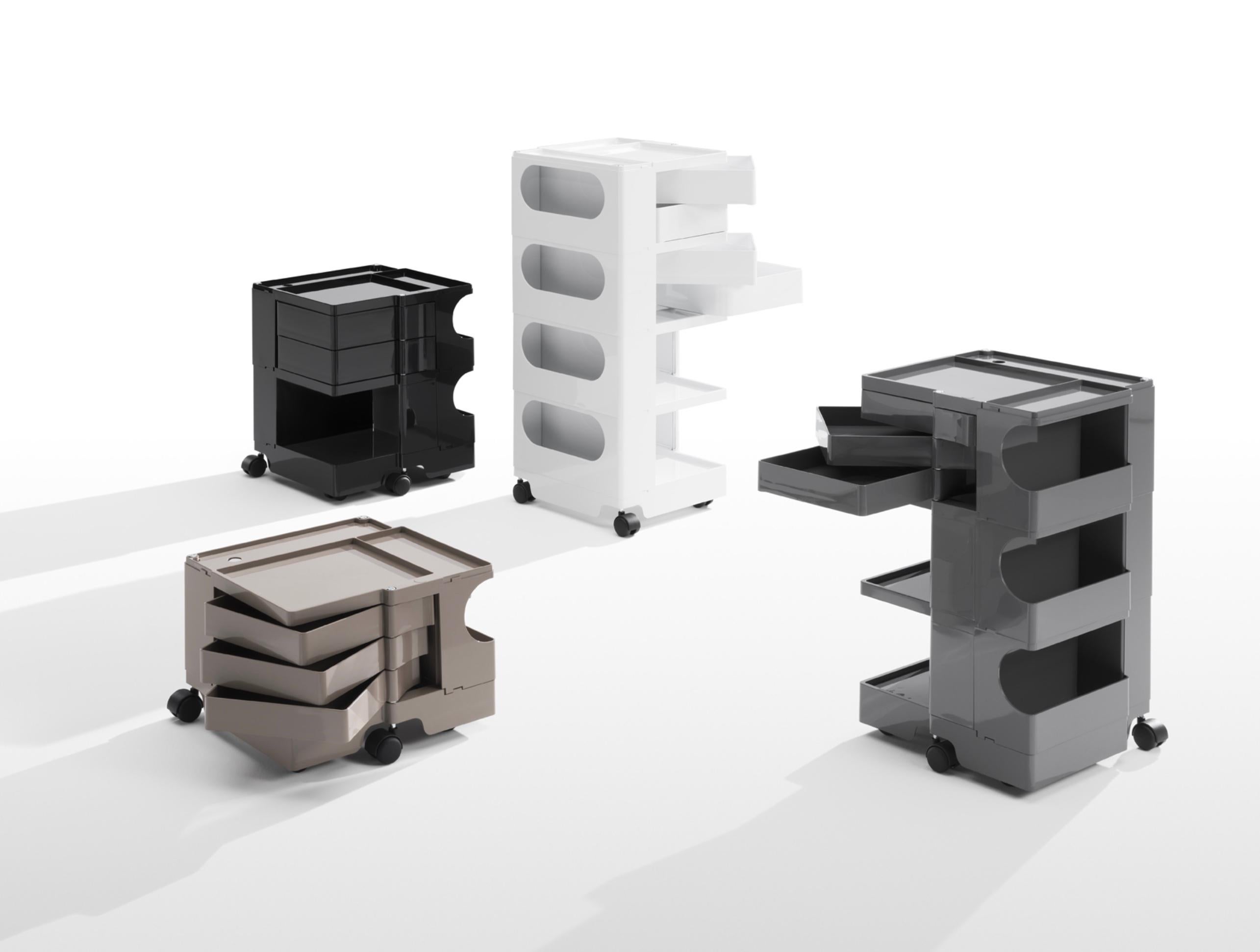
The Boby Trolley is the object the wider design culture knows best, and on its own terms it is straightforward: a modular ABS rolling storage cart with swivelling drawer compartments on castors, designed for use beside a drafting table. Colombo’s own studio practice was the test bench. The drafting table is a workstation that consumes pens, scales, set-squares, paper rolls, drawing inks and reference books at speed; existing furniture solutions — fixed drawers, separate trolleys, low chests — could not keep up. The Boby answered the brief by making the storage rotate around its own axis, putting any compartment within an arm’s reach without the user leaving the stool.
Bieffeplast manufactured the original Boby in Padua from 1970. It won the SMAU Prize in 1971 — Colombo would die in July of that year, on his forty-first birthday — and entered the MoMA and Triennale Milano collections during the same period. After Bieffeplast wound down its furniture line, the Boby was reissued by B-Line, a Treviso company founded in 1999 by Giorgio Bordin specifically to keep certain Veneto plastic-furniture classics in continuous production. The current B-Line Boby is dimensionally identical to the 1970 piece; the ABS chemistry has been updated for present-day fire and emissions standards, but the tooling philosophy is the same.
The Multichair, also 1970, was Colombo’s second great configurable seat. Two stretch-fabric-covered foam elements — a larger curved base and a smaller curved pad — recombine into chair, chaise or floor lounger by means of leather straps. Originally produced by Sormani at Arosio, the Multichair was reissued by B-Line in 2004; like the Tube Chair, it sits in both MoMA’s and the Metropolitan Museum of Art’s collections. Together with the Boby, the Multichair closes Colombo’s decade with two objects that argue, in physical form, that furniture is a verb. A chair is what you do with the foam elements; storage is what you do with the rotating compartments. The Joe Colombo Milan archive holds the working prototypes for both.
It is here that the Santa Tecla drawings reach forward across twelve years. The unbroken-stroke perspective of 1958 was already an argument that a room is one continuous figure; the Boby and the Multichair restated that argument in moulded plastic and stretch fabric. The Joe Colombo Milan archive now contains the evidence at both ends of the arc.
Joe Colombo’s commercial output, 1962–1971
| Year | Project | Manufacturer | Material | Currently held by |
|---|---|---|---|---|
| 1962 | Acrilica lamp (with Gianni Colombo) | O-Luce, Milan | Curved acrylic, chromed steel | Triennale Milano; MoMA |
| 1963 | Elda Chair | Comfort / Fratelli Longhi, Brianza | Moulded fibreglass shell, leather | Triennale Milano; private collections |
| 1965–67 | Universale Chair, model 4860 | Kartell, Noviglio | Injection-moulded ABS, later nylon, then polypropylene | MoMA; Triennale Milano; in production |
| 1967 | KD 27 table lamp | Kartell, Noviglio | Chromed ABS base, opal PMMA disc | Triennale Milano (production 1967–1981) |
| 1969 | Tube Chair | Flexform, Meda | Polyurethane-foam-padded cylinders, rubber clips | MoMA permanent collection |
| 1969 | Visiona 1 — Habitat of the Future | Bayer (Interzum, Cologne) | Polyurethane, ABS, PMMA, integrated electronics | Bayer archive; reconstructed elements at Vitra Design Museum |
| 1970 | Boby Trolley | Bieffeplast, Padua (reissued B-Line, Treviso, from c. 2000) | Injection-moulded ABS, castors | MoMA; Triennale Milano; in production via B-Line |
| 1970 | Multichair | Sormani, Arosio (reissued B-Line, 2004) | Stretch-fabric-covered polyurethane foam, leather straps | MoMA; Met; in production via B-Line |
The table reveals one detail that the prose tends to soften: every Colombo object in production today is in production through reissue rather than through unbroken manufacture. Kartell’s 4860 is the exception. B-Line, founded twenty-eight years after Colombo’s death, is the principal vehicle by which his Bieffeplast and Sormani work re-entered the market. The Joe Colombo Milan archive is, in that sense, an active asset rather than a historical one — a phenomenon we have tracked across other estates in our survey of mid-century archive revivals and in the Lalanne auction-record analysis.
The brothers Colombo: Acrilica and the kinetic image
Cesare Colombo’s brother Gianni (1937–1993) was a pioneer of Italian kinetic and programmed art, a contemporary of Bruno Munari and the Gruppo T. Where Joe worked at the scale of the room and the object, Gianni worked at the scale of the image — light installations, programmed surfaces, environments that changed under the viewer’s gaze. The brothers collaborated only rarely; the Acrilica Lamp of 1962 for O-Luce is the principal surviving collaboration and the lamp that opens our timeline above.
The Acrilica is a prismatic curved acrylic table lamp: a single piece of clear acrylic, bent so that the light enters at the chromed base and emerges along the upper inner edge of the curve, illuminated by internal reflection. The light source is hidden; the acrylic itself becomes the lamp. The collaboration was natural: Gianni’s kinetic-art practice was about light as a medium rather than an illumination, and Joe’s industrial practice was about reducing an object to a single material gesture. The Acrilica is both at once. It is held by Triennale Milano and MoMA and is still produced by O-Luce.
The Brera-Politecnico-Bayer triangle is worth tracing once more. The brothers had Brera (painting) and the Politecnico (architecture and design) in their formation; the Movimento Nucleare circle gave them their first exhibition platforms; Bayer’s Visiona commission, late in the decade, gave Joe the budget to build the manifesto. The Joe Colombo Milan archive sits inside that triangle. It is in dialogue with the kinetic-art archives that Gianni’s estate has been activating since the 1990s, and the Acrilica is the object that connects them. The 2026 Santa Tecla rediscovery, by recovering Joe’s late-1950s painter-to-designer pivot, also makes the early-1960s collaboration with his kinetic-artist brother legible as a continuation rather than a departure — both brothers were, at root, students of how a single material gesture can describe a room. Readers tracking the broader story of post-war Italian design culture may want to compare with our notes on the Branzi continuous-present generation that arrived a decade later.
Coda
Joe Colombo’s studio existed for nine years. He opened it in 1962 and closed it, by dying, on 30 July 1971 — his forty-first birthday. In that window he designed at least eight objects that remain in production or in major museum collections, organised one of the defining speculative habitats of the late 1960s, and won the Compasso d’Oro in 1970, three years before his peers in Italian Radical design would even publish their first major polemics. He did all of it from a studio on via Argelati, with a brother who was making kinetic art across town, and with manufacturers spread in a hundred-and-eighty-kilometre triangle around Milan.
The May 2026 rediscovery of the two Santa Tecla drawings in Enrico Baj’s law-office archive proves nothing that the existing Joe Colombo Milan archive did not already suggest — but it proves it earlier. The unbroken pen-stroke that Ignazia Favata identified in 1958 is the same gesture that produced the rotating compartments of the Boby in 1970. Twelve years separate the drawings from the trolley; the line does not lift.
The closing image is small and specific: a pen-nib touching paper somewhere in a Milan basement in 1958, and not leaving it again until the room has been drawn.