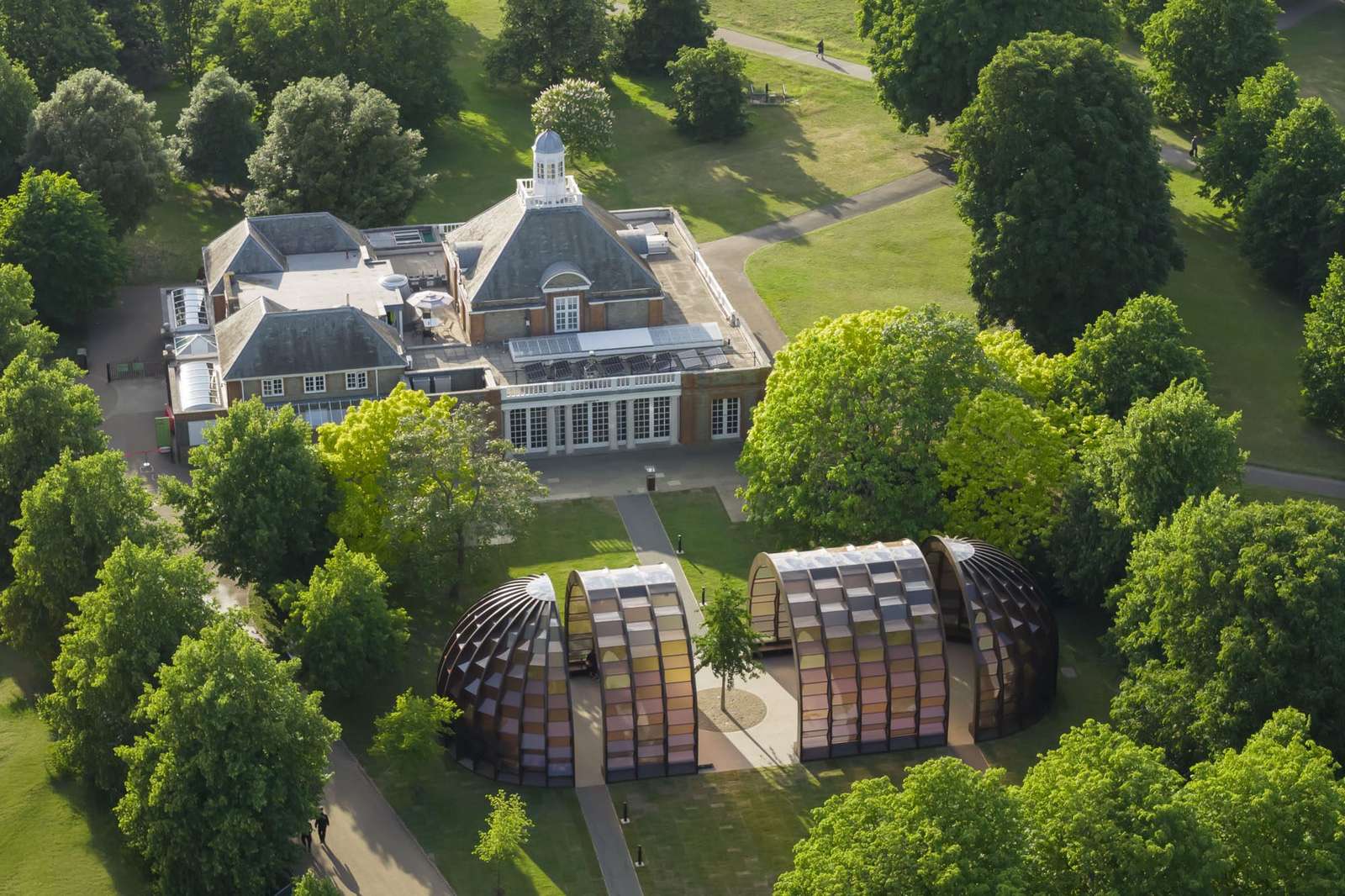
Twenty-six summers, twenty-six architects, and one impossible brief — design a London building before you are allowed to design a London building. The Serpentine Pavilion architects, from Zaha Hadid in 2000 to Lanza Atelier in 2026, have together built the most reliable predictor in contemporary architecture of who will define the next decade of museums, biennales and pavilions. Read the commission as a long roster — Hadid, Libeskind, Toyo Ito with Cecil Balmond, Oscar Niemeyer, Álvaro Siza and Eduardo Souto de Moura, OMA, SANAA, Frank Gehry, Jean Nouvel, Peter Zumthor, Herzog & de Meuron with Ai Weiwei, Sou Fujimoto, Smiljan Radić, SelgasCano, BIG, Francis Kéré, Frida Escobedo, Junya Ishigami, Counterspace, Theaster Gates, Lina Ghotmeh, Mass Studies, Marina Tabassum, Lanza Atelier — and the line reads as a forward index to the next twenty Pritzkers, Venice directorships and global museum jobs. The pavilion does not predict the future; it commissions it.
The rule that built a decade
The constraint is one sentence long and it has done all the work. Julia Peyton-Jones, director of the Serpentine Galleries from 1991 to 2016, established the rule with the inaugural commission in 2000: the invited architect must not have completed a building in the United Kingdom. She wrote it as a logistical filter — a way of giving the Serpentine South lawn in Kensington Gardens to architects whose work London audiences could not otherwise walk through — and it became, almost immediately, a curatorial doctrine. The result is that every Serpentine Pavilion architect arrives in Hyde Park with a built portfolio elsewhere and no built portfolio here, which means the pavilion is read in London as a first sentence rather than a footnote. The brief is six months from invitation to opening, the budget is met largely by sale of the structure after the season, and the lawn is the same lawn each year. What changes is the architect, the language and the material — and the language and the material are almost always the studio’s own argument, distilled.
The rule has held for twenty-six years with two practical concessions: a co-author with Cecil Balmond of Arup in the early run, and the postponement of the 2020 commission to 2021 because of COVID-19, which rolled Counterspace’s design forward by twelve months. The format has not moved. Three months on the lawn, opening in June, closing in October, then dismantled and sold. The pavilions are the buildings that exist in London only when they exist nowhere else.
Serpentine Pavilion architects, 2000–2026: the canonical timeline
| Year | Architect | Pavilion | Material / Defining Move | Where they built next |
|---|---|---|---|---|
| 2000 | Zaha Hadid | Triangulated white-fabric tent for the gallery’s 30th-anniversary gala | 600 sqm steel frame seating 400 guests | Phaeno Science Centre, Wolfsburg (2005); MAXXI, Rome (2010); London Aquatics Centre, Stratford (2011) |
| 2001 | Daniel Libeskind with Arup | Eighteen Turns, folded origami-like structure | Riveted aluminium panels; later relocated to Cork, Ireland in 2005 | Imperial War Museum North, Salford (2002); Denver Art Museum (2006); One World Trade Center masterplan, New York |
| 2002 | Toyo Ito and Cecil Balmond | Algorithmic facade derived from an expanding cube | Randomly rotated steel and aluminium plates | Tama Art University Library, Tokyo (2007); 2013 Pritzker Prize; National Taichung Theater (2016) |
| 2003 | Oscar Niemeyer | His only completed UK building; raised cafe with ruby-red ramp | Steel, aluminium, concrete and glass; partially submerged auditorium echoing Niterói | Auditorium of Ravello (2010); Niemeyer Center, Avilés (2011); active in Rio until his death in 2012 |
| 2005 | Álvaro Siza and Eduardo Souto de Moura with Cecil Balmond | 400 sqm reciprocal grid of laminated spruce beams | Engineered timber as auteur material | Iberê Camargo Foundation, Porto Alegre (Siza, 2008); Souto de Moura’s 2011 Pritzker; Paula Rego House of Stories, Cascais (Souto de Moura, 2009) |
| 2006 | Rem Koolhaas / OMA with Cecil Balmond | Translucent helium-filled ovoid balloon canopy | Rose and fell with the weather | CCTV Headquarters, Beijing (2012); Fondazione Prada, Milan (2015); Garage Museum, Moscow (2015) |
| 2007 | Olafur Eliasson and Kjetil Thorsen (Snøhetta) | Spinning-top-like timber and steel structure | Double-helix ramp clad in plywood | Harpa concert hall facade, Reykjavík (Eliasson, 2011); Norwegian National Opera, Oslo (Snøhetta, 2008); Times Square reconstruction (Snøhetta, 2017) |
| 2008 | Frank Gehry | First UK structure; timber-and-glass amphitheatre | Four steel columns, with son Samuel Gehry and Arup | Foundation Louis Vuitton, Paris (2014); Luma Arles tower (2021); Battersea Power Station Phase 3 (London, 2022) |
| 2009 | SANAA (Kazuyo Sejima and Ryue Nishizawa) | Mirror-polished aluminium roof on slender pillars | 26 mm roof, 50 mm pillars, 557 sqm | Rolex Learning Center, Lausanne (2010); 2010 Pritzker; Louvre-Lens (2012); La Samaritaine, Paris (2021) |
| 2010 | Jean Nouvel | Entirely red pavilion; 12 m cantilevered wall | Glass, polycarbonate, fabric; London telephone-box red | Louvre Abu Dhabi (2017); National Museum of Qatar (2019); 53 West 53rd, New York (2019) |
| 2011 | Peter Zumthor | Black timber hortus conclusus | Enclosing a Piet Oudolf wildflower garden | Allmannajuvet zinc mine museum, Norway (2016); LACMA Wilshire rebuild (Los Angeles, in delivery) |
| 2012 | Herzog & de Meuron with Ai Weiwei | Excavated 1.5 m below the lawn | Cork-lined dish; twelve columns referencing each prior pavilion under a circular reflecting pool | Elbphilharmonie, Hamburg (2017); M+, Hong Kong (2021); Ai Weiwei’s Sunflower Seeds, Tate Modern (2010, prior); Royal College of Art Battersea (Herzog & de Meuron, 2022) |
| 2013 | Sou Fujimoto | Cloud-like lattice of white steel poles across 350 sqm | 20 mm poles with embedded polycarbonate disks | L’Arbre Blanc, Montpellier (2019); House of Hungarian Music, Budapest (2022); Expo 2025 Osaka masterplan |
| 2014 | Smiljan Radić | Translucent white fibreglass shell on quarry boulders | Inspired by his model Castle of the Selfish Giant | Antofagasta cultural centre, Chile (in progress); MIRA Restaurant, Vik; sustained gallery practice with Marcela Correa |
| 2015 | SelgasCano (José Selgas and Lucía Cano) | Double-skin polygon woven from ETFE | Printed in 19 colours; first Spanish commission | Second Home Lisboa (2016); Plasencia Auditorium (long-running, completed 2017); Mérida Factory Youth Movement, Spain |
| 2016 | BIG (Bjarke Ingels) | Unzipped Wall of 1,802 pultruded fibreglass frames | Paired with four debut Summer Houses by Asif Khan, Kunlé Adeyemi, Barkow Leibinger and Yona Friedman | Two World Trade Center, New York (in progress); Lego House, Billund (2017); CopenHill, Copenhagen (2019); Google Bay View, Mountain View (2022) |
| 2017 | Diébédo Francis Kéré | Indigo-blue timber pavilion with V-shaped walls and a central oculus | Channelled rain into a waterfall; inspired by the meeting tree of Gando | 2022 Pritzker Prize; Benin National Assembly, Porto-Novo (in delivery); Goethe-Institut Dakar (in delivery) |
| 2018 | Frida Escobedo | Courtyard of stacked cement roof tiles forming a celosia breeze wall | Aligned to the Greenwich meridian; mirrored canopy, reflecting pool | Met Modern and Contemporary Wing, New York (in delivery, opening 2030); Aesop New York retail; Ruta del Peregrino chapels, Jalisco |
| 2019 | Junya Ishigami | Heavy slate roof draped over slender pillars | Evoking a hillside rock formation | Art Biotop Water Garden, Tochigi (2018, prior); House & Restaurant, Yamaguchi (2022); 2026 Vitra Campus pavilion |
| 2020 | Postponed (COVID-19) | Counterspace design rolled to 2021 | — | — |
| 2021 | Counterspace, led by Sumayya Vally (Johannesburg) | Portuguese cork, micro-cement and recycled steel | Four off-site Fragments; youngest commissioned architect at 28 | Islamic Arts Biennale, Jeddah (2023); Sharjah Architecture Triennial work; Lisbon Architecture Triennale curatorial line |
| 2022 | Theaster Gates with Adjaye Associates | Black Chapel; 10.7 m blackened-timber cylinder with central oculus | Referencing Stoke-on-Trent bottle kilns and Roman tempiettos | Black Artists Retreat permanent home, Chicago; Stony Island Arts Bank programme; Mineral Spirits exhibition cycle |
| 2023 | Lina Ghotmeh | À table, low fluted timber canopy around a communal table | Engineered timber as communal device | Hermès Ateliers Louviers leather workshop (2023); Bahrain Pearling Path; AlUla guest house (in delivery) |
| 2024 | Minsuk Cho / Mass Studies | Archipelagic Void, five small timber islands around a central mandang courtyard | Gallery, Library, Auditorium, Tea House, Play Tower | Won Buddhist Temple, Seoul (2024); ongoing Korean cultural commissions; National Museum of Modern and Contemporary Art programme |
| 2025 | Marina Tabassum Architects | A Capsule in Time; MTA’s first all-wood building | Four capsule volumes wrapped in polycarbonate, oriented north–south along the bell tower of Serpentine South | Khudi Bari modular housing (Bangladesh, ongoing); Sharjah Architecture Triennial 2023 commission; first US museum solo |
| 2026 | Lanza Atelier (Isabel Abascal and Alessandro Arienzo, founded Mexico City 2015) | a serpentine, lightweight brick pavilion | Reinterpreting the English crinkle-crankle wall under a translucent roof; opens 6 June 2026 | — |
The Cecil Balmond effect, 2002–2006
The first thing to notice in the timeline is the name that recurs in the second column for four of the first six years. Cecil Balmond — then Deputy Chairman of Arup’s Advanced Geometry Unit — engineered the 2002 Ito, the 2005 Siza / Souto de Moura, and the 2006 OMA pavilions, and would return for further iterations later. The pavilions of this opening run are unintelligible without him. They are the years in which structural engineering ran ahead of the architecture and dictated the architectural argument, and they reset the discipline’s expectation of what a pavilion at this scale could be.
Toyo Ito and Balmond’s 2002 pavilion took an expanding cube — a square rotated and scaled iteratively — and unrolled its lines onto a flat envelope, then filled the resulting facets with steel and aluminium plates rotated at random. Read from a distance the structure looks like a single skin perforated at intervals; read from the inside it is a stack of triangles and trapezoids each carrying their own load. The pavilion was the first major outing of what would become Ito’s algorithmic period, and it travelled directly into the work that followed: the Tama Art University Library in 2007, the Toyo Ito Museum of Architecture in Imabari in 2011, and the National Taichung Theater in 2016. Ito’s 2013 Pritzker citation pointed at the 2002 pavilion by name.
Álvaro Siza and Eduardo Souto de Moura’s 2005 pavilion went the opposite way: an apparent retreat into Portuguese rationalism that was, structurally, the most experimental of the early run. A 400 square metre reciprocal grid of laminated spruce beams — every beam supported by, and supporting, every adjacent beam — Balmond’s office solved it as a single calculation; the architecture inherited the timber dome that resulted. Souto de Moura’s 2011 Pritzker followed; Siza’s late period of small chapels, the Iberê Camargo Foundation in Porto Alegre, and the Paula Rego House of Stories in Cascais are legible as the same line of argument that the Serpentine pavilion opened.
OMA’s 2006 pavilion is the outlier of the three: a helium-filled translucent ovoid balloon that lifted and lowered on its own according to the weather, with Koolhaas using the brief as an excuse to test a programmatic — rather than structural — provocation. The structure was, in effect, a moving roof for the gallery’s twenty-four-hour interview marathon, and it set the model for the public-talk-as-architecture programme that Hans Ulrich Obrist would extend across the rest of the decade. The Cecil Balmond effect, then, is the early Serpentine’s most under-recognised proposition: that the discipline’s most legible authorial signature in the 2000s was an engineer’s, distributed across the architects he co-authored with.
The mirror years, 2008–2012
The pavilions of 2008 through 2012 are the ones that broke into the wider design press. They are also the ones that, in hindsight, did the most concrete work for the studios that built them. Each of the five became branding for the architect’s entire output in the decade that followed.
Frank Gehry’s 2008 pavilion was his first UK structure, conceived with his son Samuel Gehry and engineered with Arup. A timber-and-glass amphitheatre anchored by four canted steel columns, it functioned as an open stage for the gallery’s summer programme and read in elevation as a study for the Foundation Louis Vuitton in the Bois de Boulogne, which would open in Paris in 2014. The Foundation Louis Vuitton’s billowing glass sails are the 2008 pavilion at six times the scale and a thousand times the budget; the lineage is so direct that the Serpentine commission now reads as a study model commissioned by Bernard Arnault by proxy. Luma Arles in 2021 and Battersea Power Station Phase 3 in 2022 carry the same vocabulary forward.
SANAA’s 2009 pavilion is the canonical mirror year. Kazuyo Sejima and Ryue Nishizawa designed a 26-millimetre mirror-polished aluminium roof that floated across 557 square metres on randomly placed 50-millimetre metal pillars, the whole structure dissolving into reflection in clear weather. SANAA’s 2010 Pritzker landed the following year; the Rolex Learning Center in Lausanne opened in the same period; Louvre-Lens followed in 2012. The pavilion was the year in which SANAA’s diagrammatic, near-invisible architecture stopped reading as restraint and started reading as a global style.
Jean Nouvel’s 2010 pavilion celebrated the gallery’s fortieth anniversary in saturated red — every material, from polycarbonate to fabric to the 12-metre cantilevered wall, painted or printed the same colour, in deliberate homage to London telephone boxes and double-deckers. Read against Louvre Abu Dhabi in 2017 and National Museum of Qatar in 2019, the pavilion is the year Nouvel committed to spectacle as a structural discipline. Peter Zumthor’s 2011 pavilion is its near-inverse: a black-stained timber hortus conclusus enclosing a Piet Oudolf wildflower garden, with the architecture entirely subordinated to the planting. Zumthor’s late period — the Allmannajuvet zinc mine museum in Norway, the long-delivery LACMA Wilshire rebuild in Los Angeles — has stayed within that register.
Herzog & de Meuron with Ai Weiwei in 2012 closed the run with the most archaeological gesture in the commission’s history. The pavilion was excavated 1.5 metres below the lawn, lined with cork, and structured around twelve columns referencing each of the previous eleven pavilions plus the present one. The roof was a circular reflecting pool. The collaboration was the most direct rehearsal yet of the Beijing National Stadium logic, and it preceded both the Elbphilharmonie in 2017 and M+ in Hong Kong in 2021. Each of these five mirror-year pavilions became the studio’s most-photographed work for the following half-decade.
Beyond Europe, 2017–2025
The commission’s third act opened the brief geographically, and the geographic shift drove a material shift that the previous decades had not predicted. From 2017 to 2025 the lawn was given to architects working out of Burkina Faso, Mexico, South Africa, the United States, Lebanon, South Korea and Bangladesh — and the pavilions made out of indigo timber, cement roof tiles, cork and micro-cement, blackened timber, fluted timber and polycarbonate-wrapped wood respectively. The shared move is the refusal of high-performance industrial cladding in favour of a vernacular reinterpreted at pavilion scale.
Francis Kéré’s 2017 pavilion was the hinge. An indigo-blue timber structure with V-shaped perforated walls and a central oculus that channelled rainfall down into a courtyard waterfall, it was modelled on the meeting tree at the centre of the village of Gando in Burkina Faso where Kéré grew up. The pavilion preceded his 2022 Pritzker — only the second African laureate, and the first sub-Saharan — and reframed the commission’s reading public around an architecture of climate-specific gathering. Frida Escobedo’s 2018 pavilion repeated the move at a different latitude: a celosia breeze wall of stacked cement roof tiles, aligned to the Greenwich meridian, with a mirrored canopy and shallow reflecting pool. Escobedo’s commission of the Met’s Modern and Contemporary Wing in New York, announced shortly afterwards, is in delivery for a 2030 opening.
Sumayya Vally’s 2021 Counterspace pavilion holds the youngest-architect record at twenty-eight, and the pavilion was the most explicitly distributed of any in the commission’s history. Made from Portuguese cork, micro-cement and recycled steel, the main structure on the lawn was paired with four Fragments placed off-site at meeting points across London’s migrant communities — Brixton, Edgware Road, Hoxton and Tottenham — each one a portable echo of the pavilion’s gathering geometry. Vally’s subsequent work at the Islamic Arts Biennale in Jeddah in 2023 has extended the same logic.
Theaster Gates’s 2022 Black Chapel, designed with Adjaye Associates as engineering co-author, was a 10.7-metre blackened-timber cylinder with a central oculus, referencing the bottle kilns of Stoke-on-Trent and the Roman tempiettos that Gates studied during his residency in Italy. It was the first pavilion designed by an artist who is also a ceramicist — the cylinder housed a bell rescued from the demolished St Laurence Catholic Church on Chicago’s South Side — and the pavilion functioned, in practice, as a working chapel.
Lina Ghotmeh’s 2023 pavilion, À table, was a low fluted timber canopy ringing a communal table. It read as a hospitality typology rather than a sculptural object, and it preceded her 2023 Hermès Ateliers Louviers leather workshop, the studio’s largest delivered commission to date. Minsuk Cho and Mass Studies’ 2024 Archipelagic Void split the pavilion into five small timber islands — Gallery, Library, Auditorium, Tea House, Play Tower — around a central mandang courtyard, importing the South Korean village configuration directly onto the Kensington lawn. Marina Tabassum Architects’ 2025 A Capsule in Time — the studio’s first all-wood building — wrapped four capsule volumes in polycarbonate and oriented the line of the pavilion north–south along the bell tower of Serpentine South.
Lanza Atelier and the crinkle-crankle wall, 2026
The 2026 commission goes to Lanza Atelier, the Mexico City studio founded in 2015 by Isabel Abascal and Alessandro Arienzo, and opens on 6 June 2026. The pavilion is titled a serpentine — lower-case, indefinite article — and it is a lightweight brick wall, sinuous in plan, set under a translucent roof. The architectural reference is the English crinkle-crankle wall: the serpentine garden wall of red brick, one course thick, whose lateral undulation provides the lateral stability that a straight one-brick wall lacks. The typology is older than England — the geometry appears in ancient Egyptian construction, where mud-brick walls were rippled for the same reason — and was introduced to England by Dutch engineers in the seventeenth and eighteenth centuries. Suffolk has more than a hundred surviving examples. Thomas Jefferson, who saw them on his European tour, built crinkle-crankle walls into the gardens of the University of Virginia.
Lanza Atelier’s pavilion is the first time the typology has been the explicit subject of a Serpentine commission, and the move is the studio’s argument compressed into a single gesture. Abascal and Arienzo’s Mexico City work — the Casa GG renovation, the El Camino Real de Tierra Adentro chapels, the studio’s gallery interventions for kurimanzutto — has consistently used a regionally specific masonry vocabulary against industrial cladding, and the brick choice for the 2026 pavilion is a continuation rather than a translation. The crinkle-crankle wall is a piece of structural shorthand the studio has lifted out of its English-vernacular context and rebuilt under a polycarbonate roof.
Read against Marina Tabassum’s 2025 all-wood capsules and Sumayya Vally’s 2021 cork-and-micro-cement Fragments, the 2026 brick pavilion completes a five-year run in which the Serpentine has consistently commissioned material vernaculars that the architect’s own country claims first. The crinkle-crankle is England’s; Lanza Atelier are commissioning it back to England through the lens of a Mexico City practice that has been working with brick for a decade. This is the most exact form the commission has yet taken: a pavilion that is, structurally, a piece of English garden architecture rebuilt by foreign architects who are constitutionally barred from building a permanent English garden.
The crinkle-crankle is not a sculptural form. It is a structural solution to a budget problem — the wave saves bricks — and Lanza Atelier’s pavilion will read as a sentence of construction logic rather than an image. That is the brief, as Peyton-Jones first wrote it in 2000. Twenty-six summers in, the pavilion is still doing the same thing: handing the Kensington Gardens lawn to architects who have not yet built in the United Kingdom, and watching what they put down. The brick wave that goes up on 6 June 2026 is its latest entry.