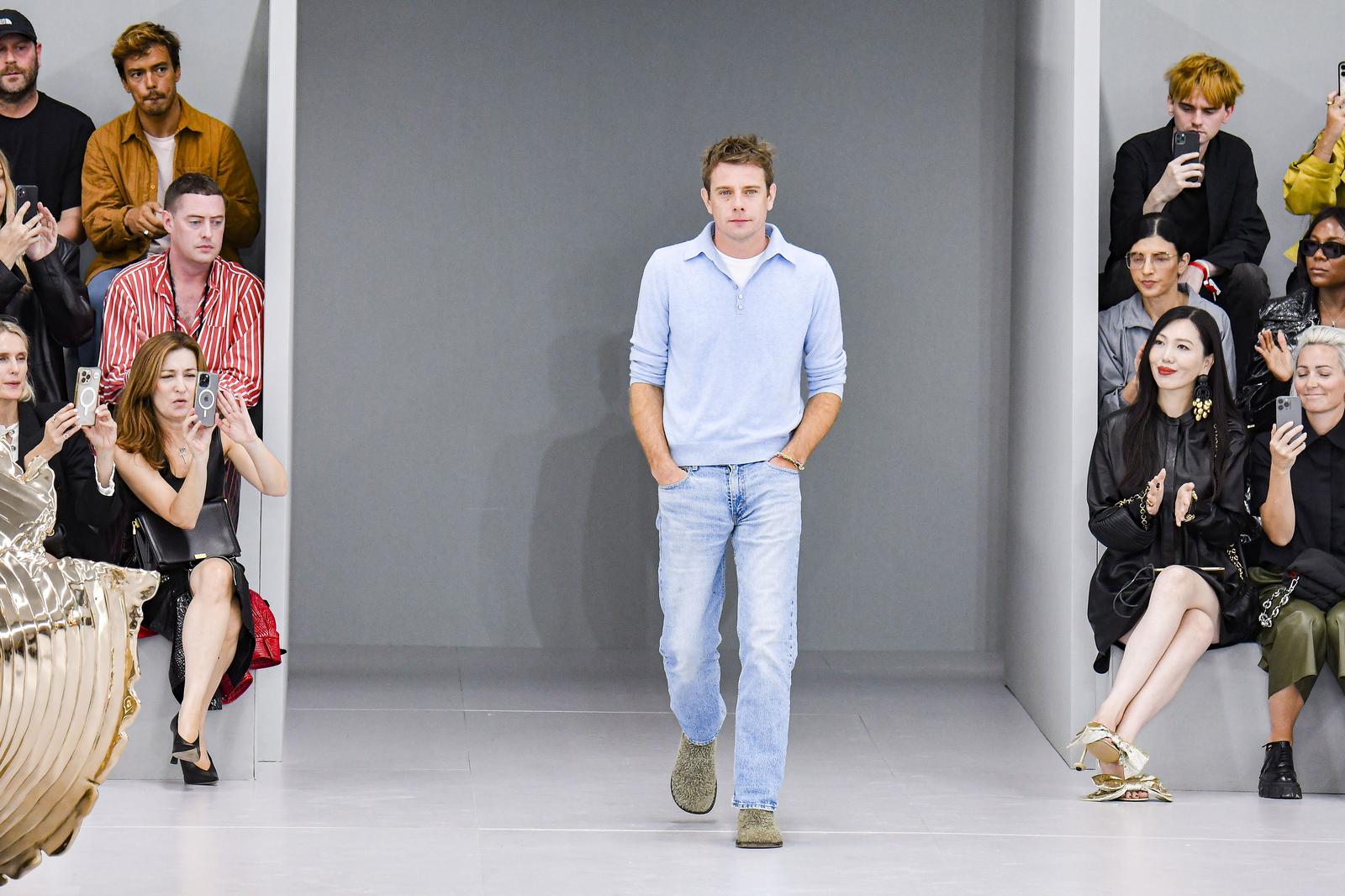
Jonathan Anderson is the first designer since Christian Dior himself, in 1946, to oversee Dior womenswear, menswear and haute couture from one office. The jonathan anderson lvmh trajectory — from the September 2013 deal that made him Loewe creative director and gave LVMH a minority stake in his independent JW Anderson label, to the April–June 2025 Dior appointments that consolidated three creative directorships under his name — is the most aggressive single-designer bet the group has placed in a generation. It runs across two brands (Loewe and Dior), one foundation prize, one curated museum show, and roughly twelve years.
This piece is a chronology, not a review. It walks the deal structures, the calendar, the debuts, and the portfolio decisions — including the 2026 LVMH divestment of Marc Jacobs — that explain why Anderson now sits where he sits, and what the group is asking him to do.
JW Anderson and the September 2013 deal
Jonathan Anderson founded JW Anderson in London in 2008 as a menswear label, adding womenswear in 2010. The label remained majority-independent throughout, sold through its own e-commerce, a Soho flagship and a global wholesale network. It was never absorbed into a conglomerate.
That independence is precisely what made the September 2013 deal unusual. In a single month, LVMH took a minority stake in JW Anderson and named Anderson creative director of Loewe, the Madrid-based leather house the group had owned since 1996. It was a structure rarely seen in the industry: a personal hire paired with a discrete brand investment, leaving JW Anderson under its founder’s majority control while binding his calendar and creative bandwidth to a much larger house. Bernard Arnault’s group effectively wrote two cheques at once — one to acquire creative capacity inside Loewe, one to keep that capacity from being acquired by anyone else.
The deal also flagged the way LVMH had begun thinking about creative talent by the early 2010s: not as a hire to be poached when needed, but as an equity position to be held. The same logic would resurface a decade later when the group rotated its portfolio around Anderson.
Loewe 2013–2025: from Madrid to Place Saint-Sulpice
Anderson’s first Loewe womenswear collection, Spring/Summer 2015, was presented in Paris on 26 September 2014 inside a 1950s brutalist building. The choice of venue was not incidental. Loewe’s design studio had relocated from Madrid to Place Saint-Sulpice earlier that year, repositioning the house from a Spanish leather marque into a Paris-calendar fashion brand without abandoning the Madrid atelier or the leather DNA.
The SS15 debut — recorded in the graph as anderson-loewe-ss15-debut — set the template for what would become the Anderson Loewe vocabulary: heritage leather translated into sculptural ready-to-wear; a logo redrawn in tighter, more architectural anagram form; and an obsession with craft media that ran through the casting of the collections, the shop windows, and eventually the brand’s most lasting institutional contribution, the Craft Prize.
Over twelve years, Anderson made Loewe a Paris fashion week fixture with consistent commercial momentum. The clearest single data point came in Q2 2023, when Loewe topped Lyst’s Hottest Brand Index for the first time, displacing Prada at number one. The same season saw the brand dress Beyoncé’s Renaissance World Tour, including the chrome-finish looks that became the tour’s defining image. Lyst rankings move quarterly; what mattered was that Loewe arrived at number one having built its desirability on craft language rather than on logo or licensing.
Anderson also threaded artist pairings through the Loewe collections. Pre-Fall 2023 was built around the Galician surrealist painter Maruja Mallo — recorded in the graph as loewe-pre-fall-2023-maruja-mallo — with later collections engaging Lynda Benglis and Richard Hawkins. These were not co-branded capsules but integrations: the artist’s vocabulary was used to set the colour, surface and silhouette logic of an entire season, not to print a single t-shirt.
He left on 17 March 2025, after approximately twelve years. The succession was handed to Jack McCollough and Lazaro Hernandez, the duo behind Proenza Schouler, in a clear signal that LVMH intended to maintain Loewe’s New York–Paris cultural register rather than reset it to a Spanish heritage frame. The Craft Prize — Anderson’s most durable institutional legacy at Loewe — would continue under the new directors.
The Loewe Foundation Craft Prize
Anderson founded the Loewe Foundation Craft Prize in 2016. The award carries a €50,000 cash prize and was conceived as the world’s most serious annual recognition of contemporary craft practice. It was first awarded in 2017 to the German wood-turner Ernst Gamperl, and across its first decade became the most prominent international craft prize, with shortlists drawn from ceramicists, weavers, basketmakers, glass artists and lacquer workers spanning more than thirty countries.
The prize is recorded in the graph as loewe-foundation-craft-prize-founding-2016. Its institutional weight is now structural to Loewe: even after Anderson’s departure, the house’s identity rests substantially on the prize’s annual cycle and on the museum-grade exhibitions that travel each finalist cohort through venues in Madrid, Paris, Tokyo, New York and now Singapore.
The 2026 edition, the first awarded after Anderson’s Loewe exit, was held on 12 May 2026 at the National Gallery Singapore. The winner was the Korean ceramicist Jongjin Park, for Strata of Illusion, a paper-and-porcelain-slip sculptural form completed in 2025. The win was a continuity statement: the prize architecture, the jury process, the international circuit — all held intact through a creative directorship transition. That continuity is the point. Anderson built an institution that outlasts his own tenure at the house that hosts it.
Disobedient Bodies and the curator role
In 2017, the Hepworth Wakefield invited Anderson to curate an exhibition. The result, Disobedient Bodies: JW Anderson curates The Hepworth Wakefield, ran from 18 March to 18 June 2017. The show paired twentieth-century sculptors — Barbara Hepworth, Henry Moore, Louise Bourgeois, Sarah Lucas — with garments by Christian Dior, Rei Kawakubo, Helmut Lang and Issey Miyake. The scenography was designed by 6a architects.
Recorded in the graph as disobedient-bodies-hepworth-2017, the show matters for two reasons. First, it established Anderson as one of the only working fashion designers willing to spend institutional currency on a curatorial project that did not directly sell garments. Second, it pre-figured the Dior appointment: the most-discussed pairing in the show was a 1948 Dior haute couture dress beside a Hepworth sculpture. Anderson was already thinking with Dior’s archive eight years before he was given the keys.
The curated-sculpture instinct also showed up across Loewe’s runway, in the Craft Prize architecture and, later, in collaborations with figures outside fashion — including the long-standing collaboration with Tilda Swinton that extends through the Hades knitwear project Precipice, recorded as hades-tilda-swinton-precipice.
The 2025 Dior reshuffle: Jones out, Chiuri out, Anderson in
The Dior transition unfolded in three discrete moves over five months in 2025.
In January 2025, Kim Jones exited Dior Men. Jones had succeeded Kris Van Assche as Dior menswear artistic director in 2018 and had run the house’s men’s collections for seven years, anchoring the streetwear-meets-couture line that defined the menswear category across the late 2010s. His exit left Dior Men without a creative director for the first time since the line was relaunched.
On 29 May 2025, Maria Grazia Chiuri announced her exit from Dior womenswear after nine years. Chiuri had joined Dior in July 2016 as the first woman to lead the house’s womenswear since its 1946 founding. Her final show was the Dior Cruise 2026 in Rome on 27 May 2025 — recorded as chiuri-final-dior-cruise-2026-rome — a homecoming staged in the city where she had built much of her own design language before Dior, and where her tenure had repeatedly returned for couture and cruise activations.
Anderson’s appointment came in two stages. In April 2025, LVMH named him Dior menswear artistic director, filling the Kim Jones seat. In June 2025, the group added womenswear and haute couture to his brief, making him the first designer since Christian Dior himself in 1946 to oversee all three Dior collection categories from a single office. The decision dissolved the two-house, two-creative-director structure that had governed Dior for nearly three decades and replaced it with single-designer authorship at the scale of a roughly ten-billion-euro brand.
Jonathan Anderson at Dior: SS26 debuts and the Cruise 2027 stage
Anderson’s first Dior collection — Dior Homme SS26 — was presented in Paris on 27 June 2025. The collection, recorded as anderson-dior-mens-ss26-debut, ran to 60 looks. The press response treated the show as a stylistic reset rather than a refinement of Jones’s work: tailoring proportions changed, the colour palette compressed, and the show notes referenced the Christian Dior 1947 New Look in language that signalled Anderson intended to mine the founder’s archive rather than the more recent decades.
The womenswear debut, anderson-dior-womens-ss26-debut, was presented in Paris on 1 October 2025 — three months after the menswear show, on the standard Paris Fashion Week womenswear date. It was preceded by a soft launch on the Venice Film Festival red carpet in September 2025, when the first looks signed by Anderson appeared on actresses and ambassadors associated with the house. The Venice strategy was deliberate: it let the public see the new Dior womenswear vocabulary before the runway show, building a baseline of imagery the runway could then expand.
The cruise calendar followed. Anderson’s Dior Cruise 2027, recorded as dior-cruise-2027-anderson, will stage at LACMA’s new David Geffen Galleries — the Peter Zumthor-designed concrete building that replaced the four older LACMA pavilions on Wilshire Boulevard. The pairing matters institutionally: Dior is staging its first Anderson-era cruise show inside a building by one of the most respected living architects, on the campus of the largest art museum in the western United States. It is the same logic that produced Disobedient Bodies — Anderson placing fashion inside an institutional architecture frame rather than a custom-built marquee.
LVMH portfolio rotation: Marc Jacobs and the Dior tentpole
The Anderson appointment did not happen in isolation. It was paired, across 2025–2026, with a quiet but consequential portfolio rotation. In 2026, LVMH divested Marc Jacobs — recorded in the graph as lvmh-divests-marc-jacobs-2026 — exiting a brand the group had owned since 1997 and which had been an early test bed for the same talent-plus-investment logic later applied to JW Anderson.
The divestment reads as a clearance decision. With Anderson consolidating three Dior categories, with Loewe handed to McCollough and Hernandez, with the LVMH leather-goods portfolio consolidating around Dior and Louis Vuitton, and with the group’s American luxury bandwidth absorbed by Tiffany & Co. integration, Marc Jacobs no longer mapped to a strategic slot. The divestment positions Dior as the group’s primary creative tentpole — the brand on which Bernard Arnault’s group is now placing the largest single-designer bet in its history.
The same rotation explains why the JW Anderson minority stake from 2013 still matters. LVMH did not buy a creative director in 2025; it activated an option it had been holding since 2013. The deal that placed Anderson at Loewe also gave the group a structural relationship with his independent label, and that relationship has held across twelve years and three creative directorships. The 2013 cheque, in hindsight, was the option-value purchase. The 2025 Dior appointments are the exercise.
Timeline: Jonathan Anderson at LVMH, 2008–2027
| Date | Event | Brand | City |
|---|---|---|---|
| 2008 | JW Anderson founded (menswear) | JW Anderson | London |
| September 2013 | LVMH minority stake in JW Anderson; Anderson named Loewe creative director | JW Anderson / Loewe | London / Madrid |
| 26 September 2014 | Loewe SS15 womenswear debut, 1950s brutalist building | Loewe | Paris |
| 2016 | Loewe Foundation Craft Prize founded (€50,000) | Loewe Foundation | Madrid |
| 18 March – 18 June 2017 | Disobedient Bodies curated exhibition, scenography by 6a architects | The Hepworth Wakefield | Wakefield |
| Q2 2023 | Loewe ranked #1 on Lyst Hottest Brand Index, displacing Prada | Loewe | — |
| 17 March 2025 | Anderson exits Loewe after ~12 years; succeeded by Jack McCollough and Lazaro Hernandez | Loewe | Paris |
| April 2025 | Anderson named Dior menswear artistic director | Dior | Paris |
| 27 May 2025 | Maria Grazia Chiuri’s final Dior show, Cruise 2026 | Dior | Rome |
| 29 May 2025 | Chiuri exit from Dior womenswear announced after nine years | Dior | Paris |
| June 2025 | Anderson adds Dior womenswear and haute couture; first since Christian Dior in 1946 to hold all three | Dior | Paris |
| 27 June 2025 | Dior Homme SS26 debut, 60 looks | Dior | Paris |
| September 2025 | Anderson-signed Dior womenswear soft launch on Venice Film Festival red carpet | Dior | Venice |
| 1 October 2025 | Dior womenswear SS26 debut | Dior | Paris |
| 12 May 2026 | Jongjin Park wins Loewe Craft Prize 2026 for Strata of Illusion (2025) | Loewe Foundation | National Gallery Singapore |
| Future (2027 cruise) | Anderson’s Dior Cruise 2027 stages at LACMA’s David Geffen Galleries (Zumthor) | Dior | Los Angeles |
The Tilda Swinton thread
One thread runs across the entire chronology and does not belong to any single brand. Anderson’s collaboration with Tilda Swinton began in the Loewe years — Swinton appeared in Loewe campaigns, presented Loewe collections, and modelled the brand’s craft-heavy editorial output — and has extended past his Loewe exit through Precipice, the Hades knitwear project recorded as hades-tilda-swinton-precipice. Precipice is not a Loewe project, not a Dior project, and not a JW Anderson project. It sits in Anderson’s personal collaborator network, and its persistence through the 2025 Dior transition signals that Anderson intends to keep extra-mural collaborations alive even at the largest house in the LVMH fashion portfolio. Few designers running a brand of Dior’s scale maintain that bandwidth. Karl Lagerfeld did. Anderson is now signalling he intends to.
What the group is asking Anderson to do
The combined load is unprecedented in living memory. A single creative director is now responsible for:
- Dior womenswear (four collections a year plus cruise).
- Dior haute couture (two collections a year).
- Dior menswear (two collections a year plus pre-collections).
- Continued cultural authorship of the Loewe Foundation Craft Prize ecosystem he founded, even after stepping back from Loewe day-to-day.
- The personal label JW Anderson, in which LVMH has held a minority stake since 2013.
The calendar implications alone are severe — roughly eight to ten Dior collection moments per year, against the two-to-four that any single creative director at the brand has carried since 1946. The decision to consolidate all three Dior categories under Anderson was therefore not a workload optimisation; it was a coherence bet. LVMH appears to have concluded that the price of dividing Dior across two designers — the Jones-Chiuri structure of 2018–2025 — was a creative incoherence that single-designer authorship can resolve, and that Anderson is the designer worth concentrating the brand around.
The 2026 divestment of Marc Jacobs underwrites the bet. With Dior elevated to primary creative tentpole and Loewe handed to a continuity team, the group has cleared the portfolio of distractions and concentrated investment around two houses, one of which is now substantially Anderson’s.
Coda
The jonathan anderson lvmh story is, at the structural level, a story about an option held for twelve years and then exercised. The September 2013 deal was unusual because it bundled a personal hire with a brand investment; the April–June 2025 Dior appointments were unusual because they reversed three decades of multi-director structure at the group’s most prestigious house. Between those two moments, Anderson built a craft prize that outlasts his tenure, curated a museum exhibition that pre-figured his Dior brief, ranked a leather house above Prada on Lyst, and maintained a personal collaborator network — Tilda Swinton, the Hepworth, 6a architects, Hades — that runs in parallel to every official creative directorship he has ever held. The 27 June 2025 Dior Homme SS26 debut, the 1 October 2025 Dior womenswear debut, the September 2025 Venice red-carpet soft launch, and the forthcoming Dior Cruise 2027 inside Peter Zumthor’s David Geffen Galleries at LACMA are the first four data points of what the option was bought for. The 12 May 2026 Loewe Craft Prize award to Jongjin Park in Singapore is the proof that what Anderson built at Loewe holds without him. Both points matter. Both are now LVMH’s.