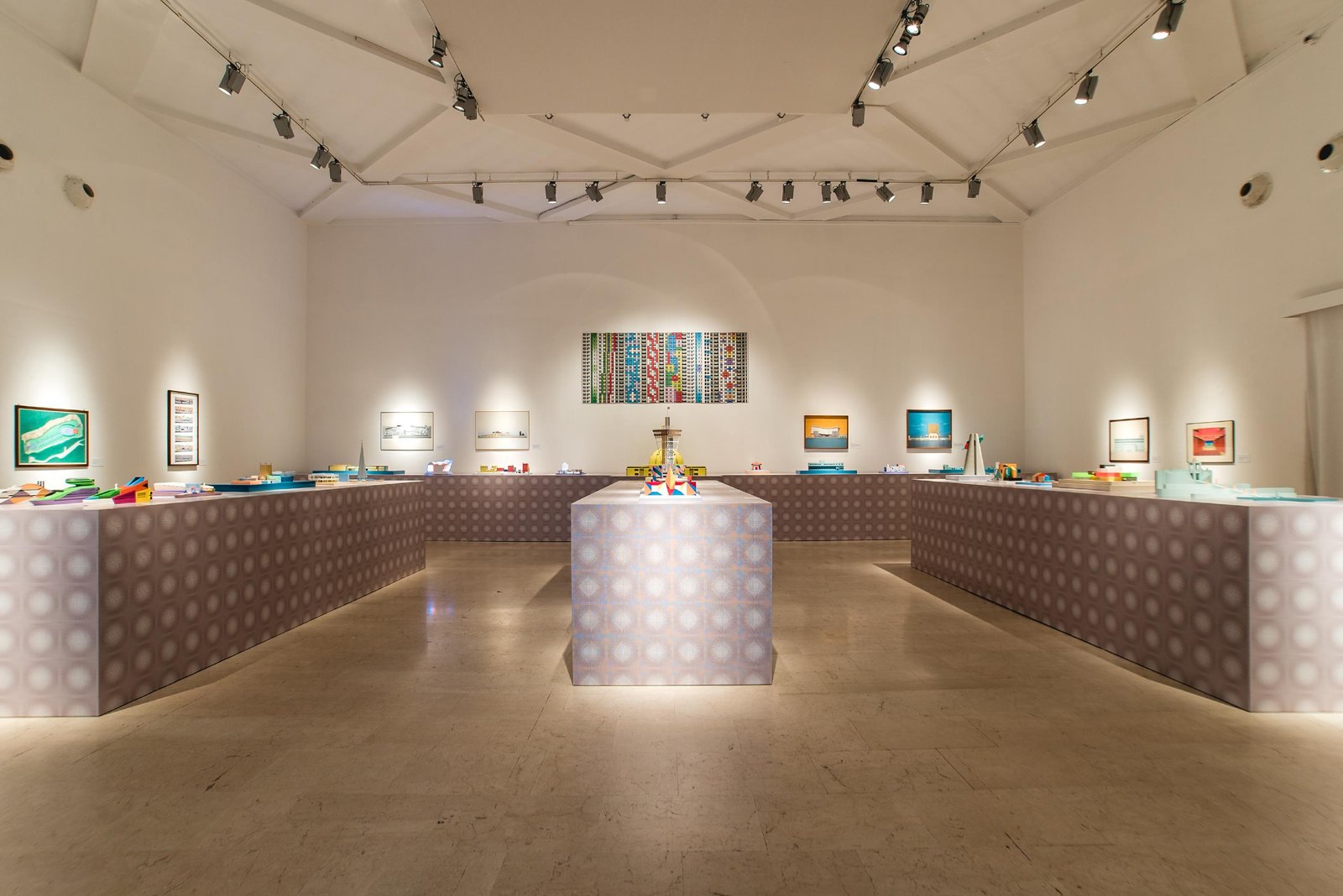
Loredana Parmesani has filled a 19th-century Pallanza villa with 130 Mendini objects arranged not as museum vitrines but as rooms — the Proust Armchair in one, the Straw Armchair in another, the 100% Make-Up vases lined up like household china, a jacket from the 1997 Furniture for Men series standing in the hallway clad in gold mosaic. The alessandro mendini retrospective at Villa Giulia, Verbania, on the western shore of Lake Maggiore, runs from 16 May to 27 September 2026, was organised by the City of Verbania with the Alessandro Mendini Archive run by Mendini’s daughters Elisa and Fulvia, and stages the Studio Alchimia and Alessi lineages inside a domestic shell rather than the white cube. The exhibition is titled “Alessandro Mendini. Objects. Rooms as worlds.” The design of the show is by Alex Mocika. The thesis, by Parmesani’s own statement, is that the room — “a place of reflection, rest, quietness, and work, but also a place of turbulence” — is the unit of Mendini’s thinking, and that to put his work in vitrines is to mistake the work for its objects.
The argument of this article is narrow. Mendini’s career has already been institutionalised in the obvious places — Triennale, Groninger, Alessi’s archives at Crusinallo — and a 130-piece survey in a lake town could easily have been a victory lap. What Parmesani and the Mendini Archive built instead is a venue argument. Villa Giulia is not a kunsthalle. It is a domestic structure with rooms, fireplaces, a service stair and a lake view, and the decision to treat those rooms as the display syntax rather than as inconvenient walls to drape with vinyl turns the show into a working demonstration of what Mendini meant when he said an object is a fragment of an imagined world. That decision sits inside the broader 2026 archive moment — the Branzi continuous-present retrospective at Triennale, the Joe Colombo Milan archive widening through Enrico Baj’s law-office papers, Cassina’s Le Corbusier Inédits at Salone — and it is the strongest argument among them that the Italian Radical operating system needs to be staged at the scale of inhabitation.
Villa Giulia as a Mendini room
Villa Giulia stands in Pallanza, the lakefront district of Verbania, its principal façade addressing Lake Maggiore. Built in the late 19th century, it belongs to the City of Verbania and has functioned for decades as a civic events venue rather than a museum. The choice for the alessandro mendini retrospective is the first curatorial move, and the most consequential. A Mendini show at Triennale would have been the Milan default; one at Groninger would have been the international canon. The Verbania choice is neither — a deliberate move into a smaller, more domestic, more peripheral architecture, with Parmesani using the smallness as a structural device rather than apologising for it.
The villa’s plan does the curatorial work. Mocika’s exhibition design distributes the 130 works across rooms so each space reads as a furnished interior rather than a sequence of pedestals. The Proust Armchair sits in one room as a piece of furniture in that room; 100% Make-Up vases occupy a sideboard; the Furniture for Men jacket-cabinet stands like a coat in a hall. The convention being broken is the vitrine convention, and the convention being recovered is the one Mendini himself used when he photographed his pieces in domestic situations in the late 1970s — the staged interior, the object as inhabitant. The lake light helps. Pallanza light off Maggiore in early summer falls through the villa’s tall windows onto Proust’s pointillist upholstery in a way no gallery LED can reproduce.
Parmesani’s curatorial statement names the room as a contradictory unit — quietness and turbulence simultaneously — and that contradiction is the show’s organisational logic. Some rooms are still: a study with drawings from the Domus years, a small room with a single Alessi object on a console. Others are loud: a salon with the Proust Armchair, a Make-Up wall, a Furniture for Men piece. The pacing is deliberately uneven, the way a real house is uneven.
Studio Alchimia and the 1978 Proust Armchair
Mendini joined Studio Alchimia as a partner in 1978. The studio, founded in Milan in 1976 by Alessandro Guerriero, was the immediate institutional vehicle for the Italian post-radical generation — the group that included Ettore Sottsass, Andrea Branzi, Michele De Lucchi and Mendini himself, all of them already established figures arguing for a new register of object-making against the rationalist Milan default. Alchimia’s logic was that the industrial object had exhausted its claim to neutrality, and that the next move was decorative, narrative, pictorial — what would later get coded as postmodern but which the participants understood at the time as a return to the object as carrier of language.
The Proust Armchair was produced in 1978, in the same year Mendini joined Alchimia, and is the work the public most reliably attaches to his name. The piece takes a baroque-revival armchair of the kind one might find in a Milanese antique dealer’s window, and hand-paints the entire surface — frame and upholstery, every centimetre — in a pointillist field of dots derived from Paul Signac and the Neo-Impressionist palette. The thesis is double. First, that decoration is not a finish applied to a structure but a complete reading of the structure, such that the painted surface dissolves the object into its image. Second, that the citation — Proust’s name on a Signac surface on a baroque chair — collapses three historical moments into a single piece of furniture and asks the user to sit on the collapse. The Proust is at Villa Giulia in one of the principal rooms. It is not behind glass.
The Alchimia years run from 1978 to roughly the mid-1980s, after which Mendini’s centre of gravity shifts to Alessi and to the Atelier Mendini he co-runs with Francesco. The Alchimia work in the Villa Giulia show — Proust, the Mobile Infinito system of 1981, drawings and manifestos — sits as the polemical core of the retrospective. It is also the period that most clearly links Mendini to the wider radical lineage explored in our Branzi continuous-present essay and the Toyo Ito and Branzi reading. Mendini is the Alchimia-era figure who most directly carries the radical thesis — that design is a critical, not a serving, discipline — into the production economy of the 1980s and 1990s.
Global Tools, 1973, and the radical inheritance
Mendini was a founding member of the Global Tools collective in 1973, alongside Andrea Branzi, Ettore Sottsass, the Archizoom Associati group and the rest of the Florentine and Milanese radical generation. Global Tools was not a studio. It was a counter-school — a federation of designers, architects and theorists who proposed an anti-academic pedagogy in which craft, body, ritual and the everyday object were treated as the proper materials of design education, against the rationalist orthodoxy of the Milan and Florence schools. The collective lasted only a few years in its formal incarnation, but its participants carried the operating system forward through the Alchimia and Memphis decades, and Mendini was one of its most public exponents.
The show includes Global Tools-era documents and pieces from the early 1970s, the most significant the Poltrona di Paglia — the Straw Armchair — of 1974. It predates Alchimia and the Proust by four years and carries the Global Tools thesis directly: a chair of woven straw, drawing on Italian rural craft, refusing industrial finish, asserting that the object’s material biography is the design. The Straw Armchair sits in a different room from the Proust, and the two together — straw and Signac dots, 1974 and 1978 — are the show’s clearest demonstration of the radical-to-Alchimia transition. The same hand, four years apart, arguing first that the vernacular is the proper material of design and then that the painted surface is.
The Compasso d’Oro context matters. Mendini received the award in 1979, 1981 and 2014; the first two sit inside the Alchimia decade. The institutional design culture of Italy — represented by ADI and the Compasso d’Oro — was awarding the radical position even as that position was supposed to critique it. The contradiction is real and productive; Mendini negotiated it for forty years and the Villa Giulia show makes the negotiation legible.
Forty years inside Alessi
Mendini’s relationship with Alessi is the longest single thread in his practice and the one that most clearly answers the question of how a radical position can be reconciled with industrial production at scale. Alberto Alessi, who took over the family firm at Crusinallo in the 1970s and turned it from a competent metalware producer into the most consequential Italian design publisher of its era, brought Mendini into the Alessi orbit in the late 1970s, and Mendini remained a central designer, art director and curator for the company until his death in 2019. The relationship outlasted Alchimia, outlasted Memphis, outlasted the postmodern moment, and produced a corpus of objects that runs into the hundreds.
The Villa Giulia show stages the Alessi work in two registers. First, the individual objects — Mendini’s own designs for the company, including the Anna G corkscrew (the anthropomorphic corkscrew whose figure is the Alessi best-seller most identified with Mendini’s hand). Second, and more importantly, the curatorial projects — the moments where Mendini’s role at Alessi was less designer than impresario. The defining example is 100% Make-Up, the 1992 project in which Mendini commissioned 100 artists, designers and architects to decorate the surface of a single porcelain vase form, with each design produced in an edition of 100, yielding 100 × 100 = 10,000 vases. The contributors included Ettore Sottsass and a roster of international figures across art and design. The Villa Giulia show presents the Make-Up vases as a wall of small objects in domestic configuration — sideboard, mantel, display shelf — rather than the museological line-up familiar from earlier retrospectives. The effect is to recover what Mendini was actually arguing in 1992: that the surface of the everyday object is the site where contemporary art and industrial design can be the same practice.
The Anna G corkscrew is on display in the Villa Giulia show. The piece is a Mendini design for Alessi and one of the company’s most widely distributed objects; we are not citing a production year here because we cannot attest one to standard of reference, and the curatorial label at Villa Giulia is the authority. What can be said with certainty is that Anna G is part of the family of anthropomorphic kitchen objects through which Mendini and Alessi together argued, across the 1990s, that the domestic tool could carry a personality without ceasing to function — a thesis that puts the corkscrew in continuous conversation with the Make-Up vase and the Proust Armchair.
The Alessi rooms at Villa Giulia are where the lake-house metaphor works hardest. A Make-Up vase on a mantelpiece in Pallanza in 2026 is, structurally, what Mendini wanted the object to be in 1992 — a piece of furniture in a real house, not a sculpture on a plinth. Verbania is the right place precisely because Crusinallo, the Alessi factory town, is forty kilometres north on the same side of the lake. The Alessi-Mendini work was always made for the Italian lake-house bourgeoisie that surrounds it, and the Villa Giulia staging closes the loop.
Domus 1979 to 1985: the editor years
Mendini was editor-in-chief of Domus from 1979 to 1985, six of the most consequential years in the magazine’s post-Ponti history. He had previously edited Casabella (1970–1976) and would later edit Modo, but the Domus tenure is the editorship by which Mendini’s critical practice is measured. The Domus he made was polemical, visually dense, and consciously engaged with the same radical-to-postmodern transition that was running through his own design work — the magazine published the Alchimia and Memphis work as it happened, and Mendini used the editorial page to argue for the position the objects were arguing in three dimensions.
The Villa Giulia retrospective dedicates a study-scale room to the Domus and Casabella years. The room contains drawings, magazine layouts, manifestos and correspondence — the editorial corpus rather than the object corpus — and is the part of the show that most clearly proves Mendini was a writer and a polemicist as much as a designer. This is a real point. The Italian Radical generation produced a great deal of text — manifestos, magazines, books, theoretical projects — and Mendini’s contribution to that textual culture is at least as large as his contribution to the object culture. The Villa Giulia show takes the text seriously enough to give it its own room, which is more than most Mendini retrospectives have done.
The editorial room is also where the show’s archival depth becomes visible. The Alessandro Mendini Archive, run by Elisa and Fulvia Mendini, has been the curatorial partner throughout, and the documentary material draws directly on the archive’s holdings — correspondence, layout proofs and unpublished material that has not previously circulated in retrospective contexts. The pattern matches the Joe Colombo Milan archive’s May 2026 rediscovery of the Santa Tecla drawings: the family-run designer archive is the institution doing the most consequential reframing of Italian design history this year.
The Groninger Museum extension, 1994
In 1994, Mendini delivered the extension to the Groninger Museum in the Netherlands, and the building is the largest single Mendini object in the world. The commission, from the museum’s then-director Frans Haks, was for an entirely new museum complex on an island in the Verbindingskanaal in central Groningen, replacing the existing 19th-century structure on the city’s edge. Mendini masterplanned the complex and designed the central pavilion himself, then invited Philippe Starck, Michele De Lucchi and the Coop Himmelb(l)au practice to each design one of the surrounding pavilions. The result is a museum that is itself an Alchimia thesis at architectural scale — multiple authors, decorative surfaces, narrative facades, a refusal of the white-cube convention at the level of the building.
The Villa Giulia show cannot, obviously, contain the Groninger Museum, but it stages the project through models, drawings, and the documentary apparatus around the commission. The Groninger room is where the show makes its largest claim about Mendini’s lineage: that the radical-to-Alchimia-to-Alessi trajectory does not stop at the object scale, and that the Groninger building is the logical extension of the Proust Armchair argument to the institutional architecture of a museum. The pointillist surface of Proust becomes the patterned facade of a pavilion; the citation of baroque becomes the citation of multiple architectural languages within a single complex; the refusal of neutrality at the object scale becomes the refusal of neutrality at the building scale.
The masterplan logic is worth flagging. Mendini did not design the whole museum; he designed the central piece and curated the other pavilions from Starck, De Lucchi and Coop Himmelb(l)au. That curatorial-of-architecture move is, structurally, what he was doing at Alessi with 100% Make-Up two years earlier — commissioning a federation of authors to inhabit a shared formal proposition. The Groninger and Make-Up are the same project in different media, and the Villa Giulia show is the first retrospective that stages them together with that argument legible.
Atelier Mendini and Francesco, from 1989
In 1989 Mendini founded Atelier Mendini in Milan with his brother Francesco. The atelier was the production vehicle for the architectural work that the Alchimia partnership was not equipped to handle — buildings, large-scale interiors, urban-scale commissions — and it ran in parallel with Mendini’s continuing work for Alessi and his independent practice. The Groninger Museum was an Atelier Mendini project; so were the Hiroshima Paradise Garden (1989), the Madsack Tower in Hannover (1994), and the long series of commercial and cultural interiors Mendini executed across Europe and East Asia from the late 1980s onward.
Francesco Mendini is named in the Villa Giulia exhibition material and his role correctly credited — a detail that matters because the Mendini-as-solo-genius framing has tended to obscure the fact that the post-1989 work is a fraternal collaboration. The Atelier Mendini room is the closest the show gets to a traditional architectural register: models, plans, photographic documentation. It also makes clear how much of Mendini’s late career was infrastructural rather than authorial — long-running studio work that does not generate the iconic objects but generates the income that lets the iconic objects exist.
A timeline of Alessandro Mendini
- 1931 — Born 16 August in Milan.
- 1973 — Founding member of the Global Tools collective with Andrea Branzi, Ettore Sottsass, Archizoom Associati and others.
- 1974 — Designs the Poltrona di Paglia (Straw Armchair).
- 1978 — Joins Studio Alchimia as a partner; the Proust Armchair is produced the same year.
- 1979 — First Compasso d’Oro award; becomes editor-in-chief of Domus.
- 1979 to 1985 — Editor-in-chief of Domus.
- 1981 — Second Compasso d’Oro award.
- 1989 — Founds Atelier Mendini in Milan with his brother Francesco.
- 1992 — 100% Make-Up project for Alessi: 100 artists decorate 100 porcelain vases, each in editions of 100.
- 1994 — Groninger Museum extension opens in the Netherlands, with pavilions by Philippe Starck, Michele De Lucchi and Coop Himmelb(l)au.
- 1997 — Furniture for Men series, including the gold-mosaic jacket-cabinet.
- 2014 — Third Compasso d’Oro award.
- 2019 — Dies 18 February in Milan.
- 2026 — Alessandro Mendini retrospective at Villa Giulia, Verbania, 16 May to 27 September.
The 130-object problem, solved
Most Mendini retrospectives have been organised by chronology (early radical, Alchimia, Alessi, Groninger, late) or theme. Villa Giulia does neither, and the refusal is the show’s principal curatorial achievement. The 130 works are organised by room — and rooms by domestic function rather than scholarly category. The hall, the salon, the study, the dining room, the bedroom. Each room contains objects from across Mendini’s career, juxtaposed by use rather than date. A 1974 Straw Armchair can sit two metres from a 1992 Make-Up vase and a 2014 Alessi object because all three belong, by Parmesani’s logic, in a salon.
This is a real risk. Chronological retrospectives are easier to walk through with a catalogue. The room-based organisation asks the visitor to do the chronological work. The payoff is that the show recovers what chronology tends to lose — that Mendini’s career was not a sequence of phases but a continuous practice returning to the same problems across decades. The Proust Armchair, the Alessi vase, the Groninger pavilion and the Furniture for Men jacket are structurally the same gesture: the object as inhabited surface, the surface as carrier of citation, the citation as critique of neutrality.
The 130 number is also right. A larger show would have lost the domestic register; a smaller show would have lost the lineage. 130 objects across the rooms of a small lakefront villa produces a density approximating a real lived-in interior with the volume turned up. The visitor walks through the villa as one would walk through a designer’s house — not a museum, not a showroom — and the work reads as inhabitation.
What the alessandro mendini retrospective makes visible
The show makes three things visible that previous Mendini retrospectives have left implicit. First, that the career is best read as a single practice — that the Alchimia decade, the Alessi decades, the Atelier Mendini architectural work and the editorial work at Domus and Casabella are facets of one operating system, not chapters. Second, that the operating system is fundamentally curatorial — Mendini was always commissioning, federating, art-directing, even when he was designing his own objects — and that Make-Up and Groninger are the clearest demonstrations. Third, that the object’s natural site is the inhabited room, not the museum, and the only honest retrospective format is one that puts the work back into rooms.
The wider 2026 archive moment makes the show legible in context. Branzi at Triennale, Joe Colombo’s Santa Tecla drawings, Cassina’s Le Corbusier Inédits, Armani/Archivio, Schloss Hollenegg’s Element: Metal — each is an archive activation addressing what the historical material is for. Mendini at Villa Giulia answers most directly: the historical material is for inhabitation, and an exhibition that does not let the visitor inhabit the work has failed the work. Parmesani and the Mendini Archive understood this, and the result is the strongest retrospective of an Italian designer staged in 2026.
Coda: the lake, the room, the object
The lake matters. Verbania is on the western shore of Maggiore, where the lake narrows toward the Borromean Islands, and the summer light off the water is the light Mendini’s generation grew up with — the light of the Lombard-Piedmontese lake bourgeoisie that bought the objects, lived with the chairs, kept the Alessi corkscrews in the kitchen drawer. To stage the alessandro mendini retrospective in a Pallanza villa thirty kilometres from Crusinallo and a hundred from the Milan ateliers is to put the work back where it was meant to be used. The villa is not a metaphor for a Mendini room. It is, for five months in 2026, a Mendini room. The Proust Armchair is in it. The Straw Armchair is in it. The Make-Up vases are on the sideboard. The jacket-cabinet is in the hall. The lake is outside the window. The work is finally where it belongs.