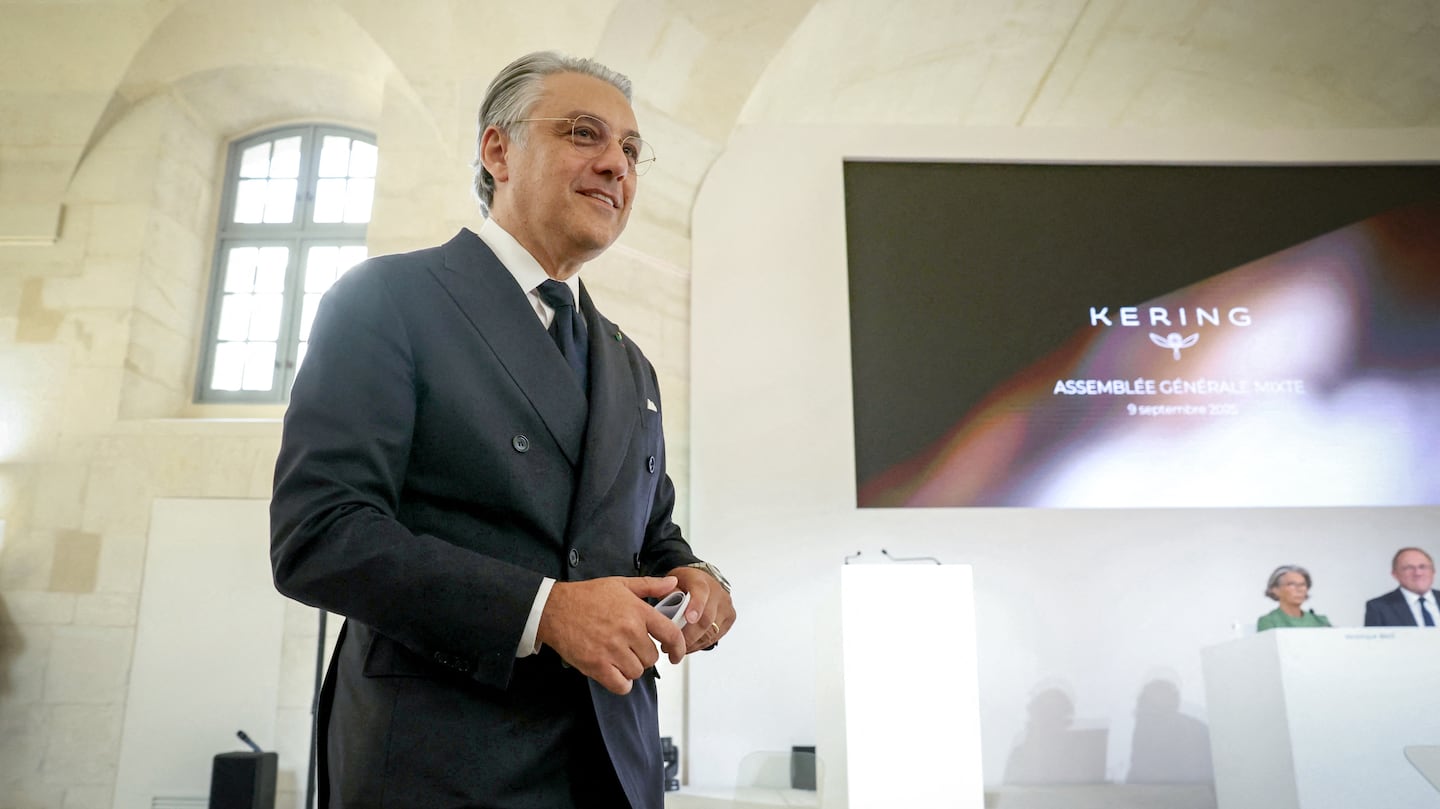
The Kering house CEOs de Meo has personally installed since he took office on 15 September 2025 number exactly three: Francesca Bellettini at Gucci on 17 September 2025, Jean-Marc Duplaix at the newly created Kering Jewelry division in March 2026, and Gianfranco D’Attis at Alexander McQueen on 1 June 2026, effective 3 June. Four further house-level appointments — Stefano Cantino to Gucci, Cédric Charbit to Saint Laurent, Gianfranco Gianangeli to Balenciaga, Federico Arrigoni to Brioni — predate him and belong to the final months of François-Henri Pinault’s solo authority over the group. One seat, Bottega Veneta, remains open as of 12 June 2026. The chronology, read together, is the clearest single document we have of how Luca de Meo intends to run Kering: through a small number of decisive, internally-promoted moves at the houses that matter most to the group’s revenue, and a willingness to leave the others uncovered until he has the right person rather than the available one.
This is the appointment-by-appointment record. The Pinault appointments cluster around late 2024 and early 2025; the De Meo appointments arrive in a pattern of one every quarter or so, each tied to a structural decision (Gucci first, then the jewellery division, then McQueen). Kering’s leadership bench is being rebuilt from inside the group, with one external hire — D’Attis at McQueen — as the early exception.
Pinault’s last appointments: Cantino, Charbit, Gianangeli, Arrigoni
At the moment De Meo walked through the door, François-Henri Pinault had already done most of the visible house-level work himself. In the eleven months between October 2024 and August 2025, Pinault named or moved four house CEOs at the group’s most important maisons. Three landed in the same week in November 2024; the fourth, at Brioni, came in early 2025. The pattern is recognisably Pinault’s: in-house promotion, careful preservation of internal mobility, and a strong preference for executives who had already spent time inside the group.
Stefano Cantino was the first. Announced on 8 October 2024 as Gucci’s incoming CEO effective 1 January 2025, Cantino arrived at the brand as deputy CEO in May 2024 and then took the top job at the start of the new financial year. His CV is one of the cleanest in the industry — twenty years at Prada (1999–2019), then five at Louis Vuitton as head of image and communications (2019–2024) — and the appointment was read as Pinault betting on a CEO whose entire career had been about brand identity. He lasted just over nine months in the seat: enough time to receive Demna’s arrival as creative director, but not enough to ship a full collection under the new leadership pairing.
Cédric Charbit was second, named on 18 November 2024 as the incoming CEO of Saint Laurent, effective 2 January 2025. The move was a homecoming: Charbit had joined Kering in 2012 and spent four years at Saint Laurent as EVP product and marketing (2012–2016) before crossing the group to lead Balenciaga as CEO from October 2016 to January 2025. He returned to the rue de Sèvres at a moment when the house was the group’s most consistent earner and the natural place for Pinault to put a known operator. Charbit succeeded Francesca Bellettini, whose 2023 elevation to Kering Deputy CEO for brand development had left the Saint Laurent CEO seat formally vacant.
The third move, announced the same day as Charbit’s, was Gianfranco Gianangeli as Charbit’s successor at Balenciaga. Gianangeli’s career mapped almost exactly onto the houses he was being asked to operate between: Givenchy global retail director (2013–2020), Maison Margiela CEO (2020–2023), Saint Laurent chief commercial officer (2023–2024), with the Balenciaga appointment made public in November 2024 and effective 2 January 2025. The Pinault logic was plain: keep a Balenciaga CEO who already understood the price architecture of an LVMH-trained creative director’s house, and align him with the Demna-to-Pierpaolo-Piccioli transition the brand was about to undertake.
The fourth appointment was Federico Arrigoni at Brioni, effective 6 May 2025, replacing Mehdi Benabadji. Arrigoni’s promotion is the clearest illustration of Kering’s in-house career ladder under Pinault: with the group since 2006, he had done nine years in Gucci HR (2006–2015), five as Saint Laurent HR director (2015–2020), three as Saint Laurent president Asia Pacific (2020–2023), and two as Saint Laurent deputy CEO (July 2023–May 2025). The Brioni appointment was a reward and a stretch — Brioni is the group’s smallest visible house, and Arrigoni’s HR-heavy background lined up with the slow-burn cultural work the Roman tailor needed.
Four appointments, all promoted from inside the Kering perimeter (Cantino had been on the deputy bench since May 2024). Read backward from June 2026, two — Charbit at Saint Laurent and Gianangeli at Balenciaga — have survived intact; Cantino was undone within forty-eight hours of the new CEO arriving; Arrigoni at Brioni has not been touched.
De Meo arrives: governance reset, 15 September 2025
The Luca de Meo who took office on 15 September 2025 was a 58-year-old Italian car executive with a five-year turnaround at Renault and a previous decade across SEAT, Audi/Volkswagen and Fiat Automobiles, and he was, by deliberate construction, the first non-Pinault-family chief executive in the group’s history. The shareholder vote on 9 September 2025 carried him through with 98.97% approval. The chairman and CEO functions, held jointly by François-Henri Pinault for the better part of two decades, were split: Pinault kept the chair, De Meo got operations. The sign-on bonus — EUR 20 million in total, EUR 15 million in cash and EUR 5 million in shares — signalled how seriously the family wanted the search read as structural change rather than tactical patience.
The governance reset did two things to the house-CEO map immediately. It dissolved the Kering Deputy CEO role Bellettini had held since 2023 — the title that had created the Saint Laurent CEO vacancy Charbit filled — and cleared the way for the new CEO to make his first appointment a brand one rather than a corporate one. Bellettini, who had spent twelve years as Saint Laurent CEO (2013–2024) and two as Kering Deputy CEO brand development (2023–2025), was the natural candidate, but the choice of where to put her — Gucci — and the speed of the announcement (two days) said everything about the new chief executive’s priorities.
De Meo’s first move: Bellettini at Gucci
The Bellettini-to-Gucci appointment was announced on 17 September 2025, forty-eight hours after De Meo took office. It made her Gucci president and CEO and terminated Cantino’s tenure after roughly nine months. The choice was less about Cantino’s failure than about De Meo’s reading of the Gucci problem. Gucci is the group’s revenue concentration risk; it is also the house whose creative-director transition (the Demna appointment) was already in motion when De Meo took over. The new CEO needed someone in the seat who had run a brand creative transition from the inside before, and Bellettini — who had built Saint Laurent across twelve years from 2013 into one of the two largest contributors to Kering revenue by 2024 — had.
The appointment also killed the Kering Deputy CEO role outright. The brand development title had been created in 2023 to formalise Bellettini’s increased remit across the houses; its elimination removed a layer between De Meo and the house CEOs. The trade-off is structural: the new CEO is closer to the brands than his predecessor was, but he is also operating without the cross-house ballast that Bellettini’s old title provided. The bet is that he can read the houses well enough himself.
Cantino’s nine-month tenure is one of the shortest CEO runs at a Kering house in recent memory. The Pinault thesis had been that a long, internal-mobility-style handover would steady Gucci through the Sabato De Sarno departure and the search for a new creative director. The De Meo decision, made within his first forty-eight hours, was that Bellettini’s record was a better answer to the same problem.
Jewelry: Duplaix and the new division
The second De Meo appointment was structurally different from the first. In March 2026, the group announced that Jean-Marc Duplaix had been named CEO of a newly created Kering Jewelry division, while retaining his existing role as group COO. The new division consolidated Boucheron, Pomellato, Dodo and Qeelin under a single P&L — combined revenue in the order of EUR 1 billion — and it absorbed both the group’s Paris-based goldsmithing operations and the Raselli Franco Group, the Italian jewellery manufacturer Kering had acquired in December 2025 for EUR 115 million.
Duplaix arrived as group CFO in 2012, took the additional title of Deputy CEO operations and finance in 2023, and absorbed the new jewellery remit on top of his existing COO functions in early 2026. His promotion was a category-level move rather than a house-level one. The four houses that report into him keep their existing CEOs; what they no longer keep is direct reporting to the group CEO. Folding them under Duplaix gave the houses a single point of executive cover, gave the group a clean P&L to discuss with investors, and gave the Raselli acquisition somewhere to live operationally.
The dissolution of the Deputy CEO brand role in September 2025 and the creation of the Jewelry division CEO role in March 2026 are the two halves of the same architectural argument: fewer functional roles at the group, more category-level ones with a P&L.
McQueen: D’Attis, June 2026
The third appointment is the most recent, the one whose timing slots inside the same fortnight that this article is being written, and the only one of the three that De Meo has made by going outside the Kering perimeter. On 1 June 2026, the group announced that Gianfranco D’Attis — Italian, 52, London-based for most of the previous decade — had been named CEO of Alexander McQueen effective 3 June 2026. He reports to De Meo directly. He succeeds Gianfilippo Testa, who had served as McQueen CEO from March 2022 and who, the company confirmed, is leaving the group later in 2026.
The D’Attis CV explains, on its own, what De Meo intended by the hire. He had been CEO of the Prada brand from 2023 to mid-2025 — the first non-family executive in that role in the brand’s history — before exiting after strategy disagreements with the Prada family. Before Prada he was president of Christian Dior Couture Americas (2021–2023), CEO of Christian Dior Couture (2019–2021), international director of Jaeger-LeCoultre at Richemont (2018–2019), international director of Chloé (2014–2018), and president of IWC Schaffhausen (2011–2014). Twenty-five years of multi-brand work at LVMH and Richemont, ending with a Prada brand-CEO assignment that ended badly enough to leave him available for the next group that wanted him.
McQueen is the group’s most under-managed house relative to its brand equity. Testa’s four-year tenure stabilised the post-Sarah Burton transition and managed the arrival of Seán McGirr as creative director, but did not crack the revenue problem. D’Attis arrives with experience at the exact category and with the credibility of having been chosen to run the Prada brand.
This is De Meo’s first external hire to a Kering house CEO seat. Bellettini was internal (twelve years at Saint Laurent); Duplaix was internal (fourteen years at Kering corporate). D’Attis is the moment De Meo signalled that the internal bench would not be enough for every seat.
Open seat: Bottega Veneta
The one remaining open Kering house CEO seat as of 12 June 2026 is Bottega Veneta. Bartolomeo Rongone announced on 20 January 2026 that he was leaving the house on 31 March 2026 to become CEO of Moncler — a move outside the Kering group that closed the most successful house CEO tenure of the previous five years. Rongone presided over the Daniel Lee and then Matthieu Blazy creative-director arcs. His departure has left the group without a permanent CEO at the house since 1 April 2026.
That the seat has remained open into June is itself a piece of the De Meo doctrine. The Bottega selection is being treated as the harder of the two open decisions — not because Bottega is in worse shape than McQueen (it is not) but because it is the group’s third-largest house by revenue and its CEO will determine the rhythm of the next creative-director cycle. The absence of an announcement, three months in, is consistent with De Meo’s pattern of leaving slots open until the right candidate is ready rather than the calendar is ready. Whoever fills it will inherit the same structural setup D’Attis has at McQueen: direct line to De Meo, no Deputy CEO layer, P&L responsibility straight to the group.
The full chronology
| Date | House | New CEO | Prior Role | Appointed By |
|---|---|---|---|---|
| 8 Oct 2024 (announced) / 1 Jan 2025 (effective) | Gucci | Stefano Cantino | Gucci Deputy CEO (May 2024–Dec 2024); previously Louis Vuitton head of image and communications (2019–2024); twenty years at Prada (1999–2019) | Pinault |
| 18 Nov 2024 (announced) / 2 Jan 2025 (effective) | Saint Laurent | Cédric Charbit | Balenciaga CEO (Oct 2016–Jan 2025); previously Saint Laurent EVP product and marketing (2012–2016) | Pinault |
| 18 Nov 2024 (announced) / 2 Jan 2025 (effective) | Balenciaga | Gianfranco Gianangeli | Saint Laurent Chief Commercial Officer (2023–2024); Maison Margiela CEO (2020–2023); Givenchy global retail director (2013–2020) | Pinault |
| 6 May 2025 (effective) | Brioni | Federico Arrigoni | Saint Laurent Deputy CEO + Asia Pacific president (Jul 2023–May 2025); Saint Laurent HR director (2015–2020); Gucci HR (2006–2015) | Pinault |
| 17 Sept 2025 (announced) | Gucci | Francesca Bellettini | Kering Deputy CEO brand development (2023–2025); Saint Laurent CEO (2013–2024) | De Meo |
| March 2026 (announced) | Kering Jewelry (new division: Boucheron, Pomellato, Dodo, Qeelin) | Jean-Marc Duplaix | Kering Deputy CEO operations and finance (2023–2025); Kering CFO (2012–2023); retains group COO role | De Meo |
| 1 June 2026 (announced) / 3 June 2026 (effective) | Alexander McQueen | Gianfranco D’Attis | Prada brand CEO (2023–mid 2025); Christian Dior Couture Americas president (2021–2023); Dior Couture Europe CEO (2019–2021); Jaeger-LeCoultre international director (2018–2019); Chloé international director (2014–2018); IWC Schaffhausen president (2011–2014) | De Meo |
| Open as of 12 June 2026 | Bottega Veneta | TBA — Rongone left 31 March 2026 to become Moncler CEO | — | De Meo |
A note on what is not in the table. The March 2025 LVMH reshuffle moved Damien Bertrand from Loro Piana CEO to Louis Vuitton Deputy CEO, with Frédéric Arnault replacing him at Loro Piana; the moves are sometimes confused with Kering reshuffles because they happened in the same window, but they are LVMH appointments, not Kering ones, and they sit on a different group’s chart. See Loro Piana under Frédéric Arnault for that group’s separate move on the same week.
The pattern, read from June 2026
The pattern that emerges from the seven months of the De Meo era so far is one of speed at the top, patience at the bottom, and a willingness to redraw the org chart rather than reshuffle within it. The Bellettini move took forty-eight hours; the Duplaix move created an entire new division; the D’Attis move went outside the group for the first time. The portfolio-level architecture De Meo is building is the one he sketched at Kering’s Florence Capital Markets Day on 16 April 2026 under the “ReconKering” label — see Kering’s Florence strategy for the operational frame and Kering Jewellery Division for the Duplaix-led category build.
The chronology argues that the Kering house CEO map of June 2026 is not yet De Meo’s map — it is still, by appointment count, mostly Pinault’s. Three of the seven filled house seats (Saint Laurent, Balenciaga, Brioni) were named by the chairman in late 2024 and early 2025; three more (Gucci, Jewelry, McQueen) belong to the new chief executive; one is open. The Bottega appointment, when it lands, will be the first move of the second phase, and the appointments that follow it will tell us whether the De Meo doctrine — internal where possible, external where necessary, structural rather than cosmetic — defines Kering’s portfolio reconstruction or just its opening chapter.