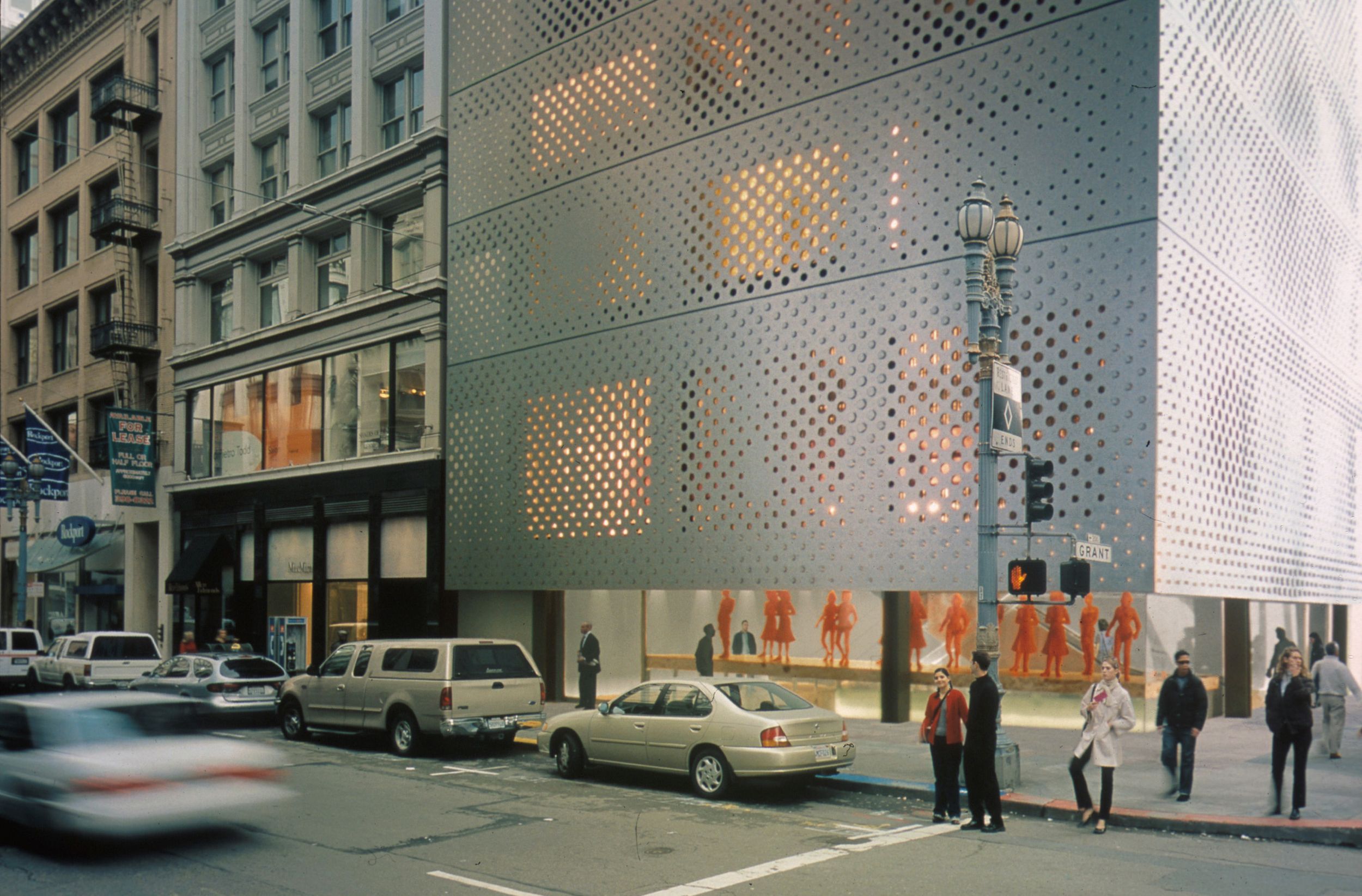
Twenty-five years separate the zebrano wave ramp that Rem Koolhaas and Ole Scheeren dropped into the former Guggenheim SoHo at 575 Broadway on 15 December 2001 from the 12,000 sqm Beymen flagship that Ellen van Loon and Iyad Alsaka have just slipped beneath the cast-iron columns of the Tersane-i Amire on the Golden Horn. Between those two openings sits a more or less continuous practice — OMA fashion retail architecture, plus the parallel AMO research studio directed by Samir Bantal — that has built the most recognisable luxury store typologies of the early 21st century. The Prada Epicenters defined the category in 2001 and 2004. The Repossi flagship at 6 Place Vendôme opened OMA’s jewellery vocabulary in 2016. T Fondaco dei Tedeschi reframed adaptive reuse for luxury retail the same year. Sotheby’s New York rewired the auction house typology in 2019. And, in 2026, the Beymen Tersane plants the practice on Turkish soil for the first time.
This piece traces every OMA and AMO commission for a fashion or luxury client from the SoHo Epicenter through to the Ottoman Arsenal, project by project, with the dates, addresses, square metres and design leads taken from the FORMA graph and from the studio’s own project pages. Where a famous “Prada store” or “Vendôme jeweller” is not by OMA, the piece flags the misattribution rather than skipping past it. The aim is a working reference, not a hagiography.
The thesis: two practices under one roof
OMA — the Office for Metropolitan Architecture — is the Rotterdam architecture studio Koolhaas co-founded in 1975. AMO, started in 1999, is the research-and-image arm; since 2018 it has been directed by Samir Bantal. The split matters when reading fashion retail. The Prada Epicenters, Fondaco dei Tedeschi, Repossi, Sotheby’s, KaDeWe and Beymen Tersane are OMA buildings — Rotterdam, New York or partner-led, with building permits and contractors. The Off-White flagships, the Jacquemus shop-in-shops, the Stone Island global store concept and most of the brand-identity work are AMO. They share the same Prinsengracht 300 letterhead, but the deliverable is different: AMO designs systems, materials palettes, identities, and pop-up vocabularies that can travel.
The thirteen projects below split roughly evenly between the two. Read together they show OMA absorbing fashion retail as a core practice — first as a Koolhaas-Scheeren-led genre experiment in 2001, then as a Pestellini-Sandor-led adaptive reuse muscle in the mid-2010s, then as an Ellen van Loon-led European department-store practice from 2016 onwards, and finally as a Shohei Shigematsu-led New York office that pulls in Sotheby’s and Louis Vuitton on the side.
The reference table
| Year | Project | City | Square Meters | OMA Lead | Brand |
|---|---|---|---|---|---|
| 2001 | Prada Epicenter New York | New York (SoHo) | ~2,000 sqm | Rem Koolhaas, Ole Scheeren | Prada |
| 2004 | Prada Epicenter Beverly Hills | Los Angeles | ~14,750 sqft retail (of 24,000 sqft) | Rem Koolhaas, Ole Scheeren | Prada |
| 2016 | T Fondaco dei Tedeschi by DFS | Venice | 9,000 sqm | Ippolito Pestellini Laparelli, Rem Koolhaas, Silvia Sandor | DFS Group / Benetton |
| 2016 | Repossi flagship Place Vendôme | Paris | 90 sqm | Rem Koolhaas | Repossi |
| 2019 | Sotheby’s New York renovation | New York | 90,000 sqft galleries | Shohei Shigematsu (OMA NY) | Sotheby’s |
| 2020 | Off-White Miami flagship | Miami (Design District) | 262 sqm | Virgil Abloh with AMO / Samir Bantal | Off-White |
| 2021 | KaDeWe masterplan + first quadrant | Berlin | first of four quadrants | Ellen van Loon, Rem Koolhaas | KaDeWe Group |
| 2021 | Off-White Paris flagship | Paris | three floors | Ellen van Loon (AMO) | Off-White |
| 2024 | Louis Vuitton 57th Street temporary Maison | New York | five storeys | Shohei Shigematsu (OMA NY) | Louis Vuitton |
| 2024 | Jacquemus Headquarters | Paris (8e) | two Haussmannian buildings | OMA with UNISPACE | Jacquemus |
| 2024 | Jacquemus shop-in-shops | Paris / London | three host stores | AMO | Jacquemus |
| 2024 | Stone Island global store concept | Chicago debut; rollout 2025-26 | rolling, ~8 cities | Samir Bantal (AMO) | Stone Island |
| 2026 | Beymen Tersane | Istanbul | 12,000 sqm | Ellen van Loon, Iyad Alsaka | Beymen Group |
Every entry below corresponds to a row.
Prada Epicenters: the wave and the sponge
The brief Miuccia Prada and Patrizio Bertelli handed OMA in 1999 — three “Epicenter” stores in New York, Los Angeles and San Francisco, plus a back-of-house digital identity — produced two completed buildings and the AMO research that grew into a permanent department of the office. Koolhaas’s Projects for Prada Part 1 (Fondazione Prada, 2001) is the book of record for the early thinking. (Prada’s longer cultural programme is collected in our Prada partnerships and Fondazione reference.)
Prada Epicenter New York opened on 15 December 2001 at 575 Broadway, SoHo, in the roughly 2,000 sqm shell of the former Guggenheim SoHo branch museum. The defining gesture was the zebrano wood “wave” — a continuous concave ramp running the full depth of the basement-to-ground volume, doubling as display surface, seating, and a flip-out performance stage when the steps were folded down. Motorised cylindrical display cages hung from the ceiling on tracks; a translucent elevator wrapped in a Plexiglas tube serviced the lower level. AMO’s contribution was the back end: RFID-tagged garments, magic mirrors in the fitting rooms, staff PDAs. Much of the technology did not survive the decade; the wave has.
Prada Epicenter Beverly Hills opened in 2004 at 343 N Rodeo Drive — 24,000 sqft across three floors with 14,750 sqft of retail. The signature move was the doorless air-curtain entrance: the Rodeo Drive facade is open during business hours, the curtain reading as a removed shopfront. On the second floor, a perforated aluminium box hangs free of the slab; the third floor is wrapped in a custom 3D “sponge” wall — porous foam-aluminium panels carved into furniture niches and back-of-house openings. Koolhaas’s text on the project frames it as the opposite move from SoHo: not a void carved into a former museum, but a building stripped of facade to dissolve the shop window.
A persistent confusion: the Prada Aoyama store in Tokyo (2003) — the crystalline rhomboid box on Aoyama-dori — is by Herzog & de Meuron, not OMA. It is part of the Epicenter programme commercially but not architecturally. The third announced OMA Epicenter, in San Francisco, was abandoned.
T Fondaco dei Tedeschi: adaptive reuse for the Benetton family
The T Fondaco dei Tedeschi, opened on 1 October 2016 at the Rialto end of Venice’s Grand Canal, was OMA’s first large-scale department-store-as-adaptive-reuse. The 16th-century fondaco — a former German merchants’ warehouse, later a post office under the Republic and then the Italian state — was bought by the Benetton family’s Edizione holding in 2008 and handed to OMA. Ippolito Pestellini Laparelli led with Rem Koolhaas and Silvia Sandor; the operator is DFS Group, the travel-retail arm of LVMH.
The 9,000 sqm intervention is calibrated: a new escalator core ascends the central courtyard, a rooftop public terrace was added (free to book, with a view across the Rialto), and a black-steel mezzanine slips inside the existing arcaded courtyard without touching the loggia. Nothing on the exterior signals luxury retail; the original ochre and red shutters were restored to their 1930s configuration. Inside, the goods are presented on free-standing pavilions of steel and tinted glass, leaving the historic perimeter walls largely empty. The project won the RIBA International Award for Excellence in 2018 and remains OMA’s clearest argument that luxury retail can occupy a monument without colonising it. The contrast with Tadao Ando’s Bourse de Commerce conversion for François Pinault — concrete cylinder inserted into a rotunda, art rather than shopping — is instructive: both are surgical insertions, but the Fondaco is the one that sells handbags.
Repossi at Place Vendôme: OMA’s first jewellery commission
Repossi, the Italian-Monegasque jeweller acquired in part by LVMH in 2015 under creative director Gaia Repossi, asked OMA to redesign its flagship at 6 Place Vendôme. The 90 sqm boutique opened in 2016 — OMA’s first jewellery commission, and a piece of architecture far smaller than anything the studio had touched.
The plan is organised as a sequence — street, gallery, salon — reading from the Vendôme arcade to the private back room. Reflective rotating slats face the square so that the facade changes character through the day. The floor is a custom terrazzo of foaming aluminium and resin; the long display case along one wall is a kinetic billboard wall engineered by Goppion, the Milan museum-display specialist also responsible for the Louvre Mona Lisa vitrine. Pieces rotate forward on motorised carriers; the case reads as both jewellery vitrine and gallery wall. Repossi opened the second store, on London’s Mount Street, in 2018 under the same vocabulary.
Sotheby’s New York: the auction house as retail
Sotheby’s New York at 1334 York Avenue is technically not a fashion store — it is an auction house — but it sits inside the same OMA-for-luxury practice and the same brief: how does a luxury client present its inventory in 21st-century Manhattan. The USD 55 million renovation, led by Shohei Shigematsu of OMA New York, opened on 3 May 2019. Exhibition space jumped from 67,000 to 90,000 sqft. Forty galleries are organised across four floors around a central atrium punched through the existing 1980 Rev Group tower. The defining move is the flexibility — galleries can be reconfigured in days for a Modigliani sale, then a watches auction, then a Banksy. Shigematsu has used the building since as a workhorse for the rest of OMA NY’s New York programme.
The Sotheby’s project is also the model for the next New York commission five years later, when LVMH asked Shigematsu to invent a temporary maison for Louis Vuitton.
Off-White: AMO and Virgil Abloh’s retail year
Off-White’s 2020-2021 store programme is AMO, not OMA. Samir Bantal, AMO’s director, partnered directly with Virgil Abloh — first on the Off-White Miami flagship in the Miami Design District, opened in 2020, 262 sqm — and then on the Off-White Paris flagship on rue de Castiglione near Place Vendôme, opened July 2021 across three floors.
Miami’s signature is a movable polycarbonate facade: the entire shopfront slides open during events, making the boutique read as a covered loggia onto the Design District street. The interior runs industrial finishes — galvanised steel grids, exposed concrete, work-light fixtures — closer to a warehouse than a Vendôme boutique.
The Paris store, designed under Ellen van Loon’s direction with Bantal, reads completely differently. A corrugated-glass vestibule scrambles the view from the street; the interior is travertine; the arched rooms are dimensioned so that the central space doubles as a runway. Off-White used it for shows during its first Paris Fashion Week as a maison. The Paris store was one of the last completed projects Abloh personally signed off; he died in November 2021, four months after it opened. AMO’s later collaborations with the brand under Ib Kamara have kept the vocabulary intact.
KaDeWe: Ellen van Loon’s twenty-year department store
The KaDeWe masterplan, at Tauentzienstrasse 21-24 in Berlin, is the slow-burn project of OMA’s fashion retail practice. The original brief was published in 2016: split the historic department store into four quadrants, each with its own atmosphere, materials and circulation, so that the building reads as four stacked stores around a central core rather than a single 60,000 sqm box. Ellen van Loon has led the project with Rem Koolhaas since the start.
The first quadrant opened in October 2021. Its defining element is a six-storey wooden-escalator void — the escalator structure itself is built up from oak slats, and the void it carves through the floor plates is irregular, more atrium than light well. Each quadrant carries a different material logic; subsequent quadrants are scheduled to open through the late 2020s. The project sits inside the wider KaDeWe Group portfolio that until recently included Berlin, Munich and Hamburg stores, and is the European reference for OMA’s department-store practice that Beymen Tersane extends in 2026.
Louis Vuitton 57th Street: the trunks in the atrium
The Louis Vuitton 5th Avenue flagship at 1 East 57th Street closed for a full rebuild in 2023 — a Frank Gehry-designed permanent maison is under construction behind a Yayoi Kusama-painted hoarding. While it builds, LVMH needed a five-year temporary store; OMA New York took the brief.
The Louis Vuitton 57th Street temporary Maison opened on 15 November 2024 at 6 East 57th Street, around the corner from the construction site. Shohei Shigematsu’s office stacked four 16-metre tall Courrier Lozine 90 trunk sculptures vertically through the five-storey atrium — sculptural references to the brand’s archival trunk, oversized into structural objects. The trunks are skinned in monogram canvas at scale; staircases wind around them. The temporary maison is calibrated to outlast the rebuild — likely operating into 2027 or 2028 — and reads, deliberately, as the loudest store on 57th Street while the quieter Gehry building completes behind it.
Jacquemus: OMA’s first French maison commission
Simon Porte Jacquemus’s house, founded in 2009 and majority-independent through 2026, asked OMA to design both its headquarters and its global retail vocabulary in 2023. Both delivered in 2024.
The Jacquemus Headquarters occupies two adjacent Haussmannian buildings in the 8th arrondissement of Paris. OMA stripped the interiors back to stone and softened them: soft curves and arched surfaces, lime-washed walls, pigmented plasters tuned to Provençal pinks and ochres. The brief integrated the founder’s art collection — works by David Hockney, Wolfgang Tillmans, Aristide Maillol and a small group of Pierre Chareau pieces — into the workplace as wall and shelf furniture rather than gallery hangs. The project was co-designed with the workplace specialist UNISPACE; OMA carried the architecture and the spatial vocabulary, UNISPACE the desk-by-desk fitout.
The Jacquemus shop-in-shops, opened across 2024 at Galeries Lafayette Paris, Harvey Nichols London and Selfridges London, are AMO. Each is anchored on a single material referencing a different element of Provence — terracotta tile, raw lavender-tinted plaster, sand-cast aluminium. They are travelling vocabularies, not buildings, and they sit inside a broader strategy of Jacquemus growing into a maison rather than a wholesale brand. The Galeries Lafayette installation in particular reads as a small Jacquemus pavilion inside the department store’s atrium.
Stone Island: AMO’s most rolled-out retail identity
The single AMO project that has put the most kilometres on the studio’s vocabulary is the Stone Island global store concept, developed under Samir Bantal starting in 2023 and debuted in Chicago in 2024. By mid-2026 it had rolled out to Paris, Shanghai, Munich, New York, Stockholm, Costa Mesa and Toronto, with further cities planned.
The vocabulary is brutalist-warm: burnt cork floors and seating blocks, ribbed plaster walls cast in long vertical reeds, stained pine for shelving, and altar-like archival niches that hold one or two pieces from the Stone Island heritage archive under directional light. The signature display device is a rotating “Chandelier” — a vertical metal armature hung from the ceiling that turns slowly through the day, displaying garments as a kinetic mast. The concept reads as a deliberate move away from the brand’s previous, Carlo Rivetti-era retail vocabulary (cold steel, military hardware) towards a softer, archival-museum register fit for the brand’s post-Moncler era under Robert Triefus. Stone Island sits inside Moncler Group’s broader luxury platform; it is one of the most aggressively scaled AMO commissions to date.
Beymen Tersane: OMA’s first Turkish project
The 2026 anchor is the Beymen Tersane flagship — OMA’s first completed project in Turkey, and the latest, largest entry in this thirteen-project sequence. The Domus report dated 10 June 2026 covers the opening.
Beymen Group is the Turkish luxury multibrand retailer founded in 1971 by Erol Aksoy, today the dominant department-store player in Turkey, with flagship stores in Istanbul, Ankara and Bodrum. The Tersane brief, awarded around 2022, asked OMA to insert a 12,000 sqm department store inside the Tersane-i Amire — the former Ottoman Imperial Arsenal — on the Golden Horn. The Arsenal is the centrepiece of the Tersane Istanbul masterplan, a USD 1.7 billion mixed-use restoration converting the imperial shipyards into a hospitality and retail district.
Design partners Ellen van Loon and Iyad Alsaka led the project from Rotterdam, working with a local Turkish team for the heritage permitting. The architectural move is consistent with the Fondaco dei Tedeschi a decade earlier: freestanding gallery volumes are inserted beneath the original brick arches, cast-iron columns and timber trusses, with no contact between the new programme and the historic structure other than the floor slab. The volumes are dimensioned to read as boxes inside the shed — clear glass, brushed steel, walnut interiors — so that the Arsenal’s industrial frame remains legible above and around them. Circulation runs in the leftover space between volumes; cafés and rest spaces occupy the bays that face the Golden Horn.
The project is significant beyond Turkey. It confirms van Loon as OMA’s senior partner for European luxury retail (after KaDeWe and Off-White Paris), extends the adaptive-reuse vocabulary the studio established at the Fondaco, and puts an OMA building on the Bosphorus a year before the Tersane Istanbul masterplan’s hospitality components are due to open. Beymen has signalled that it will use the Arsenal as both a flagship and an event venue, with runway space built into the central nave.
What is not in this list
Several stores routinely attributed to OMA are by other architects, and a clean reference needs to say so.
- Prada Aoyama, Tokyo (2003) — Herzog & de Meuron, not OMA. Often confused with the Epicenters because of the shared Prada brief.
- Bourse de Commerce, Paris (2021) — Tadao Ando for the Pinault Collection. Often grouped with OMA’s adaptive-reuse work because of the Pinault-LVMH-Prada luxury-art adjacency. Covered in detail in our Tadao Ando and the Pinault Collection piece.
- Saint Laurent Old Bond Street, London — designed in-house by Hedi Slimane during his Saint Laurent tenure, not by OMA. Part of the broader Kering portfolio we track in Kering’s portfolio refresh.
- Galeries Lafayette Champs-Élysées, Paris (2019) — BIG (Bjarke Ingels Group), not OMA.
OMA has also done large culture projects that read like retail to a non-specialist — the Fondazione Prada Milan campus, the Garage Museum in Moscow, Lafayette Anticipations in Paris — but those are art foundations, not stores, and the FORMA graph separates them. AMO’s catwalk-set practice for Prada and Miu Miu since 2004 is a separate, parallel commission stream covered in the AMO design objects reference.
Reading the practice across twenty-five years
A few patterns hold across the thirteen projects.
First, the adaptive reuse muscle runs from the SoHo Epicenter — itself a museum conversion — through the Fondaco dei Tedeschi to the Beymen Tersane. OMA does not build new luxury department stores from scratch; it inserts new programme into existing shells, almost always heritage. The Epicenter, the Fondaco, KaDeWe, Sotheby’s, the Louis Vuitton 57th Street maison and Beymen Tersane are all insertions.
Second, the Koolhaas-led signature project versus the AMO-led rolling vocabulary divide has hardened. The early Epicenters were Koolhaas-Scheeren signature pieces with AMO running back-of-house. The Off-White, Jacquemus shop-in-shops and Stone Island rollouts are pure AMO under Bantal. The big buildings — Fondaco, KaDeWe, Beymen — are Rotterdam-led under van Loon or Pestellini.
Third, OMA New York under Shohei Shigematsu has emerged as a distinct practice within the practice. Sotheby’s and Louis Vuitton 57th Street read as a New York office producing for New York clients, in dialogue with but separate from Rotterdam.
Fourth, the client mix is European luxury or LVMH-adjacent. Prada (independent), LVMH (DFS, Repossi, Louis Vuitton), Moncler (Stone Island), Jacquemus, Beymen, KaDeWe. Conspicuously absent: any Kering house, in line with the portfolio map sketched in our Kering portfolio refresh and AMO design objects pieces.
Fifth, the buildings are not screens. None of the OMA fashion retail projects reads as a digital surface. The wave at SoHo is wood; the air curtain in Beverly Hills is a removed shopfront; the KaDeWe void is oak; Beymen Tersane is brick and cast iron with glass volumes set inside. Even the Stone Island rotating “Chandelier” is a slow mechanical object, not a screen. This is the practice’s most legible position, consistent across twenty-five years.
Coda
The Beymen Tersane reads, on the FORMA graph, like an answer to the 2001 Epicenter at 575 Broadway. Both are insertions into protected heritage shells — one a museum, one an imperial arsenal. Both treat the shop floor as a piece of urban infrastructure rather than a luxury décor exercise. Both put the brand inside the building rather than on its facade. The twenty-five-year arc that connects them is a relatively rare thing in luxury architecture: a practice that has held a single position on what a store should be — a public room under a roof someone else built — across the entire span of the Koolhaas, Pestellini, van Loon, Shigematsu and Bantal generations. The OMA fashion retail architecture catalogue from Prada SoHo to Beymen Tersane is a single project in thirteen rooms.