On 9 June 2026, Christopher Bailey — the British designer who ran Burberry’s creative direction for most of the 21st century — joined a small investor group to acquire Burleigh, the 175-year-old Stoke-on-Trent pottery, from administrators. It is the latest entry in a pattern that has hardened over the last decade: fashion designers craft house acquisitions, and the adjacent moves of founding craft prizes, launching scarcity-led brands, and seeding craft foundations, have become the most legible exit path for senior creative directors leaving the runway treadmill. The line runs from Jonathan Anderson’s 2016 Loewe Craft Prize through Phoebe Philo’s October 2023 brand launch, Tilda Swinton’s Hawick-made Hades collaboration, the December 2025 announcement of the Fondazione Dries Van Noten, and now Bailey at Burleigh’s tissue-transfer kilns in Burslem.
This piece maps that trajectory entity by entity, against the verified record. The shape of the answer is narrower than the headlines suggest: there are very few outright acquisitions of named heritage craft houses by fashion creative directors. Bailey at Burleigh is the cleanest case to date. Around it sits a constellation of adjacent moves — prize platforms, foundations, direct-to-consumer scarcity brands, knitwear collaborations — that share the same underlying bet. The bet is that material know-how, when it is genuinely scarce and genuinely old, is more defensible than seasonal newness.
Christopher Bailey at Burberry, 2001-2018
Bailey’s career inside Burberry is the precondition for what he is doing now. Born in 1971 and trained through the Royal College of Art’s MA in Fashion Design, which he completed in 1994, he joined Burberry as design director in May 2001. He became creative director in 2004. In November 2009 he was appointed Chief Creative Officer, the role in which he reshaped the house’s product hierarchy around the trench, the check, and a digital-first runway. In May 2014 he took on the dual title of Chief Creative Officer and Chief Executive Officer — a rare consolidation that put runway, marketing, retail, and P&L under a single designer’s signature. In November 2017 he stepped back to the more focused role of President and Chief Creative Officer, and he exited Burberry in December 2018.
That seventeen-year arc — design director, creative director, CCO, CCO+CEO, President+CCO — is unusually long for a modern designer-CEO. It also covers the entire period in which the heritage-brand playbook (archive activation, founding myth, signature material) became orthodoxy. Bailey did not invent that playbook, but he industrialised a version of it at Burberry. Burleigh, his first major business venture since leaving Burberry in December 2018, applies the same logic at a fraction of the scale and with materially more constrained tooling.
Burleigh: tissue-transfer at Middleport
Burleigh is precise about its credentials. It was founded in 1851 in Burslem, Stoke-on-Trent, by Hulme and Booth. The name as we know it today comes from William Leigh and Frederick Rathbone Burgess, who took over in 1862 and ran the business as Burgess & Leigh. The pottery is England’s oldest continuously operating Victorian pottery, and — the load-bearing fact in any read of why Bailey would touch it — it is the last heritage pottery in the world still using the traditional tissue-transfer printing technique. Signature patterns include Asiatic Pheasants, Arden, Calico, and Regal Peacock. The brand has done partnerships with Ralph Lauren, Soho House, and Daylesford, all of which signal that the codes already travel in luxury and hospitality registers without losing the craft anchor.
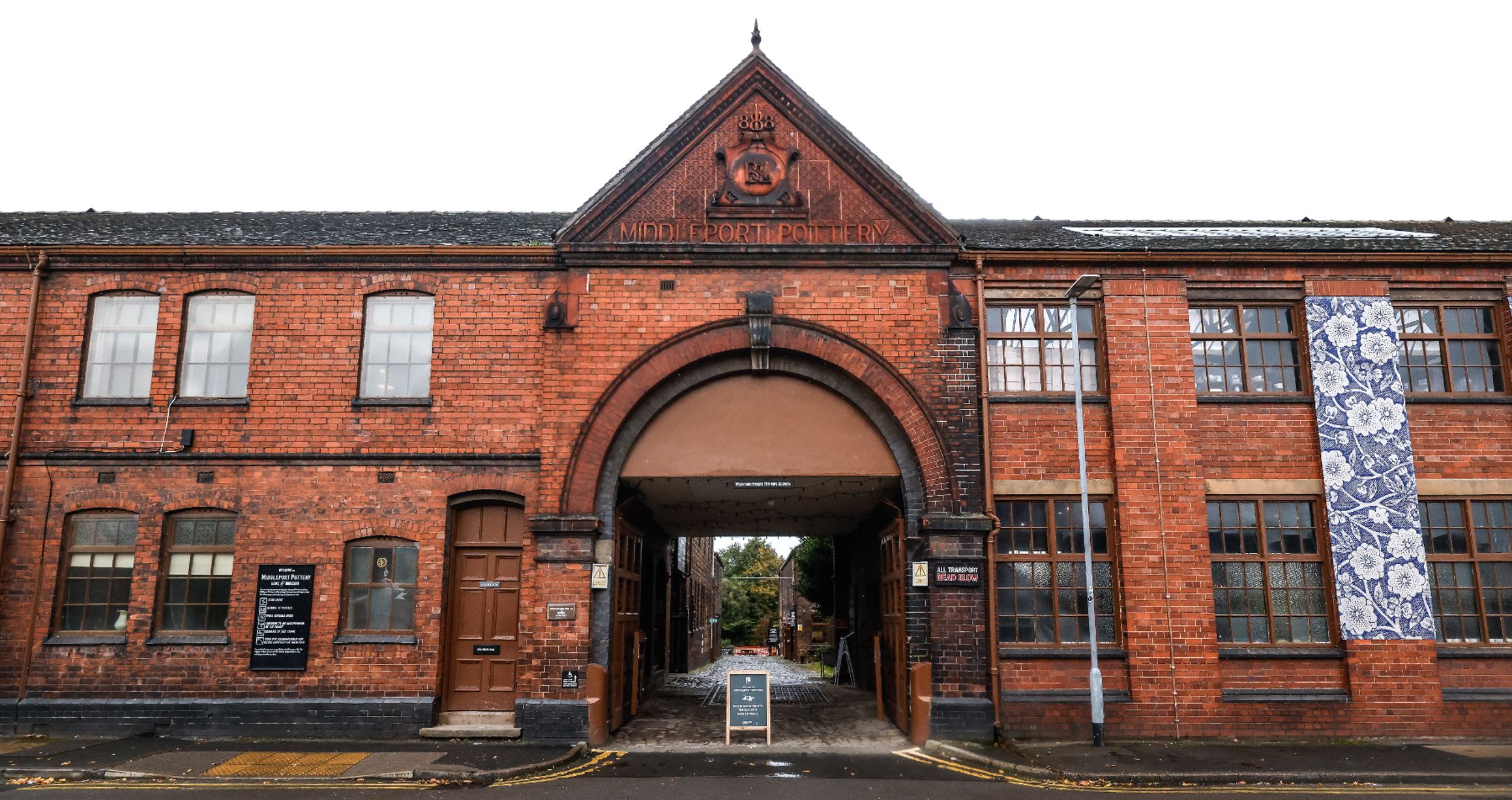
The factory itself, Middleport Pottery, is a Grade II*-listed Victorian site at Burslem, built in 1889 by Burgess & Leigh on the Trent and Mersey Canal as what was then called a “model pottery” — purpose-built around water transport, daylight, and worker conditions that were progressive for the period. Middleport was restored through a roughly £9 million programme led by the Prince’s Regeneration Trust; the visitor centre was opened by Prince Charles in 2014. That history matters because Bailey is not acquiring a brand untethered from its factory. He is acquiring a brand whose value is inseparable from the listed Victorian building, the canal, the kilns, and the tissue-transfer process that survives in exactly one place.
The acquisition itself: on 9 June 2026, Bailey joined a small investor group to acquire Burleigh from administrators, following the 31 March 2026 collapse of parent group Denby Pottery. Terms were not disclosed. Bailey takes a hands-on operating role, overseeing day-to-day business and long-term strategy. The structure — small investor group, designer in an operating seat, not just a board seat — is closer to a founder-led restart than to a luxury conglomerate’s tuck-in acquisition. There is no LVMH or Kering balance sheet behind it. There is a creative director with seventeen years of Burberry inside him, betting that he can run a Victorian pottery.
The 2010-2026 pattern, in one table
The pivots line up across a tight ten-year window. The table below tracks the verified moves named in this piece.
| Year | Designer | Move | Craft House / Platform | Type |
|---|---|---|---|---|
| 2016 | Jonathan Anderson | Founds craft prize as Loewe creative director | Loewe Craft Prize | Prize platform |
| 2023 | Phoebe Philo | Launches eponymous brand on 30 October, post-Celine | Phoebe Philo (brand) | Brand launch |
| 2024-2026 | Tilda Swinton | Collaborates with Birmingham knitwear label, knitted in Hawick | Hades | Collaboration |
| 2025 | Dries Van Noten + Patrick Vangheluwe | Acquire Palazzo Pisani Moretta, Venice (May); foundation announced December | Fondazione Dries Van Noten | Foundation |
| 2026 | Christopher Bailey | Joins investor group to acquire 175-year-old pottery from administrators on 9 June | Burleigh | Acquisition |
The categories are deliberately distinct. A prize platform is not a brand launch. A foundation is not an acquisition. A collaboration is not ownership. Conflating them flattens what is interesting about the pattern, which is that the same generation of creative directors is reaching the same conclusion — material craft is the asset — via different legal and financial structures.
Loewe Craft Prize: Anderson’s 2016 platform
Jonathan Anderson founded the Loewe Craft Prize in 2016, during his tenure as Loewe creative director, which ran from 2013 to 2025. The prize was constructed to honour the house’s 19th-century origins as a leather-making craft collective — Loewe began in 1846 as a leather workshop in Madrid — and it has since become a global patron across ceramics, textiles, woodwork, glass, metalwork, and lacquer. (See FORMA’s reporting on the Loewe Craft Prize 2026 and the 180-year creative direction lineage at Loewe for the longer arc.)
What Anderson did at Loewe in 2016 is structurally distinct from what Bailey did at Burleigh in 2026. Anderson, then in-house at a Spanish leather house owned by LVMH, used the parent group’s capital and platform to underwrite a prize. It is patronage. It does not require him to operate kilns. It does require him to put the Loewe name on craft that the house does not itself produce. The strategic effect — repositioning a fashion brand inside the craft conversation — is the same. The financial commitment, and the personal operational exposure, is much lower.
Anderson’s 2016 move is the earliest fully formed instance of the pattern at this scale. It set the template that the rest of the decade has variously copied, adapted, and inverted. Bailey’s Burleigh is, in some sense, the inversion: not the in-house designer using house capital to patronise outside craft, but the ex-house designer using outside capital to operate inside an actual craft business.
Phoebe Philo’s 2023 scarcity launch
Phoebe Philo launched her eponymous brand on 30 October 2023, after her departure from Celine. The brand was structured direct-to-consumer with a minority investment from LVMH. The inaugural collection emphasised high-quality materials and limited-quantity production — a scarcity, craft-adjacent ethos rather than a seasonal-runway one. (FORMA covered Phoebe Philo’s first object and the broader Philo and Van Noten exit pattern.)
Philo is not buying a craft house. She is building a brand whose product logic — scarcity, materials, limited drops — borrows the economics that heritage craft houses have always run on. The relevance to Bailey at Burleigh is that the underlying thesis is the same. If quantity is the variable you optimise downward and material is the variable you optimise upward, the craft side of the line is where the brand has to live. The difference is that Philo had to construct that scarcity from scratch in 2023; Burleigh has had it baked in since 1851.
It is also worth noting the financial structure. Philo took minority LVMH investment but retained control and a direct-to-consumer channel. Bailey joined a small investor group with a hands-on operating role. In both cases, the designer is not a hired creative; the designer is structurally close to the equity. That is the form factor of the 2020s craft pivot.
Fondazione Dries Van Noten: Palazzo Pisani Moretta
In May 2025, Dries Van Noten and Patrick Vangheluwe acquired Palazzo Pisani Moretta on Venice’s Grand Canal. The Fondazione Dries Van Noten was announced in December 2025, with public programming debuting in April 2026 at an interim site, Studio San Polo, while the Palazzo is prepared. The foundation is positioned as a living craft platform rather than a static museum or archive. (FORMA’s prior coverage: the Fondazione Dries Van Noten in Venice.)
Van Noten’s structure sits between Anderson’s prize and Bailey’s acquisition. It is private capital — the designer’s own, alongside his partner’s — deployed into a craft-platform vehicle that owns a building. It is not a prize underwritten by a parent group. It is not an operating company with a P&L tied to a 175-year-old kiln. It is a foundation, which is the legal form most often used to protect craft assets and educational programming over long horizons.
The Palazzo Pisani Moretta is a 15th-century Venetian Gothic palace on the Grand Canal. Acquiring it is, in some sense, a craft acquisition in itself — the building is a piece of Venetian masonry, plaster, and joinery. But the Van Noten foundation’s stated programme is broader: a living craft platform, which means workshops, residencies, public programming. The April 2026 debut at Studio San Polo signals that the foundation has chosen to start with programming before the building is ready, which is a designer’s instinct rather than an institution’s.
Swinton at Hades: collaboration, not acquisition
Between 2024 and 2026, Tilda Swinton has collaborated with Hades, the Birmingham-founded knitwear label, on a project produced with knitters in Hawick, Scotland. (See FORMA’s piece on Tilda Swinton’s Hades knitwear collaboration.) Swinton is not a fashion creative director in the same sense as Bailey, Anderson, Philo, or Van Noten — she is an actor whose long-running relationships with designers (Haider Ackermann, Jonathan Anderson, Schiaparelli) have made her a node in the same network. The Hades collaboration is included here because it sits on the same axis: a public-facing creative figure leveraging her name into a small craft producer in a specific place (Hawick), with the place doing real load-bearing work in the story.
Hawick is the Scottish Borders town that has anchored British luxury knitwear since the 18th century. Hades is a Birmingham-founded label that contracts production there. Swinton’s involvement is a collaboration — not an acquisition, not a foundation, not a prize. It is the lightest-weight instance of the pattern. It is also, possibly, the most replicable: a creative principal lending her name to a small craft producer for a defined run.
The distinction matters because the press around all of these moves tends to collapse them into a single “designers love craft” frame. The structures are not the same. Collaboration is reversible. Acquisition is not. Bailey at Burleigh is the most exposed end of the spectrum.
Why Burleigh, why now
The 31 March 2026 collapse of Denby Pottery, Burleigh’s parent group, set up the opportunity. Administrators do not run heritage potteries; they sell them. The choice of buyer matters. The alternatives — a private equity rollup, a competing ceramics group, a property play on the Grade II*-listed Middleport site — all carry the risk that the tissue-transfer technique, the last surviving instance of its kind, gets cost-engineered out within two cycles.
Bailey’s profile changes the calculus on that risk. A designer with seventeen years inside Burberry has direct experience of what archive, signature pattern, and material specificity are worth to a luxury brand. He is unlikely to discontinue Asiatic Pheasants. He is unlikely to drop tissue-transfer for digital print. The existing Ralph Lauren, Soho House, and Daylesford partnerships indicate that the codes already work in luxury and hospitality registers. The brand does not need to be repositioned upward; it needs to survive and stay legible.
The hands-on operating role is the other signal. Bailey is not a chairman; he is overseeing day-to-day business and long-term strategy. That is the posture of someone who has thought about what it would take to run the kilns, not just to own them. It is also the posture that small investor groups demand when they are putting capital into a distressed heritage asset. The terms of the deal were not disclosed, but the structure tells the story: investor group plus operating designer, not conglomerate plus hired creative.
The shape of the pattern
Across the five moves in the table, several variables are constant and several vary.
Constant: a senior creative figure with a long fashion track record. A craft asset that is materially specific (tissue-transfer printing, 19th-century leatherwork, Scottish Borders knitting, Venetian palace masonry, scarcity-led ready-to-wear). A place — Burslem, Madrid, Hawick, Venice, Paris — that does load-bearing work in the brand story. A structural distance from the seasonal-collection treadmill.
Variable: the legal vehicle (prize, brand, foundation, collaboration, acquisition). The financial source (parent group capital, minority LVMH stake, designer-and-partner private capital, contract collaboration fee, small investor group). The depth of operational exposure (low for a prize, very high for an operating acquisition).
Bailey at Burleigh occupies the highest-exposure cell in the matrix. Anderson at Loewe Craft Prize occupies the lowest. Van Noten’s Fondazione sits in the middle on capital and high on time horizon. Philo’s brand launch is a different game — building rather than acquiring craft — but pulls on the same demand-side logic. Swinton’s Hades collaboration is the lightest touch.
The pattern is not a single move repeated five times. It is a set of differently shaped bets on the same underlying thesis: in a market saturated with seasonal newness, the defensible position is material specificity, and the people in the best position to spot that are creative directors who have spent twenty years inside the seasonal machine.
What is not in this pattern
Several names that have circulated in the same conversation are not in the table for specific reasons. Tom Dixon is an industrial designer with a furniture and lighting brand; he is not a fashion creative director who has acquired a heritage craft house. Marc Newson is in the same category — industrial designer, not fashion CD. Paul Smith has not, on the verified record, acquired a named heritage craft house in this period. They are excluded not because they are unimportant, but because the question is narrower than “designers like craft.” It is “fashion creative directors taking ownership stakes in heritage craft houses.”
The narrower question has, on this evidence, exactly one clean instance through June 2026: Bailey at Burleigh. The Van Noten foundation is the closest adjacent case, since acquiring a 15th-century palazzo on the Grand Canal is in itself a craft-building acquisition, but the legal form is a foundation rather than an operating company. The Anderson prize is patronage, not ownership. The Philo brand is a new entity, not a heritage asset. The Swinton collaboration is contractual, not equity.
That is why Bailey’s move on 9 June 2026 reads as a turning point rather than another instance. It is the first time a fashion creative director of his seniority has taken an operating stake in a named heritage craft house with a continuously running production line. The precedent it sets — designer-led investor group acquires distressed heritage craft house from administrators — is the cleanest form factor of the pattern that the last decade has been gesturing at.
Coda: 2016 to 2026
The line is short and tight. 2016: Anderson at Loewe builds a prize platform that puts a fashion house’s name on global craft. 2023: Philo launches a scarcity-led direct-to-consumer brand that imports craft economics into fashion. 2024-2026: Swinton’s Hades collaboration shows the lightest-touch version of the move, with Hawick doing the place-work. 2025: Van Noten and Vangheluwe buy a Venetian palazzo and announce a foundation positioned as a living craft platform. 2026: Bailey, eight years after leaving Burberry, joins a small investor group to acquire 175-year-old Burleigh from administrators, with a hands-on operating role over tissue-transfer kilns at Grade II*-listed Middleport.
The trajectory runs from patronage to scarcity-brand to collaboration to foundation to operating acquisition. Each step is closer to the kiln, the loom, the press, the wheel. Bailey at Burleigh is the closest yet. Whether the pattern continues in this direction — whether another senior creative director, in 2027 or 2028, takes an operating stake in another distressed heritage craft house — will tell us whether Bailey’s move was the apex of the trajectory or the start of its main phase.