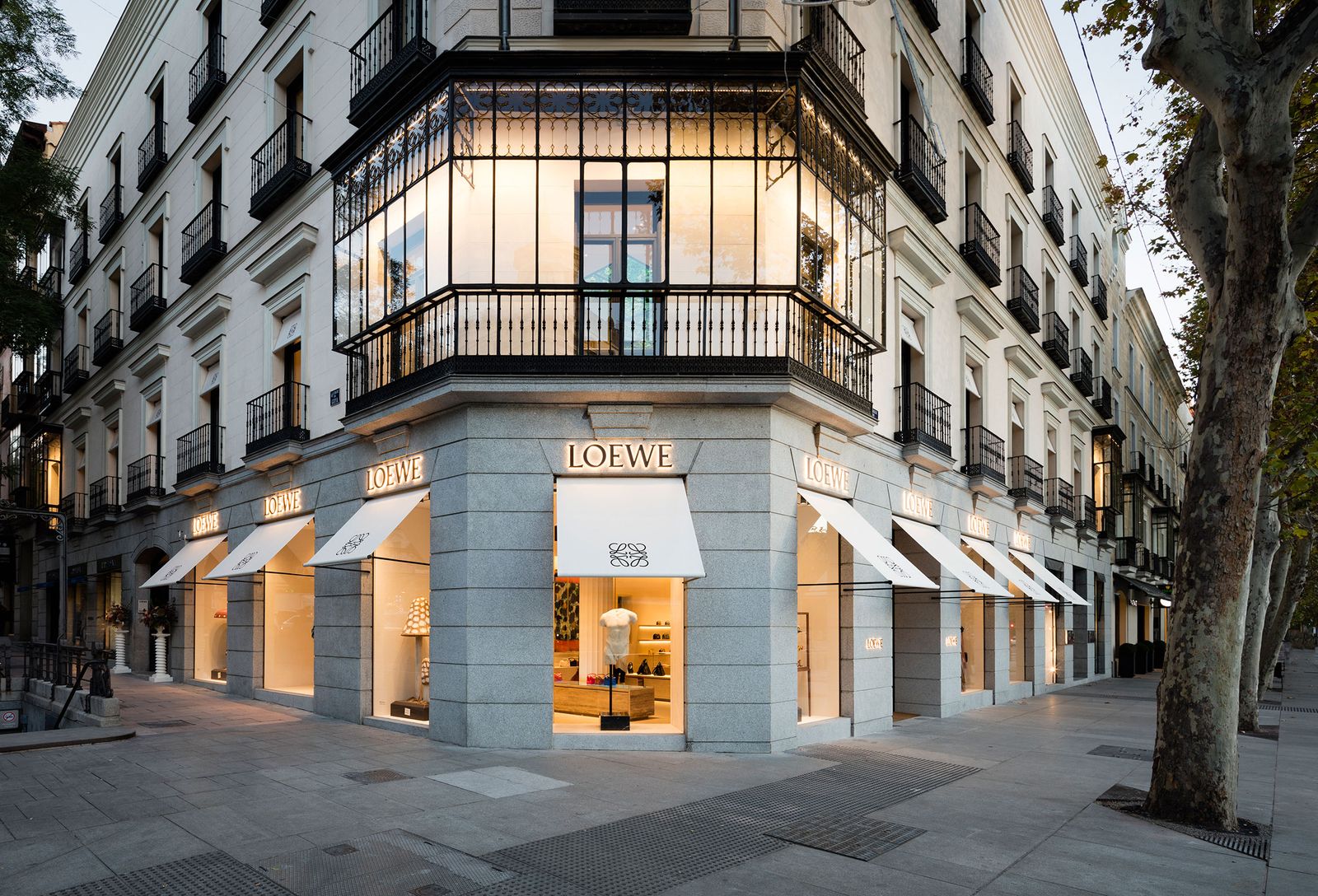
Jack McCollough and Lazaro Hernandez became Loewe’s named creative directors on 7 April 2025 — the first American duo to inherit the 180-year-old Madrid house directly from the man who designed the Puzzle bag, and the first co-leadership in a loewe creative direction lineage that runs in a straight line from an 1846 Madrid leather collective through Narciso Rodriguez, José Enrique Oña Selfa, Stuart Vevers and Jonathan Anderson. LVMH announced Anderson’s departure on 17 March 2025 after eleven years; the Proenza Schouler founders were confirmed a week later and staged their Spring/Summer 2026 debut in Paris in early October. The lineage is short — fewer than ten named creative directors in a century and a half — but each appointment has redefined what a 180-year-old Spanish leather house is allowed to be.
Founding: a Madrid leather collective, 1846–1892
Loewe begins not as a single founder’s atelier but as a collective. In 1846, a group of leather craftsmen pooled their workshops in Madrid to supply the city with billfolds, boxes, picture frames, riding accessories and the small leather goods a nineteenth-century capital required. The house’s founding date is therefore older than its name. The brand we recognise as Loewe arrived in 1872, when Enrique Loewe Roessberg — a German merchant of Hessian origin — joined the collective and lent it his surname. Some archival records place the naming in 1876 rather than 1872; the four-year ambiguity is itself a hallmark of pre-industrial maison histories, where company seals lagged behind shop-floor practice.
What is not ambiguous is the moment Loewe acquired a permanent address. In 1892, the house opened its first standalone store at Calle Príncipe in Madrid, fixing it on the city map at a moment when Spanish luxury was still organised around itinerant workshops and royal commissions rather than retail. Calle Príncipe gave Loewe a vitrine, a queue and a class of clientele that would matter very shortly after.
The first half-century is not a creative direction story in the modern sense — there are no named auteurs, no signature silhouettes, no runway debuts. It is a story of materials, of vegetable-tanned hides, of hand-stitched billfolds, of the slow accumulation of technique that later directors would all, in different vocabularies, claim to be honouring.
Royal warrant and the Amazona: 1905–1988
The royal warrant of 1905 was the first inflection point that read internationally. King Alfonso XIII appointed Loewe Purveyor to the Royal Court, a designation that established the house’s class position for the next century. Royal warrants are difficult to win, easy to lose, and impossible to manufacture; they produce a kind of institutional gravity that creative direction either honours or rebels against, but never ignores.
The second inflection was a bag. In 1975, Loewe launched the Amazona, a soft-sided travel-style holdall named for the Amazons of Greek mythology — the warrior women whose name implies both ferocity and mobility. The timing was not incidental. Spain was in transition: Franco died in November 1975, the monarchy was restored, and a generation of working women required objects that were neither matronly nor decorative. The Amazona was designed for them — light enough to carry, structured enough to hold a working life, soft enough to read as Spanish rather than Parisian or Milanese. It became the house’s first canonical bag and the reference point against which every subsequent Loewe leather goods launch would be measured.
In 1988, the Loewe Foundation was established — a cultural arm that would later become the institutional vehicle for the Loewe Foundation Craft Prize and a portfolio of poetry, photography and dance programmes. The Foundation matters to the creative direction story because it formalised, in 1988, the idea that Loewe was not merely a leather goods company but a patron — a house with an obligation to craft beyond its own product. That obligation would be inherited, decades later, by a young Northern Irish designer who would treat it as a mandate.
LVMH consolidation and the 1990s American interlude
LVMH took full ownership of Loewe in 1996, completing a consolidation that placed the Madrid house inside the same portfolio as Louis Vuitton, Dior and, in time, every other maison the group would absorb. Full LVMH ownership changed the question Loewe had to answer. It was no longer “who supplies the Spanish court” but “what does Loewe say to a global luxury customer who has never set foot in Madrid.” Each of the three creative directors LVMH appointed across the next seventeen years answered that question differently — and, until 2013, inconclusively.
Narciso Rodriguez (1997–2000). The American designer was named creative director of womenswear in 1997, the first named auteur in the modern sense and the first signal that LVMH intended to give Loewe a fashion identity beyond leather. Rodriguez stayed three years. The Cuban-American sensibility he brought — minimalism, bias cutting, a particular respect for the female body — did not produce the breakout commercial moment LVMH was looking for, but it established that Loewe would be a designer’s house, not a heritage curator’s.
José Enrique Oña Selfa (2000–2007). The Belgian-Spanish designer took over in 2000 and held the role for seven years — the longest tenure of any named director before Anderson. Oña Selfa pulled the house back towards a more overtly Latin sensuality, but the broader luxury industry was, by the mid-2000s, organising itself around a different logic: viral leather goods, blockbuster runway moments, the It-bag economics of the post-Galliano Dior years. Loewe’s quiet refinement read, in that context, as undersold.
Stuart Vevers (2008–2013). The British designer arrived in 2008 and stayed five years. Vevers modernised the leather goods category, sharpened the visual identity and made Loewe legible to a younger international customer — work that would later be cited as the foundation Anderson built on. He left in 2013 for Coach, where he became executive creative director.
By the end of 2013, Loewe had been under LVMH for seventeen years and had cycled through three creative directors, none of whom had produced the global breakout the group’s leather houses were expected to deliver. The 1990s American interlude — to use the shorthand — had professionalised the house without transforming it. What came next did both.
The Jonathan Anderson era, 2013–2025
LVMH appointed Jonathan Anderson creative director of Loewe in 2013. He was thirty-one, ran his own JW Anderson label out of London, and had no prior experience with a Spanish heritage house, a leather atelier of Loewe’s scale, or a brief of this institutional weight. His womenswear debut staged on 26 September 2014 — almost a year after his appointment — and the patience LVMH showed in that pre-debut runway was, in retrospect, one of the most consequential bets the group made in the decade.
Anderson did three structural things, in order. First, he relocated the design team from Madrid to Place Saint-Sulpice in Paris, repositioning the brand as a Paris fashion house with a Madrid leather atelier rather than a Madrid leather house with a fashion line. The decision was not without cost — it required reorganising creative and craft to operate across two cities — but it placed Loewe inside the Paris show calendar at the level the leather houses of the LVMH group occupied.
Second, he produced a bag. The Puzzle launched with the Spring 2015 men’s collection — Loewe’s first major new bag in approximately three decades. Each Puzzle was hand-assembled in Madrid from roughly seventy-five leather panels in about nine hours. The geometry was its own argument: a flat-pack construction that folded into a structured cuboid, a piece of paper-engineering rendered in vegetable-tanned hide. The Puzzle did for the Anderson era what the Amazona had done for the late 1970s — it gave the house a canonical object that the rest of the work could be organised around.
Third, he formalised the Foundation’s craft mandate. The Loewe Foundation Craft Prize launched in 2016 and awarded its first edition in 2017 to Ernst Gamperl, the German wood-turner whose hollowed vessels established the prize’s tonal range — material-first, technique-driven, indifferent to market category. The Craft Prize made Anderson’s Loewe legible to a constituency that had never bought a Puzzle bag and never would: the international craft world, museum curators, design press, the slow material culture that runs parallel to the fashion calendar.
By 2024, Anderson’s Loewe was the LVMH group’s most critically discussed fashion house and one of its fastest-growing leather goods businesses. He had built the house from a roughly €230 million revenue line at appointment into a multi-billion-euro maison by tenure’s end — the precise figures vary by year and disclosure — and had done it while running JW Anderson in parallel.
On 17 March 2025, LVMH announced his departure after eleven years. In April 2025 he was named artistic director of Dior Men. He debuted Dior Homme SS26 on 27 June 2025; the broader arc, including the LVMH context for the move, is documented in our Jonathan Anderson LVMH trajectory piece and the fashion designer debuts 2026 reference.
The McCollough–Hernandez handover, 2025–
A week after the Anderson announcement, on 24 March 2025, LVMH named Jack McCollough and Lazaro Hernandez as Loewe’s creative directors, effective 7 April. The two were the founders of Proenza Schouler, the American label they launched in 2002 directly from their Parsons senior thesis collection. The arrangement permits them to retain Proenza Schouler in absentia — the label continues under their ownership while they hold the Loewe role full-time — a structure that mirrors how Anderson held JW Anderson alongside Loewe for his first decade.
Three structural facts about the appointment are worth pulling out.
The first is co-leadership. McCollough and Hernandez are the first duo in the Loewe creative direction lineage. Previous transitions — Rodriguez to Oña Selfa, Oña Selfa to Vevers, Vevers to Anderson — were single-auteur handovers. Co-direction at this institutional scale is not unprecedented in luxury, but it is uncommon, and at a house whose recent identity was so closely bound to a single editorial voice, it represents a real reframing.
The second is the New York connection. Rodriguez was the last American to lead Loewe (1997–2000). McCollough and Hernandez are, in our reading, the third American creative direction at Loewe across the LVMH era — and the first to take the house at scale, with a Puzzle-bag inheritance, a Place Saint-Sulpice studio and a craft prize infrastructure already in place. They are also the first appointment in the lineage to inherit a fully built editorial system rather than be asked to build one.
The third is the timing. Their Spring/Summer 2026 debut staged in Paris in early October 2025 — roughly six months after they began the role, a compressed runway by recent LVMH standards. The SS26 show landed inside a broader 2025–2026 designer-debut cycle that the fashion designer debuts 2026 reference tracks in full.
The handover is also being marked by archive work. The 2026 Amazona 180 anniversary reissue was announced as part of a broader “180 años” archive programme tied to the house’s foundation date — a programme that uses the Amazona, rather than the Puzzle, as its anchor object. The choice is legible: the Puzzle is Anderson’s; the Amazona is the house’s. Reaching back to 1975 lets the new direction stake its claim to the older lineage without inheriting the most recent one whole.
The Loewe creative direction lineage in one timeline
The loewe creative direction lineage condenses to fewer than a dozen inflection points across 180 years. The table below tracks each named director and the structural moments that shaped the role they inherited.
| Year | Creative Director | Notable Project | Note |
|---|---|---|---|
| 1846 | (Collective, unnamed) | Madrid leather workshop founded | A group of craftsmen pool workshops in central Madrid |
| 1872 | Enrique Loewe Roessberg | House acquires the Loewe name | German Hessian merchant joins; some sources date this 1876 |
| 1892 | (House workshop) | First standalone store, Calle Príncipe, Madrid | Loewe fixes a permanent retail address in the capital |
| 1905 | (House workshop) | Royal warrant from King Alfonso XIII | Purveyor to the Royal Court — institutional class position established |
| 1975 | (House workshop) | Amazona bag launched | Named for Greek warrior women; designed for working women in transition-era Spain |
| 1988 | (House workshop) | Loewe Foundation established | Cultural arm formalised — later vehicle for the Craft Prize |
| 1996 | (House workshop) | LVMH takes full ownership | Loewe enters the LVMH leather goods portfolio at scale |
| 1997–2000 | Narciso Rodriguez | Womenswear creative direction | First named modern auteur; Cuban-American minimalism |
| 2000–2007 | José Enrique Oña Selfa | Latin-sensual reframe | Longest pre-Anderson tenure; seven years |
| 2008–2013 | Stuart Vevers | Leather goods modernisation | Left for Coach as executive creative director |
| 2013–2025 | Jonathan Anderson | Puzzle bag (SS15); Craft Prize (founded 2016, first awarded 2017 to Ernst Gamperl); Madrid → Paris team relocation; womenswear debut 26 Sep 2014 | Eleven-year tenure; departed 17 Mar 2025; named Dior Men’s artistic director April 2025; debuted Dior Homme SS26 27 Jun 2025 |
| 2025– | Jack McCollough and Lazaro Hernandez | SS26 Paris debut, October 2025; Amazona 180 anniversary reissue (2026) as part of “180 años” archive programme | Announced 24 Mar 2025, effective 7 Apr 2025; first duo in the lineage; retain Proenza Schouler in absentia |
Reading the table as a single sequence clarifies two patterns. The pre-LVMH century is structured by objects and institutions — a shop, a warrant, a bag, a foundation. The post-LVMH quarter-century is structured by named directors — Rodriguez, Oña Selfa, Vevers, Anderson, and now McCollough and Hernandez. The shift from object-led to auteur-led identity is the underlying story the lineage tells, and the question the new direction inherits is whether the next chapter belongs again to an object — an Amazona reissue, a new canonical bag — or to the editorial voice of a duo.
Coda
What the lineage makes visible, more than any single tenure, is the rhythm of inheritance. Each Loewe director takes the house at a different moment in its institutional life: Rodriguez inherited a house that had just been bought; Oña Selfa inherited a house that needed Spanish legibility; Vevers inherited a house that needed leather goods discipline; Anderson inherited a house that needed a global fashion identity; McCollough and Hernandez inherit a house that already has one — and now needs the second act after its defining auteur. The 180-year frame is not nostalgic. It is the timeline against which the 7 April 2025 handover will be read, and the timeline the Amazona reissue is explicitly invoking. The next four years of Loewe will be measured in objects, not seasons, and the lineage table is the document the measuring happens against.