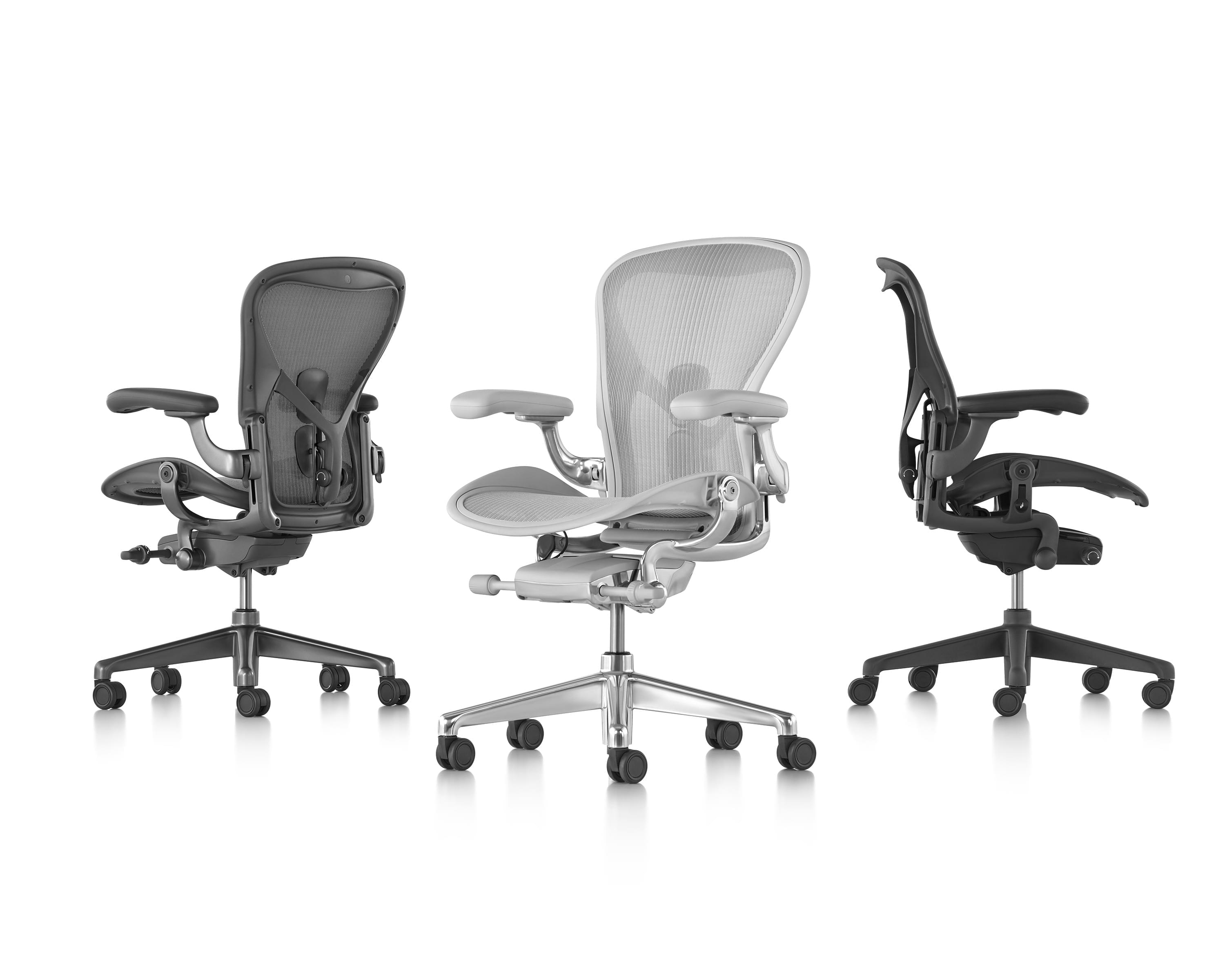
Herman Miller’s 2026 Aeron — the first full redesign of Bill Stumpf and Don Chadwick’s 1994 task chair, announced on 2 June 2026 at $2,285 — closes a 30-year run of nine million units sold and reopens the ergonomic office chair lineage that Knoll, Vitra and Steelcase have been ranged against since the Eameses’ 1958 Aluminum Group. The new Aeron lands at Fulton Market Design Days in Chicago, 8–10 June 2026, and is the clearest reset of the category since the original Aeron entered the Museum of Modern Art’s permanent collection in 1994, before it had even reached retail floors. Read backwards from that date, the lineage gathers four manufacturers — Herman Miller (founded 1905 in Zeeland, Michigan as Star Furniture Co.), Knoll, Vitra and Steelcase (founded 1912 in Grand Rapids) — and roughly a dozen designers who fixed what a seated body could expect from an office.
Postwar lounge: Eames and Saarinen, 1948–1958
The lineage begins before ergonomics was a marketing category. In 1948, Eero Saarinen — born 1910, dead at 51 in 1961 — designed the Womb Chair for Knoll, a fibreglass shell with foam and upholstery that proposed sitting as enclosure rather than posture. Florence Knoll had reportedly asked for something she could curl up in; Saarinen delivered a chair named for the brief. Eight years later, in 1956, he extended the same shell-on-pedestal logic into the Tulip or Pedestal Group, an aluminium stem ending in a moulded plastic seat that cleared, finally, what Saarinen called “the slum of legs” under American dining tables.
Herman Miller answered the same year. Charles and Ray Eames released the Lounge Chair 670 and Ottoman 671 in 1956 — moulded rosewood plywood shells, leather cushions, a five-star aluminium swivel base — designed as a gift for the director Billy Wilder and immediately put into series production. It was not an office chair. It was the chair an office worker aspired to sit in at home. Two years later, in 1958, the Eameses delivered the Aluminum Group: a thin, suspended sling of vinyl or leather stretched between two cast-aluminium side ribs, originally commissioned by Eero Saarinen and Alexander Girard for the J. Irwin Miller house in Columbus, Indiana, then scaled into office use. The Aluminum Group is where the lineage actually starts. It treated the seated body as a tensioned membrane problem rather than a cushion problem, and it is the direct conceptual ancestor of every mesh chair that followed.
Stumpf’s first ergonomic moves at Herman Miller, 1976–1984
The word “ergonomic” entered Herman Miller’s vocabulary with Bill Stumpf. Born 1936, dead 2006, Stumpf held a BFA in industrial design from the University of Illinois at Urbana-Champaign and a master’s in environmental design from the University of Wisconsin–Madison, where he had studied with researchers at the Hospital School. He came to Herman Miller via Robert Propst’s research arm and brought a clinical vocabulary — lumbar lordosis, ischial tuberosity, intervertebral disc pressure — into a company that until then had sold chairs by silhouette.
The Ergon Chair, 1976, was the result. It was the first chair Herman Miller marketed explicitly on the basis of medical research, with a contoured seat pan, pneumatic height adjustment and a back that pivoted independently of the cushion. ID magazine gave Stumpf its “Designer of the 70s” tag; the American Society of Interior Designers gave Ergon its 1976 award. The chair sold competently, not spectacularly, but it set a template: the office chair as a piece of medical equipment, sold on evidence rather than taste.
Stumpf returned in 1984 with Don Chadwick — born 1936, UCLA, founder of Chadwick Modular Seating in 1974 — and the two delivered the Equa Chair. Equa replaced Ergon’s foam-and-shell construction with a flexing one-piece moulded shell that bent with the sitter, eliminating the need for a separate tilt mechanism. Time magazine named Equa a “Design of the Decade” for the 1980s in 1990. By that point, Stumpf and Chadwick were already two years into the project that would redefine the category.
Aeron’s 1994 break
The Aeron Chair, 1994, did three things no mass-market office chair had done. It abolished foam and fabric upholstery on the seat and back, replacing them with Pellicle, a woven elastomeric mesh stretched over a glass-fibre-reinforced plastic frame. It abandoned the principle of one-size-fits-most and shipped in three sizes — A, B and C — sized to fifth-percentile female and ninety-fifth-percentile male anthropometrics. And it cost $1,000 at launch, a price that registered as transgressive in 1994 and now, after three decades of imitators, reads as the floor of the serious task-chair market.
The Aeron’s commercial reception is well-documented; its institutional reception less so. The Museum of Modern Art acquired Aeron for its permanent collection in 1994, before the chair reached general retail. That preemptive acquisition functioned as a kind of public underwriting: MoMA was telling office managers that this strange, skeletal, mesh-and-magnesium object was already historical. The chair entered the dot-com offices of San Francisco and Seattle a year later and became, within five years, the most visible single piece of furniture of the late twentieth century.
Herman Miller has revised Aeron only incrementally since. PostureFit, a sacral support added in 2002, addressed lower-back complaints that had accumulated over the chair’s first eight years. A tilt-tension lever replaced the original arm-mounted dial in 2005. In 2016, the company released Aeron Remastered — an internal reset that updated the Pellicle weave, refined the tilt, and quietly retronamed the original chair “Aeron Classic.” Total production has now passed nine million units. The reported failure-or-replacement rate sits at 0.055%, a number Herman Miller cites in warranty disclosures and one that explains why the chair has survived three furniture cycles without being replaced.
The Vitra and Knoll responses, 1996–2009
Vitra’s reply came two years after Aeron. Alberto Meda — born 1945, mechanical engineering from Politecnico di Milano, 1969 — was commissioned by Vitra chairman Rolf Fehlbaum to produce a task chair that would do for European offices what Aeron had done for American ones. The Meda Chair, 1996, was the result: a tensioned net back, a synchronised tilt with the pivot point placed near the sitter’s hip, and a visible mechanical clarity that distinguished it from Aeron’s enclosed casting. Good Design Gold Prize Japan recognised it in 1997; the Bundespreis Produktdesign followed in 2000. Meda has since spun off into the MedaPro and MedaPal families, both still in production. Meda’s mechanical training is legible in the chair; he treats a tilt mechanism the way a structural engineer treats a cantilever, with the load paths exposed.
Vitra’s broader office programme, developed across the Vitra Campus in Weil am Rhein, also drew on Antonio Citterio — born Meda, Italy 1950, architecture degree from Politecnico di Milano 1972, two Compasso d’Oro awards in 1987 and 1994, partner with Patricia Viel in ACPV from 2000. Citterio designed Vitra’s later T-Chair, ID Chair and AC families, threading the company’s office output between Meda’s engineered visibility and a softer Milanese tailoring. The Vitra factory complex where these chairs are produced sits within Frank Gehry’s wider institutional architecture of the 1980s and 1990s — Gehry built the Vitra Design Museum and Fire Station there — and the proximity of architects to chair production at Weil am Rhein is not incidental to how the Meda or AC ranges look.
Knoll waited until 2009 to mount a serious post-Aeron response. Generation by Knoll was designed by Formway Design, the Wellington, New Zealand studio that had spent the previous decade selling chairs primarily into the Australasian market. Generation took Best of NeoCon Gold in the task-chair category at launch. Its defining move was a frameless elastomer back in a figure-of-eight cross-section that allowed the sitter to twist, lean sideways, or sit cross-legged without fighting the chair. The seat edge offered 270 degrees of flex; the seat itself offered three inches of depth adjustment; and the lumbar support carried through the arms rather than terminating at the backrest. Generation was an argument that the post-Aeron office had become more posturally promiscuous — phones in hand, laptops on knees, monitors at angles — and that the chair needed to follow.
Steelcase and the 21st century
Steelcase, the Grand Rapids manufacturer founded in 1912, approached the same problem from a different direction. Leap, 1999, was the product of four years of development and $35 million in R&D spend. It accumulated 23 patents. Steelcase shipped 5,000 units a week in Leap’s first year of production. Where Aeron sold a clinical aesthetic — exposed mechanisms, mesh, an industrial palette — Leap sold a sympathetic spine. Its LiveBack technology used a flexible polymer spine that changed shape as the sitter reclined, mimicking the natural curve of the lumbar region. The chair was upholstered, conservative, corporate. It was the chair purchased by procurement officers who found Aeron too aggressive.
Gesture, 2013, was Steelcase’s answer to what Generation had identified four years earlier: the sitter was no longer sitting at a desk reading a single screen. Gesture’s arms moved through a wider range than any prior task chair, supporting the sitter holding a phone above shoulder height, a tablet on a thigh, or a laptop on a knee. The chair was the product of a multi-year global posture study Steelcase ran across nine countries, and it remains the standard reference for mobile-device-friendly seating. Together, Leap and Gesture established Steelcase as the volume incumbent against Herman Miller’s design-press dominance — two manufacturers within ninety miles of each other in West Michigan, dividing the global office between them.
The 2026 Aeron update and the ergonomic office chair lineage
The 2026 Aeron, announced on 2 June 2026 and debuting at Fulton Market Design Days in Chicago from 8 to 10 June, is the first redesign of the chair that Stumpf and Chadwick would have recognised as substantive. The aluminium base has been re-engineered using generative design tools, shaving two pounds while preserving load ratings. Embodied carbon has been reduced 12% through bio-based nylons and post-industrial recycled content. PostureFit SL, the Harmonic 2 Tilt and the 8Z Pellicle are all carried forward, but each has been resized to extend the chair’s anthropometric envelope at both ends — Herman Miller’s response to two decades of complaints from sitters above the 95th percentile and below the 5th. Two new finishes, Jasper (a warm olive) and Nightfall (a deep midnight blue), arrive alongside the existing palette; both are applied as single tones across frame and Pellicle, a finishing approach that replaces Aeron’s historical two-tone identity.
Joseph White, MillerKnoll’s director of design strategy and the company’s public spokesperson on the update, has framed the redesign as the chair catching up to what the company learned over thirty years of warranty data and sit-tests. Gabe Wing, MillerKnoll’s vice-president of sustainability, has carried the embodied-carbon argument: the bio-based nylons and recycled content are the company’s measurable commitment, against a corporate Climate Pledge that runs through 2030. The 2026 price — $2,285 in the United States — is roughly double the original $1,000 of 1994 in nominal terms, and within ten per cent of the 1994 price in real terms after three decades of inflation. The Aeron remains, by that measure, priced where it was when it entered MoMA.
The corporate background to the update is the 2021 merger. Herman Miller acquired Knoll for $1.8 billion in a deal announced in April 2021 and closed on 19 July 2021. The combined company trades on Nasdaq as MLKN under the name MillerKnoll and now controls a portfolio that includes Herman Miller, Knoll, Geiger, DatesWeiser, Maharam, Muuto, HAY and Naughtone. The Aeron and the Generation are, since July 2021, sister products under one parent — a consolidation that the 2026 update reads partly against, since it re-asserts Aeron’s primacy as the group’s flagship task chair.
The lineage, mapped:
| Year | Chair | Brand | Designer | Note |
|---|---|---|---|---|
| 1948 | Womb Chair | Knoll | Eero Saarinen | Fibreglass shell, foam upholstery; Florence Knoll brief |
| 1956 | Lounge Chair 670 + Ottoman 671 | Herman Miller | Charles + Ray Eames | Rosewood plywood, leather, aluminium swivel base |
| 1956 | Tulip / Pedestal Group | Knoll | Eero Saarinen | Aluminium stem, moulded plastic seat |
| 1958 | Aluminum Group | Herman Miller | Charles + Ray Eames | Tensioned sling on cast-aluminium ribs; originally for Miller House |
| 1976 | Ergon | Herman Miller | Bill Stumpf | First Herman Miller chair sold on ergonomic evidence; 1976 ASID Award |
| 1984 | Equa | Herman Miller | Bill Stumpf + Don Chadwick | One-piece flexing shell; Time ‘Design of the Decade’ 1990 |
| 1994 | Aeron (Classic) | Herman Miller | Bill Stumpf + Don Chadwick | Pellicle mesh, three sizes A/B/C; MoMA collection 1994; $1,000 launch |
| 1996 | Meda Chair | Vitra | Alberto Meda | Commissioned by Rolf Fehlbaum; Good Design Gold Prize Japan 1997 |
| 1999 | Leap | Steelcase | Steelcase design team | Four years and $35M development; 23 patents; LiveBack spine |
| 2002 | Aeron + PostureFit | Herman Miller | Stumpf + Chadwick | Sacral support added to Aeron Classic |
| 2009 | Generation | Knoll | Formway Design (Wellington, NZ) | Frameless elastomer figure-8 back; Best of NeoCon Gold |
| 2013 | Gesture | Steelcase | Steelcase design team | Supports mobile-device postures; multi-country posture study |
| 2016 | Aeron Remastered | Herman Miller | Stumpf + Chadwick (revised) | Updated Pellicle weave; original retronamed ‘Aeron Classic’ |
| 2026 | Aeron (2026 update) | MillerKnoll / Herman Miller | Stumpf + Chadwick lineage, MillerKnoll design strategy under Joseph White | Generative-design aluminium base (-2 lbs); 12% lower embodied carbon; Jasper + Nightfall finishes; $2,285 |
Read down the table, the inflection points are clear. 1958 fixes the membrane principle. 1976 introduces clinical evidence. 1994 ships the synthesis at scale and at price. 1996 brings the European mechanical answer. 1999 supplies the corporate-volume alternative. 2009 and 2013 reframe the chair around posture mobility. 2026 returns the lineage to Herman Miller, with the same designer credits — Stumpf, posthumous; Chadwick, 90 in 2026 — and a generatively engineered base that carries Aeron into its fourth decade.
The 2026 Aeron is not a new chair; it is the same chair, recalibrated against thirty years of evidence Herman Miller has been collecting since 1994. The category Stumpf opened with Ergon in 1976 has accumulated enough comparative production data — nine million Aerons, 5,000 Leaps a week, the Meda’s quarter-century on European desks, the Generation’s New Zealand-engineered spine — that the chair has become legible as a single, continuous, four-manufacturer conversation. The next chapter in the ergonomic office chair lineage, by Herman Miller’s own framing, will be measured not in patents or awards but in embodied carbon, anthropometric inclusivity, and the warranty rate that Aeron Classic set at 0.055%. Stumpf and Chadwick’s 1994 chair remains the benchmark every other manufacturer is measured against; the 2026 update is Herman Miller’s acknowledgement that the benchmark itself had to move.