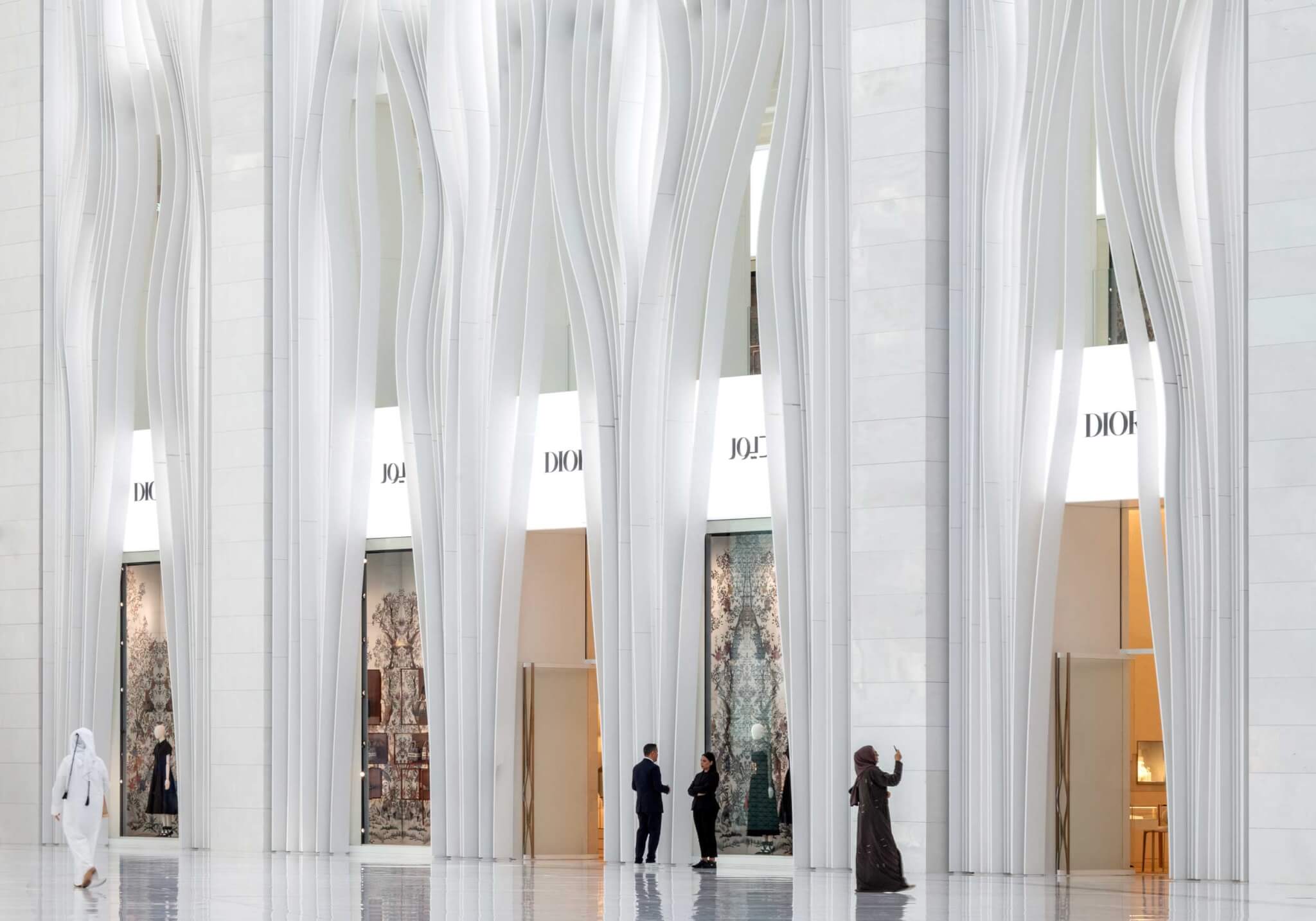
Dior’s 2026 store programme runs three architects in parallel — Sou Fujimoto’s ribbed Shinsaibashi facade in Osaka, Peter Marino’s drapery-lined interiors in New York and Beverly Hills, Alex Chinneck’s 14 knotted-clock window sculptures across both — and the throughline of the year is that Marino, the maison’s architect-of-record since 1997, is now choreographing other people’s gestures inside his own retail architecture. The Dior 2026 stores are not a single building or a single signature; they are a programme that puts a Japanese name-architect on a flagship envelope in Osaka and a British sculptor on the windows of two American boutiques within a week of each other in late May, while keeping every interior under one continuous Marino hand. Read together, the three fronts are the clearest articulation in years of how LVMH’s largest fashion house thinks about retail as architectural patronage rather than as identikit rollout.
The week of 21–28 May 2026
Two announcements, seven days apart, defined the year. On 21 May the four-storey House of Dior Shinsaibashi opened on Osaka’s main shopping spine — Fujimoto’s first publicly documented commission for any LVMH maison, with Peter Marino interiors and a Michelin-starred Anne-Sophie Pic restaurant on the upper floor (Dezeen, 27 May 2026). On 28 May, 14 surreal sculptures by Alex Chinneck were unveiled in the windows of House of Dior New York on 57th Street and House of Dior Beverly Hills on Rodeo Drive: knotted clocks, twisted cars, the British sculptor’s signature register of bent and warped everyday forms applied to American streetscapes (Dezeen, 28 May 2026).
The pairing is not a coincidence of calendar. Both projects sit inside House of Dior boutiques whose interiors Marino either authored or oversaw; both treat the storefront as a piece of architecture-scale signage in its own right; both push a non-Marino author to the public-facing surface — Fujimoto on the building skin in Osaka, Chinneck on the glass in Manhattan and Beverly Hills — while Marino’s interiors hold the line behind them. The week reads as a deliberate test of the same proposition on two continents and at two scales: that the maison can lend its retail architecture to outside voices without losing the through-grammar that has held since the 1990s.
Sou Fujimoto in Osaka: the ribbed facade
Shinsaibashi is Osaka’s principal luxury shopping street, the southern hinge of the city’s commercial centre, and the obvious next move after Dior had already used Tokyo and Seoul as platforms for name-architect flagships. Fujimoto’s four-storey building wraps the corner in an undulating, ribbed envelope whose rhythm reads as both haute couture drapery and as the lattice grammar that has defined his architecture since House NA and the 2013 Serpentine Pavilion’s cloud of 20 mm white steel poles. The ribs are decorative in elevation and structural in effect: they organise the daylight that enters the upper floors and they cast a controlled shadow pattern across the pavement that is legible at street level all day.
Interiors are by Marino’s office. The Pic restaurant on the upper floor extends the now-standard Dior pattern of giving its Asian flagships a destination food anchor — a programme Marino has helped engineer over two decades. The 21 May 2026 opening date matters because it lands Shinsaibashi inside the same quarter as Jonathan Anderson’s first Dior womenswear collections, a year in which the maison is simultaneously reorganising its product and its real estate. Fujimoto has no other publicly documented LVMH commission prior to this one. The Shinsaibashi appointment therefore reads as an introduction rather than a continuation: a way for the group to bring a major Japanese architect into the Dior orbit on a piece of real estate where his idiom — translucent skins, soft structural geometries, a public-private threshold treated as a permeable membrane — has the clearest functional alibi.
Peter Marino’s Dior, 1997 to 2026
The reason a Fujimoto facade and a Chinneck window can coexist inside the same brand grammar is that Marino has been the maison’s architect-of-record for nearly thirty years. The relationship dates at least to the 30 Avenue Montaigne headquarters renovation, which reopened on 15 October 1997 after Marino closed and remodelled it. From there it spread outwards: the New York and Beverly Hills flagships whose interiors he authored, the Omotesando interior refit in 2014 inside SANAA’s 2003 envelope, and the Seoul interiors inside Christian de Portzamparc’s 2015 fibreglass sails. By the mid-2020s every House of Dior in the world is either a Marino interior, a Marino refit, or a Marino-supervised brief executed by an outside architect on the envelope.
That status is the precondition for 2026. When Fujimoto wraps Shinsaibashi in ribs, the floors behind the ribs are Marino. When Chinneck knots a clock into the window at 57th Street, the boutique behind the glass is Marino’s. The maison can experiment with outside authorship on its most photogenic surfaces — the envelope, the window — because the durable architecture, the surface every customer actually moves through, is already under a single hand. This is a meaningful operational shift: where in earlier decades a major Dior commission could mean the architect controlled both shell and interior (Portzamparc Seoul, with Marino interiors, was already a hybrid), in 2026 the maison’s most public new interventions are commissions to author specific surfaces — facade, glass — while interiors remain Marino’s sovereign territory.
The Marino partnership is also the reason Dior’s retail looks structurally different from its LVMH siblings. Louis Vuitton has Frank Gehry on Capucines and on the Fondation; Loewe leans on the Anderson period’s design-collaboration register; Bvlgari operates Roman jewellery codes through Fondazione Bvlgari and partnerships with MAXXI. Dior, alone among the LVMH fashion houses, has had a single in-house interior author since the 1990s. The 2026 commissions extend rather than disrupt that arrangement.
Alex Chinneck’s windows: surrealism for retail
Chinneck (b. 1984, British) made his name with surreal architectural illusions. The Margate work ‘From the Knees of my Nose to the Belly of my Toes’ (2013) made a four-storey house facade appear to slide off its frame and into the front garden; ‘A Pound of Flesh for 50p’ (2014) built a small London building from melting paraffin-wax bricks that decayed over the run; ‘A Bullet from a Shooting Star’ (2015) inverted a 37-metre electricity pylon into the Greenwich Peninsula sky. His vocabulary is consistent: take a familiar piece of architecture or street infrastructure, apply a single impossible transformation — knot it, melt it, invert it, slice it — and let the surrounding city read the gesture against its own normality.
The Dior windows transpose that vocabulary onto retail. Knotted clocks and twisted cars are not random objects: they are American streetscape grammar — Manhattan storefront timekeeping, Rodeo Drive valet culture — turned into Chinneck’s signature distortion. The intervention runs across both addresses simultaneously, which gives the commission its narrative weight. A single window in a single city would read as a one-off seasonal display; 14 sculptures across the windows of the maison’s two principal American flagships read as a unified American statement, sized to compete with the city itself.
The logic is the inverse of Fujimoto in Osaka. In Shinsaibashi, a piece of permanent architecture by an outside author is wrapped around a Marino interior. In New York and Beverly Hills, a temporary sculptural intervention by an outside author is grafted onto a Marino interior’s external glass. One is the building; the other is the window. Both are, in effect, surfaces that the brand has decided to author at scale through guest architects and artists while keeping the through-line of the interior under its standing in-house hand.
Dior 2026 stores: the global storefront programme map
Read together, the three projects are the visible part of a longer pattern. Dior has spent two decades commissioning name architects for the envelopes of its East Asian flagships and pairing them with Marino interiors: SANAA’s Omotesando in 2003, with a double-skin of clear glass over translucent acrylic, refit by Marino in 2014; Portzamparc’s Seoul in 2015, six storeys in Gangnam wrapped in 20-metre fibreglass sails evoking the maison’s toiles, also with Marino interiors. Shinsaibashi extends that exact pattern into Osaka and adds Fujimoto as a third name-architect East Asian envelope. Chinneck’s American windows do something adjacent but different: they put a non-Marino author on the public surface of two existing Marino boutiques, on the other side of the world, at the same moment.
The table below traces the line from 30 Avenue Montaigne forward.
| Year | City | Address / Building | Architect or Artist | Intervention type |
|---|---|---|---|---|
| 1997 | Paris | 30 Avenue Montaigne | Peter Marino | Full headquarters renovation (reopened 15 October 1997) |
| 2003 | Tokyo | Omotesando Avenue | SANAA (envelope) | Flagship store envelope — double-skin clear glass over translucent acrylic |
| 2014 | Tokyo | Omotesando Avenue | Peter Marino (interior refit) | Interior refit inside SANAA envelope |
| 2015 | Seoul | Gangnam | Christian de Portzamparc (envelope), Peter Marino (interiors) | Six-storey flagship — 20-metre fibreglass sail panels |
| 2026 | Osaka | Shinsaibashi | Sou Fujimoto (envelope), Peter Marino (interiors) | Four-storey flagship — undulating ribbed facade, Anne-Sophie Pic restaurant on upper floor; opened 21 May 2026 |
| 2026 | New York | 57th Street (House of Dior New York) | Alex Chinneck (windows), Peter Marino (interiors) | 14 surreal window sculptures, unveiled 28 May 2026 |
| 2026 | Beverly Hills | Rodeo Drive (House of Dior Beverly Hills) | Alex Chinneck (windows), Peter Marino (interiors) | Component of the same 14-sculpture commission, unveiled 28 May 2026 |
The map clarifies what is consistent and what has shifted. The consistent element since 1997 has been Marino. The shifting element has been who gets the envelope or the window: SANAA in Tokyo’s first wave, Portzamparc in Seoul, Fujimoto in Osaka, Chinneck (an artist rather than an architect) on the American windows. The 2026 year is the first time the maison has commissioned both an outside envelope architect and an outside window artist in the same calendar window, and the first time it has put the latter on its American flagships at scale.
Why Osaka now
The Shinsaibashi opening is also a portfolio statement about where Dior thinks its next decade of retail growth sits. Tokyo and Seoul were the obvious East Asian flagship cities of the 2000s and 2010s. Osaka, the country’s second city and Kansai’s commercial centre, has been a comparatively underweight Dior presence relative to the volume of luxury spend that passes through it; opening a four-storey flagship with a Michelin-starred restaurant on the top floor is a signal that the maison sees the city as deserving the same architectural treatment as Omotesando and Gangnam, not as a tier-two satellite.
The architect choice matters. Fujimoto is the most internationally visible of the post-SANAA Japanese generation, his Serpentine Pavilion in 2013 having functioned as his global breakthrough; his architecture trades in lightness and structural geometry rather than in the heavy materiality of an Ando or the institutional monumentality of an Isozaki. Wrapping a luxury flagship in Fujimoto ribs reads to a Japanese audience as a recognisable national-architecture gesture and to a global audience as a recognisable Fujimoto gesture; both registers serve the maison’s interest in producing a building that photographs as architecture before it photographs as luxury retail.
Why Chinneck for the American windows
The American commission solves a different problem. New York and Beverly Hills are mature Dior addresses with Marino interiors already in place; there is no new building to commission. What there is, every day, is the storefront window — the surface the city sees from the pavement and which the brand controls at near-zero capital cost compared to new construction. Chinneck’s vocabulary is purpose-built for that surface: he works at the scale of single architectural objects and at the time-horizon of a temporary installation. Knotted clocks and twisted cars are sized to fit a window without losing the impossible-architecture grammar of his bigger public commissions.
Casting Chinneck — a British sculptor rather than an American one — across the two principal American flagships is also a way of avoiding the obvious. The maison has not commissioned, for instance, an American sculptor in residence; it has flown an outside artist whose work has the right scale-of-gesture for this kind of intervention, and applied that gesture to American streetscape iconography. The result reads as a maison-scale statement rather than a city-specific public-art commission.
Marino as choreographer
What the year clarifies is the evolution of Marino’s role inside the maison. He remains the in-house interior author across every Dior storefront in scope. But by 2026 he is also visibly the figure who decides when, where and how to invite other authors onto the brand’s public surfaces. Fujimoto did not turn up in Osaka by accident; Chinneck did not appear in two American windows simultaneously without a coordinating hand. The Marino practice has the institutional memory and the long relationship with LVMH leadership to act as the matchmaker between the brand and the outside authors who get one piece of the building or one piece of the window each.
This is a meaningful repositioning. In 1997, Marino was the architect who took 30 Avenue Montaigne apart and put it back together as a piece of contemporary luxury retail. In 2014, he was the interior author who refit SANAA’s Omotesando glass. In 2015, he was the interior author who handled Portzamparc’s Seoul sails. In 2026, he is — across three commissions in two hemispheres in the same calendar quarter — both the standing interior author and the figure choreographing where the outside gestures land. The pattern is closer to a fashion house’s creative director model, with Marino in the architectural equivalent of the role, than to the classical client-architect arrangement.
The LVMH context
The 2026 storefront programme also sits inside a particular LVMH moment. The group has been visibly accelerating its design and architectural patronage — Frank Gehry’s institutional commissions, the long Gehry partnership with Louis Vuitton, the LVMH-funded Fondation Louis Vuitton in the Bois de Boulogne — and Dior’s contribution to that pattern has, until 2026, been comparatively quiet on the architectural front, with the heavy lifting done inside Marino’s continuous interior idiom. Putting Fujimoto on Shinsaibashi and Chinneck on the American windows in the same month is a way of bringing Dior’s retail architecture more visibly into the same conversation that the wider LVMH group has been having about named-architect patronage for two decades.
It is also a way of competing on architectural terms with the group’s siblings. Louis Vuitton has Gehry on Capucines and on the Fondation; the group’s leather-goods houses have been visibly investing in design-led product programmes through 2025 and 2026; Loewe under Anderson treated craft and design partnership as a central brand axis. Dior’s 2026 answer is to put an outside architect on a new flagship envelope and an outside artist on its principal American windows, while keeping the interior continuity that none of its peers can match.
What the three commissions don’t do
It is worth saying what is not happening. None of these projects is a Marino retreat. The interiors of Shinsaibashi are Marino’s; the interiors behind the Chinneck windows are Marino’s; the Marino practice continues to be the through-author of the maison’s retail experience. None of the 2026 commissions disturbs that arrangement; if anything they reinforce it by treating the envelope and the window as the only public-facing surfaces on which it is now acceptable for the maison to bring in outside voices.
Nor is the year a programmatic announcement. There is no published Dior 2026 stores master document; the three projects are visible because they have launched, not because the maison has packaged them as a programme. What 21 May and 28 May together produced is the readable evidence of a strategy that was already running: name architects on East Asian envelopes, surrealist artists on American windows, Marino on everything behind both.
What to watch next
The open questions are whether Fujimoto is a one-off Dior commission or the start of a longer relationship, and whether Chinneck’s American windows are a seasonal intervention or the beginning of a recurring artist-in-residence position for the maison’s storefronts. Neither has been formally announced as continuing. Both are the kind of project a luxury house typically pilots once before deciding whether to extend; the calendar coincidence of Shinsaibashi opening on 21 May and the American windows appearing on 28 May suggests the maison wanted both readings — permanent architecture and temporary intervention — in the public conversation at the same time.
What the Dior 2026 stores year shows, finally, is that retail architecture for a maison of this scale is no longer a question of who designs the building. It is a question of who designs which surface of the building, and who choreographs the relationships between those authors. Fujimoto got the Osaka envelope, Chinneck got the New York and Beverly Hills windows, Marino got the interiors of all three. The architecture of the year is the arrangement itself.