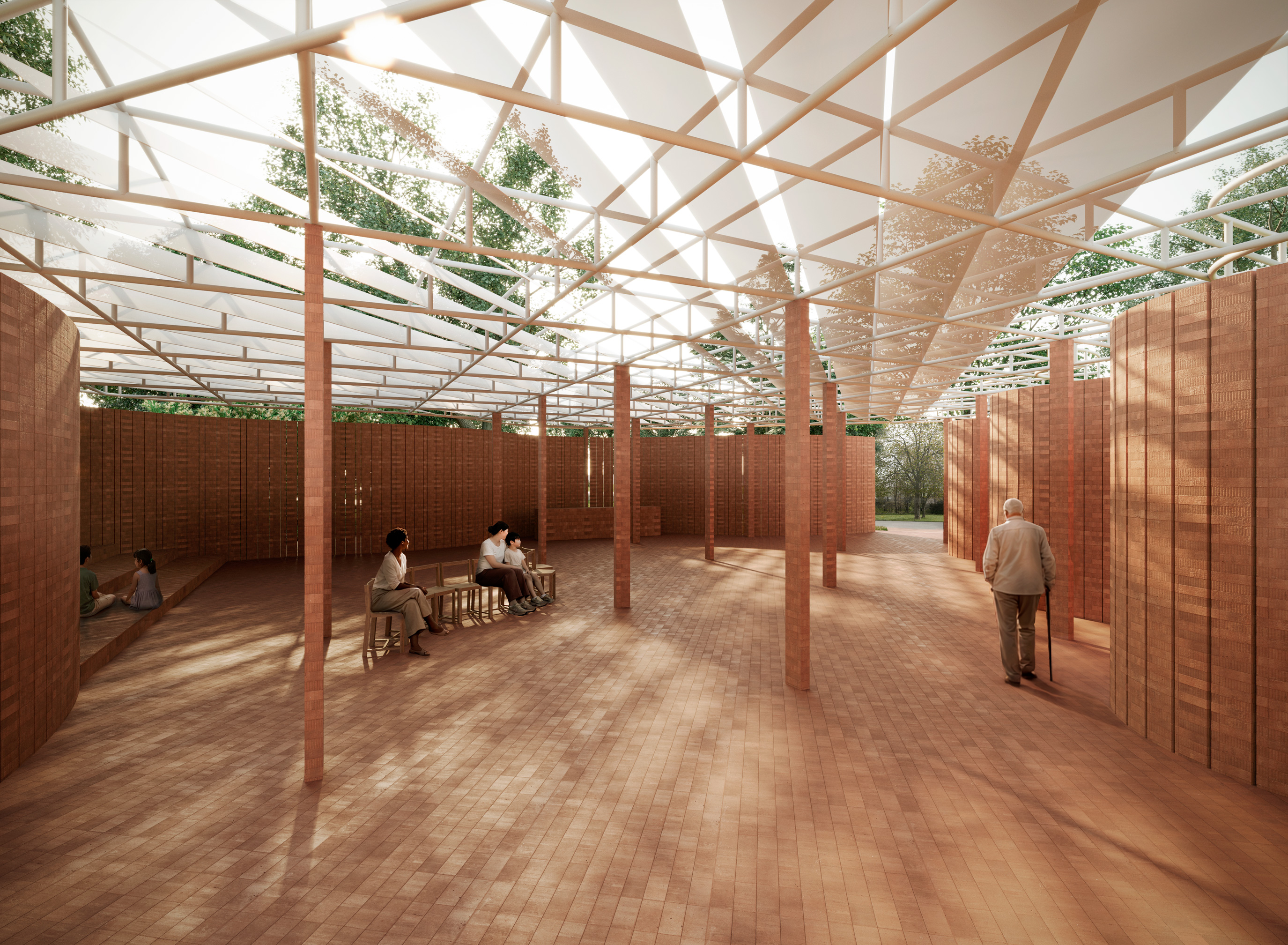
Lanza Atelier’s A Serpentine, the 25th pavilion on the Serpentine South lawn and the second Mexican Serpentine Pavilion in eight years, opened 6 June 2026 and is the first London commission since Peter Zumthor’s 2011 hortus conclusus to lead with a wall rather than a roof. The arc from Frida Escobedo’s 2018 celosia courtyard to Isabel Abascal and Alessandro Arienzo’s red-brick crinkle-crankle is the entire Mexican entry in the Serpentine’s twenty-six-year ledger. Two pavilions, eight years apart, both from Mexico City, both built around perforated mass and a careful argument with the lawn — and yet they read as opposite propositions about what Mexico City exports to Kensington Gardens.
This is a short list, and that is its interest. Of the architects invited to the Serpentine Pavilion since Zaha Hadid’s white-tent commission in 2000, only Escobedo and Lanza Atelier have come from Mexico, which makes the comparison the only one available and the comparison worth making in detail. Escobedo took the commission at 38, the youngest architect ever to do so at the time, and built a pavilion whose geometry pointed at the Greenwich Prime Meridian. Lanza Atelier, founded in 2015 by Abascal and Arienzo, took it eight summers later and built a pavilion whose surface points at the Serpentine South Gallery’s own brickwork. The first pavilion read Mexico through the cement roof tile; the second reads England through its own crinkle-crankle wall.
Escobedo 2018: the celosia courtyard and the Greenwich axis
Frida Escobedo’s Serpentine Pavilion 2018 opened 15 June 2018 and closed 7 October 2018, the eighteenth pavilion in the series and the first Mexican Serpentine Pavilion. The commission went to Escobedo at 38 — at the time the youngest architect in the brief’s history, a record subsequently overtaken by Sumayya Vally of Counterspace in 2020/21 — and the pavilion was published in advance with the kind of plan-drawings normally reserved for permanent buildings. The form is two rectangular volumes set on the lawn in slight rotation, defining a courtyard between them. The walls of both volumes are stacked grey cement roof tiles — the standard Mexican celosia, used everywhere from Mexico City patios to provincial corridors — laid loose so that air, light and sound pass through the lattice as ventilated mass. The roof is a flat mirrored canopy. A shallow triangular reflecting pool sits on the courtyard floor.
The pavilion’s argument is the rotation. Escobedo set the outer rectangular volume on the axis of the Serpentine South Gallery and rotated the inner volume slightly so that its long edge aligned to the Greenwich Prime Meridian, the zero-degree line that has run through Greenwich since 1884 and that the Royal Observatory still anchors a few kilometres east. The two axes — the gallery’s and the planet’s — produce a wedge-shaped courtyard whose geometry is at once an architectural plan and a small cartographic statement. The mirrored ceiling collapses the celosia walls overhead; the reflecting pool collapses the celosia walls underfoot; and the Mexican cement tile is set into the canon of British architectural backdrops as a quiet act of translation. Escobedo described the celosia at the opening as a domestic technology, the kind of perforated wall that mediates climate and privacy across northern and central Mexico. In Kensington Gardens it mediated the lawn.
The 2018 pavilion is the project that made Escobedo’s international career legible as a long arc rather than a national one. Two years later she was on the Pritzker Prize jury. Three years later she was in negotiation with the Metropolitan Museum of Art over what is now the largest commission ever given to a Mexican architect outside Mexico.
Lanza Atelier 2026: a crinkle-crankle in brick
The second Mexican Serpentine Pavilion is Lanza Atelier’s A Serpentine, the 25th pavilion in the Kensington Gardens series and the first project Abascal and Arienzo have built in the United Kingdom. The pavilion opened 6 June 2026 and runs to 25 October 2026 — twenty-one weeks on the lawn, three weeks longer than Escobedo’s 2018 season. The form is two walls. The south wall is a low red-brick crinkle-crankle, the English vernacular serpentine wall first built across East Anglia in the seventeenth century and revived around Cambridge in the eighteenth, whose sinusoidal plan allows a single wythe of brick to stand without buttresses. The north wall is a single shallow curve that arcs around a tree canopy on the Serpentine South lawn. Between the two walls is a rhythm of brick columns reading as a grove.
The Mexican Serpentine Pavilion of 2026 is, in this sense, an act of literal translation. Lanza Atelier took the name of the institution — Serpentine — and read it back as a wall. The crinkle-crankle is not native to Mexico; the brick column is not the Mexican atelier’s signature material. The architects went looking for an English vernacular that the Serpentine South Gallery itself, a Grade II-listed former tea pavilion of 1934, would already be holding in its own facade, and they found the brick wall as the answer. The pavilion’s red brick is set in stretcher bond; the crinkle-crankle plan reduces the wall to a single brick’s thickness; the columns are continuous-section rather than load-distributed; and the roof, where it exists at all, is light enough to read as canopy rather than ceiling. The decision to put a wall before a roof is the structural argument of the season. The last Serpentine to do this with comparable rigour was Toyo Ito and Cecil Balmond’s 2002 cube-derived envelope, and even that pavilion was a roof problem dressed as a wall.
There is a second argument layered into the brick. Lanza Atelier’s Mexico City office has built almost exclusively in modest materials at modest scales — single-family houses, small institutional renovations, one library — and A Serpentine is the first time the practice has worked at pavilion scale on a global stage. The brick is the studio’s argument that scale does not require new material. The pavilion can be dismantled and the brick re-laid; the columns can be unstacked; the wall can be moved. The post-season sale of Serpentine Pavilions is by now a known coda — twenty-five pavilions, twenty-three private buyers — and Lanza’s brick is sized for re-use.
The eight-year arc, Mexico City to Kensington Gardens
The two Mexican pavilions are best read against each other and against the canonical entries that bracket them. The table below holds Escobedo 2018 and Lanza Atelier 2026 alongside two reference points from the Serpentine’s pre-Mexican era — Zaha Hadid’s inaugural 2000 commission and Sou Fujimoto’s 2013 lattice, both of which set the structural vocabulary that subsequent architects either accepted or argued against. The columns track form, materials, site relationship and opening dates; the right-most column lists the entry in the FORMA graph.
| Year | Architect | Form | Materials | Site relationship | Open dates | Reference |
|---|---|---|---|---|---|---|
| 2000 | Zaha Hadid | Triangulated white-fabric tent for the gallery’s 30th-anniversary gala | 600 sqm steel frame seating 400 guests | Set parallel to the Serpentine South Gallery’s long elevation | Summer 2000 | First-ever Serpentine commission |
| 2013 | Sou Fujimoto | Cloud-like lattice of 20 mm white steel poles across 350 sqm | White steel rods with embedded polycarbonate disks | Open lattice on lawn; readable through from any approach | 8 June – 20 October 2013 | Pre-Mexican-era benchmark for porosity |
| 2018 | Frida Escobedo | Two rectangular volumes defining a courtyard; celosia breeze walls | Stacked cement roof tiles; mirrored ceiling; triangular reflecting pool | Outer volume on the gallery axis; inner volume rotated to the Greenwich Prime Meridian | 15 June – 7 October 2018 | First Mexican Serpentine Pavilion |
| 2026 | Lanza Atelier (Isabel Abascal and Alessandro Arienzo) | A Serpentine: red-brick crinkle-crankle south wall, curved north wall, rhythmic brick columns | Red brick in stretcher bond; light canopy | South wall echoes Serpentine South Gallery’s 1934 brickwork; north wall wraps a tree canopy | 6 June – 25 October 2026 | Second Mexican Serpentine Pavilion; 25th pavilion in the series |
What the table makes visible is the eight-year argument. Hadid in 2000 and Fujimoto in 2013 both treat the lawn as neutral ground — the pavilion sits on it, the lawn supports it, and the relationship is one of figure on field. Escobedo in 2018 starts to bend the field: the pavilion is still a discrete object, but its geometry is calibrated to a coordinate (Greenwich) and an axis (the gallery’s), and the lawn is no longer neutral but indexed. Lanza Atelier in 2026 finishes the move. The pavilion is no longer figure on field; it is wall against wall. The brick of A Serpentine is in direct conversation with the brick of Serpentine South — same colour register, same brick module, lower height — and the field has become a context rather than a backdrop.
The other thing the table makes visible is the duration. Hadid’s pavilion was a summer; Escobedo’s was sixteen weeks; Lanza’s is twenty-one. The commission is slowly elongating, the lawn is slowly occupied for longer, and the brick — heavy, reusable, expensive to dismantle — is the material that has finally caught up with the longer season.
Escobedo beyond Serpentine: La Tallera to the Met’s Tang Wing
Escobedo’s pavilion is now eight years old, and the practice that produced it has moved decisively into permanent architecture. The first signal had already been built in 2012: La Tallera Siqueiros, Escobedo’s renovation of David Alfaro Siqueiros’s former home and studio in Cuernavaca into a museum, workshop and artists’ residence. The intervention is small and exact. Escobedo rotated the existing Siqueiros murals — large-scale exterior panels Siqueiros had painted in the 1960s and 70s — so that they no longer faced inward into the artist’s private courtyard but outward, opening the site onto the adjacent public plaza. The rotation is the project. La Tallera reads, in 2026, as the early statement of an architectural method that the Serpentine pavilion then carried into Kensington Gardens: a small geometric move that re-indexes a site.
The trajectory that has followed the 2018 pavilion is the largest commission of any Mexican architect’s career. Construction begins this year on the Oscar L. Tang and H.M. Agnes Hsu-Tang Wing, Escobedo’s five-storey, $550 million modern and contemporary art wing for the Metropolitan Museum of Art in New York. The wing is the first the Met has commissioned from a woman architect in the museum’s 154-year history. The Fifth Avenue elevation is a textured limestone screen — a celosia-derived perforated facade scaled up from cement roof tile to dimensional masonry — and the building is expected to open in 2030, twelve years after the Serpentine commission that announced her. The line from the 2012 mural rotation in Cuernavaca to the 2018 cement-tile celosia in Kensington to the 2026 limestone screen on Fifth Avenue is one continuous argument about perforation, sightline and the rotation of an existing surface. The argument is now $550 million large.
Lanza Atelier beyond Serpentine: Casa Jajalpa, House T, the Mexico City practice
Lanza Atelier was founded in 2015 in Mexico City by Isabel Abascal and Alessandro Arienzo — both Mexican-born, both trained as architects, both still under forty when the Serpentine invitation arrived. The practice’s pre-Serpentine portfolio is built almost entirely in and around Mexico City, at the scale of the single-family house and the small institutional renovation. The work is quiet. It is not the Escobedo line of museums and pavilions; it is the line of the small object built with care: brick, concrete, timber, stucco, set in plans that organise domestic life as a sequence of partly enclosed rooms.
The Mexico City practice is the proof that the Serpentine commission, post-Counterspace, no longer requires a published international portfolio. Lanza is a studio of two architects whose work has been visible largely in Mexican architectural journals and the occasional international group exhibition; the invitation reads as a deliberate continuation of the Julia Peyton-Jones rule that the architect must not have completed a building in the United Kingdom, extended now to: the architect’s portfolio may also be entirely domestic. The Serpentine commission is, in 2026, an explicit instrument for breaking architects out of national circuits. Escobedo broke out in 2018 via Mexico City to Hyde Park to Fifth Avenue. Lanza Atelier is at the second of those three points as of this June.
The decision to use brick is consistent with the studio’s Mexico City method. Brick is a working material in Mexico — a material of small builders, single courses, low parapets, garden walls — and Lanza Atelier’s translation of brick into the English crinkle-crankle is the studio’s own argument for material continuity. The brick is the same in Mexico City and in Kensington; the wall is what changes. The pavilion’s south elevation is the studio’s Casa Jajalpa enlarged, rotated and unmoored from its Mexican site; the north elevation’s tree-wrapping curve is the House T gesture extended to civic scale. Whether the practice now follows Escobedo’s line into permanent institutional work — a museum, a wing, a school — is the question the 2026 commission has just opened, and the brick wall is the studio’s first answer.
The crinkle-crankle reference is precise. The English serpentine wall is documented in East Anglia from the seventeenth century and built in significant numbers around Suffolk and across Cambridge college gardens through the eighteenth — a wall that, by being curved in plan, can stand a full course higher than a straight wall of the same single-brick thickness without buttressing. Abascal and Arienzo’s choice of the crinkle-crankle is therefore not a stylistic flourish but a structural pun: the most economical English brick wall in the historical record, deployed on the most photographed lawn in contemporary British architecture, and named after the institution it stands in front of. The pun is the project. A Serpentine is, in this reading, the most literal pavilion the Serpentine has ever commissioned — a wall that names itself after the gallery that holds the lawn, in the material the gallery is already made of.
The Mexican Serpentine Pavilion read as one line
The eight-year arc from Escobedo’s cement-tile celosia to Lanza Atelier’s red-brick crinkle-crankle is short enough to read in a single afternoon’s walk across the Serpentine South lawn, if the pavilions were still both standing. They are not, of course — the 2018 pavilion was dismantled in October 2018 and sold, as every pavilion is — and the comparison must be made between drawings, photographs, the surviving lawn, and the new brick wall that has been there since 6 June. What the comparison shows is the slow transition of the Mexican Serpentine Pavilion from a discrete object that took its bearings from a planetary line to an embedded wall that takes its bearings from the institution’s own bricks. The first pavilion was Mexico talking to Greenwich. The second is Mexico talking to the Serpentine South Gallery. Escobedo’s celosia made the lawn point at the Prime Meridian; Lanza’s crinkle-crankle makes the lawn point at the 1934 brick facade behind it. Both pavilions, read in sequence, are the Mexico City practice teaching the lawn how to be specific.