Sam Hecht and Kim Colin of London’s Industrial Facility were named Herman Miller creative directors on 4 June 2026 — the first holders of that title in the company’s 121-year history, ending a 54-year gap since George Nelson stood down as director of design at Herman Miller in 1972. The appointment was disclosed the same week MillerKnoll chief executive Andi Owen confirmed her 30 June retirement after eight years, and it answers — for the first time since the Eames Office — the question this piece sets out to map: who, in any given era, has decided what Herman Miller looks like? The shape of the answer is uneven. One design director from 1947 to 1972; thirty-four years of ergonomic R&D credited to Bill Stumpf and Don Chadwick; thirty years of a multi-studio collaborator portfolio with no central voice; and now, finally, a named creative directorate in a public furniture company that for most of its history did not believe it needed one.
Nelson’s design directorate, 1947–1972: recruitment as authorship
George Nelson (Hartford 1908 – New York 1986) became Herman Miller’s director of design in 1947, two years after D.J. De Pree’s company in Zeeland, Michigan had been founded as Star Furniture Co. in 1905 and a quarter-century after it became Herman Miller Furniture Company in 1923. He held the title for 25 years, until 1972. His most consequential acts were not the objects he designed himself — the Marshmallow Sofa (1956), the Coconut Chair, the Bubble Lamp series — but the people he brought into the house. Nelson convinced De Pree to sign Charles Eames and Ray Eames in 1946, before the title “director of design” formally existed, and then folded Isamu Noguchi and Alexander Girard into the same roster across the next decade. He functioned as an editor, not an auteur.
The Eames Office produced for Herman Miller across 32 years, from the 1945–46 plywood DCW/DCM through the 1948–50 Fiberglass Armchair, the 1951 Wire-Mesh DKR, the Eames Lounge Chair 670 and Ottoman 671 (1956) and the Aluminum Group (1958). The Lounge Chair was conceived as a gift for the director Billy Wilder and put into series production immediately; the Aluminum Group was originally a private commission for J. Irwin Miller’s Eero Saarinen-designed house in Columbus, Indiana, then scaled into office use. Neither was generated inside Herman Miller’s Zeeland office. Both were authored at the Eames Office at 901 Washington Boulevard in Venice, California, and licensed for production. Nelson’s role was not to draw them. His role was to make sure De Pree signed the contract, to handle the corporate identity work — the famous “M” logo, the catalogue typography, the trade-show stands — and to negotiate the unusual production economics that allowed two independent designers in Los Angeles to ship objects under a Michigan brand. Charles died in 1978; Ray died exactly ten years to the day later, on 21 August 1988; the Eames credit on Herman Miller’s catalogue outlived both of them and is still current in 2026.
What Nelson built was a directorate, not an auteurship. He did not impose a house style. He recruited people whose styles were strong enough to define one for him. The corporate identity work he did handle — the “M” logo of 1946, the catalogue grids, the trade-show stands at Chicago’s NeoCon and at the Merchandise Mart — held the brand together visually while the actual products were arriving from California, Tokyo and Detroit. It is the only period in Herman Miller’s history when one person controlled all of identity, graphic, exhibition and product simultaneously, and it ended the moment Nelson stopped showing up to the Zeeland office. That is the model the next half-century would, intermittently, fail to replace.
Stumpf, Chadwick, the research era, 1970–2006: design as ergonomic R&D
When Nelson stood down in 1972, Herman Miller did not appoint a successor. Robert Propst’s research arm, the Herman Miller Research Corporation, had been operating since 1960 and was already absorbing the parts of design that had been Nelson’s. Propst’s own Action Office (1964, expanded 1968) had given the company a system, not an object — the structural ancestor of every cubicle farm built between 1970 and 2000. After 1972 the company’s identity migrated, almost completely, from visual direction into ergonomic R&D.
Bill Stumpf (1936–2006) joined Propst’s research operation in 1970. He held a BFA in industrial design from the University of Illinois Urbana-Champaign and an MS in environmental design from the University of Wisconsin–Madison, where he had worked alongside researchers at the Hospital School on the medical literature of seated posture. He brought a clinical vocabulary — lumbar lordosis, ischial tuberosity, intervertebral disc pressure — into a company that, under Nelson, had sold chairs by silhouette. His Ergon Chair (1976) was the first office chair Herman Miller marketed on the basis of medical research; it won the 1976 ASID Award and earned Stumpf ID magazine’s “Designer of the 70s” tag. The Equa Chair (1984), co-designed with Don Chadwick — UCLA-trained, born 1936, founder of Chadwick Modular Seating in 1974 — replaced upholstery with a flexing one-piece moulded shell and won Time magazine’s Design of the Decade in 1989.
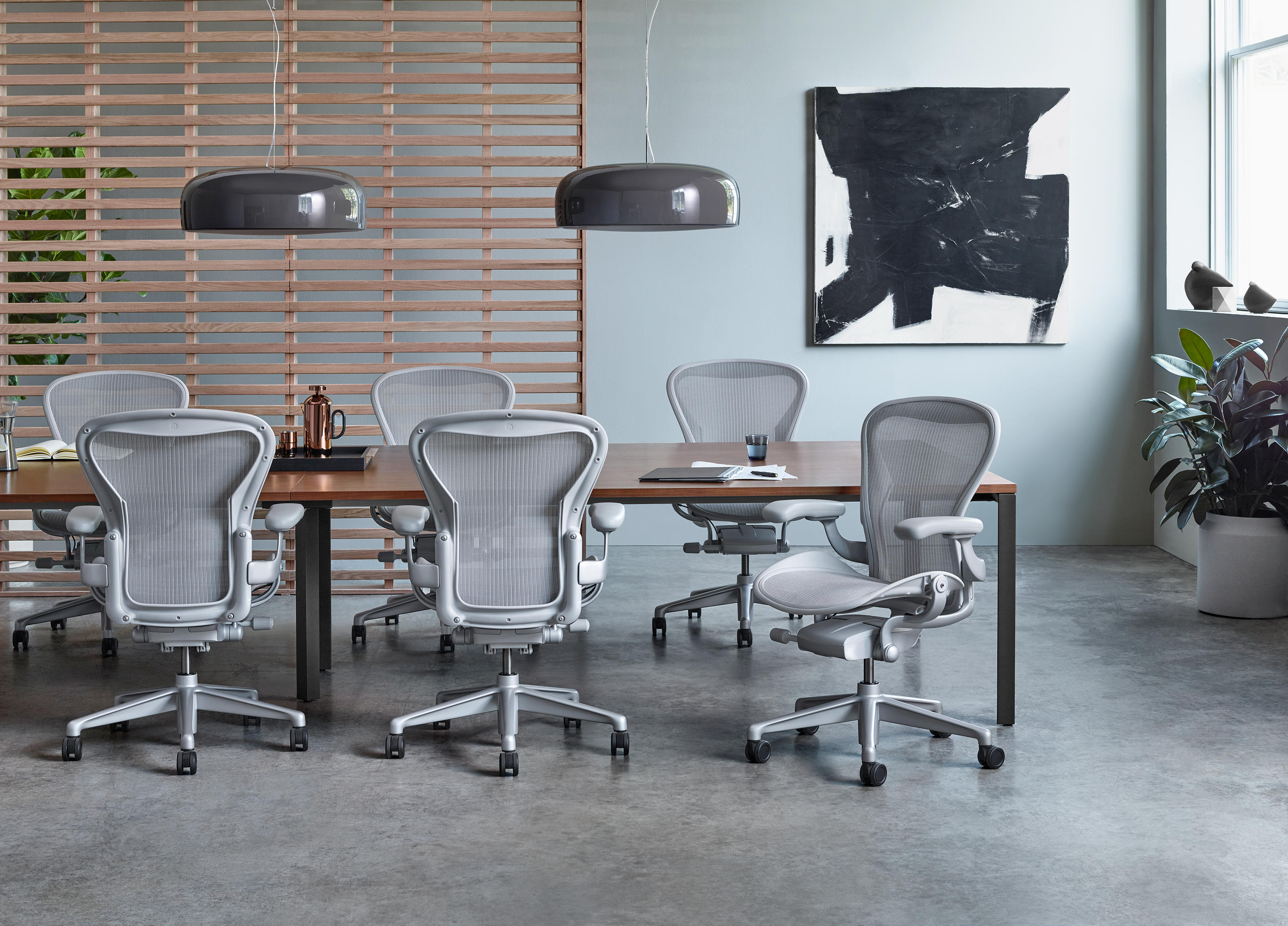
The era’s hinge is the Aeron Chair (1994), Stumpf and Chadwick’s Pellicle-mesh task chair on a glass-fibre-reinforced frame, shipped in three sizes — A, B, C — sized to fifth-percentile female and ninety-fifth-percentile male anthropometrics. It retailed at $1,000, entered MoMA’s permanent collection in 1994 before it reached general retail, and went on to sell over nine million units with a measured failure-and-replacement rate of 0.055 per cent. The full chair-by-chair history is set out in our ergonomic office chair lineage; what matters here is the organisational fact. From 1976 to 2006 Herman Miller’s public identity was a research deliverable. The credited “designers” — Stumpf and Chadwick — were external consultants under multi-year contracts, not staff. There was no design director. There was no head of design. There was a research lab and a portfolio of test outputs, of which the Aeron was the commercial breakout.
Stumpf received the 2006 National Design Award, posthumously, the year he died. By that date the model that had defined Herman Miller for thirty years was already obsolete. The 2003 Mirra had introduced a different design economy.
The collaborator portfolio, 1994–2024: Studio 7.5, Fuseproject, Industrial Facility
The Aeron’s success funded a thirty-year experiment in distributed authorship. Herman Miller, between roughly 1994 and 2024, ran what is best described as a brand-collaborator portfolio: multiple independent design studios under simultaneous contract, each given a product or system, none given the keys to the visual identity. “Herman Miller creative directors” is not the appropriate term for this era. The appropriate term is brief-by-brief commissioning.
The portfolio’s first major outside studio was Berlin’s Studio 7.5, founded in 1992 by Burkhard Schmitz, Carola Zwick, Roland Zwick and Claudia Plikat. Their debut Herman Miller object was the Mirra Chair (2003), a polymer-backed task chair that was Cradle to Cradle Silver-certified at launch — a deliberate environmental answer to Aeron’s heavier construction. Studio 7.5 went on to deliver Setu, Mirra 2, Cosm and Zeph for the same brand across two decades. They became, by tenure, the longest single Herman Miller seating consultancy after Stumpf and Chadwick — without ever holding a title inside the company.
The second was San Francisco’s Fuseproject, founded in 1999 by Yves Béhar (Lausanne 1967, Swiss-American). Béhar delivered the Sayl Chair in 2010 — a frameless task chair whose webbed back was inspired by the suspension cables of the Golden Gate Bridge — and priced it from $399 to widen access to Herman Miller seating, a deliberate move below the Aeron-Mirra band. He then delivered Public Office Landscape in 2013 at NeoCon Chicago: a modular system of social desks, group spaces and in-between settings that read as Herman Miller’s first serious answer to the open-office collaboration brief.
The third was Industrial Facility itself, founded in 2002 in Clerkenwell by Hecht (London-based British industrial designer with stints at IDEO Japan) and Colin (Los Angeles-born architect). Their first Herman Miller delivery was Locale, launched at NeoCon 2013 — the same June as Public Office Landscape — and winning the Silver Award there. Locale was a benching system of cantilevered tables, linear storage spines and wrap-around screens; it sat alongside, not under, Béhar’s Public Office Landscape, and the two systems competed for the same RFPs from the same A&D firms. That is what the era looked like from inside the brand: two external studios with overlapping briefs and no internal arbiter ranking their work.
Add Naoto Fukasawa (Yamanashi, born 1956, founder of Naoto Fukasawa Design in Tokyo in 2003 and a Muji advisory board member since 2002), who delivered task and side seating across the late 2000s, and you have a four-studio rotation operating in parallel without an editor. The model worked commercially because the products were strong individually. It produced, however, no coherent visual position. A Herman Miller catalogue between 2003 and 2020 reads as four houses sharing a logo.
MillerKnoll, 2021: the merger that needed a face
On 19 July 2021, Herman Miller closed its $1.8 billion acquisition of Knoll — announced in April 2021 — and rebranded the combined entity MillerKnoll, listing on the Nasdaq under MLKN. Andi Owen, an American executive who had joined Herman Miller as president and CEO in 2018 after 25 years at Gap Inc., became MillerKnoll’s first president and CEO. The combination put under one holding company two American furniture archives that had spent seventy years answering each other: the Eames-Nelson-Stumpf-Chadwick stack on the Herman Miller side; the Saarinen-Bertoia-Pollock-Florence Knoll stack on the Knoll side, including the Womb Chair (1948), the Tulip Pedestal Group (1956) and, more recently, Generation by Knoll (2009) by Formway Design and Barber Osgerby’s Pilot Chair (2015). The combined back catalogue contained more iconic seating than any other furniture group in the world; the combined front catalogue contained no centralised aesthetic authority for either brand.
The strain showed in the product calendar. MillerKnoll’s June 2026 weeks were dominated by two parallel launches, each handled by a different internal model. The first was the Aeron 2026 update, credited to MillerKnoll’s internal design strategist Joseph White and announced 2 June 2026 ahead of Fulton Market Design Days in Chicago, 8–10 June 2026. It is described, in MillerKnoll’s own copy, as “the boldest update in three decades” to the 1994 Aeron: a generatively-designed aluminium base 1.85 lb lighter, bio-based and recycled nylons cutting estimated embodied carbon by 12 per cent, two new tonal colourways named “Jasper” and “Nightfall”, at a US price of $2,285. Architecturally, that is an internal job. The second was Konzert, Knoll’s new modular wall-to-wall private office system designed by Paolo Dell’Elce (born Pescara 1983, partner at David Chipperfield Architects since 2018) and debuted at Clerkenwell Design Week 19–21 May 2026 — an external commission rooted in Miesian planning logic. One brand under MillerKnoll was activating its portfolio internally; the other was activating externally; no single creative voice connected them.
Owen’s exit was confirmed the same week the Hecht-Colin appointment was announced. She had been at the top of Herman Miller and then MillerKnoll for eight years. The brand portfolio problem she leaves — too many brands, too many studios, no single face — is the problem the new creative directorate has been hired to solve.
Industrial Facility, June 2026: the Herman Miller creative directors named
The 4 June 2026 announcement is the structural moment. Hecht and Colin are the first Herman Miller creative directors in title — not “design director” in the Nelson sense, not “design consultant” in the Stumpf-Chadwick sense, not “external collaborator” in the Studio 7.5 / Fuseproject sense. They take a named creative directorate inside a public, Nasdaq-listed furniture group, while keeping Industrial Facility’s external practice in Clerkenwell.
The pair’s credentials for the role are documented. Locale (2013) is a 13-year-old Herman Miller deliverable, NeoCon-decorated, still in the catalogue. Outside Herman Miller, Industrial Facility’s client list includes Mattiazzi, Muji, Emeco and Santa & Cole; work is held in the permanent collections of MoMA, the V&A and Cooper Hewitt; Colin is a Royal Designer for Industry. The studio’s voice — restrained, plain-spoken, allergic to ornament, comfortable with industrial materials — reads as the closest English-language equivalent in 2026 to what the Eames Office’s voice was in 1956: rigorous, anti-rhetorical, willing to publish a chair that does not look like one. That alignment is presumably what got them the job.
What “creative director” means inside a public furniture company is the open question. The role does not yet have a fixed precedent in the contract-furniture industry. At Knoll, Florence Knoll herself was the closest historical analogue — design lead and co-owner from 1946 until her 1965 retirement, then design director until 1968 — but the title “creative director” was never applied to her in the modern sense. At MillerKnoll’s competitor brands, the role is patchier still: Vitra runs an in-house Design Development team under Rolf Fehlbaum’s family; Steelcase has internal design leadership but no public creative-director credit; Cassina, Cappellini and B&B Italia rely on external “art directors” — Patricia Urquiola at Cassina, Piero Lissoni at Cappellini — rather than centralised creative directors. The closest immediate analogue for what Hecht and Colin will be asked to do is probably Konstantin Grcic’s brief role as art director at Plank, or Jasper Morrison’s quiet long-running editorial position at Vitra and Maharam.
Three working assumptions, based on Industrial Facility’s public statements as filtered through the announcement: that the directorate will edit the active catalogue rather than fill it (Nelson’s model, not Stumpf’s); that it will coordinate the existing collaborator portfolio — Studio 7.5, Fuseproject and others — rather than replace it (an evolution of the 1994–2024 model, not a break from it); and that the visual identity of MillerKnoll itself, distinct from Herman Miller’s, remains an open file. None of those is confirmed in the 4 June text. All of them are what the structural moment is for.
Herman Miller creative directors compared, 1947–2026
| Era | Title | Holder(s) | Tenure | Notable output |
|---|---|---|---|---|
| 1947–1972 | Director of design | George Nelson | 25 years | Marshmallow Sofa (1956), Coconut Chair, Bubble Lamps; recruited Charles and Ray Eames, Isamu Noguchi, Alexander Girard |
| 1946–1978 | External office (contracted) | Eames Office (Charles and Ray Eames) | 32 years contributing | DCW/DCM plywood (1945–46), Fiberglass Armchair (1948–50), Wire-Mesh DKR (1951), Lounge Chair 670 + Ottoman 671 (1956), Aluminum Group (1958) |
| 1972–1994 | (None) — research arm operating | Robert Propst / Herman Miller Research Corp | 22 years | Action Office (1964/1968); ergonomic R&D pipeline |
| 1970–2006 | External consultants | Bill Stumpf and Don Chadwick | 36 years contributing | Ergon (1976), Equa (1984), Aeron (1994); 9M Aerons sold by 2026 |
| 1992– | External studio (contracted) | Studio 7.5 (Schmitz, Zwick, Zwick, Plikat) | 34 years contributing | Mirra (2003), Setu, Mirra 2, Cosm, Zeph |
| 1999– | External studio (contracted) | Fuseproject (Yves Béhar) | 27 years contributing | Sayl (2010), Public Office Landscape (2013) |
| 2002– | External studio (contracted, then in title) | Industrial Facility (Sam Hecht, Kim Colin) | 24 years contributing | Locale (2013); appointed Herman Miller creative directors 4 June 2026 |
| 2018–2026 | President and CEO, MillerKnoll | Andi Owen | 8 years | $1.8B Knoll acquisition (July 2021); MLKN listing; retired 30 June 2026 |
| 2026– | Internal design strategist, MillerKnoll | Joseph White | active | Aeron 2026 update (announced 2 June 2026, $2,285) |
| 2026– | Creative directors, Herman Miller | Sam Hecht and Kim Colin (Industrial Facility) | from 4 June 2026 | First named creative directorate since Nelson |
For 79 years Herman Miller ran without one. The model worked because the people it ran on — Nelson as recruiter, the Eameses as authors, Stumpf and Chadwick as researchers, Studio 7.5 and Fuseproject and Industrial Facility as commissioned studios — were strong enough individually that no editor was needed to make them legible. The 2021 MillerKnoll merger broke that condition. With two American furniture archives under one holding company, with a CEO leaving, with parallel internal and external product activations in the same month, the absence of a single creative voice stopped being a feature and started being a structural risk. Hecht and Colin’s appointment is the company answering that risk with the only model it has ever used successfully: an editor with strong taste, recruiting and ranking the work of stronger studios. The 54-year gap is closed by going back to Nelson’s job description.