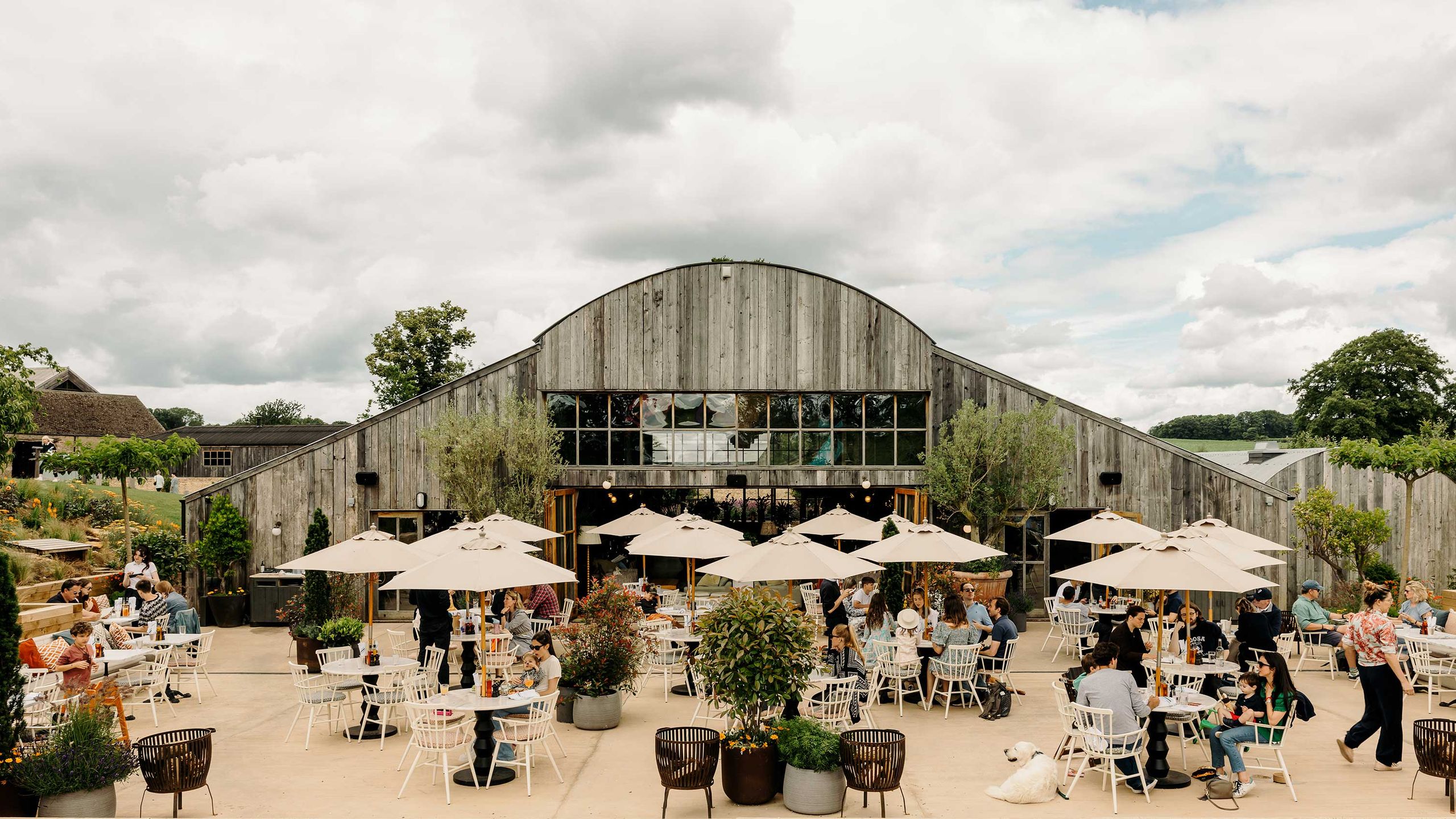
BoF VOICES 2026’s December stage at Soho Farmhouse will host five CEOs whose combined companies posted roughly €130bn in 2024 revenue — and three of them (Luca de Meo at Kering, Michelle Gass at Levi Strauss, Geoffroy van Raemdonck at Saks Global) inherited their seats within the past eighteen months as explicit turnaround leaders. The fifth, Sidney Toledano, handed his executive seat at LVMH Fashion Group to Pietro Beccari on 1 January 2026 and now appears in Oxfordshire as Special Advisor to Bernard Arnault rather than as an operator. The line-up announced for the tenth-anniversary edition of BoF VOICES 2026 — 1–4 December 2026 at Soho Farmhouse in the Oxfordshire countryside — is not a celebration of luxury at altitude. It is a panel of operators hired or repositioned to manage what comes after the 2021–2023 boom.
The thesis underneath the booking choices is visible if you read the five biographies against each other. Three of these CEOs come from outside fashion: de Meo from twenty years of car-industry P&Ls at Fiat, SEAT and Renault, Gass from seventeen years at Starbucks and four at Kohl’s, Crevoiserat from Abercrombie & Fitch and a CFO seat. One, van Raemdonck, has spent his career running US luxury retail from the buying side. Only Toledano represents the classic European maison career arc — École Centrale Paris 1976, Christian Dior Couture for two decades, LVMH Fashion Group for almost eight years on top of that. The other four are management-school CEOs hired to fix specific operating problems at specific brands, in a window where the easy money in handbags and aspirational ready-to-wear has stopped arriving on schedule. BoF VOICES 2026 has, deliberately or not, assembled the post-growth bench.
Luca de Meo: Kering’s outsider, hired to fix Gucci
Luca de Meo became Chief Executive Officer of Kering on 15 September 2025, succeeding François-Henri Pinault as the operating head of the group while Pinault remained chairman. De Meo, born in Milan on 13 June 1967, arrived from five years as Chief Executive Officer of Renault SA, where he ran the post-Carlos Ghosn restructuring from 2020 to 2025. Before Renault, he spent five years as president of SEAT (2015–2020) inside the Volkswagen Group, and before that he ran Fiat’s brand from 2004 to 2009 under Sergio Marchionne. There is no precedent at Kering — or at LVMH, or at Richemont — for installing a CEO whose entire prior P&L experience is in cars. The decision is itself the news.
The reason for the appointment is in the 2024 numbers. Kering reported €17.2bn in group revenue for the 2024 financial year, down 12 per cent on the prior year. Gucci, still the group’s anchor brand, contributed €7.7bn — a sharp drop from its 2022 peak above €10.5bn, and the proximate cause of the share-price collapse that took Kering from a €100bn-plus market capitalisation in 2021 to something closer to a third of that by mid-2025. Saint Laurent delivered €2.9bn, Bottega Veneta €1.71bn. None of those three houses is in immediate trouble; all three are in a co-ordinated soft patch that requires a CEO comfortable with the management of decline before recovery rather than the management of growth. De Meo’s Renault tenure was exactly that, and Pinault’s pitch to the board was reportedly built around that parallel.
The brand-management question de Meo inherits is whether Gucci’s repositioning under a new creative direction — and the chronic underperformance of the wholesale and aspirational price points that drove its 2018–2022 run — can be solved by industrial discipline imported from Renault. This is contested territory inside the luxury industry, and it sits alongside the wider brand management firms luxury pivot that has reshaped the mid-market through Authentic, WHP and Bluestar. De Meo’s first public outings as Kering CEO — at the Salone del Mobile sidelines in April 2026 and now BoF VOICES 2026 in December — are being read as the first serious statements of how he intends to communicate the strategy externally. He has not, as of June 2026, published a strategic plan.
Sidney Toledano: LVMH’s institutional memory, now as advisor
Sidney Toledano belongs to a different generation and a different theory of luxury management. Born in Casablanca on 25 July 1951, he graduated from École Centrale Paris in 1976 and joined Christian Dior in 1994 as managing director of the couture house. He became Chief Executive Officer of Christian Dior Couture in 1998 and held that seat for twenty years, growing the maison from a €200m business into something closer to €2.5bn before handing over to Pietro Beccari in February 2018. He then took the chairmanship of LVMH Fashion Group, an internal LVMH division that gathers the smaller and structurally riskier fashion maisons — Loewe, Celine, Givenchy, Kenzo, Marc Jacobs, Berluti, Patou and Rimowa — under one operating umbrella. He held that role from February 2018 until 1 January 2026, when Beccari again succeeded him.
The Toledano-to-Beccari sequence is now the most important succession pattern inside LVMH. Beccari has effectively followed Toledano twice — at Christian Dior Couture in 2018 and at LVMH Fashion Group in January 2026 — and the move clears Toledano into the role of Special Advisor to Bernard Arnault, an unstructured but real position from which he sits on boards, mentors maison CEOs and represents the group externally. His BoF VOICES 2026 appearance is the first major public outing in that new posture. He is no longer running anything, and the booking is an explicit choice to put institutional memory on the stage rather than current operators. Within the group, his tenure at LVMH Fashion Group oversaw the Loewe creative direction transition and the rebuild of LVMH leather goods design, both of which continue to define how the smaller maisons are positioned.
The financial scale Toledano represents on the panel is hard to overstate. LVMH’s Fashion & Leather Goods segment posted roughly €41bn in 2024 within group revenue of €84.7bn, meaning the F&LG division alone is larger than all of Kering, Hermès below Birkin scale, or any single American luxury group. The strategic question Toledano will be expected to address — what does post-growth luxury actually look like when measured from the top of the world’s biggest F&LG portfolio — has no comparable interlocutor on the BoF VOICES 2026 stage. He is the only panellist who has operated through three full luxury cycles (the late-1990s reorganisation, the 2008–2009 contraction, the post-2020 boom-and-cool) inside the same group.
Michelle Gass: Levi’s transition CEO, imported from Kohl’s and Starbucks
Michelle Gass took the Chief Executive Officer seat at Levi Strauss & Co. in January 2024, having joined the company as president in 2023 specifically to inherit the role from Chip Bergh after a year of handover. The structure of her appointment matters: Levi’s board did not run an external search and parachute her in. They imported her at president level, gave her twelve months inside the company, and then handed her the CEO title on a planned date. The mechanism is closer to a Japanese keiretsu succession than to a typical American CEO hire, and it tells you how much the board wanted to avoid the missteps that have characterised CEO transitions at peer denim and apparel brands over the previous decade.
Gass came from Kohl’s, where she was Chief Executive Officer from May 2018 to December 2022. Before Kohl’s she spent roughly seventeen years at Starbucks, ending as president of Starbucks EMEA. Neither of those tours involved luxury or apparel manufacturing at any meaningful level. What they did involve was the operating discipline of mass-market retail under cost pressure — Starbucks during the 2008–2009 crisis and the 2014–2018 China expansion, Kohl’s during the Amazon-driven flattening of US mid-tier department stores. Levi’s, with $6.3bn in FY2025 revenue (up 4 per cent on the prior year), sits at a comparable structural point. The brand is healthy at premium denim price points, less healthy at the bottom of its range, and exposed to wholesale concentration. The hiring brief was visibly to bring in someone who had run a comparable shape of business at scale.
The BoF VOICES 2026 booking of Gass alongside the European luxury CEOs is its own argument. Levi’s is not a luxury brand by any meaningful definition — average price points sit one to two orders of magnitude below Saint Laurent ready-to-wear — but the company sells globally recognisable design IP and now competes for the same shelf space, in the same multi-brand retailers, as the upper end of the contemporary market. The convergence of “premium denim”, “luxury casualwear” and “designer collaboration” between roughly 2019 and 2026 has put Levi’s in the same conference programme as Kering for the first time since the early 2000s. Gass’s panel is one of the markers that BoF, as a publication, is taking that convergence seriously.
Joanne Crevoiserat: Tapestry’s CFO-turned-CEO, the steady operator
Joanne Crevoiserat became Chief Executive Officer of Tapestry in October 2020, having served as interim CEO from July of that year after Jide Zeitlin’s departure. She had joined Tapestry as Chief Financial Officer in August 2019, which means her ascent to the top seat took fourteen months — fast even by American consumer-company standards, and faster still given that she had no prior CEO experience at a public company. Before Tapestry she was Chief Operating Officer of Abercrombie & Fitch from 2017 to 2019, after a long tour at Kohl’s that overlapped, briefly, with Gass’s. She was named to the TIME 100 list in 2024, the only one of the five BoF VOICES 2026 CEOs to have received that recognition.
The numbers under Crevoiserat are strong and getting stronger. Tapestry posted $7.01bn in FY2025 revenue, up 5 per cent on the prior year, split as Coach $5.6bn, Kate Spade $1.20bn and Stuart Weitzman $215m. Coach has become the single most consistent growth brand in the US accessible-luxury segment under her tenure, with operating margin holding above the mid-twenties and a successful repositioning toward Gen Z handbag customers via the Coachtopia sub-line and the Tabby reissue. Kate Spade has been more uneven — the brand reset announced in late 2024 has not yet shown clean results in the wholesale channel — and Stuart Weitzman remains a structurally small contributor. The group was renamed from Coach Inc. to Tapestry in October 2017 specifically to signal a multi-brand identity, and seven years in, the question Crevoiserat will be asked in Oxfordshire is whether the multi-brand thesis has actually paid off or whether Coach is now carrying the holding company.
The strategic posture Crevoiserat represents — operationally disciplined, brand-by-brand cost control, a CFO’s view of capital allocation — is the closest thing on the BoF VOICES 2026 panel to a control case for what European luxury could look like if it were managed by Americans. Kering under de Meo, in particular, has been compared to a Coach Inc.-style turnaround in the trade press, even though the brand mix and price points differ sharply. The shared lineage with Kohl’s between Crevoiserat and Gass is a quiet but real signal of where American apparel and accessories CEOs are now being trained. Neither came up through the brand side; both came up through stores and P&L.
Geoffroy van Raemdonck: Saks Global’s Chapter 11 operator
Geoffroy van Raemdonck became Chief Executive Officer of Saks Global on 14 January 2026 — the same day the company filed for Chapter 11 bankruptcy protection in the Southern District of New York. The simultaneity is the story. Hudson’s Bay Company completed the $2.7bn acquisition of Neiman Marcus Group from Ares Management and CPP Investments in December 2024, folding it together with Saks Fifth Avenue, Saks Off 5th and the legacy HBC retail estate into the new holding company called Saks Global. The integration ran from January through December 2025 and produced, by the trade reporting of late Q4, an operating structure too leveraged for the available trade-creditor base. The Chapter 11 filing in January 2026 was the engineered outcome.
Van Raemdonck’s biography for the role is precise. He was Chief Executive Officer of Neiman Marcus Group from February 2018 through the December 2024 merger close, meaning he ran NMG through its own 2020 Chapter 11 (filed May 2020, emerged September 2020), the post-pandemic luxury boom, and the protracted sale process that ended with the HBC acquisition. Before Neiman Marcus he was Group President EMEA at Ralph Lauren from 2014 to 2017, Chief Executive Officer of St. John Knits in 2013, and held senior international roles at Louis Vuitton from 2008 to 2013 — including running the maison’s Mexico and South America business. He started his career at Boston Consulting Group, where he spent eight years from 1998 to 2006. He is the only one of the five BoF VOICES 2026 CEOs to have run a US luxury retailer through Chapter 11, and now he is doing it for the second time.
The substance of his Oxfordshire appearance will be unavoidable. Saks Global’s vendor base — including Kering, LVMH and a long tail of independent designers — has spent the first half of 2026 in active negotiation over unpaid receivables from 2024 and 2025. Both Kering and LVMH publicly disclosed Saks Global exposures in their Q1 2026 reporting. De Meo and van Raemdonck on the same stage in December 2026 is, in commercial reality, two sides of an active workout meeting played in front of a paying audience. BoF VOICES 2026 booked them deliberately. The conference has historically used the panel format to surface conversations the trade press cannot host without losing access, and the de Meo–van Raemdonck pairing is the clearest example on this year’s programme.
The five CEOs at a glance
The comparison table below is the structural argument of the line-up: five CEOs, three brand-new in seat, two coming from outside the apparel industry entirely, only one with a classic European maison career arc, and combined company revenues — Kering, LVMH, Levi Strauss, Tapestry and Saks Global — that sum to roughly €130bn at 2024–2025 exchange rates.
| CEO | Company | In post since | Previous role | Company FY revenue |
|---|---|---|---|---|
| Luca de Meo | Kering | 15 September 2025 | Chief Executive Officer, Renault SA (2020–2025) | €17.2bn (2024) |
| Sidney Toledano | LVMH (Special Advisor) | 1 January 2026 (advisor); CEO LVMH Fashion Group Feb 2018 – Jan 2026 | Chief Executive Officer, Christian Dior Couture (1998–2018) | €84.7bn group / €41bn F&LG (2024) |
| Michelle Gass | Levi Strauss & Co. | January 2024 | Chief Executive Officer, Kohl’s Corporation (2018–2022) | $6.3bn (FY2025) |
| Joanne Crevoiserat | Tapestry, Inc. | October 2020 | Chief Operating Officer, Abercrombie & Fitch (2017–2019) | $7.01bn (FY2025) |
| Geoffroy van Raemdonck | Saks Global | 14 January 2026 | Chief Executive Officer, Neiman Marcus Group (2018–2024) | Private; HBC paid $2.7bn for NMG in Dec 2024 |
Three of the five — de Meo, Toledano in his new advisor posture, van Raemdonck — took their current positions inside the eight months between 15 September 2025 and 14 January 2026. The clustering is not a coincidence; it tracks the same downcycle. Kering’s revenue contraction, LVMH’s planned succession at Fashion Group, and the Saks Global Chapter 11 filing are three responses to the same post-2023 cooling in luxury demand, executed by three groups with very different balance sheets and very different shareholder bases.
What the line-up says about post-growth luxury
The BoF VOICES 2026 CEO panel reads, taken whole, as a statement that the industry has moved from a growth conversation to an operations conversation. None of the five was hired or repositioned to launch new categories, open new geographies or acquire new brands. De Meo was brought in to make Kering work at its existing size; van Raemdonck was put on Saks Global to run a Chapter 11 restructuring; Gass was lined up at Levi’s to manage the cost base of a stable but slow-growing core; Crevoiserat has been running Tapestry as a margin story rather than a top-line story since 2020; Toledano is no longer running anything operationally. Four of the five appearances are about discipline. The fifth is about institutional memory.
The career-path data underneath that is more interesting still. Two of the five (de Meo, Gass) came from outside fashion. Two (Crevoiserat, Gass) overlap on Kohl’s as a training ground for American apparel-and-accessories CEOs. Two (van Raemdonck, Toledano) have run businesses through luxury downturns before — Toledano through 2008–2009 at Christian Dior Couture, van Raemdonck through 2020 at Neiman Marcus. The European maison career arc — twenty years inside a single house, an École Centrale or HEC degree at the entry, a managing-director seat in the late 1990s — exists, at the BoF VOICES 2026 level, in exactly one biography. Sidney Toledano is the last of his cohort. There is no obvious successor model behind him at LVMH or Kering, because Beccari is six years younger but in the same template, and de Meo is the explicit alternative.
A reasonable read of the booking decision is that BoF is calling the end of the 2010s luxury management consensus. That consensus held that European maisons should be run by their own institutional graduates, that American department stores were a permanent distribution layer, and that mass-premium brands like Levi’s and Coach belonged in a different conversation from Saint Laurent or Christian Dior. None of those three propositions survives the 2024–2026 numbers as currently reported. Kering hired a car CEO; the largest US luxury department-store group filed Chapter 11 on the day its CEO arrived; Tapestry’s accessible-luxury business posted operating margin and growth metrics that several European houses would now happily trade for. The five seats on the BoF VOICES 2026 stage in December at Soho Farmhouse have been booked to reflect that re-ordering, not to disguise it. Whether the panel itself confirms or complicates the reading is the question the tenth-anniversary edition has set for itself, and the audience that arrives in Oxfordshire on the first of December 2026 will be the one to answer it.