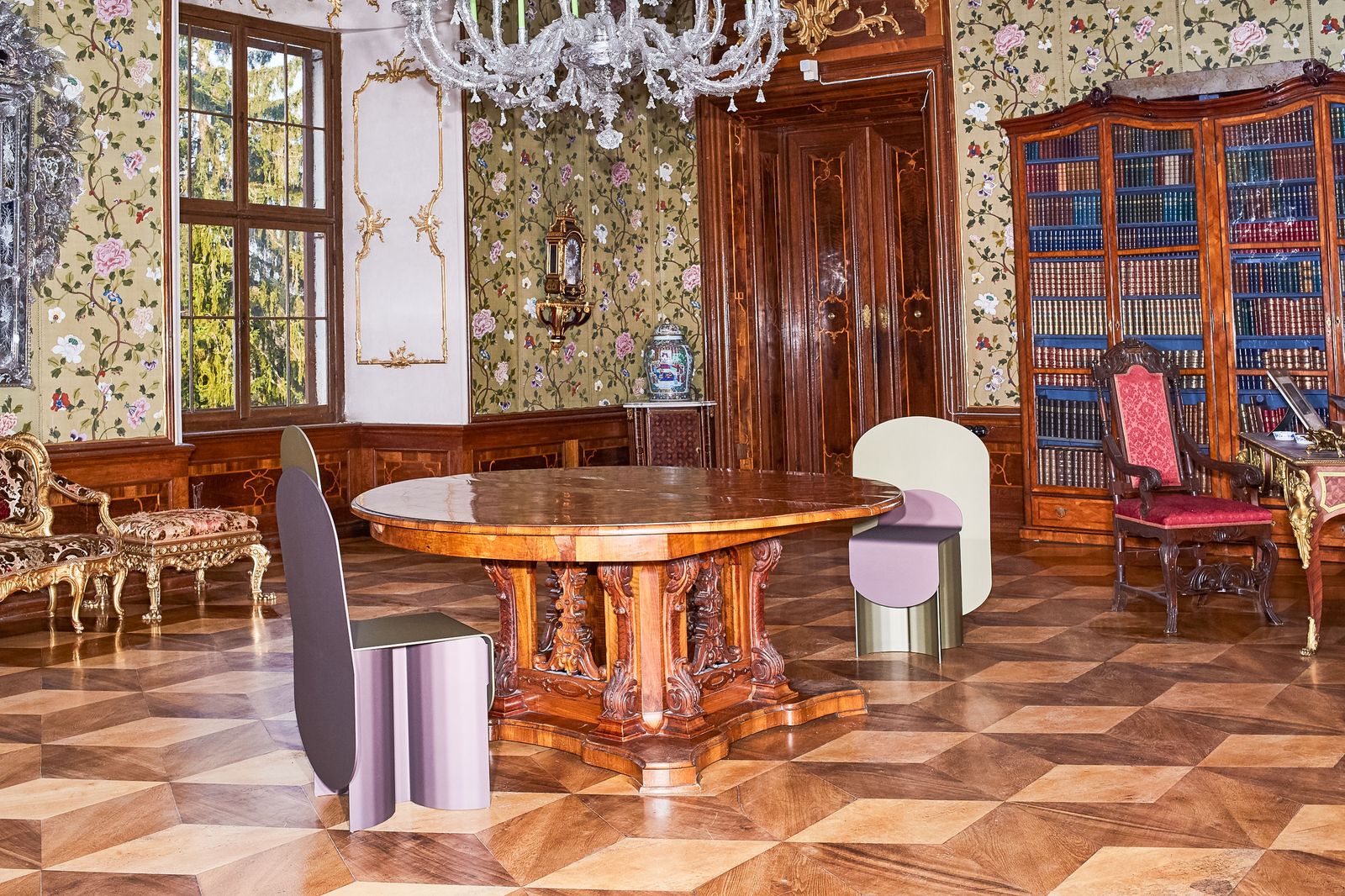
Element: Metal at Schloss Hollenegg closes a five-edition castle programme that has, since 2016, turned a 12th-century Styrian fortress into the most material-specific design exhibition outside the museum circuit. The schloss hollenegg metal show runs until 31 May 2026 in a building first documented in 1163, owned by the Liechtenstein family since 1821, and curated by Alice Stori Liechtenstein with works by Max Lamb, Philippe Malouin, Sabine Marcelis and a cast of roughly a dozen others. It is the last in a sequence that has cycled through the classical elements one material at a time. To close on metal - and on extruded aluminium in particular - is a choice with its own logic, and the choice deserves to be read carefully.
The five-element brief, and why metal closes it
Stori Liechtenstein, Milan-born in 1978, trained at IED Milan and Elisava in Barcelona, moved to Austria in 2004 after marrying into the family that has held Schloss Hollenegg for two centuries, and started a designer residency at the castle in 2015. The exhibition programme - Schloss Hollenegg for Design - launched the following year. The Element series ran across the back half of the programme’s first decade: a single classical material per edition, each one staged inside the 52-room schloss with its baroque additions, its Gothic stair, and its Renaissance courtyard intact. Metal is the closer. Stori Liechtenstein’s framing for the brief is blunt: “Metals are the building blocks of our planet and literally hold our world together.” It is not a metaphor she stretches. The show is loaded with works that take the sentence at face value - structural extrusions, lost-wax casts, welded vessels, mild-steel forgings.
The choice of metal as the closing material does two things at once. It rhymes with the castle - a building whose roof structure, locks, hinges, weapons rack, and balustrade fasteners are all metal artefacts older than most European nation states - and it puts the programme into direct contact with industrial design’s most production-scale material. The five-part series has, by ending on metal, refused to stay inside the craft register that castle programmes typically default to. The Hydro-supplied extruded-aluminium thread running through three of the headline pieces is the clearest signal: this is not a show about hammered copper bowls.
The schloss hollenegg metal cohort, designer by designer
Three names anchor the cohort, and each has been given a Hydro-supplied extruded-aluminium brief to work against. Max Lamb (British, b. 1980) contributes Prove, a light built from extruded-aluminium profiles. Lamb’s catalogue has long been a study in materials taken at face value - the polystyrene chairs cast in pewter and bronze, the Marmoreal terrazzo work, the Crockery series - and an extrusion brief sits inside that lineage cleanly. An aluminium extrusion is a profile pulled through a die at length; everything that matters about the object is decided in the die geometry. Prove reads as Lamb’s interrogation of exactly that constraint.
Philippe Malouin (Canadian, London-based since 2008) contributes T-Board, a modular shelving system also built from extruded aluminium. The piece extends a strand of Malouin’s work - the rigorous, repeat-unit furniture for Established & Sons, Hem, Zanotta and SCP - into a different production language. Extrusion lets a single profile become a structural component repeatable to any length; T-Board uses that property to make a shelf that can be lengthened without altering its parts. The discipline of the piece is in the die.
Sabine Marcelis (Dutch, b. 1985 in Alkmaar, raised in New Zealand, Design Academy Eindhoven 2011) contributes Orbit, a pendant light, again in extruded aluminium with Hydro. Marcelis’s Rotterdam studio is known principally for cast resin and stone - the Candy Cubes, the No Fear of Glass work for Mies’s Barcelona Pavilion, the stone furniture for Nilufar - so extruded aluminium is a step sideways into a less familiar process. Orbit reads as the most light-led of the three; where Lamb and Malouin treat the extrusion as a structural member, Marcelis lets it carry illumination.
Together the three pieces are a small thesis: extruded aluminium is a material with a die-defined section and an arbitrary length, and three British, Canadian and Dutch designers asked to work the same constraint produce a light, a shelf and a light. That the two lights differ - Lamb’s structural, Marcelis’s luminous - is the productive part of the rhyme.
Junko Mori, Ildar Wafin and the craft register
Outside the Hydro-extrusion thread, the cohort widens fast. Junko Mori contributes work in mild steel and cast silver, two metals at opposite ends of the price and density spectrum but united in her catalogue by an additive, multi-piece-forging approach. Mori’s mild-steel pieces have for years been about repetition under heat - single forged elements multiplied into organic-looking masses - and the cast-silver counterpart introduces a lost-wax dimension to the same logic.
Ildar Wafin contributes a set of bells in 925 sterling silver, cast lost-wax. The brief sits cleanly inside one of metal’s oldest production languages - bells are arguably the earliest objects designed for acoustic tuning - and reading them inside a Styrian castle, where bell-towers and chapel bells would have shaped the daily rhythm for centuries, gives them a venue-specific resonance the schloss does not need to underline.
These two contributions are the cohort’s clearest counterweight to the Hydro thread. Where Lamb, Malouin and Marcelis work the industrial extrusion register, Mori and Wafin work the casting and forging register that predates the industrial revolution by millennia. The schloss is large enough to hold both without either feeling like a token.
Elliott Hundley’s Scythian pendant and Polyxena mirror
Elliott Hundley contributes two pieces, both with named referents. The Scythian pendant draws on the metalwork of the Iron Age horse-nomad culture whose gold and bronze plaques are now in the Hermitage and the British Museum; the Polyxena mirror takes its name from the Trojan princess sacrificed at Achilles’s tomb. Mirrors and pendants are the two oldest categories of personal metalwork - decorative metal worn on the body and reflective metal held in the hand - and Hundley’s titling positions the pieces inside that long history without being coy about it.
What is interesting about the inclusion is the register shift. Hundley is best known as a Los Angeles-based artist whose collage work folds found imagery, pinned to foam, into densely layered tableaux. Metal is not his default register. His presence in the cohort suggests that Stori Liechtenstein has read metal as a material that opens onto narrative as much as production, and that the schloss is willing to host work that comes at the brief from an art-side rather than a design-side starting point.
Hannah Kuhlmann, Soft Baroque and the wall-mounted register
Hannah Kuhlmann’s contribution is a stainless-steel wall lamp with a baroque pearl switch. The detail - a single freshwater pearl serving as the on-off mechanism - is the show in miniature: an industrial metal (stainless steel, a 20th-century alloy that did not exist in commercial form until 1913) interrupted by a baroque ornament that the castle has carried in its decorative language for four centuries. The switch is the joke and the thesis at once.
Soft Baroque - the London studio of Saša Štucin and Nicholas Gardner - contributes a wall piece in cut and heat-formed aluminium. The studio’s practice has, since its founding, mined the gap between the historical decorative language its name invokes and the industrial materials it actually uses; an aluminium wall piece that has been cut and heat-formed sits inside that practice cleanly. Heat-forming aluminium - working the sheet at a temperature below its melting point but high enough to let it take a curve - is a process that sits between sheet-metal fabrication and ceramic slumping, and Soft Baroque has long enjoyed exactly that kind of register-crossing technique.
Both pieces share a wall-mounted format that the schloss’s stone and panelled walls accommodate without needing plinths. The exhibition is staged in occupied rooms - the schloss is a working house, not a white cube - and wall-mounted works are a practical answer to that constraint as much as a compositional one.
Mantas Lesauskas, Anna Zimmermann and the object register
Mantas Lesauskas contributes an aluminium chess set. Chess sets are a recurring category in design exhibitions for the same reason they were a recurring category in 1960s Italian design - the brief is fixed (sixteen pieces a side, six piece types, two colours), and the variation is entirely in the formal language. An aluminium chess set takes the brief into a material that is unusual for the category; most chess sets are wood, stone, plastic or cast metal, but extrusion or machining aluminium for the pieces is rare. The choice frames the set as a study of the material as much as the game.
Anna Zimmermann contributes welded aluminium vases. Welding aluminium is not trivial - the metal’s oxide layer melts at a much higher temperature than the metal beneath it, which makes the weld pool unpredictable - and TIG-welding aluminium for vessel work is a technique that announces itself in the seam. Zimmermann’s vases use that fact rather than hiding it.
These two contributions, along with Soft Baroque’s wall piece and Kuhlmann’s wall lamp, set the cohort’s middle register: objects that are neither the headline industrial-extrusion pieces nor the historical-casting pieces, but discrete metal artefacts working at a domestic scale. The schloss can absorb them into its rooms without curatorial scaffolding.
The Vienna students: Liebl, Riener, Zerbini
Three University of Applied Arts Vienna students round the cohort out. Lea Liebl contributes a cyanotype on aluminium. Cyanotype - the photographic process patented by John Herschel in 1842, which produces a Prussian-blue image from iron-salt chemistry - is normally a process executed on paper or cotton. Executing it on aluminium requires a coating or an adhesion layer that lets the iron salts bond to the metal substrate. The piece is a quiet demonstration that the cohort’s brief was open enough to accommodate photographic chemistry as a metal technique.
Elena Riener contributes cast-aluminium cigarette butts. The object is a sand-cast or lost-wax replica of a discarded object that everyone in the cohort’s likely audience will recognise; the choice to cast it in aluminium - a metal that has aviation, beverage-packaging and architectural associations - rather than bronze (the default for the cast-found-object genre since Jasper Johns’s Painted Bronze of 1960) is the piece’s argument.
Lorenzo Zerbini contributes a mobile of copper-cast sequoia needles. Copper is the cohort’s third metal - alongside aluminium and steel - and the sequoia-needle source is its clearest gesture toward the natural-systems framing the brief invokes.
The student inclusions matter for the programme’s positioning. Schloss Hollenegg for Design has run a residency since 2015, and the presence of student work in the closing edition of the flagship series signals that the residency-and-exhibition relationship is structural rather than decorative.
The Hydro extrusion thread, read as a producer brief
The decision to commission three headline pieces from a single industrial partner - Hydro, the Norwegian-headquartered aluminium producer - is the cohort’s most consequential production choice. Hydro’s extrusion business is large enough to supply structural sections for facades, automotive frames and rail systems; supplying three designers with a brief to produce a light, a shelf and a light is, for Hydro, a marketing-budget exercise more than a production stretch. For the schloss, the partnership underwrites a level of finish on three of the show’s headline pieces that would otherwise be hard to reach.
What the three Hydro pieces have in common, beyond the material and the producer, is the die. Extrusion is a process whose creative work happens at the die-design stage; once the die is cut, every metre of profile pulled through it is identical. Lamb, Malouin and Marcelis each had to commit to a single section before fabrication began, and the section then governs everything about the finished piece. The brief is therefore a brief in die design as much as in product design.
Reading the three pieces against each other, the section-led discipline is visible. Lamb’s Prove uses the extrusion as the light’s structure. Malouin’s T-Board uses the extrusion as the shelf’s repeating member. Marcelis’s Orbit uses the extrusion as the housing for the light source. Three uses of the same material constraint, three pieces of different typology, one partner. That is what a Hydro brief, executed well, looks like.
Designer | Piece | Material technique | Producer | Form
| Designer | Piece | Material technique | Producer | Form |
|---|---|---|---|---|
| Max Lamb | Prove | Extruded aluminium | Hydro | Light |
| Philippe Malouin | T-Board | Extruded aluminium | Hydro | Modular shelving |
| Sabine Marcelis | Orbit | Extruded aluminium | Hydro | Pendant light |
| Junko Mori | (untitled) | Mild steel forging, cast silver | Self-produced | Sculptural object |
| Ildar Wafin | (bells) | 925 sterling silver, lost-wax cast | Self-produced | Bells |
| Hannah Kuhlmann | (wall lamp) | Stainless steel with baroque pearl switch | Self-produced | Wall lamp |
| Mantas Lesauskas | (chess set) | Aluminium | Self-produced | Chess set |
| Soft Baroque | (wall piece) | Cut and heat-formed aluminium | Self-produced | Wall piece |
| Anna Zimmermann | (vases) | Welded aluminium | Self-produced | Vases |
| Elliott Hundley | Scythian pendant; Polyxena mirror | Pendant and mirror | Self-produced | Wearable / hand object |
| Lea Liebl | (cyanotype) | Cyanotype on aluminium | Student work | Photographic object |
| Elena Riener | (cigarette butts) | Cast aluminium | Student work | Cast found object |
| Lorenzo Zerbini | (mobile) | Copper-cast sequoia needles | Student work | Kinetic mobile |
The castle as exhibition logic
Schloss Hollenegg’s exhibitions are not staged in a white cube. The castle has 52 rooms, the oldest parts of which date to a building first documented in 1163, with the bulk of the standing fabric from Renaissance and baroque expansions, and the Liechtenstein family has occupied the building since 1821. The decorative programme - the stuccowork, the panelling, the painted ceilings, the chimneypieces - is in place when the design works arrive. The exhibition is therefore a question of negotiation, not installation: how do contemporary metal works sit alongside four centuries of metalwork already in the rooms?
The negotiation has been an explicit part of the schloss’s programme since 2016. Visitors move through occupied rooms, the works are placed against decorative backgrounds that are themselves period objects, and the resulting reading is comparative rather than isolated. A Junko Mori mild-steel piece set against a baroque chimneypiece reads differently to the same piece on a museum plinth; the chimneypiece does some of the framing work. The schloss is in this sense a context machine.
Element: Metal exploits the machine particularly well because the castle’s existing metalwork - locks, hinges, candelabra, fire-irons, weaponry, balustrade fixings - is already part of the visual field. Lamb’s extruded-aluminium light enters a room where the cast-iron grate, the wrought-iron firedog and the bronze candlesticks are all metal objects of an earlier moment. The new piece reads as the most recent layer in a continuous metalwork conversation rather than as a foreign body. That is a curatorial advantage no purpose-built gallery can replicate.
What it means to close the series
Five editions, one material each, staged across roughly a decade. The series structure has given Schloss Hollenegg for Design a discipline that distinguishes it from the design-week and gallery model that dominates the field. Where a Milan Design Week installation is a one-week event with a publication afterwards, a Hollenegg Element edition is a six-month exhibition with a residency feeding it and a successor edition already in mind. The cumulative effect, viewed at the closing point, is a set of five linked material studies that the programme can now point back to.
Closing on metal is a choice that recognises where contemporary design’s production language sits. Aluminium extrusion, stainless-steel sheet, cast silver and welded steel are the materials that contemporary product design actually uses at scale, and a closing edition that puts them at the centre of a castle programme is, in effect, a claim that craft and industry are not separable. The Hydro thread makes that claim with the most force; the Mori and Wafin contributions make the same claim from the craft side; the Vienna student work shows that the next generation has already absorbed it.
What the series does not do is announce a successor. Stori Liechtenstein has not, as of the May 2026 closing, signalled what follows Element. The programme’s residency continues - it has run since 2015 and is not tied to the Element framing - and the schloss is not going dark. But the five-part series has, on 31 May 2026, ended.
A coda on metal and the castle
The show benefits from being read against its venue. A castle is, among other things, a metal artefact: the building was made functional by hinges, locks, fasteners, gutters, weather vanes and weaponry that have outlived most of its organic components. To stage a metal exhibition inside such a building is to put new metal next to old metal and let the visitor do the comparative reading. The new metal includes Lamb’s Hydro-extruded light, Malouin’s extruded shelving, Marcelis’s extruded pendant, Mori’s mild-steel forgings, Wafin’s sterling-silver bells, Kuhlmann’s stainless-steel wall lamp, Soft Baroque’s cut-and-heat-formed wall piece, Zimmermann’s welded vases, Lesauskas’s chess set, two named Hundley pieces, and the three Vienna student works. That range is the point. Metal is not one thing. It is alloys, processes, scales and histories that the cohort takes apart and lays out across the schloss’s rooms one piece at a time. The series ends on a material that refuses to be reduced. That is the right way for it to end.