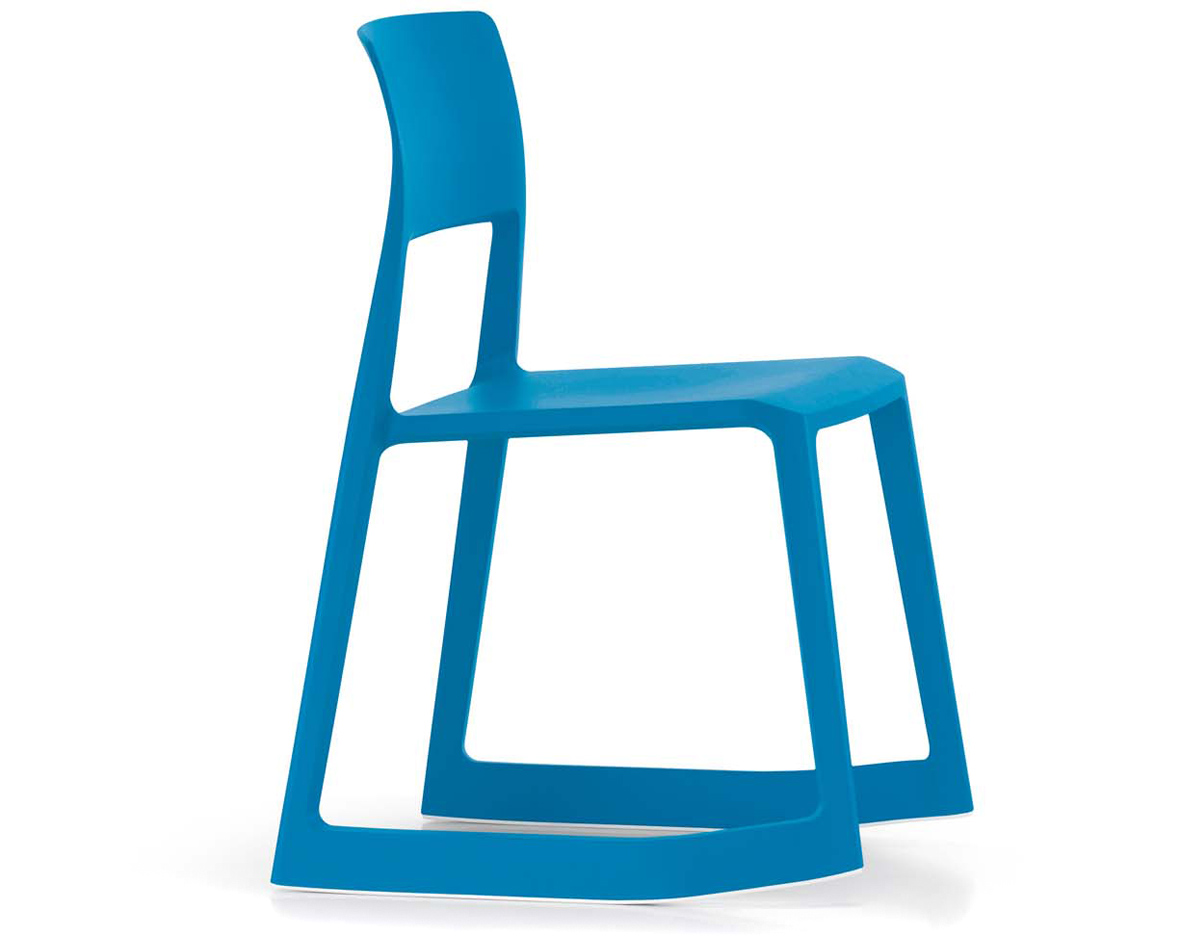
Barber Osgerby designs span thirty years and ten manufacturers, and on 20 May 2026 Edward Barber and Jay Osgerby confirmed in interviews to mark the closure of their London studio that the catalogue is now closed. The partnership that began in 1996 with a bent-plywood low table for Isokon Plus ends in the same week that their Triennale Milano retrospective, Alphabet, comes down — a roster that runs through the Loop Table, the Tab Light for Flos, the Iris Table for Established & Sons, the Tip Ton chair for Vitra, and the London 2012 Olympic Torch. The Barber Osgerby designs that defined the last three decades of British industrial design are not being withdrawn; the practice is. The majority of the pieces shown at the Triennale remain in production, which is the answer to most of the questions readers will ask first.
What follows is a chronological accounting of every Barber Osgerby project attested in the FORMA graph, with manufacturer, year and material, plus a reading of what the studio’s 2026 closure actually means for the firms — Vitra, Flos, Emeco, Established & Sons, Isokon Plus, Dedon — that built a generation of products around two designers who shared a single voice. The thesis is simple, and worth stating up front: Barber Osgerby did not invent a style. They built a methodology — RCA architecture training translated into industrial scale — and then they spent thirty years applying it to the manufacturers most willing to be patient about it.
The Royal College, 1994: where it actually started
Edward Barber (b. 1969, Shrewsbury) and Jay Osgerby (b. 1969, Oxford) met on the MA Architecture programme at the Royal College of Art in 1994. Neither qualified as a registered architect. They worked, almost from the beginning, in the territory where architecture training becomes furniture practice — a lineage that runs from the mid-century figures the RCA still teaches through to a generation of British designers whose first commissions came not from furniture fairs but from architects who needed objects at scale.
The partnership formalised as Barber Osgerby in 1996, in a London studio that grew, eventually, to encompass two sister practices: Universal Design Studio (founded 2001, for spatial and interior work) and Map Project Office (founded 2012, for product strategy and industrial design consultancy). The two sister offices were always positioned as the load-bearing commercial walls of the operation. Barber Osgerby itself, the name on the door, was reserved for the work the principals signed personally — the chairs, lights, tables and the occasional ceremonial object.
That distinction matters now. When Edward Barber and Jay Osgerby announced on 20 May 2026 that they were closing the eponymous studio, the closure applied to the signed work. The sister practices and their staff are part of a longer ongoing story that the two principals declined, in interviews this week, to map out in detail. Osgerby’s line — “the thing about us is that we’re unpredictable” — was less coy than accurate. The pair are leaving the studio open-ended on purpose.
Loop Table, 1997: the first commercial piece
The Loop Table for Isokon Plus, designed in 1996 and put into production in 1997, is where Barber Osgerby designs begin as a public record. The piece is a low table in bent plywood, manufactured at Isokon’s Hackney workshop, and it is the kind of debut that frames the entire arc of what follows: an architectural object — geometry first, decoration absent — made in a material with a clear British modernist lineage (Isokon, Marcel Breuer, the long plywood history of the company Jack Pritchard founded in 1931).
Two facts about the Loop Table are worth holding on to. First, it was picked up almost immediately by Cappellini for international distribution, which gave a barely-formed two-person studio access to a Continental retailer with a global press footprint. Second, it remains in the Isokon Plus catalogue today, which is to say that the first commercial Barber Osgerby design has now been in continuous production for 29 years. Most studios would consider that a career.
The architectural reading of the Loop Table — a bent-plywood ribbon describing a closed circuit, no exposed joinery, no decoration — set the grammar. Look at the Iris Table for Established & Sons a decade later, or the Mariposa Sofa for Vitra in 2014, and the same compositional logic is doing the work: a closed geometric figure, a single material gesture, no superfluous secondary moves.
Tab Light, 2007: the first Flos commission
Between 1997 and 2007, the studio’s product output was largely funnelled through small commissions for small audiences. The Tab Light, designed for Flos and released in 2007, is the first piece in the catalogue that scaled. A folded paddle-shaped shade pivots on an aluminium stem; the geometry is described by a single bent plane and a single vertical axis. It is, as a piece of industrial design, almost embarrassingly economical with its moves.
Tab is also the project that introduced Barber Osgerby designs into the part of the lighting market — Flos, with its long collaborations with Castiglioni and Sapper — where a young studio either holds its own or disappears. They held it. Tab generated a desk version, a floor version, a wall version, and stayed in the Flos catalogue for nearly two decades. By the time Bellhop arrived in 2021, the Tab had paid off the partnership several times over.
Iris Table, 2008: the Established & Sons editions
The Iris Table for Established & Sons, released in 2008, is the Barber Osgerby project that hangs most consciously in the collectors’ market. It is a ring-form table built from individually anodised aluminium segments, with a low-iron glass top. Five iterations of the design were issued in editions of twelve. The Iris is not, in any conventional sense, a piece of mass-manufactured industrial design. It belongs to the part of the collectible design market that Established & Sons cultivated in its first decade — limited editions, anodised colour palettes, gallery-priced furniture for a London buyer.
Iris is also worth flagging because it sits at the only point on the Barber Osgerby career timeline where they made a sustained foray into editioned work. Most of the catalogue is industrially produced — Vitra, Flos, Emeco — for an open buyer. The Iris is the exception, and the colour-by-edition logic of it (each of the five iterations in a different anodised palette) reads now as a sketch for the kind of material variation they would later push into industrial scale with Tip Ton.
Tip Ton, 2011: the chair that explains the studio
If a single Barber Osgerby design is going to be remembered in design history textbooks in 2050, it is Tip Ton. Released in 2011 by Vitra, the chair is moulded in a single shot from polypropylene, weighs 4.5 kg, is fully recyclable, and incorporates a nine-degree forward-tilt rocker that allows the sitter to lean forward into focused work without rebalancing the chair. There is no upholstery, no fastener, no secondary part. It is one of the cleanest applications of single-mould polymer manufacturing in twenty-first century furniture.
Tip Ton was originally commissioned for a UK education project — chairs for British classrooms — and the brief explains a great deal about the final object. It needed to be cheap, stackable, durable, and capable of being thrown across a school hall without breaking. That all of those constraints produced a chair that ended up in the Vitra catalogue, in MoMA’s permanent collection, and at every design fair from 2011 onwards is the kind of accident that the studio’s RCA training made possible.
The follow-up, Tip Ton RE, arrived in 2020 and reformulated the same geometry in post-consumer recycled plastic. It was the studio’s most legible response to the manufacturing question that began to dominate Vitra’s product strategy in the early 2020s: how do you keep moulding new plastic chairs in a recycling economy. The answer, in Tip Ton RE, was to keep the geometry and change the polymer.
London 2012 Olympic Torch: the object outside the catalogue
The Olympic Torch, designed for the 2012 London Games, is the single Barber Osgerby project that the British public knows by sight. The brief was to design a triangular gold aluminium torch perforated with 8,000 circles — one for each torchbearer carrying the flame across the country. It was a state commission, run through the LOCOG design programme, and it is the only major Barber Osgerby project that does not sit in a manufacturer’s catalogue. You cannot buy one.
The torch matters here because it shifted the studio’s public profile in a way that almost no other commission could. Up to 2012, Barber Osgerby were known inside design — at Milan, at the V&A, in the trade press. After 2012, they were known to anyone in Britain who watched the opening ceremony. The gold triangular form, the perforation pattern, the fact that 8,000 torches were manufactured and distributed individually to the bearers, all built a public legibility that pulled the rest of the catalogue forward with it.
Mariposa Sofa, 2014: the Vitra system grows
Three years after Tip Ton, Vitra released the Mariposa Sofa: a modular upholstered system with low, generous cushions and two- and three-seat configurations. Mariposa is the studio’s clearest answer to the question that haunted upholstered furniture in the 2010s — how to design a sofa that does not look like a Vitra archive piece and does not look like a Scandinavian retread. The solution, in Mariposa, was to push the cushion proportions slightly past comfort-default — lower seat, deeper return — and let the system carry the rest.
Mariposa never had the cultural reach of Tip Ton, but commercially it gave Vitra a soft seating piece in the contract market that was unambiguously contemporary, and it cemented the studio’s position inside the Vitra catalogue as something more than a one-product collaborator. By the time Pacific Chair landed two years later, Barber Osgerby were effectively house designers for one of the three or four most important furniture manufacturers in Europe.
Tibbo, 2016: outdoor, and the Dedon pivot
Tibbo, designed for Dedon and released in 2016, is the only outdoor collection in the Barber Osgerby catalogue. It uses teak frames with hand-woven synthetic fibre — Dedon’s house material — and it is one of the few projects in the catalogue where the studio worked inside another manufacturer’s craft signature rather than imposing their own. The hand-weaving, the teak, the fibre palette: all of that is Dedon. What Barber Osgerby contributed was the line.
Tibbo is interesting in the catalogue’s arc because it pushed the studio briefly into a register — outdoor furniture, weatherproofing, fibre weaving — that they did not return to. Dedon was a one-collection relationship. The studio learned, made a strong object, and moved on. That selectivity is one of the things the Barber Osgerby catalogue exhibits most consistently: they did not repeat themselves with the same manufacturer in the same typology unless the original piece warranted a sequel.
Pacific Chair, 2016: the task chair argument
Pacific Chair, also released in 2016, is the project that is hardest to read at a glance and most consequential to read carefully. It is a task chair for Vitra — the contract category that, more than any other, defines a manufacturer’s office furniture business — and it conceals its ergonomic mechanism inside a slim upholstered shell. Where most task chairs of the 2010s announced their adjustability through visible levers, plastic plates and exposed lumbar supports, Pacific was an argument that the mechanism should disappear into the upholstery.
This is, again, the RCA-architecture habit asserting itself. A task chair, treated as a piece of architecture rather than a piece of equipment, becomes an object that asks not “what does it do” but “what does it look like when it is doing nothing.” Pacific Chair sold the proposition successfully enough that Vitra has kept it in the catalogue ever since, and most ergonomic task chairs released in the second half of the 2010s show some Pacific influence — slimmer shells, hidden adjustment.
On & On, 2019: the Emeco recycled brief
By 2019, the recycled-material conversation had moved from peripheral to default in the furniture industry, and Emeco had been answering it longer than most. On & On, designed by Barber Osgerby and released in 2019, is a stacking chair (and stool variant) moulded from 70% recycled PET, 20% glass fibre and 10% non-toxic pigment. The geometry is upright, functional, and reads as a workhorse — the kind of chair a hospitality buyer specifies for a café floor without thinking about it.
What makes On & On a notable point on the Barber Osgerby timeline is not the geometry but the material thinking. Emeco’s commercial proposition — that a recycled chair can be priced as a long-life industrial object rather than a disposable seat — required a designer who would not over-style the polymer. Barber Osgerby’s discipline, the same restraint that produced Tip Ton, applied here. On & On is the second of the two single-material polymer chairs (after Tip Ton) that the studio used to argue for industrial seating as a sustainability question.
Bellhop Floor Lamp, 2021: closing the Flos loop
Bellhop began life as a table-lamp for Flos in 2018 — a small, dome-shaded, blob-bodied object designed originally for the restaurant of the Newport Street Gallery in London. By the time the floor lamp version arrived in 2021, the typology had become a small Bellhop family across table, floor and wall. The 2021 floor lamp is cordless and rechargeable, extending the table lamp’s portability into a taller object that could be moved around a room without a power tether.
Bellhop is the last Barber Osgerby design in the FORMA graph, and reads in retrospect as a logical full stop. Tab in 2007 introduced the studio to Flos with a paddle pivot and a single material gesture. Bellhop in 2021 closed the partnership with a cordless lamp for the way contemporary rooms actually work.
The Barber Osgerby designs in one table
The ten projects above, in chronological order, with manufacturer, type and material. (Other commissions exist in the wider Barber Osgerby record — the Cappellini Hula stools, the De La Warr Pavilion bench, the V&A rug projects, the Royal Mint coin — but the list below is the spine of the catalogue attested in the FORMA graph.)
| Year | Project | Type | Manufacturer | Material / notable spec |
|---|---|---|---|---|
| 1997 | Loop Table | Low table | Isokon Plus | Bent plywood; studio’s debut commercial piece; later also at Cappellini |
| 2007 | Tab Light | Lamp (table / floor / wall) | Flos | Folded paddle-shaped shade pivoting on aluminium stem |
| 2008 | Iris Table | Ring-form table | Established & Sons | Anodised aluminium segments + low-iron glass; five iterations, editions of twelve |
| 2011 | Tip Ton | Chair | Vitra | Single-mould polypropylene, 4.5 kg, fully recyclable, nine-degree forward-tilt rocker (Tip Ton RE in 2020 uses post-consumer recycled plastic) |
| 2012 | London 2012 Olympic Torch | Ceremonial object | LOCOG (state commission) | Triangular gold aluminium, perforated with 8,000 circles, one per torchbearer |
| 2014 | Mariposa Sofa | Modular sofa | Vitra | Upholstered, low generous cushions, two- and three-seat configurations |
| 2016 | Tibbo | Outdoor seating | Dedon | Teak frames + hand-woven synthetic fibre |
| 2016 | Pacific Chair | Task chair | Vitra | Ergonomic mechanism concealed in slim upholstered shell |
| 2019 | On & On | Stacking chair / stool | Emeco | 70% recycled PET + 20% glass fibre + 10% non-toxic pigment |
| 2021 | Bellhop Floor Lamp | Floor lamp | Flos | Cordless rechargeable; extends earlier Bellhop table-lamp typology |
What the closure actually changes
Read in sequence, the catalogue is short. Ten signed pieces over thirty years is not a productive output by the standards of, say, Konstantin Grcic or Ronan Bouroullec. Barber Osgerby’s volume was always in the work done through Universal Design Studio and Map Project Office, where the principals’ direct authorship was diffused into a larger team. The signed Barber Osgerby designs are a curated row of decisions, not a flood.
That makes the closure, in commercial terms, less disruptive than it sounds. Vitra continues to produce Tip Ton, Mariposa and Pacific. Flos continues to sell Tab and Bellhop. Emeco continues with On & On. Isokon Plus continues with Loop. Established & Sons holds the Iris editions. Dedon’s Tibbo collection remains in catalogue. The manufacturers do not need the studio to remain open in order to keep selling the work that the studio designed for them. The royalty arrangements, the moulds, the manufacturing rights — those are all settled. None of the Barber Osgerby designs in production are being withdrawn from sale.
What does change is the pipeline. Manufacturers who have grown used to a new Barber Osgerby piece every two or three years — particularly Vitra and Flos — now need to recalibrate. The slot in a manufacturer’s catalogue release schedule that was Barber Osgerby’s is open. Whether it is filled by the principals’ future independent work, by one of the larger generation of British studios trained inside Universal or Map, or by an entirely new partnership, is the open question that the manufacturers will be answering through the back half of the 2020s.
The other thing that changes is the institutional centre of gravity. Universal Design Studio and Map Project Office continue as separate businesses with their own leadership, and they will outlast the Barber Osgerby name in the strict legal sense. The principals have not, as of 20 May 2026, announced what happens to either practice in the long run. The position both gave in interviews this week — Osgerby: “it’s definitely time to try new experiments”; Barber: “we’ve always thrown that stuff up in the air and given something a go” — is deliberately uncommitted. They are leaving themselves the option to surprise.
What three decades of Barber Osgerby designs leave behind
The body of work that closes on 20 May 2026 is a particular kind of British industrial design — RCA-trained, architecturally educated, industrially executed, manufactured at scale by Vitra and Flos and Emeco and the rest. It does not look like the work of the British craft revival of the same decades, and it does not look like the work of the Established & Sons collectible generation either, except in the one Iris Table outlier. It looks like itself.
What the catalogue argues, taken as a single document, is that thirty years of disciplined output by two designers who shared an office and a methodology can produce a small number of objects that do not date. Tip Ton from 2011 reads, in 2026, as a chair released last year. Tab Light still sells. Loop Table is still in the Isokon catalogue. That is the answer to the question this article opened with. Thirty years of Barber Osgerby looks like ten pieces, six manufacturers, one ceremonial object, and a back catalogue the firms who hold the moulds will go on producing. The studio is closed. The work is not.