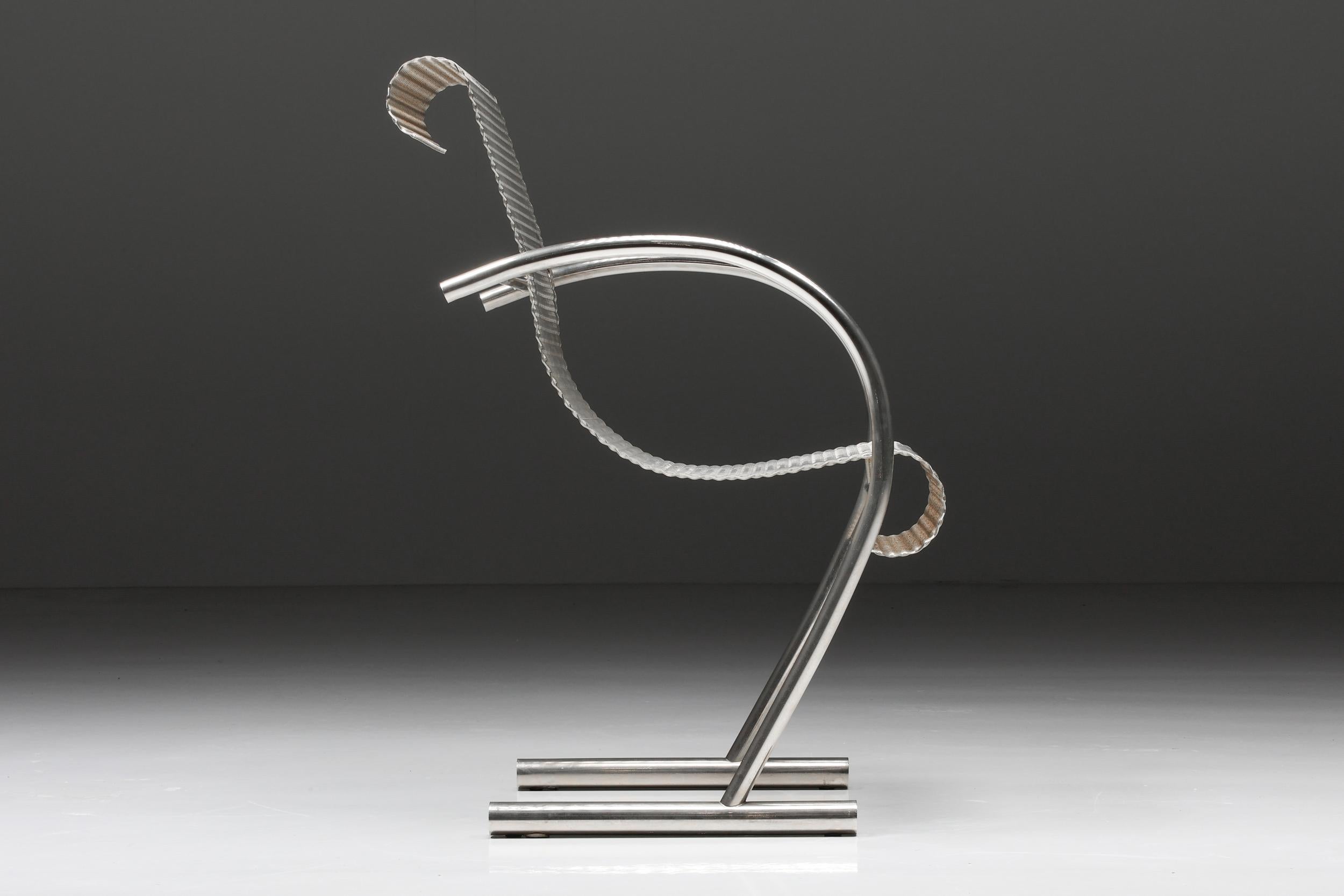
Shiro Kuramata spent the last fifteen years of his life dematerialising furniture into industrial gauze: nickel-plated expanded steel mesh for Vitra’s How High the Moon in 1986, clear acrylic resin embedded with artificial red roses for Miss Blanche in 1988, and glass plates bonded with UV-curing photosensitive adhesive for the 1976 Glass Chair. The career from the Kuramata Design Office in Tokyo in 1965 through his death on 1 February 1991 reads as a single, sustained argument: that an object’s job is to disappear and let its weight go with it. Ettore Sottsass’s Memphis Milano invitation in 1981 supplied the international stage, but the work was already complete in its grammar.
This piece is an object-by-object accounting of the Kuramata cabinet between 1965 and 1991, organised by the three brands that gave him scale — Memphis Milano, Cappellini, and Vitra — and the Tokyo interiors that ran in parallel for Issey Miyake and the city’s bar economy. The thesis is that Kuramata’s project was not Japanese postmodernism, not a Memphis colour spin-off, and not a steel-mesh fad. It was a fifteen-year programme to engineer transparency and weightlessness with materials Japanese industry could already supply — heated acrylic, optical glass, expanded metal, terrazzo embedded with light-emitting diodes — and a refusal to let the chair stop looking like a drawing once it had been built.
The 1934 Tokyo origin and the 1965 office
Shiro Kuramata was born in Tokyo on 29 November 1934 and trained first as a cabinet maker, completing the Tokyo Municipal Polytechnic woodworking course before moving to the Kuwasawa Institute of Design in Tokyo in 1954. The combination matters. By the time he opened the Kuramata Design Office in Tokyo in 1965, he had a craftsman’s understanding of joinery — exactly the discipline he then spent the next twenty-six years methodically deleting. The Glass Chair would later read as a manifesto precisely because Kuramata knew what joinery was supposed to look like and chose to bond the six plates with adhesive instead.
The 1965 office date also sets the chronology. Kuramata was thirty when he opened the studio. He had fifteen years to publish a body of work before Sottsass called from Milan, and he used them to do the slow material research the Memphis members would later admire. The Oba-Q lamp series from 1972 was the first public demonstration of his acrylic programme — table lamps formed from heated, slumped sheets that read as small ghosts (“oba-Q” is a Japanese cartoon ghost), the sort of object that looks weightless because it actually is. The 1972 lamps are the prototype for everything that followed: a single industrial material, heat or adhesive instead of fasteners, a finished form that refuses to confess how it was made.
The retail commission that arrived in 1976 made this method scale. Issey Miyake opened the From 1st boutique in Tokyo’s Minami-Aoyama district and asked Kuramata to do the interior; the relationship would run for the rest of Kuramata’s life, eventually including Miyake stores in Paris and New York. The Issey Miyake boutique interiors brief was effectively to design rooms that could hold Miyake’s pleated, sculptural garments without competing with them. Kuramata’s answer was minimal, light-charged shells — pale terrazzo, brushed metals, fittings that looked drawn rather than constructed — and the same vocabulary he was already developing for the small studio pieces. The Miyake relationship is the structural reason Kuramata’s interior work survived: a designer with an architectural sensibility had a long-running client willing to fund the iteration.
The 1976 Glass Chair and the UV-adhesive proof
The Glass Chair, completed in 1976, is the technical pivot. Kuramata commissioned the chair from six plates of optical glass bonded with a UV-curing photosensitive adhesive — a material then almost unused in Japanese furniture production. The chair has no metal joinery, no visible fixings, no hardware. Cure the adhesive under ultraviolet light and the plates bond molecularly; the glass appears to stand by itself.
The Glass Chair matters for three reasons. First, it proves the method that the rest of the career assumes — that an industrial chemistry borrowed from optics or aerospace can replace the joinery a cabinet maker would normally cut, and the result will look more like an idea than an object. Second, it dates Kuramata’s transparency programme to a full decade before How High the Moon, which is to say before Memphis. The chair is 1976, not 1986. The argument is older than the international platform. Third, the 1976 chair clarifies what the Memphis years were and were not. Kuramata did not learn his vocabulary at Sottsass’s table. He arrived with it.
Shiro Kuramata at Memphis Milano, 1981-1988
Ettore Sottsass founded Memphis Milano on 11 December 1980 in Milan and debuted the collection at the Salone del Mobile in September 1981. Kuramata was one of the founding international members invited by Sottsass; the Japanese cohort within Memphis was small, and Kuramata’s presence supplied the group with its material conscience. Where Sottsass and Michele De Lucchi were detonating colour and plastic laminate, Kuramata was contributing pieces whose visual aggression came from material restraint rather than pattern.
The Memphis years gave Kuramata three things he could not have manufactured in Tokyo alone. First, distribution: Memphis pieces were sold internationally from the start, which put Kuramata in front of European and American collectors who otherwise would have seen his work only in Japanese magazines. Second, scholarly framing: by the time the group dissolved in 1988, Memphis had been written into design history as the central postmodern episode, and Kuramata’s pieces were embedded in that account. Third, peer pressure of a productive kind. Kuramata’s Memphis contributions sat next to Sottsass’s Carlton bookcase and Aldo Rossi’s furniture for the same era, which forced his work to be read in dialogue with Italian rationalism and not just Japanese modernism. The Memphis catalogue still produces Kuramata pieces from those years.
The same 1981 brought formal Japanese recognition: the Japanese Cultural Prize. The Memphis profile and the Tokyo establishment were arriving simultaneously, which made the next decade possible.
The 1986 How High the Moon and the Vitra commission
How High the Moon was designed in 1986 and went into production with Vitra in Weil am Rhein as an oversized armchair fabricated entirely from nickel-plated expanded steel mesh. The form quotes a classical upholstered club chair — wings, rolled arms, a deep seat — but executes the entire silhouette in industrial mesh, so the chair reads as a wireframe rendering of the type it imitates. Sit in it and the form holds; look at it and the form barely exists. The piece took its name from the Duke Ellington/Morgan Lewis 1940 jazz standard, a reference Kuramata used to fix the chair’s weightlessness.
How High the Moon matters because it is the first time a Kuramata armchair entered serial European production at scale. The How High the Moon armchair was Vitra’s bet that a Tokyo studio’s material research could be productionised in Switzerland for international distribution — a bet that paid off and stayed in catalogue. Vitra’s institutional commitment to Kuramata also matters retrospectively: when the Vitra Design Museum later staged Kuramata retrospectives and acquired examples for the permanent collection, How High the Moon was the entry point, and the chair remains the most reproduced photograph in Kuramata’s archive.
The mesh is the argument. Nickel-plated expanded steel was an industrial-fence material, not a furniture material, when Kuramata specified it. Putting it through the silhouette of a Charles Eames or Florence Knoll club chair simultaneously industrialises the form and ghosts it. The chair becomes a drawing of the comfort it pretends to offer. This is the same operation as the Glass Chair — substitute one material for another and let the visual logic collapse — but applied at production scale rather than studio scale.
Cappellini and the Memphis afterlife
Giulio Cappellini’s editorial programme at Cappellini in Carugo, Lombardy, ran in close adjacency to Memphis and absorbed several of its designers as the group dissolved. Kuramata’s relationship with Cappellini sits inside this larger pattern: a Lombard furniture brand willing to put serious money behind objects that had no obvious mass-market case, and a designer who needed Italian production to scale Tokyo prototypes. Cappellini’s later catalogue continued to issue Kuramata pieces and reissue the Memphis-era work, embedding Kuramata in the same Italian design conversation as Jasper Morrison, Marc Newson and Tom Dixon — all of whom Cappellini incubated in the 1980s and 1990s.
The Cappellini-Memphis-Vitra triangle is the structural point of this article. None of the three brands could have carried Kuramata alone. Memphis gave him the cultural slot; Vitra gave him serial production; Cappellini gave him the Italian editorial continuity once Memphis dissolved in 1988. Read together, the three brands describe the export route for any Tokyo studio at the period — the cultural validation in Milan, the industrial execution in Weil am Rhein, the editorial home in Carugo.
Miss Blanche, Kiyotomo and Comblé: the 1988 trio
1988 is Kuramata’s densest year on record. Three projects from that twelve-month window establish the late vocabulary.
Miss Blanche is a chair of clear acrylic resin embedded with artificial red roses, named after Blanche DuBois from Tennessee Williams’s A Streetcar Named Desire — the wilted-rose corsage scene supplies the image. The fabrication is the point. Each rose has to be suspended in liquid acrylic at the moment of casting so that the flower sits inside the seat back and arms as if frozen mid-fall. The cured block then needs to be polished to optical clarity. The chair refuses to look like a chair; it looks like a still life that happens to be load-bearing. It is the most photographed Kuramata object after How High the Moon, and the chair where the literary reference makes the engineering legible.
Kiyotomo was a sushi bar in Tokyo’s Shimbashi district, fitted out in 1988 with the same restraint as the Miyake stores but with the materials pushed harder — terrazzo embedded with metallic chips, mirror, brushed steel, a single sushi counter calibrated against the room’s geometry. The bar closed in the 2000s and would have been lost in the normal Tokyo turnover, except that M+ Museum in Hong Kong acquired the complete interior — fittings, counter, cabinetry, lighting — and reinstalled it as a permanent display when the museum opened in 2021. Kiyotomo is now one of the only late-twentieth-century Japanese commercial interiors preserved in a museum as a coherent room, which makes it the institutional anchor for everything else Kuramata did in Tokyo bars and restaurants.
Comblé was a Tokyo cocktail bar from the same year built around a curved red aluminium counter and a terrazzo floor with LEDs embedded directly in the aggregate — the light reads as small points trapped inside the stone, an effect that prefigures the wider use of integrated lighting in fit-out work decades later. Comblé did not survive in the way Kiyotomo did, but its photographs are now treated as primary documents of how Kuramata used colour at the end of the career: a single saturated hue against a neutral, light-puncturing ground.
The Tokyo interior economy: Miyake and the bars
Kuramata’s project survives in two registers — the small editioned object collected by museums, and the Tokyo interior commissioned by retailers and restaurateurs. The interior economy is harder to reconstruct because many of the rooms were demolished or remodelled in the 1990s and 2000s, but it accounted for most of the studio’s day-to-day production.
The Miyake commissions ran from 1976 to Kuramata’s death, growing from the From 1st boutique in Tokyo into the Paris and New York stores. Bar and restaurant commissions filled the schedule between Miyake openings — Kiyotomo and Comblé in 1988 are the best documented but not the only ones. The pattern across the interior work is consistent with the object work: a single dominant material handled with surgical restraint, lighting integrated into the architecture rather than dropped on top of it, and an insistence that the room read as one drawing rather than as accumulated decisions.
The Issey Miyake relationship also explains a piece of the European reception. By the time Memphis launched in 1981, Miyake was already the most visible Japanese designer in Paris, and Kuramata’s name travelled with him. European editors and curators encountering Memphis met Kuramata’s work simultaneously through Miyake’s retail interiors and through Sottsass’s catalogue, which is the reason Kuramata was read in Europe as part of a coordinated Japanese-Italian conversation rather than as a single import.
Kuramata projects 1972-1988: a material ledger
| Object | Year | Brand / Client | Material |
|---|---|---|---|
| Oba-Q Lamp | 1972 | Kuramata Design Office | Heated, slumped acrylic sheets |
| Glass Chair | 1976 | Mihoya Glass | Optical glass plates bonded with UV-curing adhesive |
| Issey Miyake From 1st boutique | 1976 | Issey Miyake | Pale terrazzo, brushed metals |
| Memphis Milano membership | 1981 | Memphis Milano | Mixed; coloured laminate, lacquered timber |
| How High the Moon armchair | 1986 | Vitra | Nickel-plated expanded steel mesh |
| Miss Blanche | 1988 | Kuramata Design Office | Clear acrylic resin with embedded paper roses |
| Kiyotomo sushi bar | 1988 | Private (now M+ Museum) | Terrazzo, mirror, brushed steel |
| Comblé cocktail bar | 1988 | Private | Red aluminium counter, terrazzo with embedded LEDs |
Read down the materials column and the argument becomes a list. Acrylic in 1972 was a children’s toy material; Kuramata gave it weight. Optical glass in 1976 was an instrument material; Kuramata gave it a seat. Expanded steel mesh in 1986 was a fencing material; Kuramata gave it a club chair’s silhouette. The 1988 work returns to acrylic but loads it with literary reference, and the interiors push terrazzo into a lighting substrate. Every one of these moves is the same move, made eight times in sixteen years.
Sottsass, Rossi and the Italian frame
Two Italian figures bookend Kuramata’s European reception. Ettore Sottsass is the obvious one: the 1981 Memphis invitation is the single most decisive moment in Kuramata’s biography because it converted a Tokyo studio’s body of work into an international design conversation almost overnight. Sottsass’s editorial generosity — he routinely put younger or non-Italian members on equal footing with himself — meant Kuramata’s pieces appeared in Memphis catalogues and exhibitions alongside Sottsass’s own, and the comparative reading was always available.
Aldo Rossi, 1990 Pritzker laureate and the architect of the Italian rationalist revival, is the second pole. Rossi’s furniture, his teapots, his cabinets for the same Italian brands all shared exhibition space with Kuramata’s work in the 1980s, and the contrast is instructive. Rossi was using furniture to argue for typology and memory — the cabinet as small architecture, the teapot as urban fragment. Kuramata was using furniture to argue for transparency and material substitution. The two designers were both arguing about what an object could carry, just on different vectors, and Italian editorial culture in the 1980s was sophisticated enough to publish them in the same magazine spreads and read them as complementary rather than competing.
The 1990 French recognition closes the European arc. Kuramata was awarded the Ordre des Arts et des Lettres by the French government in 1990 — the only Japanese designer of his generation to receive that decoration for furniture and interior work. The award arrived a year before his death, fixing him in the French institutional record alongside Miyake.
The 1991 cutoff and what was preserved
Kuramata died in Tokyo on 1 February 1991, at the age of fifty-six. The studio had been operating at peak intensity for the previous five years — How High the Moon, Miss Blanche, Kiyotomo, Comblé, and the continuing Miyake commissions had all landed inside a five-year window — and the work that was on the drawing board at the time of his death never reached production. What survives is therefore a remarkably compact body of work: roughly two and a half decades of studio output, concentrated into a final fifteen-year publication arc, with a small number of objects carrying disproportionate weight in the historical record.
The preservation has been uneven but better than typical for postwar Japanese design. Vitra continues to produce How High the Moon. The Memphis Milano catalogue continues to produce Kuramata’s Memphis-era pieces. Cappellini holds editorial rights to several titles. M+ in Hong Kong holds Kiyotomo as a permanent installation. The Vitra Design Museum holds examples of the major chairs. Miss Blanche editions appear at auction with regularity and now clear seven figures in dollar terms when complete examples are offered. The Issey Miyake interiors have mostly been remodelled or demolished, which is a more typical retail outcome and removes a substantial chunk of Kuramata’s documented output from the standing record.
The philosophical claim that anchors the work is Kuramata’s own: “I have a strong desire to escape from the forces of gravitation, to free myself from gravity and float free.” The quote is treated by curators as the studio’s mission statement because the work makes it operational. Acrylic, glass, steel mesh, integrated LEDs — every material choice in the cabinet is a method for engineering visual weight downwards. Read backwards from 1991, every project from 1972 onward fits the sentence.
Coda: a single argument in eight objects
Kuramata’s case for design history is that he made the same argument eight times with different materials, refused to repeat himself within any single object, and finished each version cleanly enough that none of the eight competes with the others. Oba-Q teaches the method; Glass Chair proves it scales; the Miyake interiors apply it to retail; Memphis Milano internationalises it; How High the Moon productionises it through Vitra; Miss Blanche literarises it; Kiyotomo and Comblé carry it into the Tokyo interior economy where M+ has now preserved it. The Cappellini-Memphis-Vitra triangle is the export channel; the Tokyo work is where the daily practice lived. The career closes with the French decoration in 1990, the death in February 1991, and a catalogue that has not stopped producing the pieces since. Kuramata’s chairs still float, and the cabinet maker who started by learning every joint in the Japanese woodworking tradition is now best remembered for the joints he refused to cut.