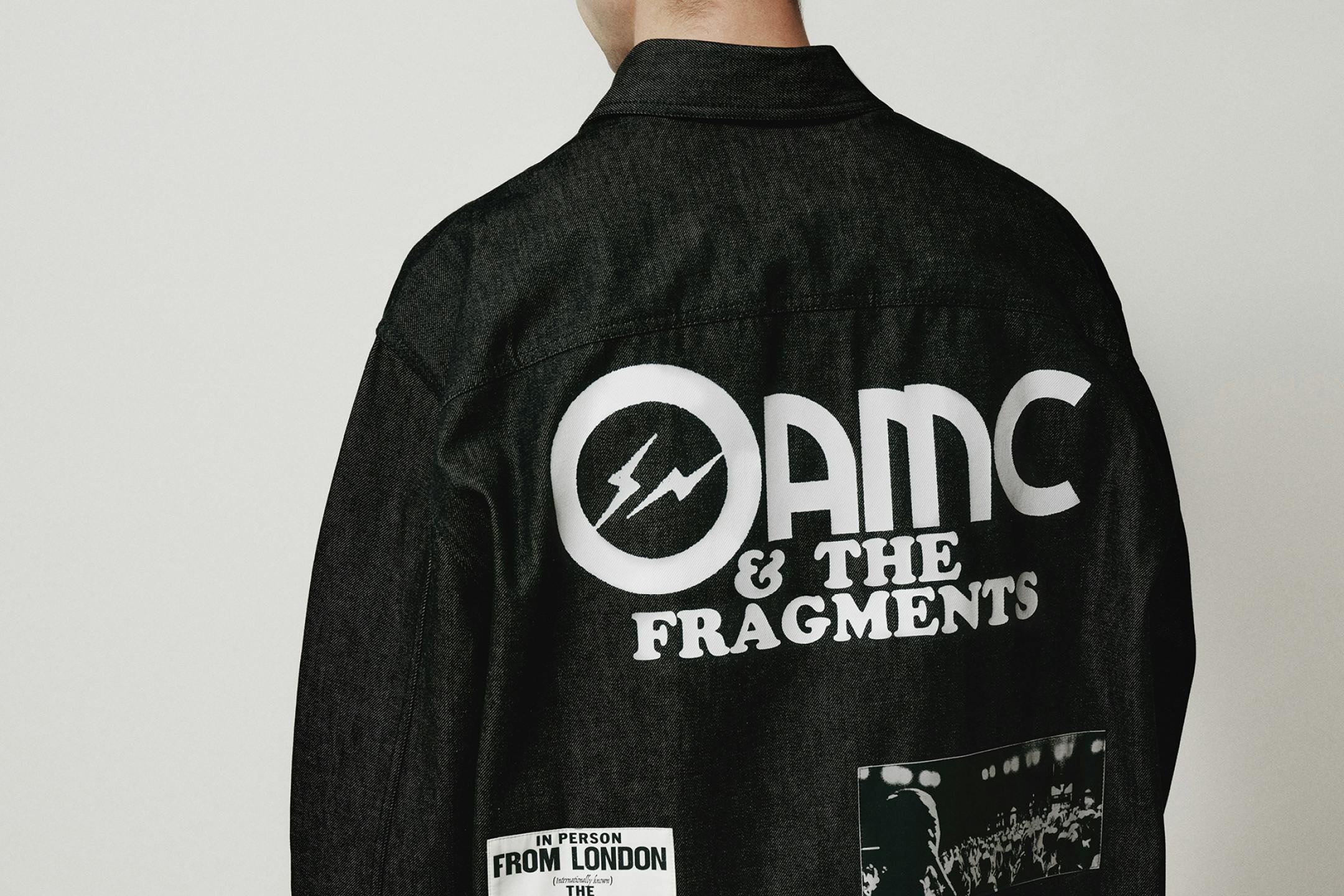
Hiroshi Fujiwara collaborations are the single longest co-sign run in postwar Japanese design — thirty-eight years of partner brands, from a 1988 Tokyo hip-hop label to a 3 June 2026 Bang & Olufsen stereo cabinet, executed by one figure born 7 February 1964 in Ise, Mie prefecture. Read partner-by-partner, the line that runs from Major Force in 1988 through Goodenough in 1990 and Fragment Design in 2003 to the Bang & Olufsen Beosystem 9000c in 2026 reads less like a career and more like a single twelve-step inventory of how Tokyo learned to license a graphic, then a silhouette, then a finish, to every category that mattered.
This piece is the partner-by-partner accounting. It walks the named collaborations in order of discipline — record label, streetwear, retail, footwear, fashion, audio, character IP, snow — and lands the comparison in a single table. Every fact is anchored to a date, a place, or a price. The thesis is that the same operating system — co-sign, restraint, lightning bolt — has held across nearly four decades, and that the Hiroshi Fujiwara cabinet is best read not chronologically but by the partner brand that supplied the substrate.
Major Force and the 1988 origin story
The first named Fujiwara collaboration is not a fashion brand. It is a record label. Major Force was founded in Tokyo in 1988 by Fujiwara together with Toshio Nakanishi, K.U.D.O. and Kan Takagi — the four-man unit better known as Tiny Punx. Major Force is consistently named in Japanese music histories as the first label to systematically produce hip-hop in Japanese, importing the New York and London production grammar Fujiwara had encountered in the early 1980s — Malcolm McLaren’s orbit, the Def Jam catalogue, the early UK rare-groove scene — and rerouting it through a Tokyo signal chain.
Major Force matters to the later Fragment cabinet because it set the engineering pattern that every subsequent Fujiwara collaboration would copy. Take an imported visual or sonic vocabulary. Recompress it through Tokyo distribution. Release in deliberately small numbers under a label that signs the work rather than authoring it from a blank sheet. The label’s commercial outcomes were modest by mainline standards; its structural outcome — proof that a Tokyo signature could legitimately credit foreign material without erasing it — became the template Fragment Design would later apply to sneakers, down jackets, headphones and stereo cabinets.
The 1988 date also fixes the Fujiwara CV in a useful way. By the time the Air Force 1 HTM landed in 2002, Fujiwara had already spent fourteen years running co-sign projects under his own name. The Nike line was not a debut. It was iteration seven or eight of a working method.
Ura-Harajuku 1990–1993: Goodenough, NOWHERE, and the Nigo handoff
In 1990 Fujiwara founded Goodenough, the foundational Ura-Harajuku streetwear label. Goodenough was a T-shirt and outerwear programme, predominantly black, white and navy, with graphics by Sk8thing — the Tokyo graphic designer whose work would later structure A Bathing Ape, Cav Empt and a generation of subsequent streetwear logos. Goodenough’s house tone — single logo position, minimal text, a graphic that reads at fifteen metres — became the visual constraint that Fragment Design would inherit thirteen years later.
The retail handoff came in 1993. Fujiwara co-founded the NOWHERE store at 4-26-21 Jingumae, in the Ura-Harajuku side streets behind Omotesando, with Jun Takahashi — founder of Undercover — and Nigo, born Tomoaki Nagao in 1970 in Maebashi, Gunma. Nigo had been Fujiwara’s assistant; the nickname “Nigo” reads as “number two” in Japanese and reflected the visual resemblance between the two men. NOWHERE incubated both Undercover and BAPE — the brand Nigo founded the same year — and remains the single most consequential retail address in Tokyo street fashion history.
The Ura-Harajuku triangle of 1990–1993 — Goodenough, NOWHERE, and the Takahashi-Nigo handoff — explains why Fujiwara’s later collaborations never read as commercial-only. By 1993, Fujiwara had already credentialled himself as the producer behind two of the most influential streetwear labels Japan would export — Undercover and BAPE — without designing either. The producer role, not the designer role, is the role the Fragment cabinet would later sell to Nike, Louis Vuitton and Moncler.
Fragment Design 2003 and the lightning bolt as licence
Fragment Design was incorporated in Tokyo in 2003. The double-lightning-bolt logo was carried over from Fujiwara’s earlier Electric Cottage project, where it had served as an in-house mark; under Fragment Design it became a licensing instrument. The brief is structurally narrow. Fragment does not author full collections from a blank sheet. It co-signs partner-brand product — a Nike silhouette already in the catalogue, a Moncler down piece, a Bang & Olufsen speaker — with the bolt applied to a deliberately restrained colourway.
The 2003 incorporation also separated the Fragment book from the Goodenough book. Goodenough was a streetwear shop’s brand; Fragment was a vehicle for the brand-to-brand commissions that did not fit a shelf in Ura-Harajuku. The split allowed Fujiwara to take meetings at Beaverton, Paris and Struer without dragging a Tokyo retail P&L into the room. The bolt became a licensable mark, applied across categories that Goodenough could never have reached: footwear in 2002, audio in 2014, luxury fashion in 2017, snow in 2025, integrated stereo in 2026.
Hiroshi Fujiwara collaborations with Nike, 2002–2014
The Nike book is the largest single category in the Hiroshi Fujiwara collaborations cabinet. HTM — for Hiroshi, Tinker and Mark, the three principals — was launched at Nike in 2002 with the Air Force 1. Tinker Hatfield is the Air Jordan designer; Mark Parker was then Nike’s brand president and would later run the company as CEO. HTM’s brief was small and consistent: take a Nike silhouette already in the catalogue, upgrade the materials and construction beyond mainline justification, and ship in low numbers. The Air Force 1 HTM was the inaugural project. HTM was later used to preview Nike’s Flyknit construction — the woven upper that would reshape the running line a decade later — before that technology hit the broader Nike catalogue.
The Nike line’s commercial inflection arrived twelve years after HTM. The Fragment x Air Jordan 1 Retro High OG, in a blue, black and white colourway with the lightning bolt at the heel, was released on 27 December 2014 — initially as an exclusive at THE POOL aoyama, Fujiwara’s Tokyo retail vehicle, before wider release. The colourway became one of the most replicated Air Jordan 1 templates of the 2010s and seeded the secondary-market pricing engine that subsequent Fragment x Nike drops would inherit. The Air Jordan 1 Fragment is the file under which Fragment moved from a Tokyo-known signature to a globally tradable one.
Across the 2002–2014 window, the Nike book established two patterns that every subsequent Fujiwara collaboration would reuse. First, exclusivity routes through Tokyo retail before global release — THE POOL aoyama in 2014, THE CONVENI in 2018, Isetan Shinjuku in 2026. Second, the lightning bolt is small, placed on a single visible surface, and never disrupts the partner brand’s silhouette. The Nike cabinet is the cabinet against which everything else in this list is calibrated.
Luxury: Louis Vuitton 2017 and Moncler Genius 2018
Fujiwara’s luxury book opened on 21 April 2017 with Louis Vuitton x fragment design — the AW17 men’s pre-collection co-designed with Kim Jones, then Vuitton’s menswear artistic director. The capsule was framed around an imaginary band called “Louis V and The Fragments,” with the lookbook staged as concert imagery and the Tokyo Omotesando pop-up running into early May. Product included monogram canvas re-graphed with the lightning bolt, varsity outerwear, a backpack programme and a small trunk run. Pricing bracketed every Vuitton category that mattered to a Tokyo streetwear audience, from small leather goods at the entry tier to headline outerwear above USD 3,000.
Louis Vuitton 2017 mattered for a structural reason. It was the first time the Fragment bolt was applied to monogram canvas — the most defended graphic in the luxury industry — and the first time a maison-level house ran a Fragment capsule as a named pre-collection rather than a small footwear drop. Kim Jones’s authorship signature credited Fragment as a co-designer, not a graphics supplier; the precedent set the rates for the Moncler deal that followed ten months later.
That deal was 7 Moncler Fragment Hiroshi Fujiwara — the inaugural Moncler Genius capsule, unveiled at Milan Fashion Week in February 2018. Moncler Genius reset the house’s collaboration model: instead of one annual designer credit, Moncler distributed a numbered grid of designer capsules under one Milan show. Fragment did not occupy a line on the grid. Fragment opened the grid. The 7 Moncler Fragment Hiroshi Fujiwara line ran across car coats, hoodies, varsity and coach jackets in a punk-grunge register — predominantly black, with the bolt applied to outerwear shoulders and zippers. Fragment continued to deliver under the 7 numeral across subsequent Genius cycles.
Read together, Louis Vuitton 2017 and Moncler 2018 establish that the luxury book runs on house-to-house collaboration rather than house-to-streetwear collaboration. The Fragment cabinet is, in luxury, the file under which a Tokyo graphic studio co-signs a French and an Italian house on their own outerwear silhouettes — not the file under which a luxury house borrows streetwear codes.
Hiroshi Fujiwara collaborations across audio, 2014–2026
The audio book opens in 2014. The Beats by Dre x Fragment Studio headphones — part of the Beats Artist Series — landed in smoke grey with white head-strap stripes and aqua-blue accents on the ear cushions. Beats had been acquired by Apple in May 2014 for USD 3 billion; the Fragment Studio drop was one of the first post-acquisition collaborations the brand signed with a non-musician partner. The smoke-grey colourway became one of the cleanest examples of Fragment’s approach to applying its house restraint to a partner-brand product without disrupting the silhouette.
The Beats partnership did not end with the Studio over-ear. Subsequent Fragment x Beats drops ran across the BeatsX neckband, the Powerbeats Pro true-wireless, the Beats Flex neckband and, more recently, the Beats Fit Pro in-ear. Each carried the Fragment colourway logic — monochrome with one accent — and each routed through Apple-owned Beats distribution. The Beats book is the file under which Fragment first co-signed a category — consumer audio — where the partner brand’s silhouette was already fixed by industrial-design constraints rather than fashion seasons.
The audio book’s 2026 inflection is Bang & Olufsen. The Fragment x Bang & Olufsen capsule is a four-object run: the Beoplay H100 over-ear headphone, the Beosound A1 portable speaker, the Beosound Shape modular wall system and — Japan-exclusive — the Beosystem 9000c integrated CD system. All four objects ship in anodised, hand-polished black aluminium with matte black surfaces and a double-lightning-bolt logo etched on the metalwork. The Tokyo pop-up opened at Isetan Shinjuku on 20 May 2026; global release followed on 3 June 2026, with the Beosystem 9000c restricted to Japanese retail. Bang & Olufsen is the first European industrial-craft house that Fragment commissions outright rather than co-signing as a fashion category — a structural inversion that the Beats book had been edging toward for twelve years.
The Pokemon and Starbucks years: 2018 saturation
Fragment’s 2018 calendar absorbed three category openings in addition to Moncler Genius. The first was the Thunderbolt Project by FRGMT and Pokemon, which debuted in 2018 inside Pokemon GO and then expanded to apparel and plush toys, all in predominantly black palettes. The Thunderbolt name was the structural joke: the Japanese “Inazuma” lightning motif connects the Pokemon Pikachu silhouette to the Fragment double-bolt logo, and the project read the two graphics as one mark across categories.
The second was the Starbucks x Fragment x Stanley stainless bottle, released on 27 June 2018 — a tri-party drop that married Starbucks’s Japan distribution, Stanley’s vacuum-flask manufacturing and the Fragment bolt. The drop was the first time Fragment co-signed a hardline kitchenware object, and the price discipline carried through: an accessible price point with the bolt applied to a single visible surface on a partner-brand product whose silhouette was unaltered.
The third was THE CONVENI, which opened in August 2018 in the basement of Ginza Sony Park, Tokyo. THE CONVENI is modelled on a Japanese convenience store — the konbini grid of shelves, the cooler doors, the cashier counter — but stocks Fragment-signed goods instead of bento and onigiri. The format is itself a collaboration: with Sony as landlord on the Ginza Sony Park site, and with the manufacturer roster behind every product on the shelves. THE CONVENI’s importance is that it gave Fragment a permanent Tokyo retail address for its non-footwear inventory, in a building whose architecture was itself a temporary park on a redeveloped Sony site.
2018 was the year the Fragment book moved from a fashion-and-footwear inventory to a multi-category retail object cabinet. Moncler, Pokemon, Starbucks, Stanley and Sony — five named partners in a single twelve-month window, across four distinct categories.
Burton 2025 and the Beosystem 9000c coda
The snow book opened on 13 November 2025. The Burton x FRAGMENT capsule — a full snowboard and outerwear programme for the 2025/26 season — extends Fujiwara’s relationship with Burton Snowboards back through the Burton iDiom line, founded in 2008, and the Burton AK457 line of 2017. The 2025 Burton x FRAGMENT capsule consolidates those earlier sub-line projects into a single named co-sign at the parent-brand level, with the bolt applied to deck graphics, outerwear shoulders and accessory hits. The release date sits inside the early-season snow drop window — early November is when North American and Japanese snow retail loads inventory for the December opening — and the capsule is the most product-dense Fragment snow drop yet.
The 2026 Bang & Olufsen capsule is the structural coda. The Beoplay H100 ships at the over-ear flagship price tier, the Beosound A1 at the portable entry tier, the Beosound Shape as a modular wall system, and the Beosystem 9000c — Japan-exclusive, made-to-order — as a fully integrated CD stereo cabinet built at Struer. The 9000c is the highest-priced object the Fragment book has ever co-signed, and the first Fragment object to be tied to a Japan-only distribution. The 20 May 2026 Isetan Shinjuku pop-up and the 3 June 2026 global release together close the line that opened with Major Force in Tokyo in 1988: thirty-eight years on, the same operating system — Tokyo-first retail, lightning bolt on a restrained surface, partner brand authoring the silhouette — is still running, against a Danish stereo cabinet that costs more than a small flat in Aichi prefecture.
Comparison table: Hiroshi Fujiwara collaborations, 1988–2026
The named partners run as follows. Every row is a single collaboration entry — date, partner, project, and the lead detail that fixes the project in the Fragment cabinet.
| Year | Partner | Project | Key detail |
|---|---|---|---|
| 1988 | Toshio Nakanishi + Tiny Punx | Major Force label | First Japanese hip-hop production label, Tokyo |
| 1990 | (solo / Sk8thing graphics) | Goodenough founding | Foundational Ura-Harajuku streetwear; graphics by Sk8thing |
| 1993 | Nigo, Jun Takahashi | NOWHERE store | 4-26-21 Jingumae, Tokyo; incubated BAPE and Undercover |
| 2002 | Tinker Hatfield, Mark Parker | Nike HTM Air Force 1 | Inaugural HTM project; vehicle for later Flyknit preview |
| 2014 | Beats by Dre | Fragment Studio headphones | Smoke grey with white stripes and aqua-blue accents |
| 2014 | Nike | Fragment x Air Jordan 1 Retro High OG | Blue/black/white; THE POOL aoyama, 27 December 2014 |
| 2017 | Kim Jones (Louis Vuitton) | LV x fragment design AW17 men’s | “Louis V and The Fragments” pre-collection, 21 April 2017 |
| 2018 | Moncler | 7 Moncler Fragment Hiroshi Fujiwara | First Moncler Genius capsule, MFW February 2018 |
| 2018 | Pokemon | Thunderbolt Project by FRGMT | Debuted in Pokemon GO; expanded to apparel and plush |
| 2018 | Sony / Starbucks / Stanley | THE CONVENI; Starbucks x Stanley tumblers | Ginza Sony Park, August 2018; tumblers 27 June 2018 |
| 2025 | Burton Snowboards | Burton x FRAGMENT | 13 November 2025; extends iDiom (2008) and AK457 (2017) |
| 2026 | Bang & Olufsen | Beoplay H100, Beosound A1, Shape, Beosystem 9000c | Isetan Shinjuku 20 May 2026; global 3 June 2026 |
Read down the table, the categories run: record label, streetwear, retail, footwear, audio, footwear, luxury fashion, luxury fashion, character IP, hardline retail, snow, audio. The repetition is structural: the 1988 record-label engine is the same engine running the 2026 stereo cabinet, with the lightning bolt in place of the Major Force imprint and Struer in place of a Tokyo pressing plant.
The thirty-eight-year arc of Hiroshi Fujiwara collaborations is not a story about a Japanese streetwear designer who later moved into luxury. It is a story about a Tokyo producer who, since 1988, has run the same operating system — co-sign, restraint, Tokyo-first retail, single graphic mark — against an ever-expanding list of categories: hip-hop in 1988, streetwear in 1990, retail in 1993, footwear in 2002, audio in 2014, French and Italian fashion in 2017–2018, character IP and hardline in 2018, snow in 2025, and Danish industrial audio in 2026. The Beosystem 9000c is not a new file. It is the same file, applied to a cabinet that Major Force could not have reached. That is the Fragment cabinet, and that is the answer.