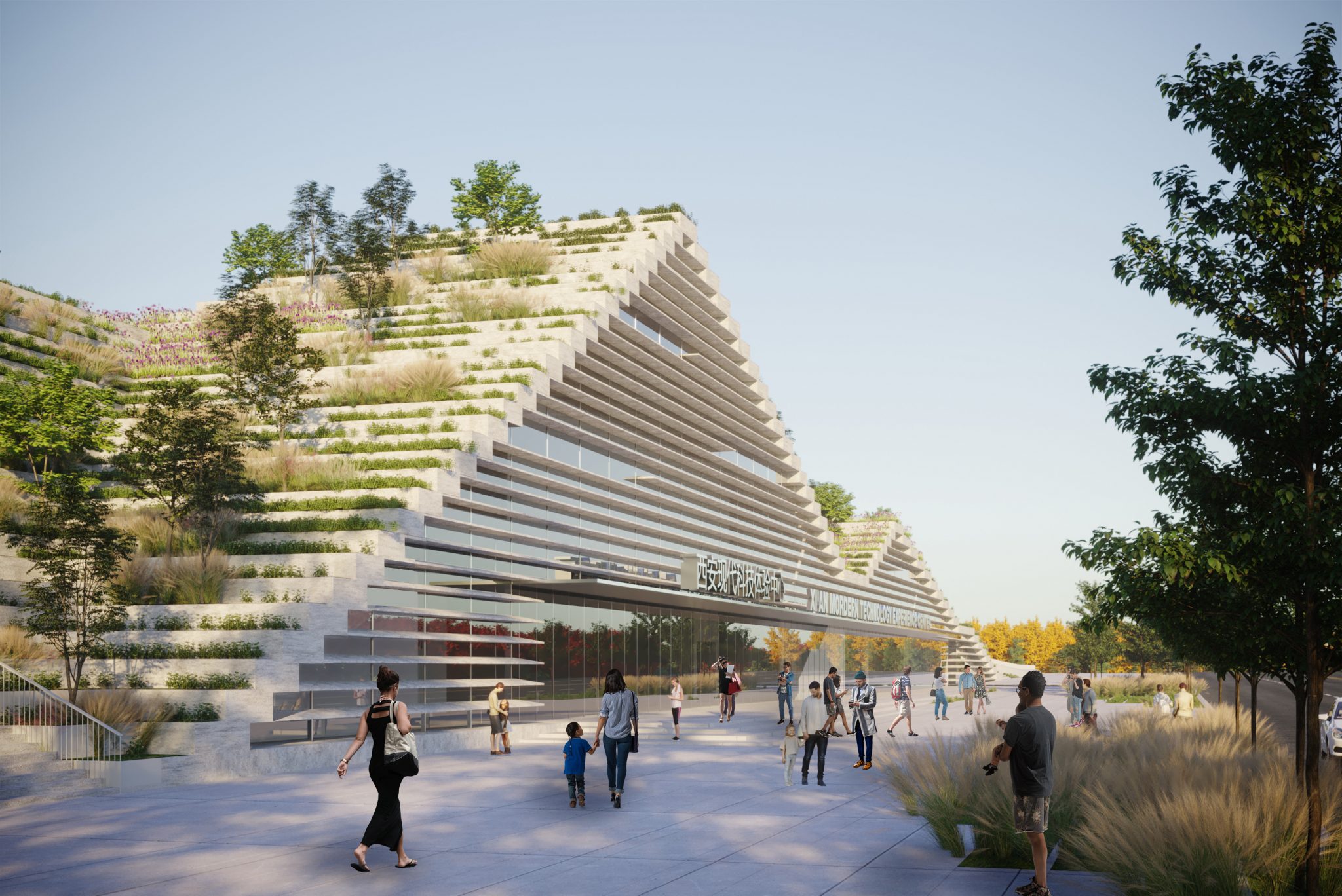
Stefano Boeri’s Rome work has, in eighteen months, turned from a one-off Colosseum-perimeter commission into an 8,000-square-metre rooftop garden on an ATAC tram depot the city had left empty since 2006 — and the gesture grounds the Milanese Vertical Forest vocabulary, formerly reserved for new towers, into the city’s nineteenth-century industrial fabric. The Stefano Boeri Rome catalogue is small but precisely split: Stefano Boeri Architetti is converting the 16,000 sqm Deposito delle Vittorie at Piazza Bainsizza in the Prati-Della Vittoria district, while sister practice Stefano Boeri Interiors has just finished the southern-ambulatory restoration of the Colosseum for the Parco Archeologico del Colosseo. Two projects, two practices, two centuries of fabric — and one designer, Stefano Boeri, translating a Milan signature into a Roman idiom.
Deposito delle Vittorie, Piazza Bainsizza, 1916-2026
The Deposito delle Vittorie is the bigger and louder of the two Rome interventions, and it is the one that, on 26 May 2026, both Dezeen and Domus reported as approved by the Rome City Council. The depot sits on Piazza Bainsizza, in the Prati-Della Vittoria district north of the Vatican, on a triangle of nineteenth- and early-twentieth-century block edges that the city laid out as it filled toward Monte Mario. The building itself was approved in 1916 and opened to traffic around 1919-1920 — a hangar-scale shed of riveted iron and brick built for ATAC, the Azienda Tramvie e Autobus del Comune di Roma, to garage and maintain the trams that connected the new bourgeois quarter to the historic centre.
It worked as a tram depot until 1963, then as a bus depot for another generation, then it sat. ATAC, which had owned the parcel for most of the twentieth century, eventually sold the building, and it has been privately held while the city argued with itself about what a 16,000-square-metre municipal void should be allowed to become. The depot has been disused for nearly two decades; the May 2026 council vote is the first piece of paper that actually unblocks the brief.
The Stefano Boeri Architetti scheme proposes a single conversion across the whole 16,000 sqm footprint. The programme is plural rather than single-use: culture, education, commerce, co-working, social interaction and leisure are listed in the official description, in that order, which puts the cultural and educational functions ahead of the retail ones — a hierarchy the council appears to have signed off on rather than the standard mall-with-an-auditorium configuration. The ground floor is conceived as a public square that the depot opens into rather than seals: geometric groves, terraces and what the practice calls ‘green rooms’ subdivide the slab horizontally without enclosing it.
The headline number is on the roof. Eight thousand square metres — exactly half the building’s footprint — become a rooftop garden conceived, in the practice’s own brief language, as an open-air museum. That phrasing matters. It is not described as amenity space for a co-working tenant, nor as a private terrace for a member’s club; it is positioned as a civic museum-in-the-air on top of an ATAC building the city had given up on. Half of the Deposito’s mass is, in effect, being recovered as public horizontal ground at the height of the old tram shed’s eaves, with planting that does the cultural and ecological work simultaneously.
This is also where the Bosco Verticale vocabulary stops being a tower idea and starts being a city idea. The 2014 Bosco Verticale — twin residential towers at 112 m and 80 m in Milan’s Porta Nuova district, carrying roughly 800 trees and several thousand plants on their balconies — invented a typology that needed new structure to exist. The Deposito delle Vittorie reverses the proposition: the structure already exists, the canopy is added on top, and the trees are placed not on cantilevered slabs but on a rebuilt roof of an early-twentieth-century industrial shed. The vocabulary is the same; the substrate is two generations older.
Stefano Boeri Rome: from the Colosseum to Della Vittoria
The other half of the Stefano Boeri Rome ledger is older and quieter. In March 2026, ArchDaily and Dezeen documented the completed restoration of the Colosseum’s southern ambulatory — the long curved strip along the monument’s southern flank — authored by Stefano Boeri Interiors, the sister practice the architect runs with Giorgio Donà. The client was the Parco Archeologico del Colosseo, the autonomous institute that manages the Roman amphitheatre, the Roman Forum and the Palatine.
The intervention is a piazza, not a building. Roughly 3,130 square metres of paving was laid in trapezoidal slabs of Classic Travertine quarried at Cava del Barco — a material and provenance chosen to align with the amphitheatre’s first-century AD travertine skin without mimicking its mass. Forty-four extruded travertine blocks, each 40 cm high, are set across the new piazza along the line of the lost outer wall: they read at once as a measured archaeological notation and as continuous public seating. The same blocks that mark, in plan, what is no longer there also let visitors sit in the geometry of what was. Between arches 65 and 71, an archaeological window cuts the new ground plane to expose the substructure below, so the surface refuses to be merely decorative.
Two things are worth pulling out of this. First, the practice that did the Colosseum work is Boeri Interiors, not Architetti — a deliberate institutional choice. The southern ambulatory is a permanent civic interior at urban scale: a piazza is, in this reading, a ceiling-less room. Second, the Colosseum brief is not a restoration of a building but a restoration of a relationship between a monument and its perimeter. The 3,130 sqm of travertine paving is a piece of furniture for the monument as much as it is a piece of city for the visitor.
Both Rome projects, then, are about ground plane. The Colosseum work redraws the ground plane around an ancient monument. The Deposito delle Vittorie work lifts a new ground plane — the 8,000 sqm rooftop garden — onto an early-twentieth-century shed. The two interventions face each other across roughly 1,800 years of Roman fabric, but they share an instinct that the city’s primary architectural surface is horizontal.
How Boeri Architetti and Boeri Interiors split Rome
The split between the two practices is institutionally clean and worth tracing, because outside Italy the two are often collapsed into one signature. Stefano Boeri Architetti is the architecture office in the strict sense: founded in 2011 by Boeri with Francesca Cesa Bianchi, Marco Giorgio and Pietro Chiodi, with offices in Milan, Tirana and Shanghai. It is the successor to Boeri Studio, the 1999-2008 partnership Boeri ran with Gianandrea Barreca and Giovanni La Varra and under which the Bosco Verticale was conceived and largely designed. The Deposito delle Vittorie scheme — building scale, urban hub, structural reuse — sits squarely in this lineage.
Stefano Boeri Interiors is the multidisciplinary studio Boeri co-founded with Giorgio Donà. The brief is broader than the name implies: it covers interiors in the conventional sense, but also retail, hospitality and, as the Colosseum commission demonstrates, public-realm restoration. The studio’s brand identity treats interior and exterior as one continuous design problem, which is the only intellectually coherent way to read a 3,130 sqm travertine piazza as ‘interiors’ work.
In Rome, the split has produced a useful division of labour: Interiors handles the monument’s edge and Architetti handles the disused infrastructure. There is no overlap, no shared site, no shared client. The Parco Archeologico del Colosseo commissioned one; Rome City Council approved the other; and the privately held Deposito delle Vittorie is being delivered for a private owner with a council-sanctioned brief. The Rome work is, in other words, the cleanest case study available for how Boeri’s two practices triangulate.
It is also a useful warning against reading the architect’s output as a single sensibility. The Boeri Interiors travertine work at the Colosseum is restrained, archaeological and almost entirely mineral. The Boeri Architetti work at the Deposito is loud, vegetal and programmatically maximal. The same designer authored both; the institutional split is what lets the same designer hold both registers without contradiction.
The Vertical Forest as urban vocabulary, grounded
The clearest way to read the Deposito delle Vittorie is as the third iteration of a vocabulary that began in 2014 with the Bosco Verticale and has since been exported to Eindhoven, Tirana and a list of further cities. The vocabulary’s essential move is to load architectural surface with vegetation as a primary, structural design decision rather than as landscaping applied after the fact. The towers carry their planting on engineered cantilevers; the Deposito carries its planting on a re-engineered nineteenth-century shed.
Sustainably, the difference is not trivial. A new-build vertical forest has to justify the carbon cost of its concrete frame and the maintenance regime of its tree-bearing balconies against the cooling, biodiversity and air-quality benefits that the planting eventually provides. An adaptive-reuse vertical forest starts with the carbon already spent: the brick, the iron, the riveted trusses of the 1916 ATAC shed are already there, embodied carbon already amortised over a century of municipal use. The planting on top of that shed is therefore a pure addition rather than a partial offset. This is the most defensible version of the Bosco Verticale argument available to the studio in 2026.
Programmatically, the difference is also clean. The 2014 Bosco is a residential building: its trees serve apartments and balcony users. The 2026 Deposito is a civic building: its rooftop garden serves walk-up visitors and a programme list led by culture and education. The vegetation that, in Milan, framed two private high-rise households per balcony is, in Rome, framing an open-air museum on top of a depot. The typology has been translated from vertical to horizontal and from private to public in a single move.
The Della Vittoria neighbourhood is also a usefully specific test bed. Prati-Della Vittoria is a planned bourgeois quarter laid out in the late nineteenth and early twentieth century on the right bank of the Tiber, immediately north of Castel Sant’Angelo. Its grid is tight, its courtyards are private, and its public space is largely confined to the church squares and the radial streets around Piazza Mazzini. An 8,000 sqm publicly accessible roof in the middle of that grid is, by the standard of the surrounding morphology, a substantial enlargement of the district’s open ground.
A timeline of Stefano Boeri Rome, 2024-2026
Below is a chronological inventory of every Stefano Boeri-led project in Rome across both practices, with site, intervention type and floor area where documented.
| Year | Project | Practice | Site | Type | Area |
|---|---|---|---|---|---|
| 2026 (March) | Colosseum Southern Ambulatory restoration | Stefano Boeri Interiors | Colosseum, Parco Archeologico del Colosseo | Travertine piazza, 44 extruded blocks, archaeological window | c. 3,130 sqm |
| 2026 (May, approved) | Deposito delle Vittorie Community Hub | Stefano Boeri Architetti | Piazza Bainsizza, Prati-Della Vittoria district (former ATAC tram depot, 1916/1919-1920) | Adaptive reuse: multifunctional hub with rooftop garden / open-air museum | 16,000 sqm total; 8,000 sqm rooftop garden |
Two projects, three numbers worth keeping in view: 3,130 sqm of new travertine ground at the Colosseum; 16,000 sqm of recovered ATAC volume at the Deposito; 8,000 sqm of vegetated roof on top of it. The Rome catalogue is a 19,130 sqm public-realm operation by a Milanese practice, split between Boeri Interiors at the monument and Boeri Architetti at the depot, with no overlap of site, brief or client.
What the Deposito changes about adaptive reuse in Rome
The Rome adaptive-reuse pipeline has historically been dominated by interventions in the historic centre and in residential palazzi, with industrial conversions either handled by the public sector or routed through the museum economy (Centrale Montemartini being the obvious touchstone). The Deposito delle Vittorie is unusual because the parcel is privately owned, the brief is mixed-use civic rather than purely museological, and the design author is a Milanese practice with no prior Roman operational base outside the Colosseum commission.
That combination is what gives the May 2026 council approval its weight beyond the architectural press cycle. A privately held early-twentieth-century industrial volume of 16,000 sqm in a central Roman district, converted under a brief that puts culture and education ahead of commerce, with an 8,000 sqm publicly conceived rooftop, is a template the city has not built before. If the project completes substantially as approved — and the design is now council-sanctioned, which removes the largest civic obstacle — it becomes a precedent for the remaining stock of disused ATAC and municipal-industrial buildings across Rome.
It also positions the Boeri practice in a market it had not been particularly active in. Boeri Architetti’s domestic centre of gravity has historically been Lombardy and the Veneto, with international work concentrated in Tirana and a tower commissions list distributed across Eindhoven, Utrecht and Nanjing. A 16,000 sqm Roman commission in Prati-Della Vittoria gives the practice its first substantial operational anchor in the capital, complementary to the Boeri Interiors commission already delivered for the Parco Archeologico del Colosseo.
The designer behind both practices
Stefano Boeri was born on 25 November 1956 in Milan, which makes him 69 at the date of the council approval. He trained as an architect, co-founded Boeri Studio in 1999 with Gianandrea Barreca and Giovanni La Varra, and founded Stefano Boeri Architetti in 2011. Between 2011 and 2013 he served as Culture Councillor of the Municipality of Milan, a tenure that overlapped with the construction phase of the Bosco Verticale and that placed him inside, rather than across the table from, the municipal apparatus he has subsequently worked with as an architect.
That biographical detail is relevant to the Deposito story for a specific reason: the May 2026 Rome City Council approval is the kind of municipal architectural negotiation that the architect has personal political experience of from the other side of the desk. The Bosco Verticale itself was delivered while Boeri sat on the Milan council; the Deposito is being delivered, twelve years later, into a Roman council process by an architect who knows what such processes look like from the inside. None of this changes what is on the drawing. It does, however, explain why the brief reads more like a piece of municipal policy than like a developer pitch — culture and education ahead of commerce, a publicly conceived rooftop, the building treated as civic ground rather than as a real-estate asset.
The Giorgio Donà partnership at Boeri Interiors is the other half of the picture. Donà runs the interiors practice with Boeri and was the co-author of the Colosseum southern-ambulatory work documented in March 2026. The Rome catalogue, taken together, is in that sense not a one-person signature but a two-practice, three-architect operation: Boeri at the centre, Donà on the Colosseum interiors brief, and the broader Boeri Architetti partnership behind the Deposito conversion.
The Milan precedents the Rome work is read against
For an audience already literate on the Bosco Verticale, the Deposito delle Vittorie reads as a specific kind of test case: can the vertical-forest vocabulary survive translation into a horizontal, public, adaptive-reuse format? The 2014 Bosco demonstrated that the typology could deliver on its planting brief at residential-tower scale in Milan’s Porta Nuova. The Tirana, Eindhoven and Nanjing sequels demonstrated that the typology was portable as a new-build tower. The Deposito will be the first significant test of whether the planting strategy can also be carried by a recovered industrial shed without compromising either the planting or the shed.
The Milan towers were a partnership between a new high-rise frame and roughly 800 trees and several thousand plants. The Deposito’s planting brief has not been disclosed in numerical detail beyond the 8,000 sqm rooftop figure, but the same studio is the author of both, and the typology’s success at scale will, by 2028 or so, depend on whether the rooftop garden performs as ecological surface as well as it does as civic gesture. The Milan towers have answered the residential version of that question. The Roman depot will answer the civic, horizontal version.
For Della Vittoria, the everyday consequence is more immediate. An 8,000 sqm publicly programmed roof, sitting on top of a 16,000 sqm building of cultural, educational, retail, co-working and leisure functions, is a substantial enlargement of a neighbourhood that historically does not have a major public square. The Deposito will be one. The Colosseum work, finished a few months earlier, is the other end of the same designer’s Roman year: a new public ground at the foot of the city’s most-visited monument.
The two interventions can also be read against the larger Milan story FORMA has been tracking. The CityLife tower district is the most visible recent example of Milan exporting a high-rise typology under signature authorship; Bosco Verticale and CityLife together rewrote the city’s skyline between 2011 and 2026. The Stefano Boeri Rome work is the same lineage flipping direction — a Milanese signature exported into Roman fabric, but this time the operation is adaptive rather than additive.
Coda
In the spring of 2026 the same architect put a travertine piazza around the Colosseum and got council sign-off to lift an 8,000 sqm garden onto a 1919 tram shed half a city away. The Rome catalogue, viewed end-to-end, is a small, deliberate two-practice operation that takes the Milanese vertical-forest argument and rebuilds it as a horizontal, public, adaptive-reuse argument inside the capital. What the Deposito delle Vittorie will be in 2028, when it opens, is the test of whether the Bosco Verticale vocabulary can hold up when it is not the new building but the recovered one — and whether half of a 16,000 sqm ATAC depot, given back to the city as planted ground, can change the way Rome thinks about its own disused industrial stock.