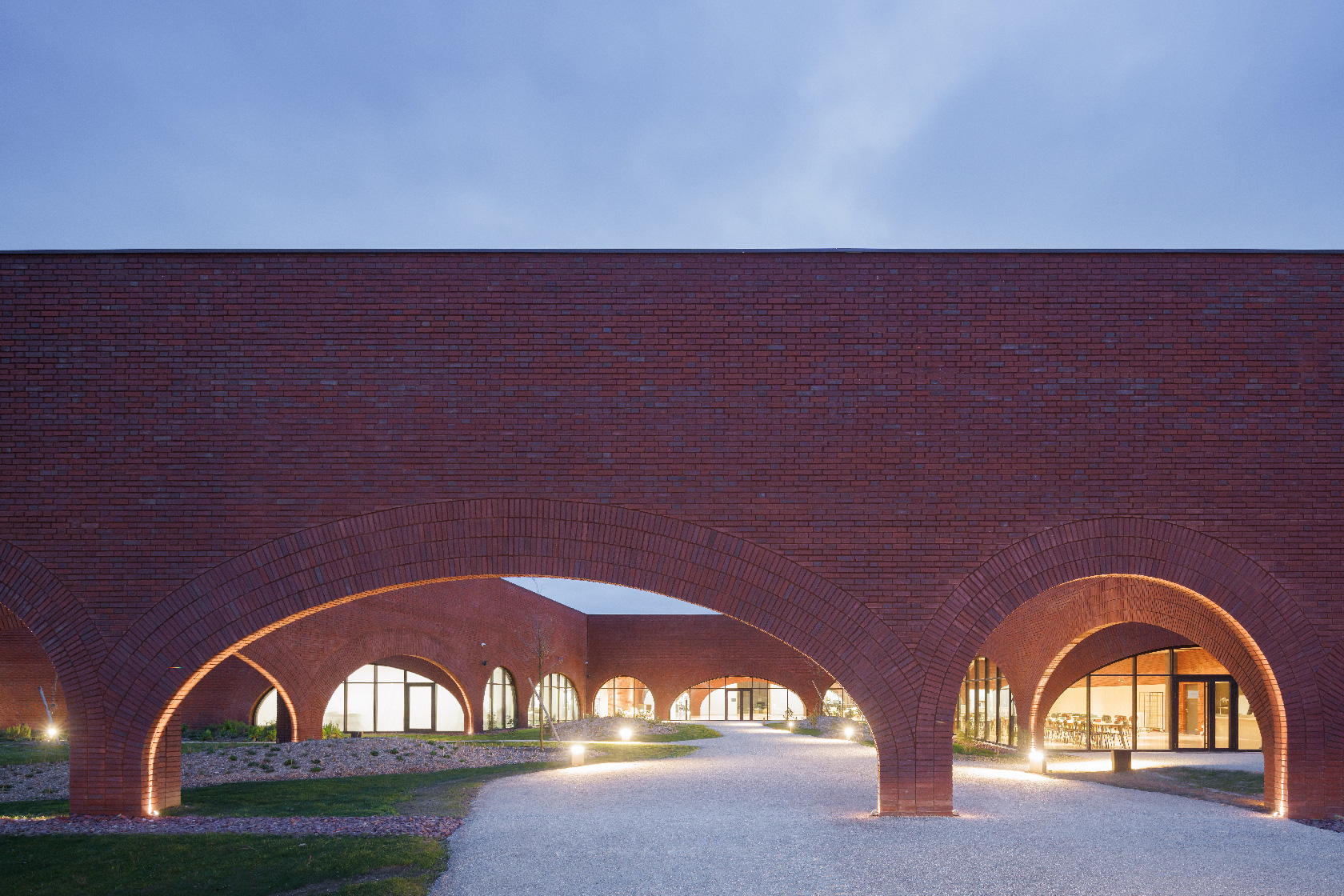
Lina Ghotmeh’s “Reality is Fluid” manifesto, published in Domus 1112 on 28 May 2026, is best read backwards — as a Rosetta stone you hold up to Stone Garden in Beirut, the 550,000-brick Hermès leather workshop in Normandy, and the timber Serpentine Pavilion of 2023 to discover that they were all making the same argument before she gave it a name. The Lina Ghotmeh manifesto is short on prescription and long on syntax — a single ecological sentence stretched across two decades of built work, from the 356-metre Estonian National Museum in Tartu to the unbuilt revolving forest observatory at Nanto. Read in order, the projects index the manifesto more clearly than the manifesto indexes the projects.
This is a reference piece. It walks every project the Domus text explicitly names or implicitly invokes, in chronological order, and notes what each one contributes to the central claim that architecture is “a temporary alignment of flows, a momentary condensation of time, matter and life”.
What “Reality is Fluid” actually argues
Strip the manifesto of its poetic register and three claims remain.
The first is ontological. Buildings are not objects but slow events. Ghotmeh writes:
“Architecture is never fixed. It is always provisional, constantly negotiating with time, fragility and becoming.”
She is not making the usual ecological point that buildings consume resources over their lifespan. She is making a stronger one: that the building, as a thing, does not exist in the static way the architectural drawing implies it does. The drawing freezes a moment in a process that has neither beginning nor end — the geology that supplied the stone, the artisans who tuned the surface, the weather that will rework the facade, the future occupants who will renegotiate the plan.
The second claim is methodological, and it is the line that does the most work in the essay:
“Movement is the capacity to change. It is not rupture but continuity. Not erasure but becoming.”
This is the manifesto’s central polemic, aimed at two adversaries at once. On one side, the demolish-and-replace logic of speculative construction. On the other, the heritage reflex that freezes buildings as period pieces. Ghotmeh proposes a third position: the building as an organism whose continuity is the continuity of its changes. Her preferred materials — rammed earth, hand-combed concrete, untreated cedar, regional brick — keep recording change after the architect leaves the site.
The third claim is ethical, and it lands as instruction:
“To build is not to fix form, but to enter this ongoing current with care, to listen before acting.”
The phrase “to listen before acting” carries the weight. The Lina Ghotmeh manifesto is, on this reading, less a programme than a defence of a method she has been refining since the Estonian competition in 2005.
The Estonian National Museum, 2016: a 356-metre Rosetta stone
The earliest project the manifesto leans on, even if it does not name it explicitly, is the Estonian National Museum in Tartu. Designed under the DGT Architects partnership (Dorell.Ghotmeh.Tane) that Ghotmeh co-founded after winning the 2005 international competition as a recent graduate, the museum opened in 2016 — the same year she dissolved DGT and founded her solo Paris studio, Lina Ghotmeh — Architecture.
The building is a 356-metre linear gesture that extends from the runway of a former Soviet airbase outside Tartu. The single sloping roof begins flush with the runway surface, then rises as it stretches toward the museum’s main hall, transforming a militarised tarmac into civic ground without erasing it. The strip becomes the spine of the building; the airfield is preserved as the longest possible reminder of what the site was. Nothing is demolished. Nothing is restored, either. The runway is allowed to continue being a runway, except now it is also a museum.
Read against “Reality is Fluid”, Tartu is the proof of concept for almost everything the manifesto will later argue. The Estonian National Museum is a building whose entire form is an argument against erasure. It accepts the airbase as a strata of Estonian history that should remain legible, rather than as an embarrassment to be cleared. The 356 metres are the literal length of a continuity refusing to be cut. It is the first project in which Ghotmeh’s listening method produced architecture at national scale.
Tartu is also the breakpoint in her career. The museum opens; DGT dissolves; the Paris studio is founded. Every project from this point forward is, in some sense, a single architect’s exploration of what she learned from a runway in Estonia.
Stone Garden, Beirut, 2020: the project that refuses to be static
If Tartu is the methodological foundation, Stone Garden, completed in 2020 in the Mar Mikhael district of Beirut, is the emotional and political pivot. The manifesto cites it as the project that “refuses to be static” — a phrase that needs to be read in full knowledge of what happened to it on 4 August 2020, when the Port of Beirut ammonium nitrate explosion ripped through the neighbourhood half a kilometre away. Stone Garden survived. The Mina Image Centre, which the tower houses on its lower floors, continued to operate. The building’s irregular bow windows, hand-combed earthen-concrete facade and planted apertures became, in the months after the blast, one of the most photographed elevations in the city.
The construction logic matters here because Ghotmeh’s manifesto rests on it. Stone Garden is a thirteen-storey residential tower whose facade was hand-combed by local artisans into vertical striations across an earthen pigment mixed to approach the colour of Beirut’s dust. The bow windows are not arrayed on a grid; they puncture the facade in irregular positions, sized to admit specific views and to host planted vegetation that turns the elevation into a vertical garden over time. The facade is a surface designed to keep recording what happens to it.
“A temporary alignment of flows, a momentary condensation of time, matter and life.” Stone Garden is the line made vertical. It is also a building that, having survived an industrial-scale blast, has acquired a second meaning the architect did not draw: evidence that careful construction in the region’s own materials can outlast catastrophic failures of governance.
The Hermès Ateliers in Louviers, 2023: 550,000 bricks at the cadence of a horse
By the time Ghotmeh delivers the Hermès Ateliers Louviers in Normandy in 2023, the studio is operating at a different scale and within a different patronage logic. The commission is industrial: a leather-goods workshop for Hermès — the same maison whose 2026 Milan presentation Les Mains de la Maison and brick-clad Louviers atelier sit on either side of the same craft economy. Ghotmeh’s response is to build the structure from approximately 550,000 handmade bricks, sourced and laid to revive a regional vernacular that had largely retreated from contemporary French construction. The building is presented as France’s first low-carbon, energy-positive manufacturing building, with its roof, orientation and thermal mass tuned to produce more energy across the year than the workshop consumes.
Ghotmeh has described the bricks’ rhythm as echoing “the cadence of a galloping horse” — a gesture toward Hermès’s equestrian origins, but also a structural argument about repetition as continuity. The 550,000-brick figure is not decorative. It is the scale at which the “listen before acting” method translates into industrial labour. Each brick is small enough to be handled individually; the wall is large enough to envelope a serious manufacturing facility. The mediating term between the two is the mason.
Read against the manifesto, Louviers is the argument that material intelligence scales. The Hermès Ateliers are not a craft pavilion or a one-off villa — they are a working leather-goods plant. The “ongoing current” the manifesto invokes is, here, the continuity of a regional building tradition that was at risk of being lost; the “care” is the willingness of a luxury patron to underwrite the slower, more expensive process required to keep that tradition employable.
The Serpentine Pavilion “À table”, London, 2023: dismantling as design
A few months after Louviers opens, Ghotmeh delivers the 23rd Serpentine Pavilion in Kensington Gardens. Titled “À table”, it is a timber-ribbed, wheel-like geometry in ash wood with a fluted skirt, organised around a single circular communal table at its centre. The pavilion is built to be fully dismantled and reused at the end of the London summer.
What “À table” does differently from the broader Serpentine lineage is to make the table the brief. The pavilion is not an enclosure with a programme inserted later; it is a piece of furniture scaled up until visitors can walk inside it. The act the pavilion organises — sitting at a single round table — is the architectural type.
The manifesto’s line about movement as “continuity, not rupture” finds almost literal expression here. The pavilion is designed to leave Kensington Gardens without leaving a trace, but the timber components are designed to continue their lives elsewhere. The ash is jointed and bolted rather than glued; the ribbing is calibrated to standard reusable dimensions. The summer pavilion is a thirteen-week pause in the working life of a set of timber elements that will outlast it.
It is also the project that contributed most to the international legibility of Ghotmeh’s vocabulary. Tartu was admired but remote; Stone Garden had become inseparable from a national tragedy. The Serpentine put the ribs, the materials and the listening method in front of a London audience inside a single summer. The manifesto, when it arrives in Domus in 2026, is read against that summer.
The Bahrain Pavilion, Expo 2025 Osaka: 3,000 pieces of cedar and a dhow
The Bahrain national pavilion at Expo 2025 Osaka is the project that most directly tests Ghotmeh’s method against a foreign vernacular. The structure is built from approximately 3,000 pieces of untreated Japanese cedar, assembled with refined carpentry that echoes the construction logic of traditional dhow boats — the lateen-rigged vessels that defined Bahrain’s maritime economy for centuries before oil. The pavilion arrives as a structure made in Japan, from Japanese material, but assembled to a logic borrowed from the Gulf.
The cedar is left untreated, which is itself a manifesto position. The wood will weather, silver, swell and contract across the Expo’s run; the joints accommodate that movement rather than suppress it. The dhow reference is not iconographic but constructional. The pavilion is built the way a dhow is built, by joining many small members along a continuous curving spine, with each piece sized for hand assembly. The result reads simultaneously as Bahraini and as Japanese, because the two cultures’ carpentry economies converge at the scale of the human hand.
Against “Reality is Fluid”, Osaka is the argument that the listening method is portable. Ghotmeh did not impose a Lebanese or Norman vocabulary on the Bahraini brief; she found the carpentry logic that both Bahrain and Japan could authentically share and built the pavilion at that intersection.
AlUla Wadi al-Jadid, announced September 2025: rammed earth at masterplan scale
The AlUla Wadi al-Jadid commission, won through the AlUla “100 Houses” competition and announced in September 2025, takes Ghotmeh’s method back into permanent, large-scale residential work — and into a Saudi context whose patronage economics are unlike anything in the studio’s earlier portfolio. The project embeds new housing into the geology of the wadi, with rammed-earth and stone construction continuous with the surrounding sandstone escarpments.
The brief is the kind of test that exposes whether a method is a method or a style. Ghotmeh’s solution — rammed earth, local stone, building geometries calibrated to the wadi’s existing rock walls — is consistent with the position Stone Garden took in Mar Mikhael: build with what the site has already supplied, and let the new construction read as a continuation of the geology rather than an intervention against it. The “100 Houses” frame, which distributes commissions across multiple architects, makes the comparison explicit.
In the manifesto’s terms, AlUla is the test of whether “to listen before acting” can survive the time pressure of a national development programme. The project is ongoing as of the manifesto’s publication; the answer will be visible only as houses come out of the ground.
Play Earth Observatory, Nanto, 2025–: the canopy as programme
The most explicit gesture toward the manifesto’s ecological premise is the Play Earth Observatory in Nanto, Japan, in development from 2025. The project is a revolving forest observatory — a circular timber structure that extends upward toward the forest canopy, designed to bring visitors into the rhythm of the surrounding ecology. The building’s geometry is open enough that the canopy is not framed; it is entered.
The Nanto project is the one the manifesto cites with the most enthusiasm, because it is the project in which the architecture comes closest to vanishing into the system it is observing. The revolving structure rotates with the visitor; the timber members thread between existing trees; the upper deck registers wind, light and seasonal change as primary content rather than ambient context. The building’s programme is the forest’s behaviour.
The manifesto’s argument that the building is an event rather than an object is, in Nanto, almost over-fulfilled.
Metamorphosis in Motion, Palazzo Litta, April 2026: the manifesto on a Baroque floor
The most recent project in the index — and the one closest in time to the manifesto’s publication — is the Metamorphosis in Motion installation in the courtyard of Palazzo Litta during Milan Design Week 2026. A pink-hued labyrinth of curved geometric modules unfolds across the seventeenth-century floor; it is Ghotmeh’s first site-specific solo outdoor work in Italy.
The installation reads, in retrospect, as the manifesto’s prologue. The pink modules are removable. The labyrinth is reconfigurable. The Baroque courtyard is left exactly as it was. “Movement is the capacity to change” is, in Palazzo Litta, the structural premise of the modules themselves: each curved element is sized to be carried, rotated and re-set, so that the labyrinth is a different shape on the day it leaves than on the day it arrived. For an Italian design audience that had not yet read “Reality is Fluid”, Metamorphosis in Motion was the manifesto’s introduction in three dimensions.
Lina Ghotmeh manifesto, project by project
The chronological index below lists every project the manifesto explicitly names or implicitly anchors, in the order Ghotmeh built them. It is the article’s original asset and the form in which the studio’s argument is easiest to hold in the hand.
| Year | Project | Location | Material / concept |
|---|---|---|---|
| 2016 | Estonian National Museum (with DGT Architects) | Tartu, Estonia | 356-metre linear museum extending from a former Soviet airfield runway; single sloping roof as civic ground |
| 2020 | Stone Garden | Mar Mikhael, Beirut, Lebanon | Thirteen-storey residential tower; hand-combed earthen-concrete facade; planted bow windows; houses Mina Image Centre |
| 2023 | Hermès Ateliers Louviers | Louviers, Normandy, France | Approximately 550,000 handmade bricks at the “cadence of a galloping horse”; France’s first low-carbon, energy-positive manufacturing building |
| 2023 | Serpentine Pavilion “À table” | Kensington Gardens, London, United Kingdom | 23rd Serpentine Pavilion; ash-wood ribbed structure around a single circular communal table; designed for full dismantling and reuse |
| 2025 | Bahrain Pavilion, Expo 2025 | Osaka, Japan | Approximately 3,000 pieces of untreated Japanese cedar; carpentry logic borrowed from traditional dhow boats |
| 2025– | AlUla Wadi al-Jadid | AlUla, Saudi Arabia | Ongoing residential and cultural commission, won through the AlUla “100 Houses” competition; rammed-earth and local stone continuous with the sandstone wadi |
| 2025– | Play Earth Observatory | Nanto, Japan | Revolving forest observatory; circular timber structure extending upward toward the canopy |
| 2026 | Metamorphosis in Motion | Palazzo Litta, Milan, Italy | Pink-hued labyrinth of curved geometric modules in the Baroque courtyard during Milan Design Week 2026; Ghotmeh’s first site-specific solo outdoor work in Italy |
The index has two things going for it. The first is chronological honesty: it shows the gap between Tartu (2016) and Stone Garden (2020), the period in which the solo Paris studio is being built. The second is geographical spread: Estonia, Lebanon, France, the United Kingdom, Japan, Saudi Arabia, Italy. The Lina Ghotmeh manifesto is not a regional argument disguised as a universal one.
What the manifesto leaves out
The omissions are as informative as the inclusions. “Reality is Fluid” does not catalogue every commission the studio has delivered. It does not mention competition entries that were not built, nor the smaller civic interiors and exhibition designs alongside the major works. The manifesto is not a portfolio. It is an index — and the editing principle is clear once you read it against the chronology.
Ghotmeh selects projects in which the listening method produced an outcome the conventional brief would not have predicted. The runway-as-spine at Tartu, the planted bow windows at Mar Mikhael, the 550,000 bricks at Louviers, the table-as-programme in Kensington Gardens, the dhow logic at Osaka, the rammed earth at AlUla, the revolving observatory at Nanto, the dismountable Baroque labyrinth at Palazzo Litta. Every project in the index is one in which the architect’s first move was to refuse the obvious form and look for the material or constructional logic the site was already proposing.
It is also the theory of an architect who has built her practice across three patronage economies — national governments, luxury maisons, civic institutions — without producing a different vocabulary for each. The clients change; the listening does not.
Coda
The most useful test of any architectural manifesto is whether you can read the buildings without it. By that test, “Reality is Fluid” is unusually honest. The Estonian National Museum already argued that erasure is the wrong default; Stone Garden already argued that the facade is a surface for the building to keep recording itself on; the Hermès Ateliers already argued that craft scales; the Serpentine Pavilion already argued that reversibility is a design constraint; the Bahrain Pavilion already argued that the listening method is portable; AlUla and Nanto are arguing now that it survives at masterplan and ecological scale. The manifesto, published in Domus 1112 on 28 May 2026, gives those arguments a shared syntax. It does not invent them. It indexes them.
That, in the end, is the use of reading a manifesto backwards. The buildings remain the evidence. The manifesto is the table of contents.