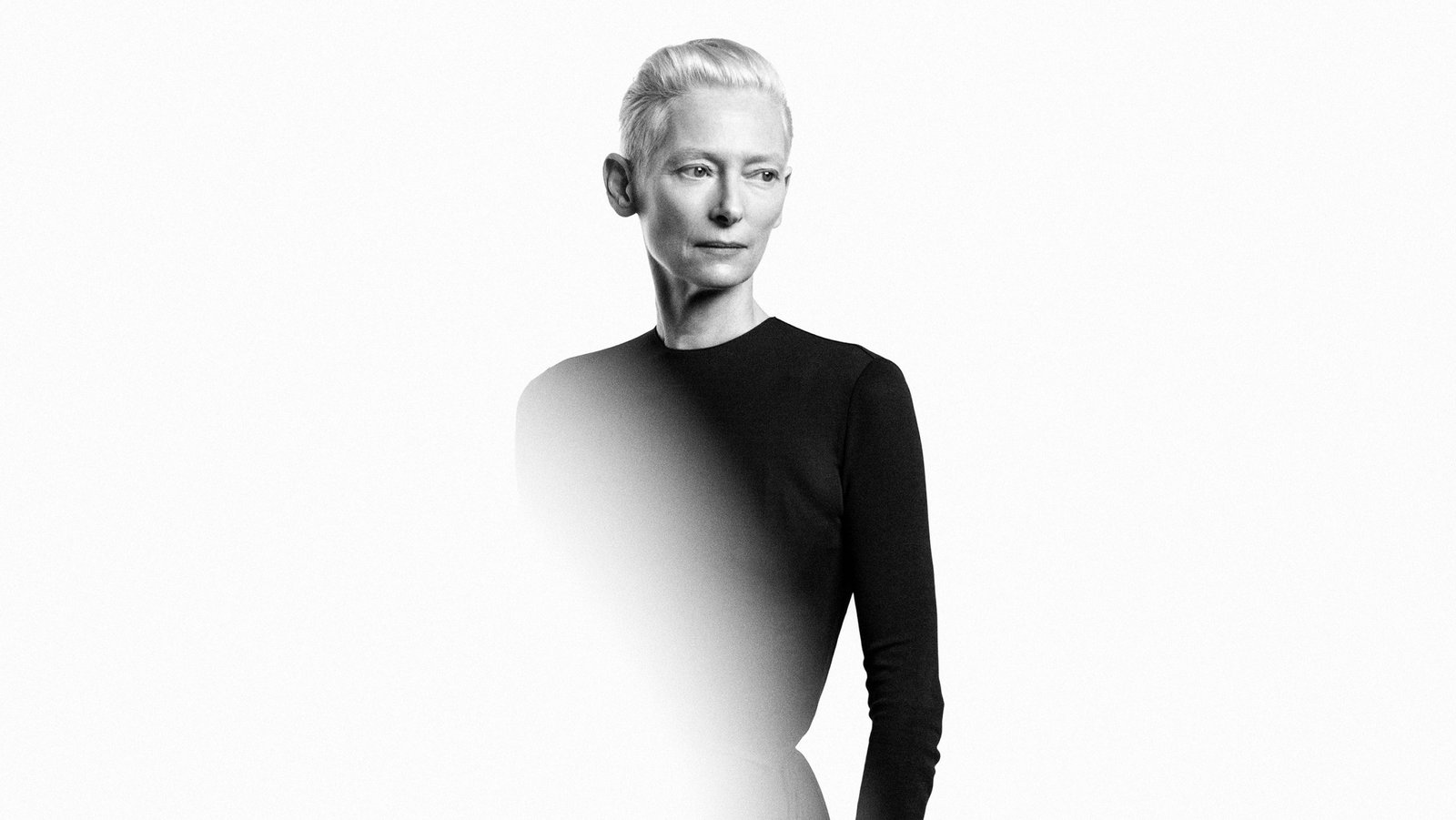
Twelve years after Olivier Saillard first handed her an 1810 jacket once worn by Napoleon Bonaparte on the second floor of the Palais de Tokyo, Tilda Swinton’s design projects have become a parallel filmography — a sequence of stagings that treat the archive, the runway and the museum as the same room. The Tilda Swinton design projects assembled between 2012 and 2026 do not look like an actor’s brand portfolio. They look like a curatorial practice: four Saillard performances, two knitwear capsules with the Hawick label HADES, a Gentle Monster eyewear campaign inside HAUS NOWHERE Seoul, and, on 5 and 6 June 2026, House of Gestures in the atrium of Frank Gehry’s Guggenheim Museum Bilbao — co-presented by Dom Pérignon to mark the unveiling of its 2018 vintage. The throughline is not celebrity. It is the object, the garment, and the room they share.
Tilda Swinton design projects, 2012–2026: the Saillard arc
To read the Tilda Swinton design projects in order, you have to begin with Olivier Saillard. The French curator, born in 1967, ran the Palais Galliera — Paris’s municipal fashion museum on Avenue Pierre 1er de Serbie — from 2010 to 2018, became Artistic Director of J.M. Weston in 2018, and has been at the helm of the Fondation Azzedine Alaïa in the Marais since 2017. His public method is performance: garments handled in front of an audience, narrated by their provenance rather than worn. Swinton arrived as his partner in that method in September 2012, and almost everything she has done in design since has been refracted through it.
The Impossible Wardrobe opened the cycle on 29 September 2012 and ran for two more nights — 30 September and 1 October — in the lower-ground galleries of the Palais de Tokyo on Avenue du Président Wilson, the 1937 contemporary art centre that had been programmed by Festival d’Automne Paris that autumn. The piece lasted forty minutes. Saillard, in a dark suit, lifted fifty-seven archival garments from the collection of the Palais Galliera and carried them, one at a time, across the floor to Swinton. The roll call was vertiginous: a Schiaparelli, a Balenciaga, a Chanel, a Dior, a Balmain, a 1968 Paco Rabanne metal-disc mini-dress once worn by Brigitte Bardot, an ermine collar that had belonged to Sarah Bernhardt, and the 1810 Napoleon Bonaparte jacket that the museum had held since the early twentieth century. Swinton received each piece, held it, walked it the length of the room, and returned it. She wore none of them. Her own costume was an ivory dust-cover kimono — the unbleached cotton sleeve that conservators slip over hangers to keep light off the cloth. The point, made explicitly by Saillard in the post-show notes, was that an archival garment cannot be worn without being damaged, and that the only honest way to display it on a body was to let the body bear it, not put it on.
The Eternity Dress followed in autumn 2013 at the auditorium of the École Nationale Supérieure des Beaux-Arts, on the Quai Malaquais in Paris, again under the Festival d’Automne banner. Where Impossible Wardrobe had been an inventory of finished objects, Eternity Dress was a construction. Saillard played the petite main — the seamstress’s apprentice — and built a single garment around Swinton on stage over the course of the piece. The cloth and references came from the Maison Chloé archive on Avenue Percier; the dress that existed at the end of the evening was a composite of every Chloé silhouette of the previous half-century. Saillard worked in a tailor’s apron and white gloves. He measured Swinton with a tape, marked seams in tailor’s chalk, pinned bodice pieces directly to the linen toile she was already wearing, and unpicked them as he went. The audience saw a dress invented from the inside out, and at the close of the piece Swinton walked the auditorium in the finished garment for less than ninety seconds before stepping back out of it. The point was that the dress had existed in front of the public for the entire forty-five minutes; only the last gesture turned it into clothing.
Cloakroom — Vestiaire Obligatoire came next, in 2014, originally staged in Paris and then restaged in the Saloncino of the Teatro della Pergola in Florence as a Fondazione Pitti Discovery project for Pitti Immagine. Swinton and Saillard worked the cloakroom: members of the audience handed over their own coats and bags at the door, and the two performers spent the piece classifying, hanging, mis-pairing, returning and re-describing them. The performance lasted as long as the public’s patience for being read by their outerwear — usually around fifty minutes.
The fourth performance, Embodying Pasolini, world-premiered on 25 June 2021 in the central hall of the Mattatoio — the former Testaccio slaughterhouse on Piazza Orazio Giustiniani in Rome, run by Azienda Speciale Palaexpo — as the headline commission of ROMAISON 2021. Studio Olivier Saillard produced it with Zétema and PalaExpo. The garments this time were not museum dress but cinema dress: the costumes Pier Paolo Pasolini’s leading actors had worn on screen, pulled from the Italian state’s film-archive holdings. Swinton handled the rough wool dress and apron that Anna Magnani had worn through the streets of the Borgata Gordiani for Mamma Roma in 1962, the structured Milanese tailoring Silvana Mangano had put on for the bourgeois interior scenes of Teorema in 1968, and the heavy embroidered robe Maria Callas had worn for the title role of Medea in 1969. She did not impersonate; she carried. The piece ran roughly fifty minutes and was performed twice over the ROMAISON weekend, the second night ending with the costumes lined back along a steel rail at the rear of the hall, lit from above, and left there as an exhibition that ran for the next month.
Four pieces, four cities, nine years: the Saillard arc is the spine of the Tilda Swinton design projects, and every later collaboration — knitwear, eyewear, champagne — has been organised around its central proposition. A garment is a record. The performer’s job is not to inhabit it but to read it aloud.
HADES: knitwear as character
In September 2024, that proposition migrated, for the first time, onto a commercial product line. Tilda Swinton x HADES, the first capsule with the British knitwear label HADES, landed in HADES’s own e-commerce and at a handful of stockists that autumn. HADES had been founded in 2016 by Eamonn McGill in Hawick, the Borders town in southern Scotland that has knitted cashmere and lambswool for the British and Italian luxury trade since the 1840s; its design is led from London by Cassie and Isabel Holland, the sisters who run the Swinton collaborations. The label’s earlier reputation had been built on its slogan jumpers — Latin tags, cigarette-pack typography, school-crest borrowings — and on a client list that included Alexa Chung and Chloë Sevigny.
The first Swinton capsule used four of her films as briefs. Female Perversions (1996), Susan Streitfeld’s adaptation of Louise Kaplan’s psychoanalytic study, produced a navy intarsia jumper. The Last of England (1987), Derek Jarman’s Super-8 elegy for Thatcherite Britain, produced a wool dress in burnt sienna with a stamped flag motif at the hem. Orlando (1992), Sally Potter’s adaptation of Virginia Woolf, produced a high-necked cream jumper with a chain-stitched line of the novel running across the breast. Suspiria (2018), Luca Guadagnino’s remake of Dario Argento, produced a blood-red cardigan with a coven of small embroidered figures along the sleeves. Every piece was knitted on the Hawick floor, in Scottish wool, on machines that pre-dated the label.
In spring 2026, the partnership returned with Notes from the Precipice, the second HADES x Tilda capsule. Six pieces: two jumpers, two hand-screenprinted skirts, a cotton dress and a cotton-silk shoulder bag. The texts printed and embroidered onto the fabric came from two of Swinton’s own 2025 statements — the acceptance speech she gave at the Berlinale on 13 February 2025, when she received the Honorary Golden Bear, and a poem she had circulated privately that summer titled “Notes for Radical Living.” Pricing ran from $237 for the cotton-silk bag to $677 for the heaviest jumper. The capsule sold through HADES’s e-commerce and through a five-day Soho London pop-up that opened in late April 2026 in a former gallery on Greek Street. The capsule is the existing partnership of record; the present article is its sibling rather than its replacement.
The screenprinting was done by hand in a small London studio rather than on a factory line, which is why the price ladder runs higher than HADES’s mainline knit. The phrases lifted from the Berlinale speech — Swinton had spoken from the Berlinale Palast stage about the obligation of an artist to “stand in the room with the people who are not safe” — were set in a slab serif and printed across the back of the long cotton skirt in ink that has been allowed to bleed slightly into the weave. The cotton-silk bag carries a single line from “Notes for Radical Living” in chain-stitch embroidery along its strap. The two heavy jumpers, both knitted in Hawick on the same machines that produced the 2024 film-titled run, leave the phrases unsaid: they are plain, oversized, in deep oatmeal and dark moss, and were sold first because the existing HADES customer recognised them as HADES before recognising them as Swinton.
The HADES collaborations matter inside the Tilda Swinton design projects because they are the only commercial line — the only thing you can buy and wear — and because the design logic is identical to Saillard’s. The film titles are the archive; the knit is the body; the printed phrase is the narration. A Swinton HADES jumper is a wearable cousin of Cloakroom: a garment that tells you what it is for.
Gentle Monster BOLD 2025, HAUS NOWHERE Seoul
On 6 September 2025, the South Korean eyewear house Gentle Monster released BOLD with Tilda Swinton, a campaign film built around four oversized acetate frames from its autumn collection. The piece was shot inside HAUS NOWHERE Seoul — Gentle Monster’s six-storey conceptual retail-and-exhibition space in the Sinsa-dong district — by the Catalan director Mau Morgó, whose work for Loewe, Carhartt WIP and Marc Jacobs had already pushed the fashion campaign toward staged choreography. The soundtrack was “AS Disco,” a track by the Berlin–Helsinki duo Amnesia Scanner with Freeka Tet, all distorted snare and dial-tone bass.
What Gentle Monster bought, in commissioning Swinton, was not a face but a posture: she walked the HAUS NOWHERE atrium frame by frame, paused, swapped, turned, sat. The film reads like a fifth Saillard performance with sunglasses substituted for archival couture. Pop-ups followed in three cities — the Apgujeong flagship in Seoul, the Sanlitun store in Beijing, the Aoyama outpost in Tokyo — each running for two weeks and each rebuilt around a still from the Morgó film. The campaign is included here because it is the only Tilda Swinton design project of the cycle that operates primarily as image: a photograph and a clip rather than a worn object. But the grammar is the same. Swinton handles the frames. She does not endorse them.
House of Gestures: Guggenheim Bilbao, June 2026
On the evenings of 5 and 6 June 2026, Swinton and Saillard will mount House of Gestures in the atrium of the Guggenheim Museum Bilbao — the 55-metre central void that Frank Gehry called “The Flower” when the building opened to the public on 18 October 1997, and that has remained the museum’s single most recognisable interior. The atrium rises from the floor of the museum’s lowest level to a skylight at the top of a titanium-and-zinc-clad tower on the south bank of the Nervión river. Its limestone-clad walls fold and lean; its catwalks cross it at three heights. Saillard’s brief, made public in the museum’s 21 May 2026 press note when free registration opened, is to use the entire vertical of the space.
The performance has no script and no speech. Garments — Saillard has not, at the time of this writing, named the specific archive — will be carried out, worn, replaced and re-hung in front of the standing audience over the course of an hour. Each evening will admit roughly four hundred people, the maximum the atrium can hold under Spanish fire code, and registration is free through the museum’s website.
The co-presenter is Dom Pérignon, the vintage-only champagne house owned by LVMH through Moët & Chandon and run since 2019 by chef de cave Vincent Chaperon. Chaperon is named in the museum’s press materials as a “conceptual contributor,” which in practice means that House of Gestures coincides with the unveiling of Dom Pérignon Vintage 2018, the house’s first release from the 2018 harvest. The pairing is not a sponsorship in the ordinary sense — there is no logo on the stage and no tasting embedded in the performance — but it is the first time Saillard and Swinton have worked under a commercial co-presentation, and the first time a Dom Pérignon vintage has been launched inside a Frank Gehry building.
For Swinton, House of Gestures is the first major performance commission of her career to take place inside a piece of canonical contemporary architecture. The Mattatoio is industrial heritage; the Palais de Tokyo is municipal modernism; the École des Beaux-Arts auditorium is a teaching hall; the Saloncino of the Pergola is a nineteenth-century theatre. Gehry’s Guggenheim is the first explicitly authored, single-architect, post-1990 building in the sequence. The choice is the point. The atrium will hold the garments; the building will hold the atrium; the public will hold both.
Every Tilda Swinton x Olivier Saillard performance, 2012–2026
- 2012 — The Impossible Wardrobe — Palais de Tokyo, Paris (Festival d’Automne) — 40 minutes, three nights, 57 archival garments handed across the floor.
- 2013 — The Eternity Dress — auditorium, École Nationale Supérieure des Beaux-Arts, Paris (Festival d’Automne) — single garment built on stage, Maison Chloé archive.
- 2014 — Cloakroom — Vestiaire Obligatoire — Saloncino, Teatro della Pergola, Florence (Pitti Immagine / Fondazione Pitti Discovery) — audience coats and bags, c. 50 minutes.
- 2021 — Embodying Pasolini — central hall, Mattatoio, Rome (ROMAISON 2021, Studio Olivier Saillard with Zétema and PalaExpo) — Pasolini film costumes from Italian archives.
- 2026 — House of Gestures — atrium, Guggenheim Museum Bilbao (co-presented by Dom Pérignon, Vintage 2018) — 5 and 6 June 2026, free public registration, no script, no speech.
What unites a knit jumper and a Gehry atrium
The fastest way to misread the Tilda Swinton design projects is to treat them as the side hustle of an actor who happens to like clothes. The slower, more accurate reading is that they are a single curatorial argument staged in four registers — performance, knitwear, eyewear, and architecture — and that what they share is an archival logic. Every object in the body of work points away from itself. The 1810 Napoleon jacket pointed to the museum vitrine it had come from. The Hawick jumper points to Suspiria and to the Borders mill that knitted it. The Gentle Monster frame points to the HAUS NOWHERE atrium and to Morgó’s camera. The garment that will move through Gehry’s “Flower” on 5 June 2026 will point — by the design of both Swinton and Saillard — to the building itself, and beyond it to every previous room in the cycle. The throughline is provenance. The object only matters because of where it came from and because someone in front of you is willing to say so out loud. That is the rule that organises the Tilda Swinton design projects, and it is the rule the Bilbao performance will test at the largest scale yet.