When the Obama Presidential Center dedicates its 19.3-acre campus at 6001 S. Stony Island Avenue on 18 June 2026 and opens to the public on Juneteenth, it will be the largest civic commission Tod Williams Billie Tsien Architects have completed in forty years of practice — and only the sixth public-campus building they will have placed on a site they did not previously own as architects of record. The shape of the answer to “how did a small Manhattan firm best known for the demolished American Folk Art Museum end up designing a presidential museum on Chicago’s South Side?” is a forty-year arc that runs through La Jolla, Manhattan, Hong Kong, Philadelphia, Princeton and Lincoln Center, and that builds tod williams billie tsien architecture one small civic building at a time. This piece walks that arc in order.
The arc has a method. Tod Williams and Billie Tsien began collaborating in 1977 and founded their firm in 1986. They received the National Medal of Arts and the AIA Firm of the Year award in 2013, both in the same calendar year, after thirty-six years of partnership and roughly a dozen completed buildings. The portfolio is short on purpose. Every project on it is a cultural or research institution; almost every one sits inside a larger civic campus the firm did not master-plan; and almost every one is clad in a material that reads as stone from across a plaza and as handwork at the threshold. That material thinking — folded white-bronze tombasil at 53rd Street, cantilevered concrete in Admiralty, light stone with a brise-soleil at Jackson Park — is the through-line.
Neurosciences Institute, La Jolla, 1995
The first building in the canonical Tod Williams Billie Tsien lineage is the Neurosciences Institute, completed in 1995 on the Torrey Pines Mesa above La Jolla. The brief from the institute’s founder Gerald Edelman was for a three-building complex housing laboratories, a 350-seat auditorium and a fellows’ residence, arranged around a sunken plaza cut into the Pacific bluff. The complex won the 1997 AIA Honor Award. It is also the first project in which the firm’s working method is fully legible: a public research institution sited inside a larger campus (the Scripps Research mesa), clad in tilt-up concrete and slate, organised around an outdoor room rather than a corridor. The auditorium’s freestanding pavilion, set diagonally to the laboratory block, prefigures the way the Forum and Museum buildings will be set against each other at Jackson Park thirty-one years later.
La Jolla is also the project that establishes scale. The Neurosciences Institute is roughly 50,000 square feet on a six-acre lot — small enough to be drawn in detail, large enough to register as a piece of a campus rather than a single object. Every subsequent Tod Williams Billie Tsien commission sits inside that scalar window until 2021.
American Folk Art Museum, 53rd Street, 2001
The American Folk Art Museum opened in December 2001 at 45 West 53rd Street in Manhattan, on a 40-foot-wide lot squeezed between MoMA’s then-eastern flank and the CBS Building. The street frontage was a folded panel of white-bronze tombasil, an alloy of copper, zinc and tin cast in sand moulds to produce a faceted surface that read at street level as something between hammered metal and stone. The interior was a vertical stair atrium lit from above, with galleries pinwheeling off four landings. It was the firm’s first nationally reviewed cultural commission and remains, with the Barnes, their most photographed facade.
The 53rd Street site was sold to the Museum of Modern Art in 2011, after the Folk Art Museum’s bond default, and the building was demolished in 2014 to make way for Diller Scofidio + Renfro’s MoMA expansion. The demolition is part of the lineage. It is the reason every subsequent TWB cultural commission has been on a site the institution either owned outright or had a long-term ground lease over; it is the reason the OPC site at the western edge of Jackson Park was negotiated with the Chicago Park District before design began; and it is the reason the firm’s later facades are mostly stone rather than cast metal.
Asia Society Hong Kong, Admiralty, 2012
The Asia Society Hong Kong Center opened on 9 February 2012 at 9 Justice Drive in Admiralty, on a hillside compound that had served as a British military explosives magazine from the 1860s until the 1990s. The brief was an adaptive reuse: four nineteenth-century powder magazines and a former laboratory were stabilised and rewired as galleries, a 100-seat theatre and a café; two new buildings — a reception pavilion and an exhibition hall — were inserted between them. The two halves of the compound, separated by a steep ravine, were stitched together by a pair of cantilevered footbridges that hang over a protected fruit-bat colony.
Hong Kong is the first international commission in the canon and the first project in which the firm worked at the scale of a campus rather than a building. The bridges are the structural set piece: they are visibly cantilevered, paved in granite, and threaded between trees that the bat colony nests in. The site planning logic — keep the historic fabric, insert new pavilions between it, link the whole with a pedestrian armature — is the template the firm carries to Jackson Park.
Barnes Foundation, Philadelphia, 2012
The Barnes Foundation opened on 19 May 2012 at 2025 Benjamin Franklin Parkway in Philadelphia, four months after the Hong Kong building. The brief was a constraint: the new gallery wing had to replicate, room by room, the exact proportions and wall sequence of Albert Barnes’s original 1925 Merion gallery, including the ensembles in which Barnes had hung Cézanne, Matisse and Renoir. Tod Williams Billie Tsien Architects built a stone-clad pavilion — Negev limestone, laid in a deep horizontal coursing — around that replicated interior, with a “Light Court” gallery and a 150-seat auditorium attached. The complex was certified LEED Platinum and won the 2013 AIA Institute Honor Award for Architecture.
The Barnes is the project that established Tod Williams Billie Tsien architecture as a national institutional language. The Negev limestone facade is the direct ancestor of the light-stone cladding now wrapping the 225-foot OPC museum tower. The Light Court — a top-lit double-height room used for events, set against a low gallery block — is the direct ancestor of the OPC Forum building. Even the budget shape (a roughly $150 million project with a discrete, repeatable interior at its centre) prefigures the way the OPC museum is organised around an Oval Office replica.
Logan Center for the Arts, Chicago’s first TWB anchor
In October 2012, eight months after Philadelphia, the Logan Center for the Arts opened at 915 East 60th Street on the University of Chicago campus, four blocks west of the future Obama Presidential Center site. The brief was a 184-foot tower housing performance halls, recital rooms, a 474-seat theatre, gallery space and arts faculty offices, set at the southern edge of the Hyde Park campus on the 60th Street boundary between the university and the Washington Park neighbourhood. The tower is clad in pale limestone with deep-set windows; the ground-floor performance hall faces east, toward Jackson Park.
The Logan Center is the first piece of tod williams billie tsien architecture on the South Side. Every subsequent piece of the Chicago corridor reads through it. It is the building the Obama Foundation selection committee visited in 2016 when it was shortlisting architects for the presidential center; it is the building Theaster Gates has cited as the proof that an outside firm could build on the South Side without erasing it; and it is the project that established the firm’s relationship with the University of Chicago, which retains an academic affiliation with the Obama Foundation. The Logan Center prefigured the OPC commission on the same South Side corridor in a way no other building in the portfolio could have.
Andlinger Center and David Geffen Hall, 2015-2022
The middle years of the canon — between Logan and the Obama Center — are two campus insertions on East Coast institutions where the firm had longstanding relationships. The Andlinger Center for Energy and the Environment opened on the Princeton University campus in 2015. The brief was 129,000 square feet of energy laboratories, much of it requiring vibration isolation and clean-room conditions, on a tight site near Olden Street. The firm buried half the programme below grade and organised the above-grade volumes around a partly sunken courtyard, with brick and cast stone facades that tie the new complex to Princeton’s prewar campus. Tod Williams’s own Princeton education (BA 1965, M.F.A. 1967) and his fellowship at the American Academy in Rome are visible in the courtyard logic.
David Geffen Hall reopened on 8 October 2022 at 10 Lincoln Center Plaza after a $550 million renovation of the former Philharmonic Hall on the Lincoln Center campus. Tod Williams Billie Tsien Architects led the public-space design — a new Welcome Center on Broadway, a 50-foot media wall in the lobby, and the reorganised grand promenade — while Diamond Schmitt redesigned the 2,200-seat auditorium itself. The Geffen Hall commission is the project in which the firm worked at the scale of a public lobby that has to host thousands of nightly visitors and at the scale of a curated room at the same time. It is the immediate rehearsal for the Forum building at Jackson Park.
Tod Williams Billie Tsien architecture, a 1995-2026 timeline
| Year | Building | City | Program |
|---|---|---|---|
| 1995 | Neurosciences Institute | La Jolla, CA | Research institute, auditorium, fellows’ residence |
| 2001 | American Folk Art Museum | New York, NY | Museum (demolished 2014) |
| 2012 | Asia Society Hong Kong Center | Admiralty, Hong Kong | Galleries, theatre, café (adaptive reuse) |
| 2012 | Barnes Foundation | Philadelphia, PA | Museum, auditorium, education centre |
| 2012 | Logan Center for the Arts | Chicago, IL | Performance halls, gallery, arts faculty |
| 2015 | Andlinger Center for Energy and the Environment | Princeton, NJ | Energy laboratories, courtyard |
| 2022 | David Geffen Hall (public spaces) | New York, NY | Concert-hall lobby, Welcome Center, promenade |
| 2026 | Obama Presidential Center | Chicago, IL | Museum, Forum, library, foundation HQ |
Eight canonical buildings in thirty-one years. The cadence is roughly one every four years, with three buildings clustered in 2012 — the year of the canon’s centre of gravity — and a four-year gap (2022-2026) into which the Obama Presidential Center falls.
Obama Presidential Center, Jackson Park, 2026
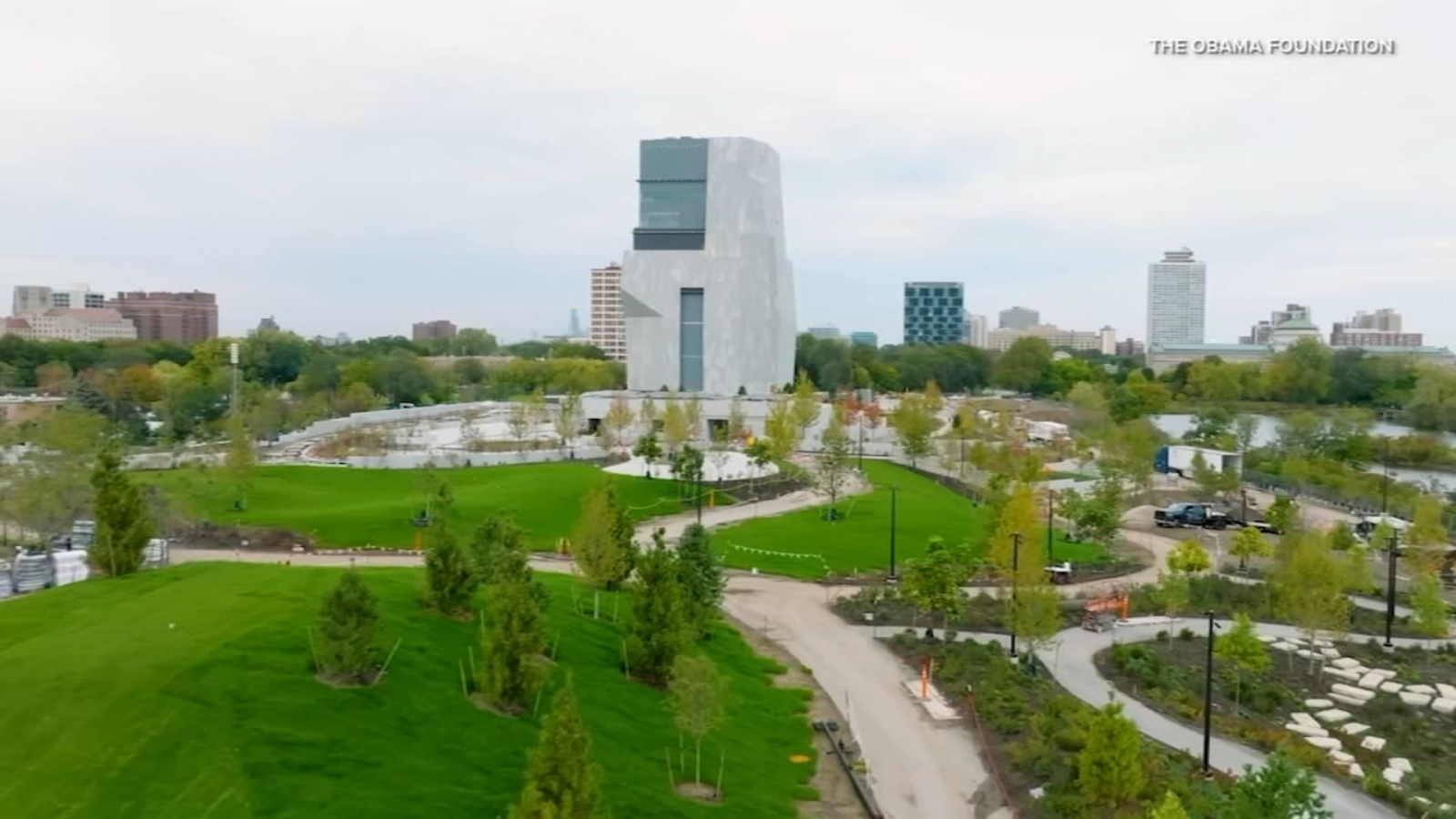
The Obama Presidential Center campus covers 19.3 acres at 6001 S. Stony Island Avenue in Woodlawn, on the western edge of Jackson Park where the park meets Stony Island Avenue. The dedication ceremony is on 18 June 2026; the public opening is on Juneteenth, 19 June 2026. The estimated project budget is $850 million. Groundbreaking was on 16 August 2021; the museum tower topped out in mid-2024; the campus has been substantially complete since the first quarter of 2026. Construction has been managed by Lakeside Alliance, a joint venture between Turner Construction and four African-American-owned Chicago firms.
The centrepiece is the 225-foot museum tower, nicknamed the “Obamalisk” by Chicago press during construction. It is clad in light-coloured stone — the cladding programme is the direct heir of the Negev limestone at the Barnes — and carries a brise-soleil across its upper third that reads, in 1.5-metre letters at the building’s scale, as quotations from Barack Obama’s “You are America” speech delivered at Selma in March 2015. The text is the facade. It is the most explicit narrative gesture in the canon, and it is set on the building furthest from Manhattan in the canon.
The tower stands at the north end of a campus that also includes a Forum building (a low, top-lit pavilion descended from the Barnes Light Court), a public Library that incorporates a branch of the Chicago Public Library system, the Obama Foundation headquarters offices, and a museum interior whose narrative spine includes a full Oval Office replica. Outside the buildings, the campus is organised around three landscape rooms. John Lewis Plaza, a paved civic square named for the Selma marcher and Georgia congressman, sits between the Forum and the Museum. The Eleanor Roosevelt Fruit and Vegetable Garden is set against the western edge of the campus. A water fountain by Maya Lin, whose Vietnam Veterans Memorial sits on the same civic-memorial axis the firm has been studying since La Jolla, is sited at a campus threshold.
The architectural team is a deliberate coalition. Moody Nolan, the largest African American-owned architecture firm in the United States, designed the Programs and Athletics Center on the campus’s southwest corner; the building is called “Home Court” and houses a regulation basketball court, programme rooms, and a public-facing community fitness space. Michael Van Valkenburgh Associates led the campus landscape, including the John Lewis Plaza paving, the Roosevelt garden, the new tree canopy along Stony Island Avenue and the regraded park edge where the campus rejoins Jackson Park’s existing Olmsted plan. Ralph Appelbaum Associates designed the museum’s permanent exhibitions, including the Oval Office replica. Tod Williams Billie Tsien Architects are the design architects of record for the campus master plan and for the Museum, Forum, Library and Foundation HQ buildings.
The OPC commission is the first nine-figure project in the firm’s history. It is also the first project on which the firm has worked as one of several architects of record on a single site rather than as the sole author of a single building. The earlier campuses in the canon — Asia Society Hong Kong, the Barnes, Logan — were sites the firm shaped end to end. Jackson Park is the project on which the firm’s method scales to a coalition.
Tod Williams and Billie Tsien, forty years of partnership
The firm’s two principals carry the lineage. Tod Williams was born in 1943 in Detroit, took his undergraduate and graduate degrees at Princeton, and was elected a Fellow of the American Academy in Rome — the Roman fellowship is the explanation for the courtyard at Princeton, the sunken plaza at La Jolla and the John Lewis Plaza at Jackson Park, which are three versions of the same room. Billie Tsien was born in 1949 in Ithaca, New York, took her BA in Fine Arts from Yale and her M.Arch from UCLA, and has served as president of the Architectural League of New York. In 2021 she was appointed by President Joseph Biden to the United States Commission of Fine Arts, the federal body that reviews the design of public buildings in Washington and on federal sites. That appointment landed five years into the OPC commission and three years before the museum tower topped out; the symmetry is real.
Williams and Tsien began collaborating in 1977, nine years before the firm’s official founding in 1986. The forty-year partnership has produced roughly one building every four years and has refused to scale into a large-office practice. The studio remains under sixty people, occupies a single floor in Manhattan, and rotates principals through every project. The Obama Presidential Center is the project on which that small-office model meets a federal-scale civic brief. The pairing is not a contradiction; it is the canon’s argument.
The patronage shape matters. The firm’s earlier commissions were given by single founders or boards — Gerald Edelman at La Jolla, Albert Barnes’s trustees in Philadelphia, the Asia Society’s Hong Kong board, the University of Chicago at Logan — and the buildings carry the imprint of a single client. The Obama Presidential Center is the firm’s first project for a presidential foundation, a federally chartered nonprofit advised by a former president and his wife, with a board that includes corporate, civic and cultural patrons. The architectural method has had to absorb a wider patronage shape without losing the small-office detail. Forty years of one building every four is the precondition for that absorption.
Coda
When the Obama Presidential Center opens to the public on Juneteenth 2026, the building it most resembles in the canon is not Geffen Hall and not the Barnes. It is the Neurosciences Institute in La Jolla, thirty-one years and roughly twenty times the budget removed. Both are research-and-public-program complexes sited on the edge of a larger civic landscape they did not master-plan; both are organised around an outdoor room set diagonally to a clad volume; both pair a stone-feeling facade with a more transparent low pavilion. The firm has not changed its method to absorb a presidential brief. It has scaled the method up. The argument tod williams billie tsien architecture has made on the western edge of Jackson Park is that a small-office method, applied to roughly one civic building every four years for forty years, is the method that can hold a 19.3-acre campus together. The opening on 19 June 2026 is the test of that argument at full scale.