The Obama Presidential Center opens to the public on Juneteenth 2026 at 6001 S Stony Island Avenue, eleven years and seven blocks north of the 1923 bank at 6760 S Stony Island that Theaster Gates restored in 2015 as the inaugural Chicago Architecture Biennial venue. Read together, those two addresses sketch the spine of a sustained Chicago South Side cultural patronage campaign that runs along a single avenue and binds an artist-led nonprofit, a presidential foundation and a New York architecture studio into one continuous urban project. The shape of the answer to “what happened on the South Side between 2015 and 2026?” is not a list of buildings. It is a corridor.
This piece walks that corridor in order. It begins in 2009 with the founding of Rebuild Foundation and Theaster Gates’s first acquisitions on Dorchester Avenue, threads through the Currency Exchange Cafe in Washington Park and the Dorchester Art + Housing Collaborative, lands at the Stony Island Arts Bank in October 2015, and ends on 19 June 2026 at the dedication of the 19.3-acre Obama Presidential Center campus in Jackson Park. The argument is that a sustained Chicago South Side cultural patronage practice has now produced its largest civic building and that the building’s site is not an accident.
Theaster Gates and Rebuild Foundation, 2009-2014
The patronage campaign on Chicago’s South Side has a founding instrument and a founding artist. Rebuild Foundation was founded by Theaster Gates in 2009 as the nonprofit vehicle through which his cultural real estate practice would operate. From the start the foundation’s mandate was specific: the restoration and reactivation of cultural buildings in the Grand Crossing, Washington Park and Greater Grand Crossing neighbourhoods on the city’s South Side, with a working method built around acquired archives and the buildings put up to hold them. That method first appeared at 6916 S Dorchester Ave in Grand Crossing, where Gates established the Dorchester Projects in 2009. The complex paired two structures with two collections: the Archive House, which holds roughly 14,000 architecture books salvaged from the closed Prairie Avenue Bookshop, and the Listening House, which holds roughly 8,000 records from the closed Dr. Wax Records. The buildings were the binding; the books and the vinyl were the text.
That working method — acquire an abandoned South Side building, acquire an at-risk archive, weld the two together as a public room — is the through-line of every Rebuild Foundation site that follows. Each new site adds another archive to the network and another address to the corridor. The thinking is closer to a library system than to a museum exhibition programme.
In October 2012, three years after Dorchester Projects, Rebuild Foundation opened the Black Cinema House at 6901 S Dorchester Ave, a few doors from the Archive and Listening Houses. The building was restored to hold a programme of Black film, partially funded by an NEA Creative Placemaking grant. The funding stream confirmed that the South Side patronage campaign had a name in federal arts policy.
Two more sites filled out the pre-2015 footprint. In 2014 Rebuild Foundation opened the Currency Exchange Cafe at 305 E Garfield Blvd in Washington Park, a roughly 2,500 sq ft cafe in a former neighbourhood currency exchange. The address is significant: Washington Park sits on the north-western edge of Jackson Park, on the same Olmsted-designed South Side park system that the Obama Presidential Center would eventually anchor. The cafe has since been re-staged twice, first as Retreat in 2020 and then as A Listening Space in 2025. The same room has now hosted three iterations of the Rebuild Foundation’s public programme without changing address.
The second pre-2015 site is the Dorchester Art + Housing Collaborative, 32 mixed-income rental units at 6949 S Dante Ave in Grand Crossing with integrated arts, theater and dance space, developed by Brinshore Development with Rebuild Foundation. The collaborative moved Gates and Rebuild from cultural real estate into residential real estate, and it did so at exactly the moment the Obama Foundation was being formed in 2014 to plan its presidential campus three miles east. The two campaigns developed on a shared timeline.
Stony Island Arts Bank: from 1923 building to 2015 archive
The Stony Island Arts Bank opened on 3 October 2015 at 6760 S Stony Island Ave as a venue of the inaugural Chicago Architecture Biennial. The building was designed in 1923 by William Gibbons Uffendell as a neighbourhood bank, and it had stood derelict for decades by the time Theaster Gates bought it from the City of Chicago in 2013 for one US dollar. The dollar was the price; the cost was the restoration, which Gates partly financed through the sale of bond certificates printed on Carrara marble salvaged from the bank itself. The Stony Island Arts Bank was the first building in the Rebuild Foundation network to fund its own restoration through an artwork derived from its own demolition.
Its public opening doubled as a biennial opening. The Chicago Architecture Biennial’s inaugural director programmed the artist-restored South Side bank as a venue, which placed the patronage campaign inside an international architecture conversation at the moment the venue itself opened. Stony Island Arts Bank became, in the same week, a Rebuild Foundation site and a biennial pavilion.
What the bank now holds is the strongest evidence that the Rebuild Foundation method is a library practice. Its collections include the Johnson Publishing Company library — the editorial archive of the Chicago-based publisher of Ebony and Jet — together with Frankie Knuckles’s personal house music records and lantern-slide collections drawn from the University of Chicago and the Art Institute of Chicago. Read as a single set, the four archives describe a particular cultural geography: Black Chicago publishing, Black Chicago music, and the visual teaching collections of the institutions that sit on the South Side. The bank is the room that holds that geography.
The Stony Island Arts Bank is the hinge of the patronage campaign. After 2015 the corridor it occupied — Dorchester to Stony Island, Grand Crossing through Washington Park — was legible as a single sustained piece of cultural urbanism. Earlier coverage of the broader Theaster Gates commissions catalogue from 2010 to 2026 places the bank inside the artist’s wider portfolio of pavilions and acquisitions; here the same building reads as the inflection point of a city-scale patronage project.
The Rebuild Foundation footprint: a five-site South Side corridor
Five sites is the number to remember. Between 2009 and 2015 Rebuild Foundation acquired and restored five South Side buildings, each holding either an archive, a programme or a residential population, and each within walking distance of the next. The list as it stood at the moment the Stony Island Arts Bank opened in October 2015 was Dorchester Projects (2009, 6916 S Dorchester Ave), Black Cinema House (October 2012, 6901 S Dorchester Ave), Currency Exchange Cafe (2014, 305 E Garfield Blvd), Dorchester Art + Housing Collaborative (32 units at 6949 S Dante Ave) and Stony Island Arts Bank (3 October 2015, 6760 S Stony Island Ave).
The geography binds the list. Dorchester, Dante and Stony Island are parallel north-south streets running through Grand Crossing on the South Side, and the Dorchester Projects, Black Cinema House and Dorchester Art + Housing Collaborative addresses sit within a three-block square between them. The Currency Exchange Cafe is further west on Garfield Boulevard, but Garfield Boulevard is the east-west spine of the Olmsted boulevard system that connects Washington Park to Jackson Park. The five Rebuild sites are not scattered across the South Side. They sit on a coherent corridor whose eastern terminus, by 2015, was already 6760 S Stony Island Ave.
The five-site footprint also fixes the campaign’s relationship to public money. The Black Cinema House drew on an NEA Creative Placemaking grant. The Dorchester Art + Housing Collaborative was developed with Brinshore Development under a mixed-income housing structure. The Stony Island Arts Bank’s land transfer from the City of Chicago for one dollar was itself a municipal subsidy. The patronage campaign is privately led but publicly braided — a detail that predicts the funding shape of the much larger civic building that landed on the same avenue eleven years later.
Obama Foundation and the move to Jackson Park
The Obama Foundation was founded in 2014, the same year the Currency Exchange Cafe opened on Garfield Boulevard. Its CEO is Valerie Jarrett. Its South Side site choice — Jackson Park, the Frederick Law Olmsted-designed park that anchors the south-eastern corner of the South Side park system — placed it at the eastern end of the same Olmsted corridor on which Rebuild Foundation had already built its footprint.
Jackson Park matters because of who designed it. Frederick Law Olmsted laid out the South Side park system, including Washington Park and Jackson Park, as a continuous designed landscape connected by boulevards. The Currency Exchange Cafe sits on one of those boulevards. The Stony Island Arts Bank sits on Stony Island Avenue, which forms the eastern edge of Jackson Park. The Obama Presidential Center sits inside Jackson Park, at 6001 S Stony Island Ave. The three sites — cafe, bank, presidential campus — sit on a single Olmsted-era infrastructure that already linked the South Side cultural landscape before either foundation existed. The patronage campaign is, in part, a re-occupation of a nineteenth-century landscape plan.
The Obama Foundation’s site selection therefore did two things at once. It claimed the most prominent South Side park as the address for the first fully digitized presidential library, and it folded the foundation into a cultural corridor that Theaster Gates and Rebuild Foundation had already been building for five years. The Obama campus did not invent the South Side as a site for cultural patronage. It inherited a corridor that had been under construction since 2009 and gave it a 19.3-acre eastern anchor.
Obama Presidential Center: 19.3 acres on Stony Island
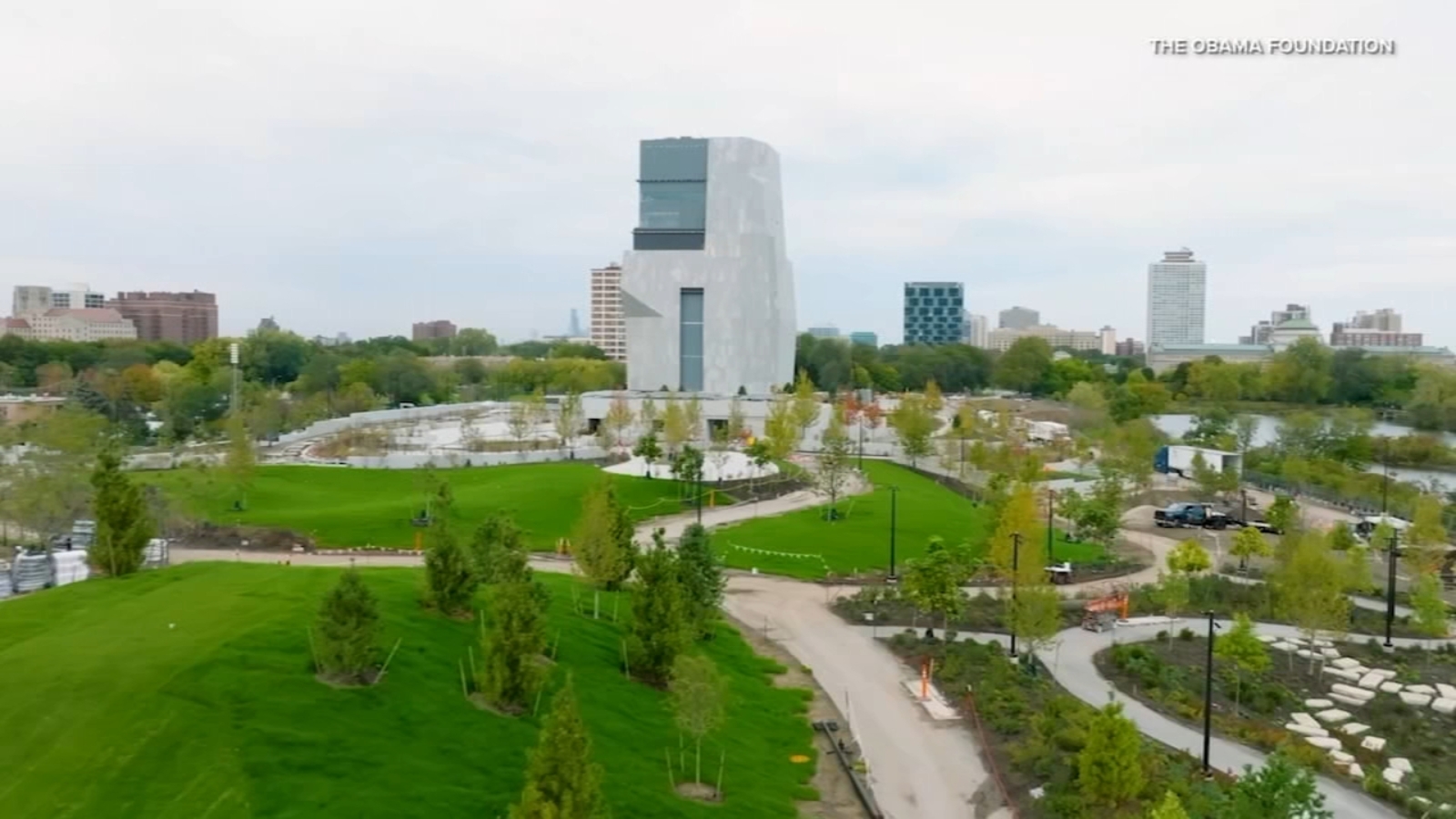
The Obama Presidential Center campus occupies 19.3 acres of Jackson Park at 6001 S Stony Island Ave on Chicago’s South Side. It was dedicated on 18 June 2026 and opened to the public on 19 June 2026, Juneteenth. The total cost is approximately USD 850M. The City of Chicago owns the completed center and leases it to the Obama Foundation under a 99-year lease, which is the second time on this corridor that the City of Chicago has transferred control of a cultural building to a nonprofit operator under a long-dated arrangement, the first being the one-dollar sale of the Stony Island Arts Bank to Theaster Gates in 2013.
The campus is a composite of five distinct buildings. The Museum is a 225-foot tower locally nicknamed the Obamalisk and is the dominant figure on the Jackson Park skyline. The Forum holds the auditorium and a restaurant. The Library is operated jointly with the National Archives and Records Administration (NARA) and, on opening, is the first fully digitized presidential library in the NARA system. The Home Court is a sports facility designed by Moody Nolan. A Chicago Public Library branch sits inside the campus and connects the presidential library to the city’s neighbourhood library system. The campus is essentially a public quarter rather than a single monument.
The landscape architect of record is Michael Van Valkenburgh Associates, working with Chicago-based Site Design Group and Living Habitats. The landscape design includes the Ann Dunham Water Garden, named for Barack Obama’s mother, and the water garden holds Maya Lin’s sculptural fountain. Lin’s role at the OPC is sculptural rather than landscape-architectural: she designed the fountain, titled Seeing Through the Universe, that anchors the water garden. The distinction matters because it correctly attributes the campus’s two co-equal disciplines — landscape and sculpture — to their separate authors.
A Domus dispatch dated 8 June 2026 set out the campus configuration ten days before the dedication. The opening on Juneteenth bound the dedication to the day commemorating the end of slavery in the United States, and the choice of date was internally consistent with the site choice. The Obama Foundation had built its presidential center on Chicago’s South Side, on land transferred from the City of Chicago under a 99-year lease, and had opened it on the day African American emancipation is publicly remembered.
Tod Williams Billie Tsien: from Folk Art Museum to OPC
The Obama Presidential Center was designed by Tod Williams Billie Tsien Architects with Chicago-based Interactive Design Architects as associate architect. The studio was founded in New York in 1986 by Tod Williams (b. 1943, Detroit) and Billie Tsien (b. 1949, Ithaca, NY), who had begun collaborating in 1977. Williams holds two Princeton degrees. Tsien holds a Yale BA in Fine Arts and a UCLA M.Arch. They received the National Medal of Arts from President Obama in 2013, the date that matters for the OPC commission: by 2013 the architects had a documented relationship with the future client.
The studio’s key works form a tight portfolio. The American Folk Art Museum in New York opened in 2001, a bronze-clad infill building on West 53rd Street that became the most-discussed museum of its decade. The Barnes Foundation in Philadelphia opened in 2012, the year before the National Medal of Arts. The David Geffen Hall renovation at Lincoln Center, completed in 2024, was the studio’s most recent major work before the OPC.
The OPC reads as the studio’s largest single project to date and the first that is a campus rather than a building. The 225-foot Museum tower is taller than any previous Tod Williams Billie Tsien object; the 19.3-acre site is larger than any previous Tod Williams Billie Tsien site. The Forum, Library, Museum, Home Court and Chicago Public Library branch each have their own footprint, and the studio’s job has been to compose them as a single piece of urbanism within the Michael Van Valkenburgh landscape.
Maya Lin in the Ann Dunham Water Garden
Maya Lin’s fountain at the Obama Presidential Center is titled Seeing Through the Universe and sits inside the Ann Dunham Water Garden, the campus landscape feature named for Barack Obama’s mother. Lin is the artist of the fountain. She is not the landscape architect of the OPC campus, which is Michael Van Valkenburgh Associates with Site Design Group and Living Habitats. The distinction is worth holding because Lin’s career — beginning with the Vietnam Veterans Memorial in Washington — has often blurred the line between sculpture and landscape. At the OPC her role is sculptural and is contained inside the water garden.
Naming the water garden for Ann Dunham, the anthropologist mother of the first African American president, attaches the personal biography of the Obama family to the campus’s hydrological feature in the same way the Juneteenth opening attaches the campus’s date to American emancipation history. Both gestures are biographical and historical at once. Lin’s fountain inside that garden is the sculptural object that fixes the gesture in physical form.
The corridor on Stony Island Avenue, 2015-2026
A chronological table is the cleanest way to read the patronage corridor that runs along Stony Island Avenue and its parallel streets.
| Year | Project | Address | Steward / Operator | Architect / Designer |
|---|---|---|---|---|
| 2009 | Dorchester Projects | 6916 S Dorchester Ave, Grand Crossing | Rebuild Foundation | Theaster Gates (artist-led restoration) |
| 2012 | Black Cinema House | 6901 S Dorchester Ave, Grand Crossing | Rebuild Foundation | Theaster Gates (artist-led restoration) |
| 2014 | Currency Exchange Cafe | 305 E Garfield Blvd, Washington Park | Rebuild Foundation | Theaster Gates (artist-led restoration of former Write-on Currency Exchange) |
| pre-2015 | Dorchester Art + Housing Collaborative | 6949 S Dante Ave, Grand Crossing | Brinshore Development with Rebuild Foundation | Brinshore Development with Rebuild Foundation |
| 2015 | Stony Island Arts Bank | 6760 S Stony Island Ave | Rebuild Foundation | Theaster Gates (restoration of 1923 William Gibbons Uffendell building) |
| 2026 | Obama Presidential Center | 6001 S Stony Island Ave, Jackson Park | Obama Foundation (99-year lease with City of Chicago) | Tod Williams Billie Tsien Architects with Interactive Design Architects (associate); landscape by Michael Van Valkenburgh Associates with Site Design Group and Living Habitats; Maya Lin (fountain); Moody Nolan (Home Court) |
The table reads two ways. Vertically, it is a chronology: 2009 to 2026, six projects in sixteen years. Horizontally, it is a map. Three of the six sites sit on streets that run north-south through Grand Crossing on the South Side (Dorchester, Dante, Stony Island), and the other two on Garfield Boulevard sit on the east-west Olmsted spine that connects Washington Park to Jackson Park. The Obama Presidential Center sits inside Jackson Park at the eastern end of that same Olmsted system.
The other column worth reading vertically is the steward / operator column. Five of the six rows list Rebuild Foundation either as steward or as the development partner. The sixth lists the Obama Foundation under a 99-year lease with the City of Chicago. The patronage campaign has two stewards rather than one — an artist-led nonprofit founded in 2009 and a presidential nonprofit founded in 2014 — and their two footprints on the South Side now sit on the same Olmsted corridor.
Chicago South Side cultural patronage as a sustained campaign
The Chicago South Side cultural patronage campaign that this piece tracks has three structural features worth restating. It is corridor-based: every site sits on the Olmsted park system or on one of the north-south streets that run through Grand Crossing toward Jackson Park. It is library-based: at least four of the six sites pair a building with an archive — the Prairie Avenue Bookshop architecture books, the Dr. Wax records, the Johnson Publishing Company library, the Frankie Knuckles house music records, the university lantern-slide collections, and the first fully digitized presidential library operated with NARA. And it is publicly braided: the City of Chicago transferred the Stony Island bank to Gates for one dollar and now leases the Obama Presidential Center site to the Obama Foundation for ninety-nine years, and the NEA, NARA and Chicago Public Library system all hold operating roles in the corridor.
The two foundations on the corridor — Rebuild Foundation, founded 2009 by Theaster Gates, and the Obama Foundation, founded 2014 with Valerie Jarrett as CEO — operate at very different scales. Rebuild’s largest single building is the Stony Island Arts Bank, restored from the 1923 William Gibbons Uffendell bank. The Obama Foundation’s campus runs to 19.3 acres and roughly USD 850M. The two operations are nevertheless structurally aligned: both are nonprofit stewards of South Side land transferred from the City of Chicago, both pair their buildings with archives, both braid public and private funding.
The architecture chosen for the eastern anchor of the corridor is consistent with the rest of it. Tod Williams Billie Tsien Architects, whose American Folk Art Museum and Barnes Foundation portfolio defined a particular kind of careful civic architecture in the 2000s and 2010s, are not stylistic outliers in this corridor. The Stony Island Arts Bank is a piece of careful civic restoration of a 1923 bank; the OPC is a piece of careful civic composition of a 2026 campus. Both buildings refuse spectacle in favour of a slower architecture that holds archive and programme.
Stony Island Avenue is now the spine of a sustained Chicago South Side cultural patronage campaign that runs from 6760 S Stony Island, where Theaster Gates opened a 1923 bank as an archive in October 2015, to 6001 S Stony Island, where the Obama Foundation opened a 19.3-acre presidential campus on Juneteenth 2026. The eleven years between those two openings are the years in which Chicago’s South Side acquired a continuous cultural corridor and learned how to read it as one project. The address on the avenue has changed; the avenue has not.