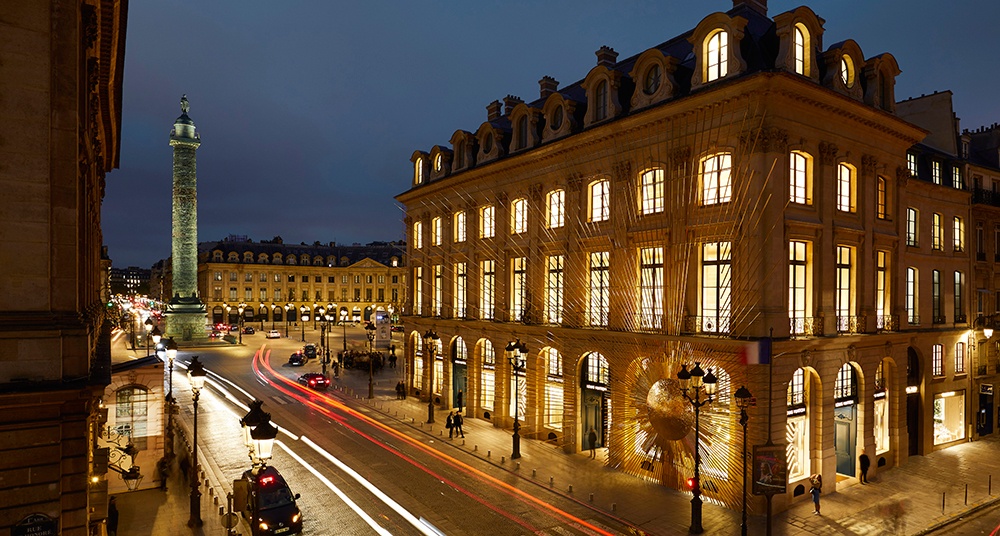
Marie-Laure Cérède spent twenty-five years moving between Cartier, Harry Winston and Cartier again before Chanel announced on 9 June 2026 that she would lead its jewellery creation studio from October — the latest beat in a generation-long pattern of place vendôme jewellery talent circulating between five or six addresses. Her appointment at Chanel Joaillerie is not a hire from outside the square. It is a transfer within it: a designer trained in the workshops above 13 Rue de la Paix, seasoned at a New York house owned by Swatch Group, then returned to Cartier for a decade, now crossing the Rue de Castiglione to 18 Place Vendôme. The Place Vendôme jewellery talent market is small — a few dozen specialists in total — and the same names keep reappearing in different windows along the arcade.
That smallness is the whole story. The houses that matter for high jewellery in Paris and Rome — Cartier, Van Cleef & Arpels, Boucheron, Chanel Joaillerie, Bulgari, Tiffany & Co., Harry Winston, Pomellato — together employ a small number of creative directors and studio heads. Between 2010 and 2026 those seats turned over perhaps a dozen times, almost always in favour of someone already inside the same circle. Cérède’s June 2026 appointment is the fourth or fifth instance of a designer making the Cartier-to-Chanel or Van Cleef-to-Chanel loop in this period. Read alongside the Kering Jewellery Division consolidation of March 2026 and the LVMH-Tiffany integration that began in January 2021, it tells you what kind of labour market Place Vendôme actually runs.
Marie-Laure Cérède, Cartier to Chanel (2026)
The announcement was specific in a way Place Vendôme announcements rarely are. On 9 June 2026 Chanel named Cérède director of its jewellery creation studio, effective October 2026, reporting to Frédéric Grangié, president of Chanel Watches & Fine Jewellery since July 2016. Cérède’s biography reads as a Vendôme-specific itinerary: trained at Cartier in the 1990s, recruited to Harry Winston in 2002 as artistic director of jewellery and watchmaking — a thirteen-year run that included the Swatch Group acquisition closing on 26 March 2013 for US$750 million — then returned to Cartier in 2016 as creative director of jewellery and watchmaking, departing at the end of 2025.
Two things are worth noting about the timing. First, Cérède’s 2016 return to Cartier coincided almost exactly with Cyrille Vigneron’s arrival as CEO; her departure at the end of 2025 sits inside the first full year of Louis Ferla’s leadership. Designers tend to move when CEOs do. Second, the Chanel role she now takes had been vacant since November 2024, when Patrice Leguéreau died after fifteen years in the same seat. Chanel did not hire from outside the Vendôme circuit, did not look to a fashion house or a couture atelier, did not appoint a jewellery editor or a contemporary artist. It went to a Cartier creative director with a Harry Winston anchor in her CV. The pool from which the brief was drawn was effectively four maisons wide.
Patrice Leguéreau and the Cartier–Van Cleef–Chanel arc (1990s–2024)
Leguéreau’s trajectory is the precedent Cérède’s appointment most closely echoes. He spent six years at Cartier and eleven years at Van Cleef & Arpels before joining Chanel in February 2009 as director of the jewellery creation studio. By the time of his death in November 2024 he had designed twenty-six Haute Joaillerie collections at Chanel, among them Tweed de Chanel, N°5 and Haute Joaillerie Sport — work that built the maison’s jewellery vocabulary from a Gabrielle Chanel reference (the 1932 Bijoux de Diamants exhibition at 29 Faubourg Saint-Honoré) into a credible Place Vendôme programme.
The Leguéreau path establishes the canonical Vendôme career arc: Cartier early, Van Cleef mid-career, Chanel as the senior creative seat. Cérède inverts the second leg — Harry Winston instead of Van Cleef — but lands at the same destination by the same logic. Both designers were trained in the Richemont jewellery system, internalised the technical grammar of Cartier and Van Cleef, then carried it into a younger maison (Chanel Joaillerie dates from 1932 by reference but only acquired 18 Place Vendôme in 1997 and reopened the renovated boutique on 18 May 2022, ninety years after Bijoux de Diamants, as the maison’s largest jewellery store worldwide).
The succession is also a generational tell. Leguéreau ran the studio for fifteen years across three Chanel creative directors — Karl Lagerfeld (in his final decade), Virginie Viard, and Matthieu Blazy’s appointment for the ready-to-wear seat in late 2025. The jewellery studio, in other words, has its own clock, longer than the couture clock, and Chanel’s choice of Cérède signals it intends to keep that cadence: a single director for ten to fifteen years, drawn from the Vendôme talent pump, given the studio at 18 Place Vendôme as a long-form brief.
Cartier under Vigneron and Ferla
Cartier is the upstream node in this network — the house that trained Cérède and Leguéreau, that runs the highest-volume high jewellery business on the square, and that holds the deepest archive. Founded by Louis-François Cartier in 1847 and seated at 13 Rue de la Paix since 1899 with high jewellery workshops directly above the boutique, the maison is owned by Richemont and effectively defines the standard Vendôme designers measure themselves against.
Cyrille Vigneron led Cartier as CEO from 2016 to 1 September 2024, then became chairman of Cartier Culture & Philanthropy. Louis Ferla, previously CEO of Vacheron Constantin (2017–2024), succeeded him on 1 September 2024. The Vigneron-to-Ferla transition matters for Place Vendôme talent because it dictates whether Cartier is a net exporter or net importer of designers in any given window. Vigneron’s eight-year tenure was a period of broad expansion in which Cérède was recruited back from Harry Winston and the studio added headcount; Ferla’s first year has been a consolidation, and Cérède’s exit at the end of 2025 reads as part of the reset rather than a departure across enemy lines.
The pattern is structural. Cartier’s training scale — workshops above 13 Rue de la Paix, plus high jewellery ateliers in the 17th arrondissement and Geneva — means it functions as the de facto school for Vendôme jewellery design. When a senior designer leaves, the question is rarely whether they will land at another maison on the square; it is which one. Leguéreau went to Van Cleef and then Chanel. Cérède went to Harry Winston and then Chanel. Other Cartier alumni populate the design studios of nearly every maison in this story.
Tiffany before and after LVMH (2013–2026)
Tiffany is the American counterweight in the Vendôme story, and its design leadership turned over twice in eight years in ways that map directly onto the LVMH acquisition cycle. Francesca Amfitheatrof was hired as design director in 2013 — the first woman in the role — and stayed until 2017. Reed Krakoff, long-tenured Coach creative director (1996–2013) credited with the house’s modern brand identity, became Tiffany’s chief artistic officer in 2017 and departed in 2021. Both seats turned over when LVMH closed its US$15.8 billion acquisition of Tiffany on 7 January 2021, with Alexandre Arnault moving from Rimowa to Tiffany as executive vice-president of product and communications in February 2021 and a new creative configuration following.
Amfitheatrof’s exit is the more legible. She was hired by Louis Vuitton in April 2018 as artistic director of watches and jewellery — i.e. she moved from one LVMH-adjacent jewellery brief to the inside of the group’s largest fashion maison, launching the Spirit and Deep Time high jewellery lines and effectively building Louis Vuitton’s high jewellery practice from the ground up. She departed Louis Vuitton in 2025, returning the seat to the open market and adding another senior Vendôme-fluent designer to the available pool just as Chanel was filling its own studio role.
That sequence — Tiffany 2013–2017, Louis Vuitton 2018–2025, available 2025 — is the template for an LVMH-side jewellery career, and it sits in deliberate counterpoint to the Cartier-Van Cleef-Chanel template on the Richemont side. The two systems trade designers across the square and across the Atlantic, and the same names recur in both columns.
Bulgari and Pomellato: the Italian jewellery axis
The Italian axis is structurally different. Bulgari and Pomellato have run with notably stable creative leadership for more than a decade — the opposite of the Tiffany or Chanel pattern of CEO-driven turnover. Lucia Silvestri joined Bulgari aged 18 in the gemmological department under Paolo Bulgari and was named Jewellery Creative Director in 2013 — the same year Kering completed its US$390 million Pomellato acquisition (81% stake, closed 18 July 2013). Silvestri has anchored the Serpenti, B.zero1 and Divas’ Dream lines from Bulgari’s Roman workshop for thirteen years and remains in the seat.
Vincenzo Castaldo has been creative director of Pomellato since 2004, a twenty-two-year run that pre-dates the Kering acquisition by nine years and now spans the Kering Jewellery Division consolidation of March 2026. He shaped the Nudo, Iconica and Sabbia collections from the maison’s Milan workshop, and his continuity through three Pomellato CEOs and two ownership configurations is the signal that Italian jewellery practice runs on a longer creative clock than Paris.
The Italian axis matters for the Place Vendôme talent market in two ways. First, it functions as a kind of stabiliser: when Paris jewellery seats turn over, the Italian seats absorb very little of the movement. Silvestri and Castaldo do not appear on the Vendôme transfer map because they did not move. Second, when LVMH acquired Bulgari in 2011 and Kering consolidated Pomellato into a jewellery platform in 2026, the Italian houses inherited Vendôme-style scale ambitions without (yet) inheriting Vendôme-style designer churn.
Boucheron, Van Cleef and the Richemont side of the square
Boucheron occupies 26 Place Vendôme — the address itself is the brand’s primary asset. Founded by Frédéric Boucheron in 1858 and seated at 26 Place Vendôme since 1893, Boucheron was the first jeweller on the square. Claire Choisne has been its creative director since 2011, a fifteen-year run that has produced the Vendorama, Animaux and Carte Blanche high jewellery collections and that mirrors Castaldo’s tenure at Pomellato in length and creative consistency. Choisne is the Vendôme designer who most resembles the Italian model: a single-house career, deep continuity, no transfers.
Van Cleef & Arpels — founded in 1896 by Alfred Van Cleef and Salomon Arpels, with the first boutique opening at 22 Place Vendôme in 1906 and Richemont ownership since 1999 — has run its design studio more quietly, without the named-director branding that Cartier, Chanel and Boucheron use. The maison’s eleven-year run with Leguéreau before his Chanel move is in that sense atypical for Van Cleef; the studio more commonly functions as a collective with internal succession rather than a star-designer seat.
Together Boucheron and Van Cleef bracket the Richemont side of the square — Boucheron at 26, Van Cleef at 22, with Cartier two blocks east at 13 Rue de la Paix and Chanel at 18. Two of the four are continuously led (Boucheron under Choisne; Van Cleef as a studio), one is the upstream training maison (Cartier), and one (Chanel) is the destination most senior designers eventually pass through. The geometry of the talent market follows the geometry of the square.
The Place Vendôme address book
The talent-transfer table below maps the seven principal designers in this story across the eight houses they have moved between since the early 1990s. Read top to bottom, it is the Place Vendôme jewellery talent pump in one chart.
| Designer | Cartier | Chanel | Tiffany | Harry Winston | Van Cleef | Boucheron | Bulgari | Pomellato |
|---|---|---|---|---|---|---|---|---|
| Marie-Laure Cérède | 1990s; 2016–2025 | from Oct 2026 | — | 2002–2016 | — | — | — | — |
| Patrice Leguéreau | 6 yrs (pre-1998) | Feb 2009–Nov 2024 | — | — | 11 yrs (c.1998–2009) | — | — | — |
| Francesca Amfitheatrof | — | — | 2013–2017 | — | — | — | — | — |
| Reed Krakoff | — | — | 2017–2021 | — | — | — | — | — |
| Lucia Silvestri | — | — | — | — | — | — | 1980s–present; CD 2013– | — |
| Vincenzo Castaldo | — | — | — | — | — | — | — | 2004–present |
| Claire Choisne | — | — | — | — | — | 2011–present | — | — |
The columns are not symmetrical. Cartier and Chanel have multiple entries; Boucheron, Bulgari and Pomellato have one each, all of them long tenures with no exits. Tiffany and Harry Winston are the only houses whose senior designers reliably depart for other Vendôme maisons — Amfitheatrof to Louis Vuitton, Cérède to Cartier and then Chanel — which is to say the American houses, despite their twentieth-century stature, function in this network as feeders rather than retainers.
The other readable pattern is the absence of cross-group transfers in some directions. No designer in the table moves from a Richemont jewellery maison directly to an LVMH jewellery maison. Cérède went Cartier (Richemont) → Harry Winston (Swatch Group) → Cartier → Chanel (independent). Leguéreau went Cartier (Richemont) → Van Cleef (Richemont) → Chanel (independent). Both arcs end at Chanel because Chanel sits outside the two big groups — independently held, privately owned — and therefore can hire from either side without triggering the non-compete and reputational frictions that constrain a direct Richemont-to-LVMH move.
What Cérède’s appointment tells the square
The June 2026 appointment confirms four things about Place Vendôme’s talent market. First, the pool is finite and the same names recur: when a senior jewellery seat opens in Paris, the realistic candidate list is perhaps a dozen designers, almost all of them already inside the square or one step removed at Louis Vuitton or Tiffany. Second, Chanel has institutionalised its role as the maison that ends Vendôme careers — Leguéreau ran the studio for fifteen years; Cérède is being hired into a comparable horizon, with a Grangié-led Watches & Fine Jewellery presidency that has been stable since July 2016 as her operating frame. Third, the Cartier-to-Chanel arc, once an outlier, is now the default senior path; the Richemont system trains, Chanel inherits, and the talent flows downhill from 13 Rue de la Paix to 18 Place Vendôme as reliably as the Tuileries-to-Vendôme axis it sits on. Fourth, the Italian houses — Bulgari under Silvestri since 2013, Pomellato under Castaldo since 2004 — sit outside the pump entirely, which means the Kering Jewellery Division will compete on platform mechanics rather than on the kind of designer free agency that defines the Paris market.