The half-century of architect-designed task chairs runs on a single commercial premise: that a named author — usually trained as an architect or an engineer, occasionally as both — can move an ergonomic office chair from the procurement page into the design press. The lineage begins on 1 January 1976, when Herman Miller shipped Bill Stumpf’s Ergon, the first mass-market task chair marketed on the basis of medical research. It closes, for the moment, in June 2026, when Foster + Partners premiered the Muku for the Japanese manufacturer Okamura — fifty years and four months later, an architect’s office attaching its signature to a recycled-aluminium structure with a mesh upholstery woven from discarded fishing nets. Between those two endpoints, the architect-designed task chair has been the most reliable category in office furniture by which a manufacturer purchases legitimacy. This piece catalogues every named-author chair in that window: nine principal projects, four manufacturers, eight credited designers, and one consistent commercial argument.
Why the architect-credit category exists at all
Task seating is a procurement product. It is bought by facilities directors against ergonomic standards (ANSI/BIFMA X5.1, EN 1335-1), measured against a warranty period, and amortised across a lease. None of those purchase mechanics reward authorship. The chair that wins a fleet order in 2026 does so on the same documents — lab tests, BIFMA submission, ten- or twelve-year warranty — as the chair that won one in 1996. And yet, since 1976, the price ceiling of the category has been held almost entirely by chairs with a credited designer on the spec sheet. The Aeron retailed at $1,000 in 1994. The Meda Chair launched at roughly DM 2,000 in 1996. The Steelcase Gesture entered the market at $979 in 2013. Each price ladder above the unbranded contract chair has been built on the same lever: a named author who is also a public figure in the design press.
The pool of names is small. Through 2026 it includes one American industrial-design partnership (Stumpf and Don Chadwick), two Italian architects of the Politecnico di Milano (Alberto Meda and, on adjacent objects, Antonio Citterio), one in-house American engineer (Dan Reese at Steelcase), one New Zealand industrial-design office (Formway), one Italian-Milanese architect linked to David Chipperfield’s office (Paolo Dell’Elce), and one London architect’s industrial-design division (Foster + Partners). The credentials are remarkably consistent. Of the credited authors of architect-designed task chairs between 1976 and 2026, more than half hold formal architecture degrees, and most of the remainder hold mechanical-engineering or industrial-design degrees from research universities.
The category’s origin date is 1976 not because earlier task chairs did not exist — Charles Pollock’s Knoll Executive (1963), Charles Eames’s Aluminum Group of 1958 and Soft Pad of 1969 had been shipping for over a decade — but because Stumpf’s Ergon was the first commercial chair sold to the buyer on the basis of its research, with a named designer attached to that research. Eames’s Aluminum Group is the precedent. The Ergon is the type.
The Stumpf-Chadwick decade at Herman Miller, 1976-1994
Bill Stumpf (1936-2006) joined Robert Propst’s Herman Miller Research Corporation in 1970, after a BFA in industrial design at the University of Illinois Urbana-Champaign and an MS in environmental design at the University of Wisconsin-Madison, where he had worked alongside the medical-school posture researchers. He did not draw the Ergon as a stylist. He specified it as a clinician would specify a brace. The Ergon launched in 1976 with three innovations that have remained, in some form, in every architect-designed task chair since: an articulated lumbar support sized to the lordosis curve, a contoured seat-pan with a waterfall front edge to relieve pressure on the popliteal fold, and a posture-following back. It won the 1976 ASID Award. Stumpf received ID magazine’s “Designer of the 70s”.
The Equa followed in 1984. Stumpf had by then partnered with Don Chadwick — UCLA-trained, born 1936, founder of Chadwick Modular Seating in 1974, with a portfolio of public seating already in the MoMA collection. The Equa replaced upholstery with a single flexing H-shaped polymer shell that bent with the sitter, eliminating most of the conventional tilt mechanism. Time magazine named it Design of the Decade in 1989. It is the first task chair to win that kind of editorial award on the basis of structure rather than ergonomics — a hinge point between the medical-research argument that had carried the Ergon and the formal-author argument that would carry the Aeron.
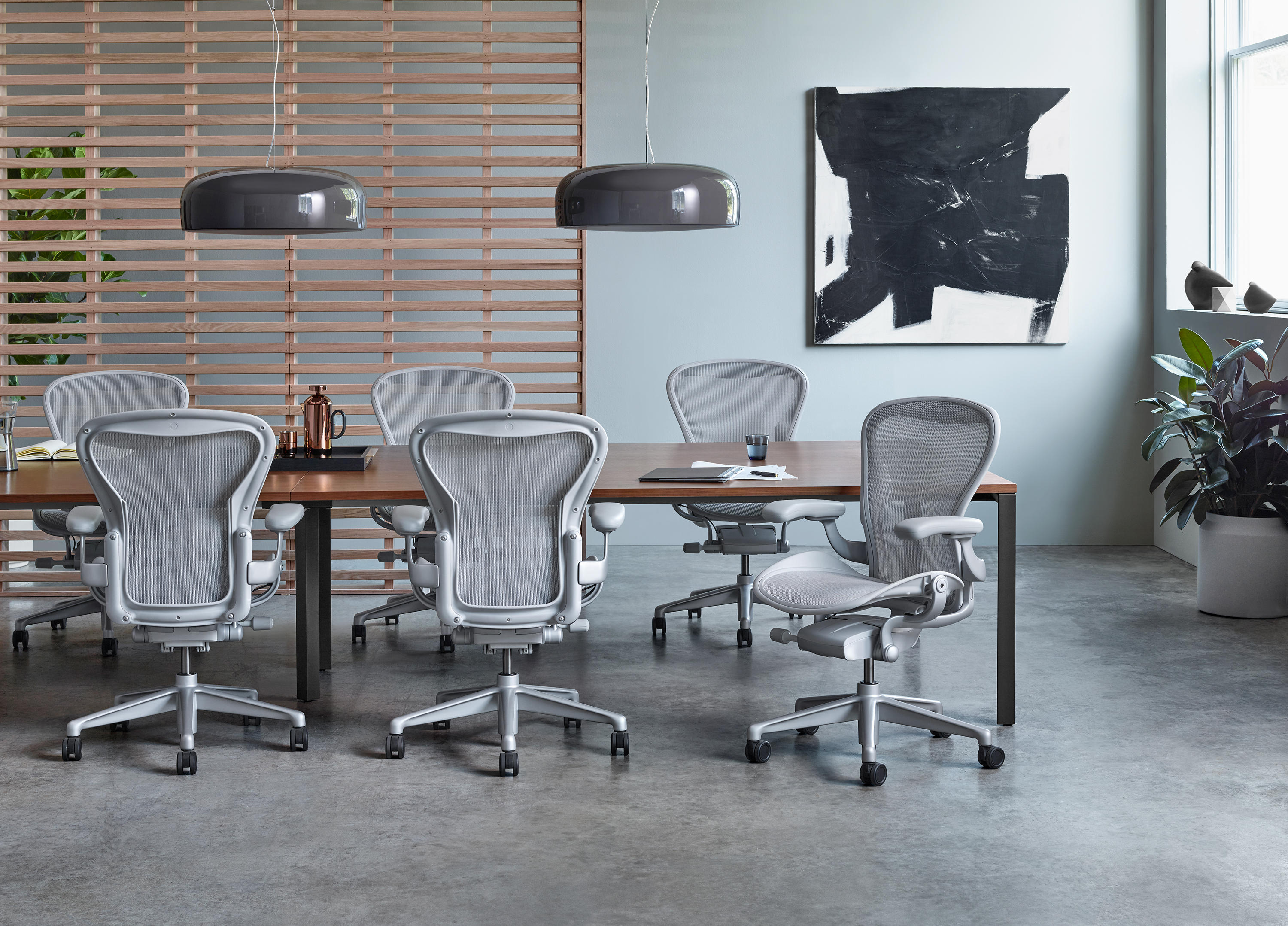
The Aeron (1994), Stumpf and Chadwick’s Pellicle-mesh chair on a glass-fibre-reinforced plastic frame in three sizes (A, B, C) sized to fifth-percentile female and ninety-fifth-percentile male anthropometrics, retailed at $1,000, entered MoMA’s permanent collection in 1994 before its general release, and has sold over nine million units by 2026 at a measured failure-and-replacement rate of 0.055 per cent. The full chair-by-chair lineage of the Herman Miller programme runs through our Herman Miller creative direction post; the point for this catalogue is narrower. From 1976 to 1994, the Stumpf-Chadwick partnership produced three of the nine chairs that define the architect-designed task chair category. They worked as external consultants under multi-year contracts. There was, for most of those eighteen years, no head of design at Herman Miller. The chairs themselves were the design directorate.
Alberto Meda’s Vitra Chair, 1996: the engineer-author from Politecnico di Milano
Alberto Meda was born in 1945 in Tremezzina, on the western shore of Lake Como, and took his degree in mechanical engineering at the Politecnico di Milano in 1969. He worked inside Magneti Marelli and then Kartell before going freelance in 1979. By the mid-1980s he was producing the carbon-fibre Light Light Chair for Alias (1987) and the Titania pendant for Luceplan (1989), pieces that read as engineering problems before they read as objects. Vitra chairman Rolf Fehlbaum commissioned him to design a task chair in the early 1990s; the result, the Meda Chair, launched in 1996.
The Meda Chair’s structural argument was that the conventional synchronous-tilt mechanism — a sprung knee-joint mechanism under the seat — could be replaced by two lateral pivots at the side of the chair. The seat and back rotate around those two pivots, automatically self-adjusting recline tension to the sitter’s weight without a dial. There is no tension knob. There is no synchro lever. The chair sets itself. The Meda Chair won the Good Design Gold Prize in Japan in 1997 and the Bundespreis Produktdesign in 2000. It seeded the MedaPro and MedaPal families that Vitra has produced continuously since. It is the only chair in this catalogue whose author is credentialed as an engineer rather than an architect or industrial designer, and it is also the only chair in this catalogue whose principal patent claim is the elimination of a mechanism rather than the addition of one.
Citterio, who attended the Politecnico architecture course one year ahead of Meda’s engineering programme (architecture degree, 1972), has supplied Vitra with adjacent office seating across the same period — the Citterio Sled task chair and the AC4 family — without ever designing the brand’s flagship task chair. He sits next to this lineage rather than in it.
Steelcase: Dan Reese’s Leap, 1999, and the Gesture, 2013
Steelcase, founded 1912 in Grand Rapids, Michigan, runs the only in-house design organisation in this catalogue that can credibly compete with the consultant-author model. The Leap (1999) was designed by Dan Reese, then a senior industrial designer at Steelcase, after four years of biomechanics research with posture specialists at Michigan State University and Cornell. The chair’s LiveBack technology tracks the sitter’s spinal flexion as the back tilts; the Natural Glide System slides the seat forward as the user reclines so that the line of sight to a monitor is preserved. The Leap took $35 million to develop, generated 23 patents, and sold roughly 5,000 units a week in its first year. It is the only chair in this catalogue whose engineering case file is in the public record at the level of a medical-device submission.
The Gesture (2013) is the same organisation’s response to a different problem. By 2010 Steelcase’s own research had documented that the average office worker spent significant time in nine distinct postures, most of which had not existed in 1999: the “smartphone slump”, the “tablet pivot”, the “laptop perch”. The Gesture’s arm mechanism — independently rotating, vertically adjustable, capable of supporting the elbow at the height required by a hand-held phone — was the first task chair designed for the body holding a device rather than the body sitting at a desk. The Gesture has no single credited author in the way the Meda Chair has Meda. It is Steelcase Design Studio’s work product. But it sits in this lineage because it is the only chair in the category whose design brief was the changing posture of the user — that is, an ergonomic argument rather than a stylistic one.
Knoll: Formway’s Generation, 2009, and Dell’Elce’s Konzert, 2026
Knoll, founded 1938 by Hans Knoll in New York, entered the architect-designed task chair category late. Its post-war seating reputation had been built on Pollock, Saarinen and Bertoia — chairs whose designers were architects, but whose programs were not principally task seating. The Generation (2009), designed for Knoll by Formway Design of Wellington, New Zealand, is the first Knoll task chair sold against the same commercial argument as the Aeron. The Generation has a frameless elastomer figure-8 back that flexes laterally as well as recline-axis; the seat edge offers 270 degrees of flex, allowing the user to sit sideways or backwards on the chair without rolling over the front; the seat depth adjusts three inches; lumbar support is carried through the arms rather than the back. It won Best of NeoCon Gold (Task Chairs) in 2009.
Knoll’s June 2026 launch, by contrast, is not a single chair but a system. Paolo Dell’Elce — Italian, born in Pescara in 1983, founder of his Milan studio in 2010 and a partner at David Chipperfield Architects since 2018 — designed the Konzert modular wall-to-wall private-office system, which debuted at Clerkenwell Design Week from 19 to 21 May 2026. Konzert is a kit of panels, tables, seating and storage modules organised by what Dell’Elce calls “tectonic planning” — a phrase that explicitly references Mies van der Rohe’s rigour, an unusual reference for an office system. The task seating module sits inside that system as one component among many. It is the first time in this catalogue that a Knoll task-seating release has been authored by an architect from a named European architecture office, and it marks the closing parenthesis of the architect-designed task chair as a stand-alone object: by 2026, the architect’s brief is to design the entire room.
Foster + Partners and the Muku for Okamura, June 2026
The Muku, premiered in the Okamura showroom in June 2026 in a Dezeen feature, is the chair that closes the half-century. Foster + Partners — founded 1967 by Norman Foster, renamed Sir Norman Foster and Partners in 1992, then Foster & Partners in 1999, then Foster + Partners in 2006 — runs an Industrial Design division that has produced products for Walter Knoll, Molteni and Vitra since the mid-2000s. Okamura, founded in Yokohama in October 1945 by former technicians of the Naval Air Technical Arsenal and listed on the Tokyo Stock Exchange in 1962, entered office furniture in the 1960s and now ranks among the world’s top five office-furniture manufacturers, alongside Steelcase, Herman Miller, Haworth and KOKUYO.
The Muku has adjustable seat depth and recline; layered-cushion lumbar support; a structural frame that incorporates recycled aluminium; and a mesh upholstery woven from recycled fishing nets recovered from the Pacific. The material story is the new commercial argument. None of the chairs from 1976 to 2013 in this catalogue made a recycled-content claim a principal selling argument. The Aeron’s first remastered version (2016) introduced a recycled-content target. The Muku makes it the headline. The chair’s launch in the Okamura showroom rather than at NeoCon, Orgatec or Salone is also a marker: in 2026 the Japanese manufacturer no longer needs the European or American trade-fair calendar to legitimate an architect-credited launch.
Architect-designed task chairs, 1976-2026: the lineage at a glance
| Year | Chair | Designer | Manufacturer | Distinct innovation |
|---|---|---|---|---|
| 1976 | Ergon | Bill Stumpf | Herman Miller | First task chair marketed on ergonomic medical research; waterfall seat-pan edge; articulated lumbar support |
| 1984 | Equa | Bill Stumpf + Don Chadwick | Herman Miller | Single flexing H-shaped polymer shell replacing conventional tilt mechanism |
| 1994 | Aeron | Bill Stumpf + Don Chadwick | Herman Miller | Pellicle suspension mesh on glass-fibre-reinforced plastic frame; three anthropometric sizes (A, B, C) |
| 1996 | Meda Chair | Alberto Meda | Vitra | Self-adjusting synchronous tilt via two lateral pivots; no tension dial |
| 1999 | Leap | Dan Reese (in-house) | Steelcase | LiveBack spinal-tracking back; Natural Glide System seat slide; four years and $35 million of biomechanics R&D; 23 patents |
| 2009 | Generation | Formway Design | Knoll | Elastomer figure-8 back; 270 degrees of seat-edge flex; lumbar support carried through the arms; three inches of depth adjustment |
| 2013 | Gesture | Steelcase Design Studio | Steelcase | First task chair designed for the postures induced by phones, tablets and laptops; independently rotating, height-adjustable arms |
| 2026 | Konzert (system, includes task seating) | Paolo Dell’Elce | Knoll | Modular wall-to-wall private-office system; “tectonic planning” referencing Miesian rigour; task seating as one module among panels, tables and storage |
| 2026 | Muku | Foster + Partners | Okamura | Recycled-aluminium structural frame; mesh upholstery woven from recycled fishing nets; adjustable seat depth and recline; layered-cushion lumbar |
The Italian-architect adjacent lineage: Bellini, Citterio, Sottsass
A second lineage runs parallel to the task chair and almost — but not quite — intersects it. Three Italian architects of the post-war generation supplied named-author office furniture to the same buyers without producing the canonical task chair that defines the category.
Mario Bellini (born Milan, 1 February 1935; architecture degree, Politecnico di Milano, 1959) was Olivetti’s chief design consultant from 1963 to 1991, won the Compasso d’Oro eight times, and edited Domus from 1985 to 1991. His Cassina Cab chair (1977) — a leather shell zipped over a steel rod frame — is one of the most-cited Italian seating designs of the half-century. He did not design a task chair. His office output for Olivetti was typewriters, calculators and electronics. The category boundary is real: the Cab chair sits in the dining room, not the office.
Antonio Citterio (born Meda, 1950; architecture degree, Politecnico di Milano, 1972; founded ACPV with Patricia Viel in 2000; two-time Compasso d’Oro winner, 1987 and 1994; Honorary Royal Designer for Industry, 2008) has produced more office seating for Vitra than any other architect of his generation, including the Citterio Sled family and the AC executive chair line. He sits closer to the task-chair lineage than Bellini. He does not, however, hold the credit on Vitra’s flagship task chair — that is Meda’s — and the chairs he has designed for Vitra are not task chairs in the procurement sense. They are executive and conference seating.
Ettore Sottsass (1917-2007), Olivetti consultant from 1956 and founder of the Memphis Group in December 1980, designed office machines and conference systems for Olivetti but no task chair. His Synthesis 45 office system (1973) is the structural ancestor of the modular office line that runs through to Dell’Elce’s Konzert; it is, in its way, the first piece of evidence that the architect-credited office object would not always be a chair. Sottsass is the prophet of the room-as-system argument that Knoll’s June 2026 launch makes explicit.
What the architect-credit category is for
The throughline across fifty years is procurement legitimation. Task seating is sold to facilities directors against BIFMA submissions and warranty pages, but the price ceiling — the chair that sells at $1,000 in 1994, at $1,400 in 2026 — is held by chairs whose designer is also a public figure in the design press. The architect or the engineer, in this market, is the legitimating signature. Stumpf and Chadwick at Herman Miller, Meda at Vitra, Reese at Steelcase, Formway and Dell’Elce at Knoll, Foster + Partners at Okamura: each name converts a research deliverable or a recycled-content claim into a press release the trade buyer can show his board. The category did not need to exist. It exists because, since 1976, no major office-furniture manufacturer has been able to hold the top of the price ladder without one.