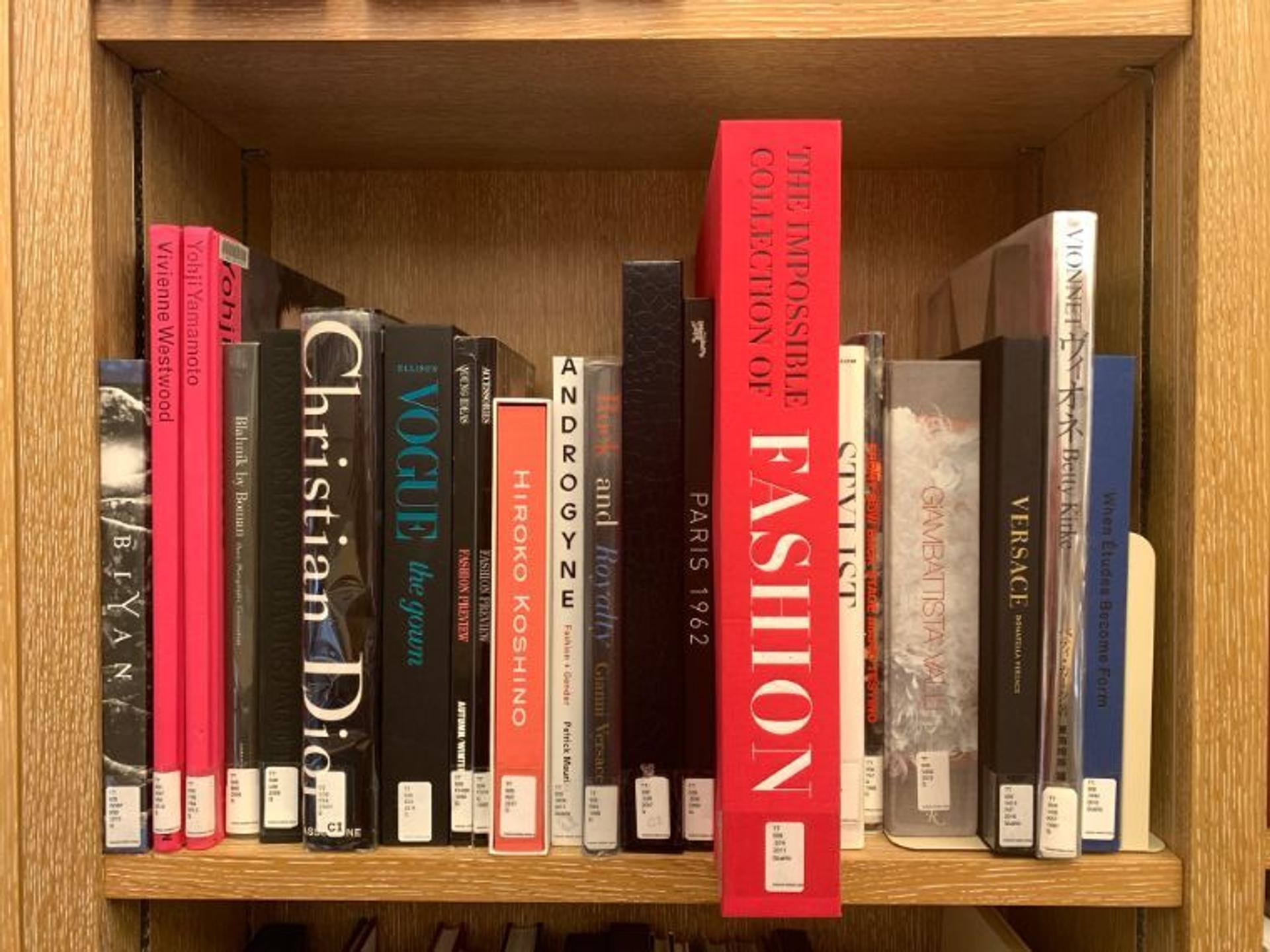
Jonathan Anderson opened his Dior on 2 January 2026 with a Book Tote embroidered as a 1955 first edition of Bram Stoker’s Dracula — and that Book Tote, retailing at $3,550, is the most expensive single position in a market that the world’s twenty largest fashion houses are now actively publishing books to claim. The trigger for the dossier is Business of Fashion’s 1 June 2026 piece “How Books Became Fashion’s Favourite Flex”, which read Coach’s March 2026 ‘Explore Your Story’ campaign with Elle Fanning and the Dior Book Cover Collection as the same gesture. They are. They are also the smallest, most visible tip of a register that has been building since at least 1973, when Hermès printed the first German-language Die Welt von Hermès. This piece is an atlas of seventeen-plus programmes by the fashion houses publishing books in 2026, organised by what each programme is for.
The honest taxonomy has five motives. Patronage — paying a magazine or an author to exist. Archive — paying for the house’s own past to be made into a hardcover. Brand voice — running an imprint that prints the house’s photography and styling at the cadence and bind quality of a museum catalogue. Retail anchor — using a bookshop or a newsstand takeover to occupy a physical address that a perfume counter cannot. And gift economy — putting a $95 charm or a free paperback into the hand of someone who would not have bought a $3,550 tote. Every programme below sits on one of those five legs, and several sit on two. The atlas is the answer to the question of why a sector that exists to sell handbags is suddenly so interested in book design.
Anderson’s Dior Book Tote and the literary capsule
The Book Cover Collection released worldwide on 2 January 2026 was Jonathan Anderson’s first commercial drop for Dior, and it deliberately collapsed the distinction between Book Tote (a Maria Grazia Chiuri silhouette since 2018) and book. The embroidered covers are eight: Bram Stoker’s Dracula, Gustave Flaubert’s Madame Bovary, Françoise Sagan’s Bonjour Tristesse, Charles Baudelaire’s Les Fleurs du Mal, James Joyce’s Ulysses, Choderlos de Laclos’s Les Liaisons Dangereuses, Truman Capote’s In Cold Blood, and — the self-referential closer — Dior by Dior, Christian Dior’s 1956 memoir. Dracula tops out at $3,550. The choices are a profile: nineteenth-century French libertinage (Laclos, Baudelaire, Flaubert), twentieth-century mid-century scandal (Sagan, Capote), modernist long-form (Joyce), Gothic source code (Stoker), and the house’s own founder writing about himself.
It is the first time a creative director has opened a new tenure at a Paris house with a book-as-handbag capsule, and the move reads as Anderson translating the Loewe habit of paying attention to printed matter into the larger-volume Dior register. The Dior Book Tote, before Anderson, was branded with city names (Paris, New York, Tokyo). Anderson kept the same blank canvas and embroidered the spines onto it. The product line did not change; the iconography did. That is what a creative-director opening is supposed to look like.
Coach Explore Your Story and the book charm at $95
Coach launched ‘Explore Your Story’ globally on 7 March 2026 — campaign starring Elle Fanning, Storm Reid, basketball player Paige Bueckers and the K-pop artist SOYEON. The deliverable is twelve readable miniature book charms at $95 each, sized for a Tabby bag. The titles include Jane Austen’s Sense and Sensibility, Maya Angelou’s I Know Why the Caged Bird Sings, and Jandy Nelson’s I’ll Give You the Sun. The publisher partner in the United States is Penguin Random House; in China, Japan and Korea, Coach signed independent publishers individually. The retail theatre includes in-store “Book Nooks” and a college-campus ‘Coach Tabby Tour’.
Read against the Dior Book Tote, the Coach charm is the same gesture executed for an entirely different price floor. The Dior tote is $3,550 and signals literacy; the Coach charm is $95 and delivers a paperback that you can actually read. Both are positioned as evidence that the wearer reads. Coach has a younger and more American buyer than Dior — Bueckers and SOYEON are the index — and the Penguin Random House lockup means Coach is the only programme in this dossier that pays a trade publisher to be the bag. The book is not a metaphor in the Coach version. It is genuinely a book, just very small.
Miu Miu turns the newsstand into a brand asset
Miu Miu is the house that, since 2024, has done the most coherent work on the fashion-publishing question, and the work has two arms. The first is the Miu Miu Literary Club, an annual two-day event held at Milan’s Circolo Filologico during Milan Design Week. The Literary Club is directed by Miuccia Prada and curated by the Italian educator Olga Campofreda. The inaugural edition opened in April 2024 with Sibilla Aleramo and Alba de Céspedes — two early twentieth-century Italian women writers whose work had been recovered by feminist scholarship in the 1990s and 2000s and whose presence on the masthead was the unambiguous statement of position. The 2025 edition, themed “A Woman’s Education” and held 9 to 10 April 2025, paired Simone de Beauvoir with the Japanese novelist Fumiko Enchi. The 2026 edition pairs Annie Ernaux — the French Nobel laureate of 2022 — with the Ghanaian writer Ama Ata Aidoo. There has also been a Shanghai edition, on 21 November 2025, devoted to Eileen Chang.
The second arm is Miu Miu Summer Reads. Launched 7 to 9 June 2024 as a newsstand takeover across New York, London, Hong Kong, Paris, Milan, Tokyo, Seoul and Shanghai, the programme prints and distributes free copies of selected titles: in 2024, Alba de Céspedes’s Forbidden Notebook, Sibilla Aleramo’s A Woman, and Jane Austen’s Persuasion; in 2025, with Simone de Beauvoir’s The Inseparables and Fumiko Enchi’s The Waiting Years added. The titles read as a syllabus. The distribution method — physical newsstands in eight cities, free copies, no purchase — is the part of the programme that the rest of the sector has not copied. Miu Miu is, in 2026, the only fashion house treating a newsstand as a brand surface.
The economic logic of Summer Reads is the cleanest case in the dossier. Miu Miu prints books at a paperback unit cost in the low single digits, hands them out free at a newsstand in Soho, and earns press coverage in every outlet that covers culture rather than handbags. It is the cheapest paid-media buy in luxury in 2026, and it has produced a Miu Miu brand voice — literary, women-first, twentieth-century-canon-aware — that no print campaign has matched.
LV’s Fashion Eye, City Guides and Travel Book — three series, one library
LV Malletier operates three publishing series in parallel, each launched in a different decade, each editorially distinct, and the three together make Louis Vuitton the fashion house with the largest active book catalogue in the world.
The City Guides came first, published in-house by LV Malletier since 1998. They are travel guides — restaurants, hotels, museums, shops — printed in pocket format and updated edition by edition. The 2026 expansion added a Paris Sport supplement (a separate volume on the city as a sporting venue, timed to the 2024 Paris Games legacy) and a Paris City Book, a hardcover that operates as the maximalist edition of the city the guides started with.
Fashion Eye launched in 2016 as a photography-book series whose conceit is one volume per city or region, each made through a single photographer’s lens. The inaugural five were Guy Bourdin’s Miami, Jeanloup Sieff’s Paris, Wing Shya’s Shanghai, Kourtney Roy’s California, and Henry Clarke’s India. Subsequent titles added Saul Leiter on New York, Peter Lindbergh on Berlin, Helmut Newton on Monte Carlo, Harley Weir on Iran, Coco Capitán on the Trans-Siberian railway, and Daniel Obasi on Lagos. The series has the most editorial discipline of the three; each volume is the photographer’s archive of that place, not commissioned new work.
The Travel Book is the illustrated sketchbook imprint, launched in 2013, where the photographer is replaced with an illustrator and the city is rendered in roughly 100 to 120 drawings per volume. The founding four were Daniel Arsham on Easter Island, Jean-Philippe Delhomme on New York, Natsko Seki on London, and the Congolese painter Chéri Samba on Paris. The series expanded through 2024 to 2026 with Amsterdam, Indonesia and Berlin volumes. The format is a landscape hardcover sized for a coffee table rather than a hand.
The three series together describe a library of more than 100 titles, all branded LV. None of them feature handbags. That is the point.
Saint Laurent Babylone and the bookshop as flagship
Anthony Vaccarello, the Belgian creative director of Saint Laurent since 2016, opened Saint Laurent Babylone in early 2024 at 9 rue de Grenelle in the Paris 7th. The bookshop is named after the rue de Babylone duplex where Yves Saint Laurent and Pierre Bergé lived together from 1970 — a biographical reference legible to anyone who has read the YSL literature and invisible to the rest. The shop stocks rare books, first editions, vinyl. It hosts photo exhibitions (an Antonio Lopez prints show in the opening months was the one the press covered).
Babylone is the first time a luxury fashion house has opened a freestanding bookshop in Paris as a brand outlet. It pairs with the Saint Laurent Rive Droite Éditions, the publishing imprint Vaccarello established in 2019 and which operates out of the Rive Droite concept stores — the Paris flagship at 66 rue Saint-Honoré is the former Colette address, which gives the imprint a Paris retail lineage that has been read as Vaccarello’s most knowing curatorial move. Rive Droite Éditions has produced books with Daidō Moriyama, the Chinese gunpowder artist Cai Guo-Qiang, the French photographer Jeanloup Sieff (whose work also appears in Fashion Eye), the Belgian photographer Bruno Roels, Betty Catroux (the YSL muse), Gray Sorrenti, Derek Ridgers and Henrik Purienne.
The pairing of Babylone (retail) and Rive Droite Éditions (publishing) is the cleanest example in the sector of a fashion house using the book as the structural reason for a flagship to exist. Babylone does not need to sell handbags to be a Saint Laurent address. It is a Saint Laurent address because it sells books that Vaccarello picked.
Prada Ten Protagonists and the celebrity-novelist short story
Prada released Ten Protagonists in spring 2025. Ten short stories by Ottessa Moshfegh — the American novelist of Eileen, My Year of Rest and Relaxation and Lapvona — were paired with Steven Meisel portraits of Carey Mulligan playing each protagonist in turn (Patricia, Fanny, Alina, and seven more). Creative direction was Ferdinando Verderi. The collection was presented at Prada events in Tokyo, Milan, Paris and London in February 2025, and the digital edition was made available as a free download on Prada.com.
Ten Protagonists is the most explicit instance of a fashion house commissioning original literary fiction. Moshfegh was paid to write ten short stories about Prada-coded women; Meisel was paid to photograph Mulligan as them; Mulligan was paid to embody them. The deliverable is a Prada-branded book that has Moshfegh’s name on the front, not a celebrity face. The line between editorial campaign and short-story collection is collapsed by design. The free download is the part that gives the game away — Prada is not selling the book; the book is the campaign.
Prada also runs a separate publishing arm through Fondazione Prada, founded in 1993 by Miuccia Prada and Patrizio Bertelli, which produces exhibition catalogues, artists’ books and monographs in-house. The Fondazione’s imprint is distributed in North America by D.A.P./ARTBOOK and is the only fashion-adjacent publishing programme that runs through a foundation rather than through the commercial label.
Hermès Éditeur and Le Monde d’Hermès — patronage as a forty-year practice
Hermès has been publishing for longer than anyone else in this dossier. Le Monde d’Hermès was first published as Die Welt von Hermès in German in 1973, then in French in 1975. The biannual house magazine has a circulation of approximately 600,000 across 11 languages, edited by Olivier Wicker. The cadence aligns with the spring/summer and autumn/winter collections, which makes Le Monde d’Hermès the longest-running fashion-house publication in the world.
Hermès Éditeur is the second prong: a contemporary-art silk-scarf programme directed by Pierre-Alexis Dumas since 2005. The format is a commissioned artist who designs scarf-sized editions printed in the Lyon silk ateliers. The opening commission was Josef Albers’ Hommage au carré — six designs, 200 units each, printed using the colour combinations from the painter’s own Homage to the Square series. Subsequent commissions included Daniel Buren (a 2010 release of 365 unique pieces, each a singular colour permutation), Hiroshi Sugimoto (2012), and Julio Le Parc (2015). The programme is the closest thing the luxury sector has to a print-edition publishing house with museum-grade artists on the masthead, and it has not been imitated.
The two Hermès programmes together describe the house’s editorial register: long, slow, patron-class. Le Monde d’Hermès is the in-house magazine; Hermès Éditeur is the in-house print imprint; neither sells handbags.
Chanel × Steidl and the Lagerfeld imprint as 7L
Karl Lagerfeld founded Éditions 7L in 2001 in Paris with the German art-book publisher Steidl, operating from his 7L bookshop at 7 rue de Lille. The catalogue at the time of Lagerfeld’s death in February 2019 ran to approximately 50 titles. The four that the press repeatedly cited are The Little Black Jacket (2012, with Carine Roitfeld, the Lagerfeld-photographed portrait series of the Chanel jacket on a multi-celebrity cast), Chanel Art (2014, documenting the Grand Palais Spring/Summer 2014 set), Chanel Shopping Center (2015, on the FW14 supermarket set), and Casa Malaparte (2015, the Adalberto Libera house on Capri).
After Lagerfeld’s death, Chanel acquired 7L and relaunched it under house ownership. The imprint continues to publish — including Sofia Coppola’s Chanel Haute Couture, which came via Mack Books rather than 7L itself but functions in the same editorial position.
The 7L story is the cleanest case study in the dossier of an imprint that survived the death of its founder by being purchased back into the house. The Lagerfeld-era 7L was a personal project — Lagerfeld photographed many of the books himself, picked the artists, ran the shop on rue de Lille. The Chanel-era 7L is a house imprint. The transition cost Chanel an asset purchase and a relaunch budget, but it kept the imprint’s name and its bookshop address. That is what continuity costs.
Bottega Veneta’s three patronage bets — Issue, BUTT and Air Afrique
Bottega Veneta under Daniel Lee deleted its Instagram account in January 2021 and launched Issue on 31 March 2021 as the replacement: a quarterly digital magazine, in PDF, that operated as the brand’s owned media channel. Three issues were released. The programme was discontinued after Lee’s exit in November 2021. Issue is the only example in this dossier of a fashion house publishing a magazine instead of using Instagram, and the fact that it lasted three quarters is the diagnostic.
Under Matthieu Blazy, who replaced Lee in November 2021 and ran the house until late 2024, Bottega’s publishing register shifted from owned media to patronage. Two bets defined it. The first was the revival of BUTT, the Dutch gay quarterly founded in 2001 by Gert Jonkers and Jop van Bennekom, which had ceased print in 2011 after 30 issues. Bottega backed the 2022 relaunch, which pre-launched at the Palais de Tokyo in March 2022 with issue 30, and continues through issue 38 (March 2026). The second was Air Afrique, the independent print magazine that launched on 23 June 2023 with a Centre Pompidou party during Paris Men’s SS24 week. Bottega-backed.
The three programmes together describe a Bottega Veneta editorial strategy that moved from owned media (Issue) under Lee to patronage (BUTT, Air Afrique) under Blazy. Patronage is the more durable instrument. Issue is gone; BUTT and Air Afrique are still printing.
Loewe Crafted World and the anniversary monograph
Loewe released Crafted World: Jonathan Anderson’s LOEWE on 27 March 2025 — a 636-page monograph marking Anderson’s tenth anniversary as creative director. The book sells for $390 and ships in a custom Anagram-embossed box. The foreword is by Zadie Smith. The central editorial gesture is a long conversation between Anderson and his long-time stylist Benjamin Bruno.
The monograph format is the most conservative move in the dossier — every luxury house releases an anniversary book — but the Loewe execution is unusual in two ways. The first is the binding and box, which sit at the Assouline price point rather than the Phaidon one. The second is the literary credentialing: Smith’s foreword and the long Anderson-Bruno conversation are positioned as readable text rather than as captions for image plates. The book is the bridge from Anderson’s Loewe to Anderson’s Dior; the Book Cover Collection that opened his Dior tenure on 2 January 2026 reads, in light of Crafted World, as the same editorial muscle applied to a larger commercial register.
Burberry by Assouline and the Dior 70th-anniversary series
The Assouline route is the publisher-house route — a fashion house pays Assouline to produce a hardcover that the house then sells through its own channels. Two cases anchor the practice in this dossier.
Burberry by Assouline was the first official Burberry monograph, written by the British fashion historian Alexander Fury, published March 2023 as part of Assouline’s Legends collection. The format is a 252-page linen-bound hardcover in a slipcase, 200 illustrations, $195. It is Burberry’s first single-volume archive in print.
Dior’s Assouline relationship runs much deeper. The seven-volume Dior 70th-anniversary series was curated by Olivier Saillard, then-director of the Palais Galliera, and dedicates one volume to each of Dior’s seven creative directors at the time: Christian Dior himself, Yves Saint Laurent (1957–1960), Marc Bohan (1961–1989), Gianfranco Ferré (1989–1996), John Galliano (1996–2011), Raf Simons (2012–2015) and Maria Grazia Chiuri (2016–present at time of publication). Photography by Laziz Hamani. Released across 2017 and 2018 at $195 per volume.
The Assouline programme is the part of fashion-publishing that operates as a service business. Assouline produces the book; the house licenses the trademark; the buyer is the customer of both.
Fashion houses publishing books, 2026 atlas
| House | Programme | Launched | Format | Most recent edition (2026) |
|---|---|---|---|---|
| Dior | Book Cover Collection | 2 Jan 2026 | Embroidered Book Totes ($3,550 top) | Anderson’s opening capsule — 8 covers including Dracula, Ulysses, Dior by Dior |
| Coach | Explore Your Story | 7 Mar 2026 | Miniature readable book charms ($95) | 12 titles with Penguin Random House; Tabby Tour college campuses |
| Miu Miu | Literary Club | Apr 2024 | Two-day live event, Milan | Annie Ernaux + Ama Ata Aidoo (2026 Milan) |
| Miu Miu | Summer Reads | Jun 2024 | Free paperbacks at newsstands, 8 cities | de Beauvoir + Enchi added to the 2025 set |
| Louis Vuitton | City Guides | 1998 | Pocket travel guides | 2026 Paris Sport supplement + Paris City Book |
| Louis Vuitton | Fashion Eye | 2016 | Photography monograph, one city/one photographer | Latest additions include Obasi on Lagos, Capitán on the Trans-Siberian |
| Louis Vuitton | Travel Book | 2013 | Illustrator sketchbook, landscape hardcover | 2024–26 additions: Amsterdam, Indonesia, Berlin |
| Hermès | Le Monde d’Hermès | 1973 (DE) / 1975 (FR) | Biannual house magazine, 11 languages | Spring 2026 issue, ~600,000 copies |
| Hermès | Hermès Éditeur | 2005 | Artist silk-scarf editions | Continuing Albers/Buren/Sugimoto/Le Parc lineage |
| Saint Laurent | Babylone | Early 2024 | Bookshop, 9 rue de Grenelle Paris | Antonio Lopez prints exhibition cycle |
| Saint Laurent | Rive Droite Éditions | 2019 | Imprint operated from Rive Droite stores | Continuing Moriyama / Cai Guo-Qiang / Sieff / Catroux lineage |
| Prada | Ten Protagonists | Feb 2025 | Short-story collection by Ottessa Moshfegh | Free download on Prada.com |
| Fondazione Prada | In-house imprint | 1993 | Exhibition catalogues, artists’ books | Distributed by D.A.P./ARTBOOK in NA |
| Chanel | Éditions 7L | 2001 | Steidl-printed art books, 7 rue de Lille bookshop | Continuing under Chanel ownership; Coppola via Mack Books |
| Bottega Veneta | Issue | 31 Mar 2021 | Quarterly digital magazine | Discontinued Nov 2021 (Daniel Lee exit) |
| Bottega Veneta | BUTT (revival) | 2022 | Quarterly print magazine | Issue 38, March 2026 |
| Bottega Veneta | Air Afrique | 23 Jun 2023 | Independent print magazine | Continuing under Blazy-era patronage |
| Loewe | Crafted World | 27 Mar 2025 | 636-page monograph in Anagram box ($390) | Anderson 10th-anniversary edition |
| Burberry | Burberry by Assouline | Mar 2023 | Linen-bound hardcover in slipcase ($195) | First official Burberry monograph |
| Dior | 70th-anniversary Assouline series | 2017–2018 | Seven-volume hardcover set ($195/vol) | One volume per creative director, Saillard / Hamani |
What the fashion houses publishing books actually want
Five answers, in order of how much money each programme actually costs.
The cheapest is Miu Miu Summer Reads. Print paperbacks at unit cost; hand them out free at newsstands in eight cities; collect press coverage that no fashion campaign at any price has earned in 2025–26. Free copies, no purchase. The reason no one else has copied it is that no one else has Miuccia’s editorial taste and Olga Campofreda’s curation discipline. The next cheapest is the digital giveaway — Prada’s Ten Protagonists is a PDF on Prada.com and Moshfegh’s name does the rest of the work. The third is the celebrity-author charm — Coach paid Penguin Random House for licensing rights and Elle Fanning for the campaign, but the unit margin on a $95 charm is competitive with any other Coach accessory at the price.
Above that price floor sit the publishing arms. LV Fashion Eye, LV Travel Book, LV City Guides, Saint Laurent Rive Droite Éditions, Éditions 7L (Chanel), and Fondazione Prada are all in-house imprints with full editorial staffs, repeat photographer relationships and museum-grade printers. They cost what museum-grade printing costs, and they sell at hardcover prices in the £40–£200 range. The Loewe monograph at $390 is the upper bound of that tier; Burberry by Assouline at $195 is the volume centre.
At the top of the budget is the architectural anchor. Saint Laurent Babylone is a Paris 7th retail lease at 9 rue de Grenelle, fitted out as a bookshop, run by Vaccarello’s office, that does not need to sell handbags to be a Saint Laurent address. That is the most expensive form of fashion-publishing in 2026 because it costs a lease in central Paris in perpetuity — and it is also the form that produces the most durable brand-equity per euro spent.
The throughline across all five tiers is that none of the programmes are about books in the publishing-industry sense. None of them are about literacy in the cultural-policy sense. They are about a register — print, bind, hardcover, foreword, ISBN — that the luxury sector did not previously control and that, in 2026, is the only register that performs the work of suggesting that a $3,550 tote with Dracula embroidered on it is not really about the tote. The books in this dossier are not the product. They are the alibi for the product. And the houses that run their book programmes well — Miu Miu, LV, Saint Laurent, Hermès — are the houses whose products no longer need to argue for themselves at the point of sale, because the books have already done it.