On 8 June 2026, Axiom Space and Prada unveiled the Liquid Cooling and Ventilation Garment — a form-fitting inner layer with a fully redundant water-cooling circuit — designed to sit beneath the AxEMU spacesuit on NASA’s Artemis IV mission, planned for 2028. It is the second deliverable from a partnership announced on 4 October 2023, and it is also the cleanest data point yet for a thesis FORMA has been tracking since the Fondazione Prada opened at Largo Isarco in May 2015: that Prada partnerships outside fashion are not marketing adjacencies. They are how the house has, for thirty-three years, built brand equity that runners-up in the luxury sector have not been able to assemble.
The list is short and exact. A foundation in 1993 that turned permanent in Milan twenty-two years later. A symposium since 2022 curated by Formafantasma. A travelling members’ club launched at Art Basel Miami Beach in December 2018 with Theaster Gates. And, since October 2023, a Houston aerospace contractor that builds spacesuits for NASA. Six anchors, three decades, one strategic position. This piece maps each one and asks what shape they make together.
A brief lineage of Prada’s owners, before the partnerships
To read the partnerships you need the two people who signed them. Miuccia Prada (born 1949, doctorate in political science from the University of Milan, member of the Italian Communist Party in the 1970s, mime student at the Piccolo Teatro) joined the family leather-goods business her grandfather Mario Prada had founded in Milan in 1913. She came in in 1978 and took over design the following year. Patrizio Bertelli (born 1946 in Arezzo, a leather-goods entrepreneur who had been producing under licence for international houses since the early 1970s) had joined Prada in 1977 and became chief executive in 1978. They married in 1987. The division of labour — Miuccia on creative, Bertelli on operations and capital — held for the next forty-eight years, and it is the precondition for every partnership listed below. Without Bertelli’s appetite for cultural infrastructure as a financial position, none of them happen.
Fondazione Prada, 1993 to 2026: the foundation as architecture commission
The Fondazione Prada was founded in 1993 as Fondazione Prada Milano-Arte by Miuccia Prada and Patrizio Bertelli, and from the beginning it was not a corporate-art collection. It commissioned. Its first decade ran from a Via Spartaco space in Milan with a commission programme that included Anish Kapoor, Louise Bourgeois and Walter De Maria; the public memory of the period is the De Maria pieces, but the institutional memory is the model — a private foundation that paid artists to make new work rather than buying finished objects from galleries.
The Venice arm opened in 2011 at Ca’ Corner della Regina, an eighteenth-century palazzo on the Grand Canal restored under the Fondazione’s lease from the Comune. It has hosted programming aligned to the Venice Art Biennale and the Venice Architecture Biennale ever since; the 2026 contribution, Helter Skelter, is one of the palazzo-takeover threads we covered in our Venice 2026 palazzo takeovers piece.
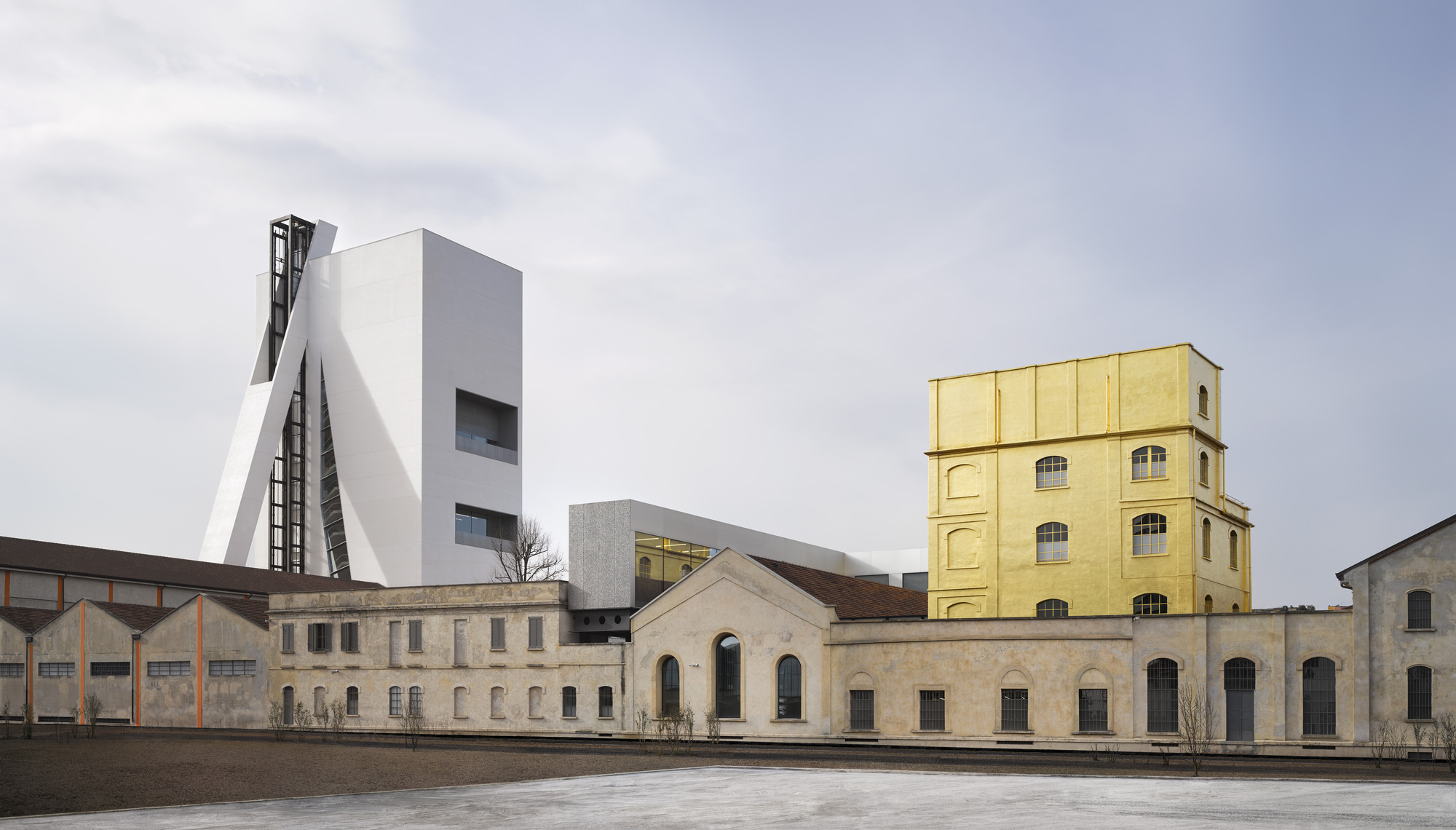
The permanent Milan venue opened on 9 May 2015 at Largo Isarco 2, a former gin distillery from the 1910s on the southern industrial fringe of the city. The architecture commission went to Rem Koolhaas’s OMA — Koolhaas had worked with Prada on the SoHo and Beverly Hills Epicenter stores in the early 2000s, so the design relationship predates the Largo Isarco scheme by more than a decade. The Milan site is 19,000 square metres of exhibition space spread across seven existing distillery buildings and three new structures, of which the Torre — a 60-metre concrete tower with stepped floor heights opened in April 2018 — is the publicly recognisable signature. The Bar Luce, designed by Wes Anderson in a pastiche of 1950s Milanese caffè interiors, opened with the venue in 2015 and has done more for the Fondazione’s Instagram footprint than any of the actual exhibitions.
OMA’s brief was unusual. The practice was asked to convert the distillery without demolishing any of the existing volumes, and to add new buildings that read as discrete objects rather than as a single composed campus. The Haunted House — clad in 24-carat gold leaf — is one of the existing structures; the Cinema, the Torre and the Podium are the new ones. The result is a compound that looks like an industrial site that has been edited rather than transformed. That editorial register — additive rather than redemptive — is the Fondazione’s programming method as well, and it is the first instance in this lineage of a Prada partnership where the architect’s working method became indistinguishable from the institution’s.
The Fondazione has run, since 2015, a publication arm that has produced exhibition catalogues with Mondadori Electa, Walther König and Progetto Prada Arte, and a programme of Cinema seasons selected by Roberto Cicutto and others. The cumulative output sits inside the broader luxury-publishing register we mapped in luxury publishing imprints; the difference is that Prada is the only house whose imprint is run through its foundation rather than its commercial arm.
Prada Frames, 2022 to 2026: a symposium produced by a fashion house and curated by Formafantasma
In June 2022, during Milan Design Week, the first edition of Prada Frames opened at the Biblioteca Nazionale Braidense — the eighteenth-century library inside Brera that holds 1.5 million volumes and is one of the largest public libraries in Italy. The theme was “On Forest”. The format was three days of panels: anthropologists, foresters, designers, climate scientists, philosophers, the occasional curator. The curatorial brief went to Formafantasma — Andrea Trimarchi (born Salerno, 1983) and Simone Farresin (born Vicenza, 1980), the Italian designers who founded their practice in 2009 at Design Academy Eindhoven and have since moved between Eindhoven and Milan, where the studio now operates from Via Camillo Hajech.
Formafantasma had, by 2022, become the de facto research arm of the European design conversation about material extraction. Their Cambio exhibition at the Serpentine Sackler Gallery in 2020 — an audit of the timber industry as a global supply chain — was the credential the Prada commission was built on. The symposium reads, in transcript, as a continuation of Cambio: tree-line ecology, monoculture plantations, the politics of veneer. What was new was that the symposium had a fashion house’s name on the masthead and a fashion house’s invitation list in the audience.
Subsequent editions ran during Milan Design Week — “Materials in Flux” in 2023, “Being Home” in 2024 — and the format moved to Hong Kong’s Tai Kwun, the former Central Police Station compound restored by Herzog & de Meuron, for an Asian edition. The transcripts are published. The video is archived. The symposium does not produce objects, exhibitions or merchandise. It produces, instead, a research register that the rest of the luxury sector has not commissioned and does not have the institutional discipline to commission.
Formafantasma’s role is the specific verb the partnership turns on. They are credited as curators because they literally are — they select panellists, structure days, write the framing texts. Prada Frames is the only symposium produced by a major luxury house where the curator is named and the curatorial method is the deliverable.
Prada Mode, 2018 to 2026: a travelling club with site-specific artists
Prada Mode launched at the Freehand Miami hotel during Art Basel Miami Beach, 4 to 6 December 2018, with a site-specific intervention by Theaster Gates. The format: a temporary members’ club programmed across three days, sited inside an existing hospitality footprint, with a contemporary artist or designer commissioned to produce an environment that doubles as the club’s interior. Members pay an annual subscription; the events themselves are free to members and accessible to invitees on a Prada list.
Gates — Chicago-born, born 1973, founder of the Rebuild Foundation and Stony Island Arts Bank — produced for the Miami opening a sequence of soul-food dinners, gospel-choir performances and an installation that referenced his Stony Island archive. We covered the broader arc of his public commissions in Theaster Gates, public commissions 2010–2026; the relevant point here is that Mode in Miami was an early piece of the Prada–Gates relationship that later produced the Prada-Theaster Gates Chawan Cabinet shown in Milan.
Subsequent Prada Mode editions ran in London (Damien Hirst, Theaster Gates again), Hong Kong (Cao Fei), Tokyo (Kazuyo Sejima) and Dubai. The cadence is one or two per year, anchored to art-fair or art-biennale weekends. The economics are opaque — Prada Mode is not a profit centre and is not framed as one — but the strategic logic is legible. The club is a recurring permission slip for Prada to be in the room when contemporary art is being bought and sold, without having to sponsor anything.
Prada × Axiom Space, 2023 to 2026: from announcement to LCVG
The Axiom Space partnership was announced on 4 October 2023 in Houston. Axiom Space is a NASA contractor founded in 2016 by Michael T. Suffredini — a former NASA International Space Station programme manager — and Kam Ghaffarian, the Iranian-American engineer who had previously founded Stinger Ghaffarian Technologies. The company holds NASA contracts for the Axiom Orbital Segment, a set of commercial modules that will attach to the ISS and eventually detach to operate as a standalone commercial space station, and for the Axiom Extravehicular Mobility Unit (AxEMU) — the next-generation lunar spacesuit NASA selected for the Artemis programme.
The Prada brief was specific. Axiom Space asked Prada to co-develop materials, textile engineering and the outer-layer aesthetics of the AxEMU. The October 2023 announcement was the first time a luxury fashion house had been named as a co-developer on a NASA spacesuit. It was reported across the trade press at the time as a marketing curiosity. It read, even then, as something more deliberate: Bertelli and Lorenzo Bertelli — the latter a marketing and corporate-social-responsibility lead at Prada Group since 2017 and the son named in the succession discussions — signing a multi-year industrial partnership with the only American company holding the AxEMU prime contract.
On 8 June 2026, two years and eight months after the announcement, Axiom and Prada unveiled the Liquid Cooling and Ventilation Garment — the LCVG — at a Houston press event covered by Business of Fashion. The LCVG is the inner layer worn under the pressurised AxEMU. It is form-fitting. It carries a fully redundant water-cooling circuit — meaning two independent loops, either of which can sustain the astronaut’s thermal regulation if the other fails. Astronauts on Artemis IV will wear it directly on the skin under the suit. The mission is scheduled for 2028; the LCVG is the first piece of the AxEMU’s interior architecture to reach public unveiling. Prada is named as co-developer on the textile engineering. The cooling circuit itself is Axiom’s mechanical IP.
The partnership has produced, by mid-2026, two visible deliverables — the AxEMU exterior shown in concept form in March 2024, and the LCVG shown in June 2026 — and a steady drip of joint press appearances at Houston, Milan and Cape Canaveral. The cumulative effect is that Prada is the only major fashion brand publicly associated with a NASA lunar return, and the association is structural rather than promotional.
A timeline of Prada partnerships outside fashion, 1993–2026
| Year | Partnership | Counterparty | Form | Anchor moment |
|---|---|---|---|---|
| 1993 | Fondazione Prada (founding) | — | Private art foundation | Founded as Fondazione Prada Milano-Arte by Miuccia Prada and Patrizio Bertelli |
| 2001–2004 | Epicenter stores | OMA / Rem Koolhaas | Architecture commission | SoHo Epicenter (2001), Beverly Hills Epicenter (2004) |
| 2011 | Fondazione Prada Venezia | Comune di Venezia | Heritage lease + programme | Ca’ Corner della Regina opens to the public |
| 2015 | Fondazione Prada Milano | OMA / Rem Koolhaas | Architecture + programming | Largo Isarco campus opens 9 May 2015 |
| 2015 | Bar Luce | Wes Anderson | Interior commission | Pastiche caffè opens with Largo Isarco |
| 2018 | Prada Mode | Theaster Gates | Travelling cultural club | Freehand Miami, 4–6 December 2018 |
| 2018 | Fondazione Prada Torre | OMA / Rem Koolhaas | Architecture commission | 60-metre concrete Torre opens April 2018 |
| 2022 | Prada Frames | Formafantasma | Symposium | “On Forest”, Biblioteca Nazionale Braidense, June 2022 |
| 2023 | AxEMU spacesuit | Axiom Space / NASA | Industrial design + materials | Partnership announced 4 October 2023 |
| 2024 | AxEMU concept | Axiom Space / NASA | Public reveal | Exterior shown in March 2024 |
| 2026 | LCVG | Axiom Space / NASA | Industrial design + materials | Liquid Cooling and Ventilation Garment unveiled 8 June 2026 |
Six tentpoles. Three architecture commissions all routed through one practice. Two cultural programmes — Mode and Frames — that operate as content engines without producing product. One aerospace partnership that is now four years old and shipping deliverables.
What Prada’s competitors run, and what they do not
Read horizontally, the absence is the data. LVMH runs Fondation Louis Vuitton in Paris (Frank Gehry, 2014) and a series of cultural commissions inside the maisons — Hermès has La Pelota in Milan and the Fondation d’Entreprise Hermès; Chanel has the Fondation Chanel and a network of métiers d’art ateliers. None of them runs a multi-year symposium with a named external curator on the masthead. None of them runs a travelling cultural club. None of them sits on a NASA contract. Brunello Cucinelli has restored Solomeo; the Loro Piana foundation has its archives. None of them operates at the breadth of Prada’s six-anchor structure.
The closest analogue is Hermès, which through La Pelota and the Fondation d’Entreprise has the cultural-commission depth, and through Petit h has the experimental object register. But Hermès has not commissioned a single architecture practice across thirty years, and Hermès has not, so far, named a fashion-house partner on a NASA contract. The breadth is Prada’s alone in the luxury sector.
What makes the position defensible is the editorial method. Each Prada partnership operates through one named external author. OMA is one practice — Koolhaas, plus the project architects he assigns. Formafantasma is two named designers. Theaster Gates is one named artist. Axiom Space is a single American contractor. There is no rotation of agency partners, no portfolio of equivalent vendors. The partnership is the long form. It is also, mechanically, the reason the partnerships keep producing — a long-form relationship with a single counterparty accumulates work in a way that a rotation never does.
Coda: cultural-program-as-brand-equity, and why no one else has matched it
Across thirty-three years, Prada has built six external partnerships outside fashion. Each is anchored to a named author. Each operates at a tempo measured in decades rather than seasons. Each produces output — a building, a symposium transcript, a club night, a spacesuit interior — that the rest of the sector has neither the patience nor the institutional shape to commission. The cumulative effect is a brand register that runs from a 1993 Milan foundation through to a 2026 NASA garment without a visible product gap.
This is what cultural-program-as-brand-equity looks like when executed continuously across a single ownership group. It is not advertising; the partnerships do not appear in Prada’s seasonal ad campaigns. It is not sponsorship; Prada is named as co-developer, co-curator or founder, not as title sponsor. It is, more accurately, a form of cultural infrastructure — owned, operated and capitalised the way another holding might own its real estate. The 2025 listing of Prada Group on the Hong Kong Stock Exchange in addition to the Milan listing did not change the structure. The acquisition of Versace from Capri Holdings, completed 2026, did not change the structure. The pending question of succession from Miuccia and Patrizio to Lorenzo Bertelli will, eventually, be the test of whether the structure survives without its founders.
The data, as of June 2026, is that no other major luxury house operates at this breadth. LVMH has the foundation; it does not have the symposium, the travelling club or the aerospace partnership. Kering has the Pinault Collection at Palazzo Grassi and the Bourse de Commerce; it does not have the research-symposium programme. Hermès has the commission programme and the métiers d’art; it does not have the architecture relationship. Richemont, Chanel, Burberry — none of them sits in this register. Prada partnerships outside fashion are, in 2026, an unmatched position in the luxury sector. The next thirty years will tell whether the position is an institution or a generation.