Luciano Pia’s 25 Verde finished in Turin in 2012, two years before Stefano Boeri cut the ribbon on Bosco Verticale on 10 October 2014—which makes the phrase Italian vertical forests a plural that Milan has spent a decade pretending is a singular. The story usually told runs in a straight line from Boeri Studio’s Porta Nuova twin towers to a global typology now imitated from Nanjing to Eindhoven. The story actually built on the ground includes a five-storey courtyard block at Via Chiabrera 25 in Turin’s San Salvario district, 80 steel columns shaped like tree trunks, and 200 living trees that were already irrigated, pruned and inhabited while the cranes were still climbing the De Castillia and Confalonieri shafts in Milan.
This piece is a reference: every inhabited Italian vertical forest before Boeri made the term famous, by city, by architect, by tree count. The set is smaller than the historiography implies. It is, in fact, exactly one fully realised, fully inhabited project—25 Verde—plus a medieval outlier in Lucca that the June 2026 Domus piece by Christian Marinotti rightly resurfaces. Everything else in the canon arrived after 10 October 2014 and was, consciously or not, downstream of Porta Nuova. The task here is to draw the line precisely and to argue why the Milanese version became the noun while the Turinese version remained an adjective.
25 Verde, Turin: the project that got there first
25 Verde sits at Via Chiabrera 25, between Corso Marconi and the Valentino park, in the dense Liberty-and-1960s grid of Turin’s San Salvario. The plot is a normal infill lot. The building Luciano Pia designed for it is not. Five floors, 63 apartments, roughly 7,500 square metres of residential space, organised around an internal patio that doubles as a microclimatic lung. The structural decision is the one everyone photographs: a steel load-bearing frame in which 80 columns are shaped like tree trunks, clad in larch shingles, branching at the top to carry the floor slabs and the roof. Around and above this metallic forest, Pia planted a real one—150 trees on the roof terraces, 50 trees in the internal courtyard, plus shrubs and climbers threaded through the balconies.
The chronology matters because it has been blurred. Design work began in 2007. Construction ran through to completion in 2012. In 2013 the Turin Order of Architects gave 25 Verde its ‘Architettura Rivelata’ (Revealed Architecture) award, a prize specifically intended to surface buildings the wider public might otherwise miss. By the time Bosco Verticale was inaugurated on 10 October 2014, 25 Verde had been occupied for two years, photographed in the architectural press, and decorated by its own city’s professional body. The ‘avant la lettre’ framing in Marinotti’s June 2026 Domus essay is not generous revisionism; it is the literal sequence of certificates of occupancy.
Pia’s biography explains some of why 25 Verde reads the way it does. Born in 1960 in San Giusto Canavese, north of Turin, he trained in the office of Andrea Bruno—the restoration architect whose practice in Turin handled some of the most demanding heritage interventions in the Piedmontese twentieth century. Pia then spent a decade in Paris, from 1990 to 2000, before returning to Turin to found Studio Luciano Pia. His portfolio up to 25 Verde was dominated by restoration and small infrastructural projects: not the typical CV of a man about to invent a high-profile architectural typology. That is part of the point. 25 Verde is a restoration architect’s vertical forest. The steel trees are not a slogan; they are a structural diagram that lets the planting sit where it sits, and the larch cladding is the move of someone who has spent twenty years matching new material to old.
The numbers, set against the Milanese reference, are honest. 200 living trees—150 on the roof, 50 in the patio—plus the 80 steel columns that mimic trees but are not. Five floors. 63 apartments. A height that does not break the cornice line of San Salvario. 25 Verde is a courtyard block with a forest pressed against it, not a tower with a forest strapped to it. That distinction will matter when we get to why Milan, not Turin, got the term.
Bosco Verticale, Milan: the project that got the term
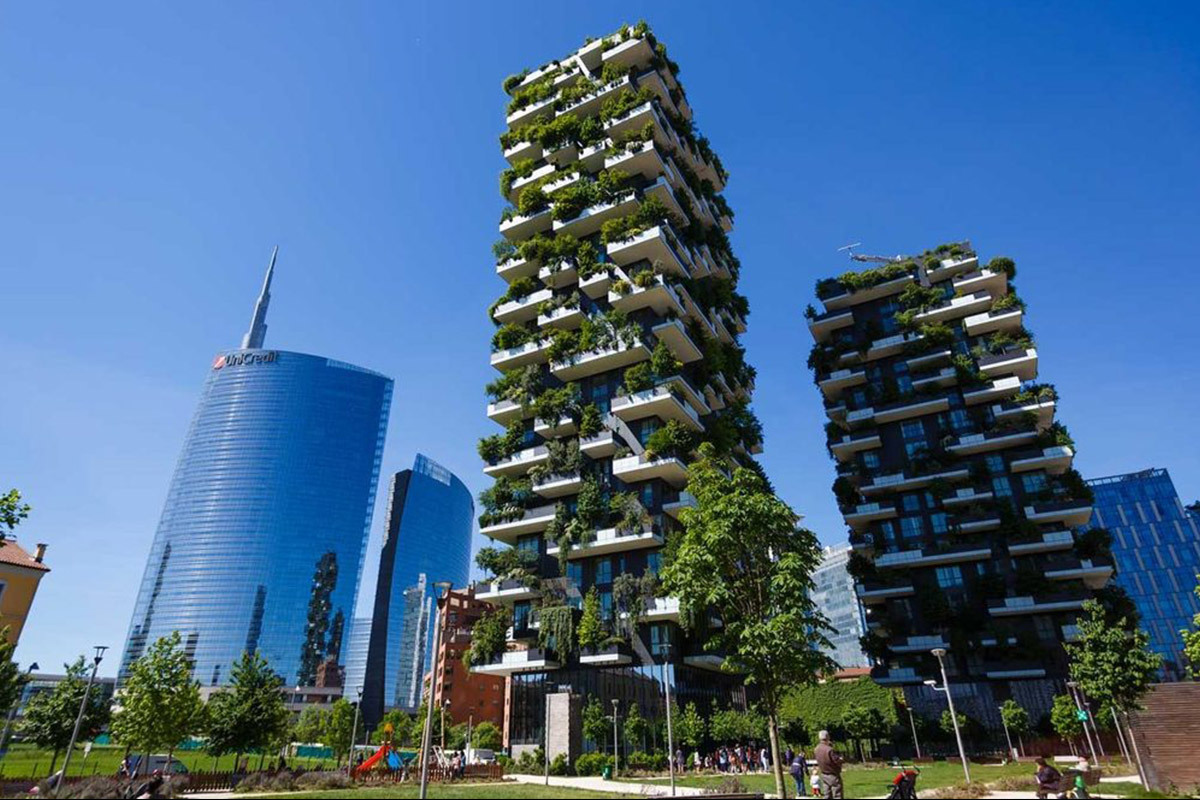
Bosco Verticale occupies the corner where Via Gaetano de Castillia 11 meets Via Federico Confalonieri 4, on the northern edge of the Porta Nuova redevelopment between Garibaldi station and the Isola district. Two towers: Torre De Castillia at 116 metres, Torre Confalonieri at 84 metres. Construction ran from 2009 to 2014. Inauguration on 10 October 2014. The plant manifest at delivery: 480 large trees plus 250 small trees—730 trees in total—5,000 shrubs, and 11,000 perennials and groundcover, distributed across 94 plant species. Awards followed almost immediately: International Highrise Award 2014, CTBUH Best Tall Building Worldwide 2015. By 2016 the towers had become, in the international press, shorthand for an entire decade of green-architecture imagery.
The authorship of Bosco Verticale is one of the least discussed and most consequential details in this story. The towers were designed by Boeri Studio, the practice Stefano Boeri ran in partnership with Gianandrea Barreca and Giovanni La Varra. After Bosco Verticale, that partnership dissolved. Stefano Boeri continued the brand under Stefano Boeri Architetti, which is the studio currently delivering projects from the Rome Deposito delle Vittorie to vertical-forest commissions in Eindhoven, Tirana, Utrecht and Nanjing. Barreca and La Varra continued separately. The shared authorship is correctly recorded in the CTBUH database and the Boeri Studio archive; it is also, in practice, almost always elided in coverage that treats Bosco Verticale as a Stefano Boeri solo project. The elision matters because it is part of how the singular noun—‘Bosco Verticale,’ rather than ‘Boeri Studio’s vertical forest typology’—came to dominate the discourse.
Stefano Boeri himself was born on 25 November 1956 in Milan. He is currently president of Triennale Milano, a post he has held since 2018 and which transitions to Vincenzo Trione in the 2026 succession we covered in our presidents lineage. The Triennale presidency is institutionally important for this argument because it is the platform from which Bosco Verticale has been continuously reframed—through exhibitions, manifestos and the Forestami urban-forestry programme—as not a building but a movement. 25 Verde, by contrast, never had a platform. Luciano Pia is not the president of anything. He runs a Turin studio.
The plant census of Bosco Verticale is also where the Milanese project decisively overshoots its Turinese predecessor. 730 trees against 200 is not a marginal difference; it is the difference between a courtyard block with planted terraces and a high-rise that genuinely behaves, from the street, like a vertical woodland. 94 plant species against the simpler palette at Via Chiabrera 25 reflects a research collaboration with botanist Laura Gatti and agronomist Emanuela Borio that turned the Porta Nuova towers into a horticultural experiment as much as an architectural one. The 116-metre and 84-metre heights, set inside the Porta Nuova skyline alongside the CityLife district towers across town, gave the project an instantly recognisable silhouette that 25 Verde, by virtue of its five-storey courtyard typology, could never produce.
Italian vertical forests, by city and architect: the comparison
The reference table below is the article’s central asset. It catalogues every inhabited Italian vertical forest delivered before the canonical ‘Bosco Verticale’ label took hold on 10 October 2014. Torre Guinigi in Lucca is included because the June 2026 Domus essay by Christian Marinotti is correct to flag it as a tree-on-tower precedent: a fourteenth-century brick tower in the historic centre with seven holm oaks growing from a rooftop garden, still inhabited as a monument and visited daily. It is not a residential vertical forest in the modern sense, but no honest account of Italian vertical forests can omit it.
| Project | City | Architect | Completed | Trees | Apartments / use | Height |
|---|---|---|---|---|---|---|
| Torre Guinigi | Lucca | Guinigi family (14th c.) | c. 1384 | 7 holm oaks (rooftop) | Tower-house, now monument | ~45 m |
| 25 Verde | Turin | Luciano Pia | 2012 | 200 living + 80 steel | 63 apartments / ~7,500 sqm residential | 5 floors |
| Bosco Verticale | Milan | Boeri Studio (Boeri, Barreca, La Varra) | 10 October 2014 | 730 (480 large + 250 small) | ~120 apartments across two towers | 116 m + 84 m |
Two clarifications belong with the table. First, the count of Italian vertical forests before Bosco Verticale, in the strict ‘inhabited contemporary residential vertical forest’ sense, is exactly one: 25 Verde. Everything subsequent—Trudo Vertical Forest in Eindhoven (2021), Easyhome Huanggang in Nanjing (delivered phases through the 2020s), Tirana’s vertical-forest tower—postdates Porta Nuova and was either commissioned from Stefano Boeri Architetti or developed in dialogue with the typology Boeri Studio codified. Second, the 80 metallic ’tree’ columns at 25 Verde are structural, not botanical, but they are part of why the project reads as a forest from the street: Pia treats steel and bark as a single visual register, with larch shingles cladding columns that branch into the slab edges.
The table also clarifies what the typology is not. It is not green roofs—Italy had those by the dozen before 2012. It is not facade-planted terraces—Carlo Mollino’s and Gio Ponti’s mid-century work in Turin and Milan included planted balconies as standard. The Italian vertical forest, as a distinct typology, requires structural trees: trees specified at the engineering stage, sized to mature heights, irrigated and maintained as part of the building’s permanent load and budget. By that definition, 25 Verde is the first and Bosco Verticale is the second, and the gap between them is two years.
Why Milan, not Turin, got the term ‘Italian vertical forests’
There are three reasons the canonical noun emerged in Porta Nuova rather than San Salvario, and all three are about institutions rather than architecture. The first is height. Bosco Verticale’s 116-metre and 84-metre towers were the tallest residential structures in Porta Nuova at delivery, and they slotted into a skyline already framed by the UniCredit Tower (231 m, completed 2011) and the Garibaldi towers. A 116-metre tree-covered tower photographs differently from a 5-storey tree-covered courtyard. The Milanese building broadcast itself.
The second is institutional gravity. Stefano Boeri became director of Domus in 2004, of Abitare in 2007, ran Milan’s culture department under the Pisapia administration from 2011 to 2013, and—from 2018—has been president of Triennale Milano, a presidency that hands over to Vincenzo Trione in the 2026 succession. Each of those positions is a publishing platform. Bosco Verticale was not just designed in Milan; it was re-narrated, exhibited and theorised from Milan for a decade after delivery. 25 Verde won the 2013 Architettura Rivelata prize from the Turin Order of Architects and then, by the standards of the international press, mostly disappeared.
The third reason is the Boeri Studio split itself. When the partnership with Gianandrea Barreca and Giovanni La Varra dissolved after Bosco Verticale, Stefano Boeri Architetti kept the brand and immediately began exporting it. By 2018 the practice had vertical-forest commissions in Eindhoven, Tirana, Lausanne, Utrecht and Nanjing. Each project repeated the core gesture—structural trees, multi-species planting, residential tower—and each was sold under the now-trademarked phrase ‘Vertical Forest.’ Pia, working from a Turin studio with a restoration backbone, did not export 25 Verde. He continued to work in Piedmont. The result is that the world has two vertical-forest precedents in Italy and one global brand, and the brand belongs to the second-built project, not the first.
A fourth reason, less institutional but worth naming: typological legibility. Bosco Verticale’s plant manifest—94 species, 730 trees, two towers, one address—reads as a system that can be copied. 25 Verde’s combination of steel-tree columns, larch shingles, internal patio and rooftop forest reads as a one-off solved for a particular Turin lot. The Milanese building was designed, intentionally or not, to be repeatable. The Turinese building was designed to be itself.
Coda: the plural Italy already had
The honest accounting of Italian vertical forests before Bosco Verticale is two structures, separated by six and a half centuries. Torre Guinigi in Lucca, c. 1384, with its rooftop holm oaks, gave Italy the medieval template: tree on tower as civic emblem. 25 Verde in Turin, 2012, designed by Luciano Pia at Via Chiabrera 25, gave Italy the modern template: tree as structural-and-living co-element in a multifamily residential building. Bosco Verticale, inaugurated on 10 October 2014 at Via Gaetano de Castillia 11 and Via Federico Confalonieri 4 by Boeri Studio—Stefano Boeri with Gianandrea Barreca and Giovanni La Varra—gave Italy the brand. The Stefano Boeri Architetti studio that continued after the partnership split has, since then, given the world a typology that runs from Porta Nuova to Nanjing and is now—via the Triennale presidency, the Forestami programme and projects like the Rome Deposito delle Vittorie—an export.
The Marinotti essay in the June 2026 Domus does the historiographical work of restoring the plural. Italian vertical forests, in the strict sense, were Pia first and Boeri second; in the looser sense that includes Torre Guinigi, they were Lucchese first, Turinese second, Milanese third. The fact that the term entered the international lexicon in its Milanese form is a matter of platform, height and brand custodianship—not of priority. 25 Verde got there in 2012, with 200 living trees and 80 steel ones, and won its city’s professional award the following year. That is the record. The vertical forest, in Italian, has always been a plural noun. Milan has simply been the loudest one.
Across Triennale Milano’s lineage of presidents and the CityLife tower district that frames the rest of the Milanese skyline, the institutional machinery that turned Bosco Verticale into a global noun is visible in plain sight. The corrective is not to take the term away from Milan. The corrective is to remember that two years before the De Castillia tower hit 116 metres, a five-storey courtyard block in San Salvario had already done the structural and horticultural work the term describes. The Italian vertical forest was inhabited in Turin before it was famous in Milan. The plural is the historically accurate form.