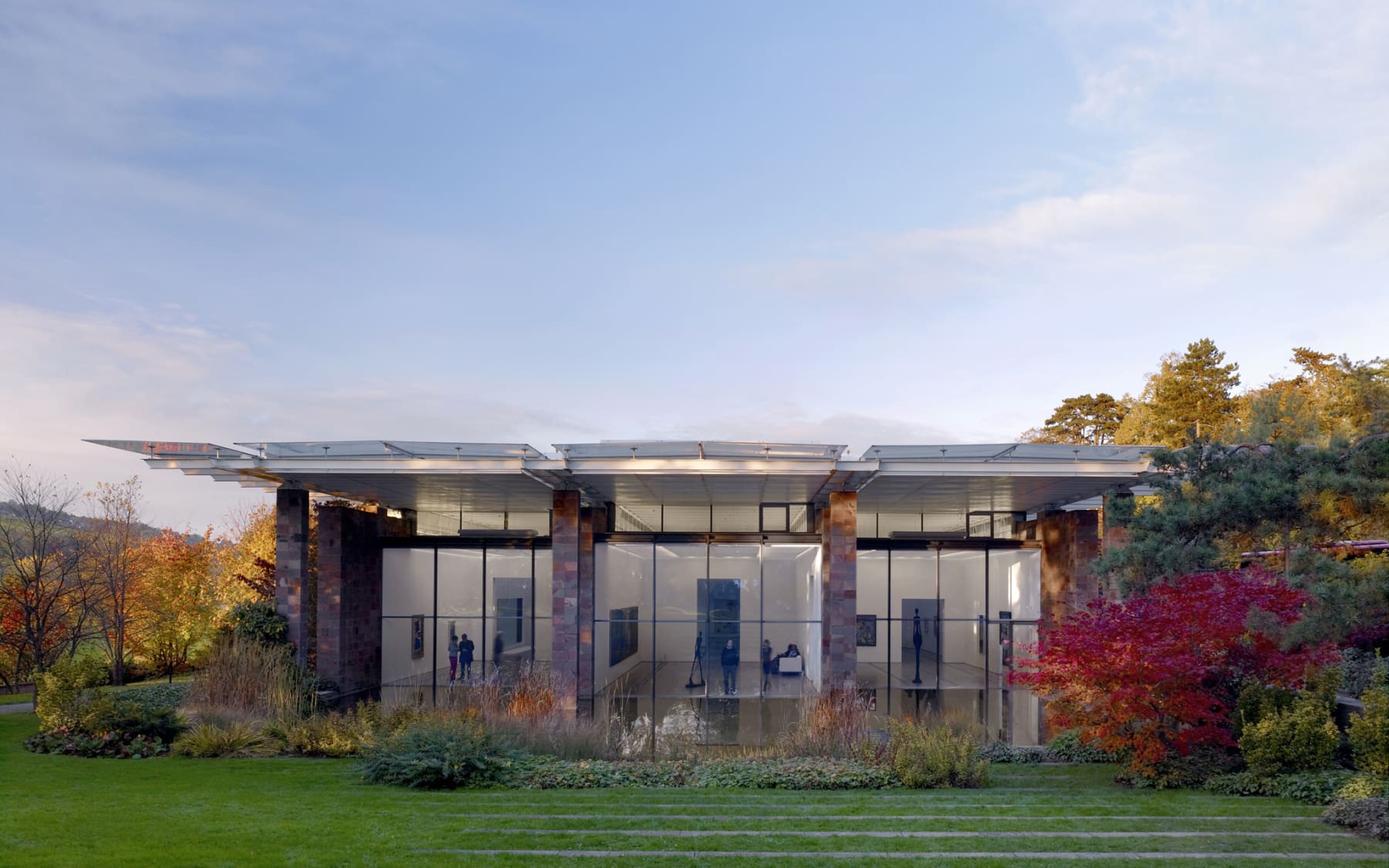
Peter Zumthor’s June 2026 extension scheme for the Fondation Beyeler in Riehen is the first time another Pritzker laureate has been asked to expand a Renzo Piano museum. The handoff is unusually clean: Renzo Piano won the Pritzker in 1998, the year after his Beyeler building opened; Peter Zumthor won it in 2009; and the two now share the same six-hectare park on the Swiss-German border. The Fondation Beyeler is one of the small set of post-war private museums whose architecture is as legible as its collection, and the 2026 commission turns it into a two-author site without removing anything that already exists.
The question this piece answers is narrow: which architects have worked on the Fondation Beyeler building, and what did each of them do. The answer is short — Renzo Piano (1994-1997), Renzo Piano again on a small 1999 extension, and Peter Zumthor (announced June 2026) — but the underlying decisions tell a longer story about how a private collector’s museum becomes a civic institution, and how a second-generation architectural intervention can be additive rather than corrective.
Fondation Beyeler, 1982-1997: Ernst Beyeler builds his own museum
The Fondation Beyeler began as a legal entity in 1982, fifteen years before it had a building. Ernst Beyeler (1921-2010) and his wife Hildy Kunz Beyeler (1922-2008) established the foundation to hold the collection they had assembled through Galerie Beyeler, the Basel gallery Ernst had opened in 1947. By the early 1980s the Beyelers had spent three and a half decades buying, selling, and increasingly keeping work by the artists they cared most about — Picasso, Cézanne, Monet, Klee, Giacometti, Bacon, Rothko — and the foundation was their mechanism for ensuring that what they kept would stay together after them.
Ernst Beyeler is also one of the three founders of Art Basel, which he co-launched in 1970 with Trudi Bruckner and Balz Hilt. That detail matters for the museum’s later architecture, because by the time the Beyelers commissioned a building in the early 1990s, Ernst was not a private collector commissioning a vanity project. He was the most influential dealer in modern art in continental Europe and the co-founder of what had become the most important art fair in the world. He could call any architect he wanted.
He called Renzo Piano. The two had met through the Menil Collection in Houston, Piano’s 1987 museum for Dominique de Menil, which had set a quiet template for private-collector buildings: long, low, naturally lit, indifferent to spectacle. Beyeler wanted something similar in scale and ambition for Riehen, the small Swiss municipality north-east of Basel where Berower Park — a piece of 19th-century parkland with mature trees and a villa — had been earmarked as the site. The foundation acquired the park; Piano took the commission; ground was broken in September 1994.
Renzo Piano in Riehen: four porphyry walls, 1994-1997
The building Piano delivered on 18 October 1997 is one of the cleanest demonstrations in his catalogue of a single architectural idea executed at scale. Four parallel walls, each 115 metres long, set seven metres apart, run north-south through the eastern edge of Berower Park. The walls are clad in Patagonian porphyry — a dark red-brown stone with a slightly granular surface — and they carry a glazed roof that floats above them on a thin white steel structure. Between the walls are the galleries; at the south end, the building cantilevers slightly over a long reflecting pool that holds water lilies, a deliberate nod to the Monet canvases inside.
The exhibition space was about 3,306 square metres at opening, rising to roughly 3,764 square metres after a small 1999 extension added 458 square metres. By post-2000 museum standards that is small. The Pompidou has roughly five times more gallery area. But the Beyeler was never trying to be a Pompidou. The brief was a permanent-collection museum with rotating temporary shows on one side of the long axis, and the porphyry-wall plan delivered exactly that: a sequence of rooms of varying width, all sharing the same daylight ceiling, all proportioned to the scale of the paintings in Beyeler’s collection rather than to a national institution’s circulation diagrams.
The daylight is the part of the building most often discussed. Piano’s roof is a layered glass-and-louvre assembly that filters the bright Swiss sun into something close to the soft northern light that European modernists from Monet onwards had built their work around. The system is partly mechanical — louvres adjust through the day — and partly geometric, with the glass tilted to shed direct sun off the gallery floor. The result is that the galleries read as naturally lit even when they are heavily supplemented by artificial sources, and the collection’s Cézannes, Monets, and Rothkos sit under a light that none of them would have rejected.
Piano won the Pritzker Prize in 1998, the year after the Beyeler opened. The award citation referenced the Menil and the Pompidou rather than the Beyeler specifically, but the timing meant that the Riehen building was read, retrospectively, as one of the projects that pushed the prize over the line. It also fixed the Beyeler in a particular position within Piano’s catalogue: not his largest museum, not his most photographed, but the one where the gap between programmatic intent and built result is smallest.
The 1999 extension and the collection at full size
Two years after opening, Piano returned to add 458 square metres of gallery space at the southern end of the building. The 1999 extension is small enough that most accounts of the Beyeler treat the building as a single 1997 object, but it matters for a clean lineage of architects on site: every square metre of gallery added between 1997 and 2026 was added by Piano himself. There was no second architect, no intervening renovation, no competition.
The collection the building was sized for is around 400 works, anchored by 23 Picassos, multiple Cézannes (including late watercolours), Monet water lilies, Vincent van Gogh, Paul Klee, Henri Matisse, Francis Bacon, Mark Rothko, Andy Warhol, Roy Lichtenstein, Jackson Pollock, and an important group of tribal-art objects from Africa and Oceania that Beyeler considered inseparable from the modernist canon they influenced. The collection’s depth in Picasso alone — 23 works across painting, drawing, and sculpture — is the kind of holding most national museums would build a wing around.
By the mid-2010s the Beyeler had become the most-visited art museum in Switzerland, posting 332,000 visitors in 2016. The number is small by Tate or Louvre standards and very large by Swiss ones; it also exposed the building’s main constraint, which was simply that 3,764 square metres of gallery cannot easily host both a deep permanent display and the kind of temporary exhibitions — Gauguin, Bacon-Giacometti, Mondrian — that the foundation had built its post-2010 programme around. Something had to give: either the permanent collection got rotated more aggressively, or the temporary shows got smaller, or the building got bigger. The foundation chose the third option, and in the late 2010s began assembling land south of the Piano building for a future extension.
The 2026 Zumthor commission: three buildings, double the grounds
On 15 June 2026, Domus published the first detailed account of Peter Zumthor’s scheme for the Fondation Beyeler’s southern expansion. The commission had been quietly developed at Atelier Peter Zumthor in Haldenstein, the Graubünden village where Zumthor has worked since the 1980s, and the foundation unveiled it publicly that month. The scheme is structured around three new buildings sited across a southern park acquisition that roughly doubles the foundation’s grounds.
The first and largest of the three is a concrete collection pavilion of approximately 1,500 square metres, organised on three exhibition levels and lit through carefully placed glazed apertures that filter daylight in the way Zumthor has refined across his career — most famously at the Kunsthaus Bregenz, where the entire facade becomes a light filter. The Beyeler pavilion is smaller than Bregenz and not a single object: it sits within the southern park as one element among several, rather than dominating its surroundings the way Bregenz dominates the lake-edge plot. The choice of concrete is deliberate. Where Piano’s 1997 building reads as a stone-and-glass machine for soft light, Zumthor’s pavilion will read as a poured monolith that admits light through cuts rather than through a continuous roof.
The second building is a transparent events pavilion. The foundation has not released full details, but the brief — a glazed structure for talks, receptions, and the kind of programming that has crept into every major museum since the 2000s — is consistent with Zumthor’s smaller glass-and-timber pavilions, including the Serpentine Pavilion he built in London in 2011. The point of having the events pavilion as a separate object is to keep the collection pavilion free of the noise, catering, and circulation that ancillary programming generates.
The third building is an underground-linked depot and administration block. This is the workhorse of the scheme: storage, conservation, offices, technical plant. Putting it underground is partly an aesthetic decision (the southern park is preserved at ground level) and partly a practical one (climate control is easier below grade). The depot connects to the new pavilions and, presumably, to the Piano building through underground service routes, which is how most contemporary museum extensions handle the back-of-house problem.
What the Zumthor scheme does not do is touch the 1997 Piano building. There is no addition to the porphyry walls, no new entrance through the existing structure, no reorganisation of Piano’s galleries. The 2026 intervention is additive in the strict sense: it puts new buildings in new ground that the foundation has acquired, and leaves the original museum exactly as it was. That decision is the cleanest possible answer to a question that has dogged museum extensions since the 1980s, which is what to do when a beloved original building runs out of space. The Beyeler’s answer: don’t touch it; build next door.
Timeline: architectural interventions at the Fondation Beyeler
| Year | Event | Architect / agent |
|---|---|---|
| 1947 | Galerie Beyeler founded in Basel | Ernst Beyeler |
| 1970 | Art Basel co-founded | Ernst Beyeler, Trudi Bruckner, Balz Hilt |
| 1982 | Fondation Beyeler legal entity established | Ernst & Hildy Beyeler |
| Sep 1994 | Ground broken for museum building in Berower Park, Riehen | Renzo Piano (RPBW) |
| 18 Oct 1997 | Museum opens; four 115m porphyry walls, ~3,306 sqm galleries | Renzo Piano (RPBW) |
| 1998 | Pritzker Prize awarded | Renzo Piano |
| 1999 | 458 sqm gallery extension at south end; total galleries ~3,764 sqm | Renzo Piano (RPBW) |
| 2009 | Pritzker Prize awarded | Peter Zumthor |
| 2016 | 332,000 visitors; most-visited art museum in Switzerland | Foundation operations |
| Late 2010s | Southern park acquisition begins, doubling foundation grounds | Foundation |
| 15 Jun 2026 | Zumthor extension scheme unveiled (Domus) | Atelier Peter Zumthor, Haldenstein |
The table is the cleanest way to see the lineage’s main feature, which is that for almost three decades only one architect worked on the Beyeler. The 2026 announcement is the first time a second name enters the project.
Two Pritzkers on one site
Joint Pritzker sites are rare. The Pritzker has been awarded annually since 1979, and most laureates’ buildings sit on plots they alone designed; when extensions happen, they are usually by the original architect or by a less-distinguished firm. There are exceptions — the Louisiana Museum of Modern Art in Humlebæk has work by multiple notable Danish architects, and several museums in Japan layer interventions by different generations — but a site where two Pritzker laureates with independent reputations both build major museum buildings is uncommon.
The Beyeler joins a short list that includes (depending on how you count) the Kimbell in Fort Worth, where Louis Kahn’s 1972 building was extended by Renzo Piano in 2013 — a Piano-on-Kahn precedent that the Beyeler now mirrors as Zumthor-on-Piano. The Kimbell case is instructive: Piano built a separate pavilion across the lawn rather than adding to Kahn’s vaulted barrel, and the result is two distinct buildings sharing a programme. The Beyeler will do something similar, with Zumthor’s three structures occupying the new southern grounds rather than touching Piano’s porphyry-walled box.
The Piano-Zumthor pairing also closes a loop in the broader Swiss museum landscape. Both architects are Pritzker laureates with Swiss or Swiss-adjacent practices (Piano’s RPBW has long operated from Genoa with strong Swiss connections; Zumthor is Swiss and works from Haldenstein), both are committed to natural light as a primary architectural medium, and both built their reputations on small-to-medium private and institutional commissions rather than on city-scale civic projects. The Beyeler is, in that sense, a natural site for the two of them to share.
Comparing the two interventions
| Dimension | Piano (1994-1997, 1999) | Zumthor (2026 scheme) |
|---|---|---|
| Pritzker year | 1998 | 2009 |
| Practice base | RPBW, Genoa | Atelier Peter Zumthor, Haldenstein |
| Programme | Permanent collection + temporary shows | Collection pavilion + events + depot |
| Primary material | Patagonian porphyry, glass, white steel | Concrete (collection pavilion) |
| Lighting strategy | Glazed louvred roof; continuous diffuse daylight | Glazed apertures in concrete shell; filtered daylight |
| Site relation | Eastern edge of Berower Park, parallel to grain | Southern park acquisition, dispersed |
| Building count | One linear bar (plus small 1999 extension) | Three discrete buildings |
| Approximate gallery area | ~3,764 sqm (post-1999) | ~1,500 sqm (collection pavilion) |
| Ground broken / unveiled | September 1994 | June 2026 |
The comparison clarifies what the 2026 scheme is and is not. It is not a doubling of gallery space; the new collection pavilion adds roughly 1,500 sqm to Piano’s 3,764 sqm, which is significant but not transformative. It is not a replacement of the original light strategy; Zumthor’s approach to daylight is different in execution but similar in intent. And it is not a single new building; the scheme’s three-object structure is closer to a small campus than to a wing.
What it is, structurally, is the conversion of the Fondation Beyeler from a single-building institution into a multi-building one, with the original 1997 museum as the anchor and the new pavilions as specialised satellites. That is a meaningful change in how the foundation operates — it can run a major temporary show in Piano’s galleries while keeping the permanent collection on display in Zumthor’s pavilion, for instance, which was difficult with only one set of rooms.
Berower Park, Riehen: the site as the constant
One element runs through every phase of the Fondation Beyeler’s architectural history, and it is not an architect. It is Berower Park itself. The park was the reason the foundation chose Riehen in the early 1990s, the reason Piano’s building runs north-south along the eastern edge rather than occupying the centre, and the reason the southern expansion was possible — there was room to grow into adjacent land without leaving the park context.
Riehen is a Swiss municipality of about 21,000 people in the canton of Basel-Stadt, directly on the German border. Berower Park sits at the northern edge of the village; the Beyeler building is reached by tram from central Basel. The park has mature trees, a 19th-century villa (now used for foundation functions), and the kind of slightly unkempt continental European parkland that the Beyelers wanted as a setting for the collection. Piano’s building was sized and oriented to keep most of the park visible from the galleries; the Monet pool at the southern end is the most explicit gesture toward the landscape, but the entire layout assumes that visitors will move from gallery to park and back rather than spending three hours indoors.
The 2026 Zumthor scheme extends that logic. By spreading three buildings across the new southern grounds rather than concentrating them in a single block, the architecture remains subordinate to the park. The events pavilion is transparent; the depot is underground; the collection pavilion, while substantial, is one object among landscape rather than a dominant volume. The site discipline that has governed the Beyeler since 1994 — buildings inside parkland, not parkland decorating buildings — is preserved.
What the lineage tells you about private museums
The Fondation Beyeler is unusual in being a private collector’s museum that has scaled successfully into a major public institution without losing its original character. Most private museums either stay small (the Menil) or become indistinguishable from public museums (the Broad in Los Angeles), but the Beyeler has managed to grow visitor numbers, programming, and now physical footprint while keeping the collection at its centre and the building legible as a single architectural statement.
Part of what makes that work is the architectural restraint of both commissions. Piano’s 1997 building is not a signature gesture in the late-1990s sense; it is a long bar with a light roof. Zumthor’s 2026 scheme is not an icon either; it is three quiet buildings on the southern side of a park. Neither architect has used the Beyeler as a personal showcase. The collection, the park, and the foundation’s programming remain the point.
This matters for how the Beyeler will read in the 2030s, when the Zumthor buildings are open and the site has been fully reorganised. The risk in any two-architect museum is that the second intervention either dominates or vanishes; the Beyeler scheme is structured to do neither. The Piano building keeps its role as the foundation’s primary public face. The Zumthor buildings absorb the functions that had outgrown it. The two architects’ work coexists across a shared park rather than competing within a shared volume.
The architects who have worked on the Fondation Beyeler
Stripped to the essentials, the list is short:
- Renzo Piano (RPBW, Genoa). Original museum building, 1994-1997. Pritzker Prize 1998. 458 sqm extension, 1999. Designer of the porphyry-walled bar that is still the Beyeler’s primary structure.
- Peter Zumthor (Atelier Peter Zumthor, Haldenstein). Southern expansion scheme, unveiled June 2026. Pritzker Prize 2009. Designer of three new buildings on the foundation’s southern park acquisition.
No other architects have produced built work on site between those two commissions. The Beyeler has commissioned interior fit-out and exhibition design from a range of designers for individual shows, and the foundation has worked with landscape consultants on the park itself, but the architecture of the buildings is the work of two practices and two practices only.
That is the answer to the original question. The Fondation Beyeler’s architectural history is, for now, a two-name list: Piano from 1994 to 1999, Zumthor from 2026 onwards, with twenty-seven years of single-architect occupancy between them. When the Zumthor buildings open later this decade, the site will become one of the very few in Europe where two Pritzker laureates have built independent major works in a shared private-museum context, and the cleanest example of how a beloved 1990s museum can be extended without being altered.