Taschen published Building Stories on 22 April 2026, a single-volume monograph of 26 Francis Kéré projects assembled by Diébédo Francis Kéré himself, and the book is the cleanest occasion in twenty-five years to read the full arc of Francis Kéré projects from the Gando Primary School clay-brick prototype that opened in 2001 to the Las Vegas Museum of Art baobab the studio is co-designing with SOM for a 2029 opening. Kéré won the Aga Khan Award for Architecture in 2004 for a single school in a Burkinabè village of roughly 3,000 people; he won the Pritzker Architecture Prize in 2022 as the first African and first Black laureate in the prize’s forty-three-year history; and he is now drawing a museum into the Red Rock Mountains. The book is the spine. The buildings are the vertebrae.
This piece walks the catalogue in order, from the 1985 carpentry scholarship that took Kéré from Gando to Berlin, through the founding of Schulbausteine für Gando e.V. in 1998 and Kéré Architecture in 2005, to the thirteen built and announced projects from the 2001 Gando Primary School to the 2029 Las Vegas Museum of Art. The argument is that every Francis Kéré project resolves into the same four-line method: locally sourced earth or stone, community labour, passive climate response, no concrete.
From Gando to Berlin: the pre-1998 biography
Diébédo Francis Kéré was born in 1965 in Gando, a village in the Boulgou Province of south-central Burkina Faso, roughly 200 km south-east of Ouagadougou. He was the eldest son of the village chief and the first child in Gando to be sent to school. The school was not in Gando. At the age of seven he left the village for Tenkodogo, the regional capital, to attend a primary school that was, by the architect’s own account in Building Stories, hot enough to make learning physically painful. The thermal misery of that classroom is the first design brief in the Kéré catalogue.
In 1985, aged twenty, Kéré won a Carl Duisberg Gesellschaft scholarship to train as a carpenter in Berlin. He completed the apprenticeship and stayed. In 1995 he enrolled at the Technische Universität Berlin to study architecture, and in 1998 he founded the Berlin-based association Schulbausteine für Gando e.V. — School Bricks for Gando — to fundraise for a primary school in his home village. The association, renamed the Kéré Foundation e.V., is still the studio’s social vehicle. He took his degree in 2004, the same year the building it funded won the Aga Khan Award for Architecture.
Gando Primary School, 2001: the prototype that became a method
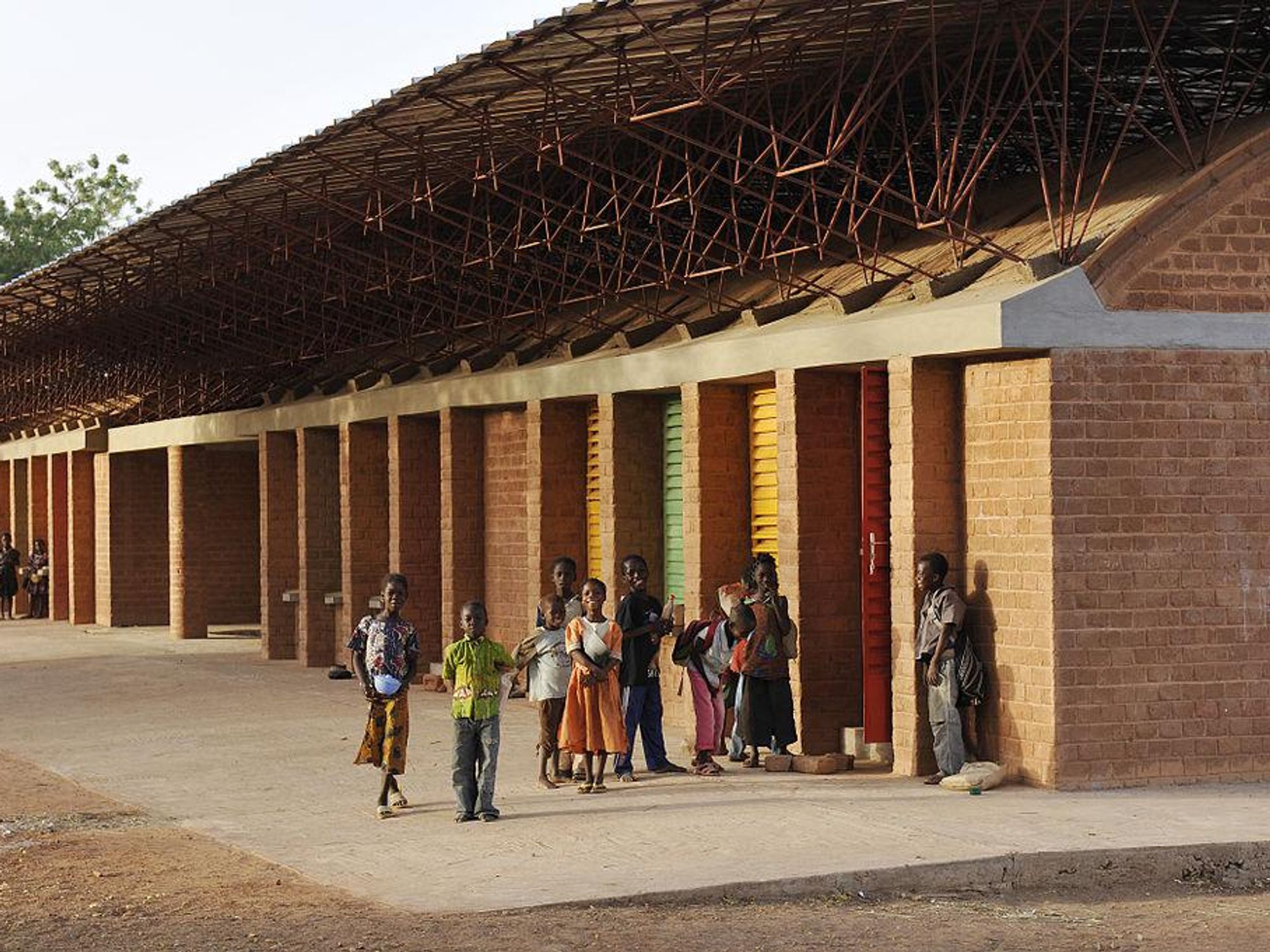
The Gando Primary School opened in 2001 in Gando, Burkina Faso, and it is the founding object of the Kéré catalogue. The brief was a three-classroom school for roughly 120 pupils. The constraints were the village’s. There was no electricity grid, no skilled construction labour beyond traditional mud-brick masons, no aggregate supply, no budget for imported steel beyond the bare minimum, and a climate that pushes daytime temperatures over 40 °C in the dry season. The design accepted every one of those constraints as a generative parameter.
The walls are pressed clay bricks stabilised with a small percentage of cement, made on site by Gando villagers from local laterite-rich soil. The ceiling is a perforated clay-brick vault. Above the vault, suspended on a lightweight steel frame, sits a large overhanging corrugated metal roof, perforated and raised clear of the ceiling so that hot air rises through the perforations and convects out under the eaves. The result is a passively cooled classroom in a village without electricity, built by villagers under a Berlin-trained carpenter-architect who was still a student. The Aga Khan Award for Architecture jury cited the school in 2004 as a model of community-built modernism. The award arrived before the diploma. Kéré graduated TU Berlin the same year and founded Kéré Architecture in Berlin in 2005, with Gando as both site and patron of the practice’s first office.
The Gando method — laterite soil pressed into bricks on site, a heavy thermal mass wall, a vented double roof, community construction — is the line every subsequent Francis Kéré project pulls on. Every project on the catalogue from the 2008 Gando extension to the 2029 Las Vegas baobab is a variation on that single section drawing.
Gando Primary School Extension, 2008: scaling the prototype
The extension was the second project, and it tested whether the method would scale. Kéré Architecture designed the Gando Primary School Extension between 2003 and 2008, adding capacity for roughly 120 more pupils and doubling the school. The new classrooms repeated the pressed-laterite walls and the raised double roof, but the roof geometry shifted toward shallow clay vaulting that the Gando masons had by then been trained to build without imported formwork. The community labour pool the first school had created became the construction crew for the second. By 2008 Kéré Architecture in Berlin was operating with a Burkinabè field office, a trained local masonry workforce in Gando, and a fundraising vehicle in the Kéré Foundation e.V. The studio could repeat the Gando section in another village without rebuilding the supply chain from scratch.
Centre for Earth Architecture, Mopti, 2010: the Aga Khan commission
The first non-Gando project arrived in 2010 with the Centre for Earth Architecture in Mopti, Mali. The Aga Khan Trust for Culture commissioned a 480 m² research and exhibition centre on a site adjacent to the Great Mosque of Djenné region’s earthen-architecture tradition. The centre is built from compressed stabilised earth blocks made from the alluvial soil of the Inner Niger Delta and roofed in shallow barrel vaults of the same brick. The programme — a building about earth architecture, built in earth — is on-the-nose, and the building accepts it. It is the only Mali project to date; the security situation in the Inner Niger Delta region from 2012 onwards effectively closed the country to follow-on commissions.
Opera Village, Laongo, 2010-: the Schlingensief commission
The Opera Village at Laongo, Burkina Faso, was commissioned by the German theatre director Christoph Schlingensief in 2010 as a cultural village built around an opera house, school and clinic. Schlingensief died of cancer in August 2010, weeks after the foundation stone was laid, and the project has been built out posthumously by his widow Aino Laberenz with Kéré as project architect. The masterplan is a 12-hectare radial nautilus, a spiral of buildings unfolding outward from a central opera house, drawn so that subsequent phases extend the spiral without disturbing earlier rings. As of 2026, the school, the clinic, residential studios and a film school are built; the central opera house remains the unbuilt nucleus. It is the longest-running open project on the catalogue and Kéré’s first European cultural-patron relationship.
Léo Surgical Clinic, 2014: the first health building
The Léo Surgical Clinic and Health Centre opened in June 2014 in Léo, southern Burkina Faso, as the studio’s first hospital. It serves a catchment of more than 50,000 people. The plan is a string of low compressed-earth-brick pavilions connected by shaded outdoor corridors, the same vented double-roof section first drawn at Gando applied to surgical wards and consultation rooms. The roof overhangs are deeper than at Gando — the building’s largest visual signature is the deep shade cast over the laterite walls — and the windows are sized to keep direct sun off operating tables for the working day. It was funded by the German NGO Operieren in Afrika e.V. and was the first Kéré building outside the school typology.
Lycée Schorge, Koudougou, 2016: the laterite radial plan
The Lycée Schorge opened in 2016 in Koudougou, Burkina Faso’s third-largest city, as a 1,660 m² secondary school for roughly 1,000 pupils. The plan is a nine-module radial, with classroom volumes arranged around a central covered courtyard and screened on the outside by a curtain wall of vertical eucalyptus louvres. The walls are deep-red laterite stone, cut into roughly 30 cm blocks from a quarry inside the school site itself — the building stands on a foundation excavated for its own walls. The Lycée Schorge is the moment the studio moved from compressed earth blocks to cut stone as a primary wall material. Cut laterite stone is durable in monsoon-wet climates where compressed earth is not, and the studio’s later projects in Kenya, Senegal and Nevada all draw on the stone-cutting logic worked out in Koudougou.
Serpentine Pavilion 2017: the Hyde Park export
The 2017 Serpentine Pavilion in London’s Kensington Gardens is the single project that exported the Kéré method to a European mass audience. Kéré was the seventeenth architect commissioned by the Serpentine Galleries — the broader Serpentine Pavilion architects from 2000 to 2026 sequence positions him in a lineage that runs from Zaha Hadid to Lanza Atelier — and the first African architect on the list. His pavilion was an indigo-blue timber drum, 12 metres in diameter, with a roof that funnelled rain through a central oculus and let it fall into a courtyard cistern. The form was drawn from the meeting tree at the centre of Gando village, where elders gather under the canopy during the dry season. The Hyde Park pavilion was a tree that collected rain. It is the moment Francis Kéré projects entered the European architectural consciousness as a full body of work rather than as a single Aga Khan-winning village school, and Kéré’s subsequent invitations — the Pritzker, the Goethe-Institut Dakar, the Benin National Assembly, the Las Vegas Museum of Art — all postdate the indigo drum.
Léo Doctors’ Housing, 2018: residential at scale
The Léo Doctors’ Housing project was built between 2016 and 2018 on the Léo Surgical Clinic site, comprising five compressed-earth-brick apartments for resident medical staff. The block is a low courtyard typology, with shaded verandas threading between the five units and a continuous double roof above. The doctors’ housing is the smallest project on the catalogue by floor area but it is the studio’s first residential building, and it closes the Léo health complex into a self-sufficient campus that does not require staff to commute from Ouagadougou or Bobo-Dioulasso. It is the third Kéré project on a single Léo site within four years, and it is the moment the practice’s working pattern of returning to the same patron and same site became visible in the catalogue.
Burkina Institute of Technology, Koudougou, 2020: in-situ formwork
The Burkina Institute of Technology opened its first phase in 2020 in Koudougou, on a 2,100 m² site adjacent to the Lycée Schorge. The institute is the studio’s first university building and the first project to use in-situ formwork-cast local clay walls instead of pressed bricks. The technique pours a stabilised clay slurry into reusable timber forms on site, producing monolithic walls that are structurally continuous and that read as cast earth rather than as masonry. The walls are corrugated on plan to throw self-shade across the facade and to brace the structure against the building’s lightweight tensile roof. From 2020 onward the catalogue draws on three wall systems — pressed brick, cut laterite, cast clay — and the studio chooses between them by climate and by labour availability.
Startup Lions Campus, Turkana, 2021: the Kenyan termite mound
The Startup Lions Campus was completed in Turkana County, Kenya, in two phases between December 2020 and April 2021 as a technology training campus on the western shore of Lake Turkana. The walls are local quarry stone, dry-laid in a roughly coursed bond with no concrete binder, and the cooling is provided by a row of pointed ventilation towers drawn directly from the termite mounds of the surrounding savanna. Hot air rises through the towers and pulls cooler air across the campus floors below. The Kenya commission demonstrated that the Gando method generalised across very different soils — Turkana is volcanic stone country, not laterite — and the termite towers replaced the vented double roof as the climate response without abandoning the principle.
Benin National Assembly, Porto-Novo, 2024: the palaver tree
The Benin National Assembly building in Porto-Novo passed its final construction inspection in November 2024, with the China State Construction Engineering Corporation as the main contractor. The building’s section is drawn from the palaver tree, the West African tradition of conducting public deliberation under a single sheltering canopy: a raised circular assembly chamber sits at the top of the building, cantilevered out over an open ground-floor plaza like a parliament held in mid-air. The plaza is public and shaded; the assembly chamber above is glazed and open to view from below.
The Porto-Novo project is the largest Francis Kéré project to date by floor area and the first national-parliament commission in the catalogue. It is also the first project executed with a Chinese state contractor at scale, and the relationship between the studio’s earth-architecture method and CSCEC’s reinforced-concrete construction practice is one of the documented tensions in Building Stories. The compromise is a steel-and-concrete primary structure clad and shaded by Kéré’s signature earth and timber detailing — the moment the catalogue accepted that not every Francis Kéré project would be built without concrete.
Goethe-Institut Dakar, 2026: the first new Goethe in 75 years
The Goethe-Institut Dakar was inaugurated on 18 April 2026 on a 1,700 m² site in the Senegalese capital. It is the first purpose-built Goethe-Institut commissioned anywhere in the world in seventy-five years — the network has grown almost entirely by leasing or retrofitting existing buildings since the mid-1950s — and it is Kéré’s first cultural-institution commission from a German federal client. The walls are compressed laterite brick produced from Senegalese soil at a kiln set up for the project; the roofs are a layered set of shaded courtyards drawn on the same vented double-roof logic the Gando Primary School first set out in 2001.
The Dakar Goethe is the moment the German cultural-diplomacy apparatus that funded Kéré’s 1985 Berlin scholarship became a client. The scholarship that sent a Gando carpenter to Berlin came back forty-one years later as the commission for a Berlin federal institution built in laterite on the West African coast.
Las Vegas Museum of Art, 2029: the baobab in the Mojave
The Las Vegas Museum of Art is the first US ground-up Kéré building and the largest single project in the catalogue. The studio is co-designing the building with Skidmore, Owings & Merrill on a 60,000 sq ft site on the western edge of the Las Vegas Strip district, with the Red Rock Mountains as the visual horizon. Ground-breaking is scheduled for 2027 and opening for 2029. The building’s form is a stylised baobab tree, with a thick lower trunk holding the lobby and circulation and a broad shaded canopy holding the galleries above. The cladding is a stone mosaic drawn from the Red Rock Mountains’ striated sandstone, sized and cut to read as a geological section pressed flat against the building. The 2026 Dezeen interview around Building Stories quotes Kéré on the design problem: the building has to thermally function in the same way as a Gando classroom — passive, vented, mass-walled — but at the scale of an American museum that needs to hold loaned collections at conservation-grade temperature and humidity. The compromise is a hybrid: passive shading and thermal mass on the external envelope, mechanical conditioning on the gallery interiors. The baobab solves the public face; the inside is an American museum.
Francis Kéré projects, in chronological order
| Year | Project | Location | Type | Signature material / feature |
|---|---|---|---|---|
| 2001 | Gando Primary School | Gando, Burkina Faso | School | Clay brick walls, eucalyptus ceiling, raised perforated steel roof |
| 2008 | Gando Primary School Extension | Gando, Burkina Faso | School | Clay vaulting, community labour |
| 2010 | Centre for Earth Architecture | Mopti, Mali | Cultural institution | 480 m², compressed earth blocks, barrel vaults |
| 2010– | Opera Village | Laongo, Burkina Faso | Cultural village | 12-hectare radial nautilus plan, with Schlingensief |
| 2014 | Léo Surgical Clinic | Léo, Burkina Faso | Health centre | Compressed earth bricks, overhanging shade roofs |
| 2016 | Lycée Schorge | Koudougou, Burkina Faso | Secondary school | 1,660 m², nine radial modules, deep-red laterite |
| 2017 | Serpentine Pavilion | London, UK | Pavilion | Indigo timber, oculus rain-waterfall |
| 2018 | Léo Doctors’ Housing | Léo, Burkina Faso | Housing | Five compressed-earth-brick apartments |
| 2020 | Burkina Institute of Technology | Koudougou | University | In-situ formwork-cast local clay walls |
| 2021 | Startup Lions Campus | Turkana, Kenya | Campus | Quarry stone, termite-mound ventilation towers |
| 2024 | Benin National Assembly | Porto-Novo, Benin | Parliament | Palaver tree form, raised assembly chamber |
| 2026 | Goethe-Institut Dakar | Dakar, Senegal | Cultural institution | 1,700 m², compressed laterite brick |
| 2029 | Las Vegas Museum of Art (with SOM) | Las Vegas, USA | Museum | 60,000 sq ft, baobab form, Red Rock stone mosaic |
The Pritzker, the Aga Khan and the Serpentine: the prize sequence
Three prizes punctuate the catalogue. The first was the Aga Khan Award for Architecture, won in 2004 for the Gando Primary School. The award arrived in the same year Kéré graduated TU Berlin and set the precedent that the Kéré method — community-built, earth-walled, passively cooled — was an architectural argument and not a humanitarian sidebar.
The second was the Serpentine Pavilion commission in 2017, which is not technically a prize but functions as one inside the contemporary architectural calendar. Kéré’s indigo drum read as the first sub-Saharan African-led entry in the Hyde Park sequence, alongside other recent African-diaspora pavilions including Theaster Gates’s Black Chapel in 2022 and Lina Ghotmeh’s À table in 2023. The body of work was no longer one school.
The third was the Pritzker Architecture Prize, awarded in March 2022. Kéré was the fifty-first Pritzker laureate and the first African and first Black laureate in the prize’s history. The jury citation read the Gando Primary School, the Lycée Schorge, the Serpentine Pavilion and the Benin National Assembly as a single body of work organised around community, materiality and climate. The first African Pritzker is also the first Pritzker for an architect whose entire portfolio is sub-Saharan, whose primary material is earth, and whose principal client has been the village he was born in.
The three-prize sequence — Aga Khan 2004, Serpentine 2017, Pritzker 2022 — sets up Building Stories in 2026 as the consolidating monograph. Taschen produced the book in three editions: a standard trade hardback, a Collector’s Edition, and a numbered Art Edition of 100 copies whose slipcase carries a custom compressed-earth Building Brick produced in Gando by the masonry workshop that has built every brick wall in this catalogue since 2001. The brick is the binding object.
The Kéré model: community-built, materially local, no concrete
Read the catalogue as a single method and four lines fall out. The labour is local: every Francis Kéré project from the 2001 Gando Primary School to the 2026 Goethe-Institut Dakar has been built by a workforce trained on or near the site, with the Gando masonry workshop functioning as a moving school of compressed-earth-brick technique that has now travelled to Mali, Léo, Koudougou, Laongo, Turkana, Porto-Novo and Dakar. Las Vegas is the first project where the labour will be predominantly American union.
The material is local. Every wall on the catalogue is laterite-derived — pressed brick in Gando, cut stone in Koudougou, cast clay at the BIT campus, quarry stone in Turkana, sandstone mosaic in Las Vegas — and every roof is either timber and corrugated metal or a clay vault. There is no off-site precast and no glass curtain wall on the catalogue before the Porto-Novo concession to a Chinese contractor.
The climate response is passive. Every project is designed to cool itself without mechanical air conditioning during the working day, using thermal mass walls, vented double roofs, deep overhangs, termite-mound stacks or palaver-tree cantilevers. The Las Vegas museum is the first project where mechanical conditioning is in the brief, and even there it is restricted to the gallery interiors.
There is, until 2024, no concrete. The catalogue from Gando 2001 to Startup Lions 2021 contains no reinforced-concrete primary structure. The Benin National Assembly in 2024 is the first concession to the material, documented in Building Stories as a constraint of the CSCEC contracting arrangement rather than a design choice. The Kéré model does not need concrete; the Porto-Novo brief was the first time the brief did.
The Taschen monograph closes the first chapter of Francis Kéré projects on those four lines. The next chapter opens in 2027 with the Las Vegas ground-breaking. The Gando Primary School answered a single question — can a Berlin-trained Burkinabè architect build a passively cooled village school out of laterite and eucalyptus? — and it answered it in 2001. The Las Vegas Museum of Art asks the inverse question. The book is the bridge between the two answers.